
#
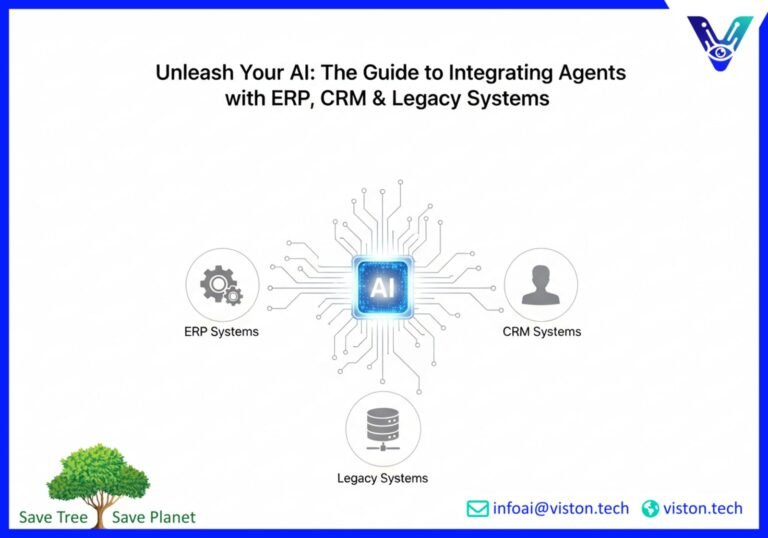
Agent Integration Services: Unleash Your AI’s Full Potential Across ERP, CRM, and Legacy Systems
The age of artificial intelligence is here, but for many enterprises, its true power remains locked away. You have invested in sophisticated AI agents, intelligent systems designed to reason, plan, and automate complex tasks. Yet, they operate in silos, unable to access the lifeblood of your organization: the vast reserves of data within your Enterprise Resource Planning (ERP), Customer Relationship Management (CRM), and foundational legacy systems. This is the critical bottleneck of modern business—a digital disconnect that stifles innovation and limits scale.
For too long, companies have relied on brittle, point-to-point integrations. These custom-coded connections are like building a new road for every single trip between two cities—they are expensive to build, difficult to maintain, and impossible to scale. As your organization grows and your AI capabilities expand, this fragile web of connections becomes an anchor, slowing you down and preventing your intelligent agents from performing the enterprise-wide workflows they were designed for. But what if there was a better way? What if you could build a superhighway for your data, allowing your AI agents to connect to any system, access any data, and execute any task with unprecedented speed and efficiency?
This is the promise of Agent Integration Services built on a modern enterprise architecture. By shifting from a patchwork of integrations to a strategic, API-first design, you can unlock the full potential of your agentic AI. This approach doesn’t just connect systems; it empowers your AI to orchestrate complex, cross-functional business processes, leading to transformative outcomes, including a potential 90% reduction in process latency. Prepare to move beyond simple automation and into the realm of the intelligent, autonomous enterprise.
The Integration Gridlock: Why Traditional Methods Are Failing Agentic AI
The core challenge of integrating AI agents into enterprise environments isn’t a lack of trying; it’s a reliance on outdated methods. Traditional system integration often results in a complex, tangled mess that technologists call “spaghetti architecture.” Each connection is a custom, one-off project, creating a rigid structure that breaks easily and costs a fortune to update.
This old model presents several critical roadblocks for scaling agentic AI:
- High Complexity and Cost: Every new AI agent or system requires a new point-to-point integration. This approach drains development resources and inflates maintenance budgets, making it unsustainable for dynamic, AI-driven operations.
- Data Silos and Inconsistency: When data is locked within individual systems like your SAP ERP or Salesforce CRM, your AI agents get a fragmented view of the business. Inconsistent data formats and synchronization issues lead to flawed analysis and poor decision-making by your AI.
- Lack of Scalability and Agility: The business landscape in 2025 is defined by rapid change. Point-to-point integrations are inherently inflexible. Adding new services, updating legacy systems, or deploying new AI agents becomes a slow, painful process that hinders your ability to adapt and innovate.
- Security Vulnerabilities: Each custom integration point represents a potential security risk. Managing security protocols and access controls across a sprawling network of unique connections is a nightmare for IT leaders and a prime target for cyber threats.
Attempting to build a truly intelligent enterprise on this shaky foundation is like trying to construct a skyscraper on quicksand. To unleash your AI, you first need to build a solid, modern architectural base.
The API-First Revolution: Building the Central Nervous System for Your AI
The solution to integration gridlock is a fundamental shift in perspective: treat your APIs (Application Programming Interfaces) not as afterthoughts, but as first-class citizens. An API-first design is an architectural approach where you design your APIs before you build the applications that use them. These well-documented, standardized APIs act as universal plugs, allowing any system, service, or AI agent to connect and communicate seamlessly.
Think of it as the difference between custom-wiring every appliance in your house versus using standardized electrical outlets. The outlets (APIs) provide a consistent, reliable way to power any device (AI agent or application). This is the foundation of a modern, composable enterprise architecture.
Designing APIs That Intelligent Agents Can Understand
Connecting AI to your enterprise isn’t just about creating an API; it’s about creating the *right* API. Agentic AI needs more than just data access. It requires APIs that are intuitive, context-rich, and designed for autonomous interaction. Key principles for designing agent-friendly APIs include:
- Clarity and Simplicity: APIs should have clear, predictable endpoints and simple data structures. An AI agent should be able to easily understand what an API does and how to use it without complex, custom-coded logic.
- Semantic Consistency: Use consistent naming conventions and data formats across all your APIs. This allows an AI agent to learn how to interact with one part of your enterprise and apply that knowledge to others, accelerating its learning curve.
- Action-Oriented Design: Design APIs around business actions (e.g., “approvePurchaseOrder,” “updateCustomerRecord”) rather than just data retrieval. This empowers agents to execute tasks directly, not just fetch information.
- Robust Documentation and Self-Discovery: Utilize standards like the OpenAPI Specification to create machine-readable documentation. This allows AI agents to dynamically discover available APIs and understand their capabilities on the fly.
By adopting an API-first approach, you are not just building connections; you are creating a flexible, scalable, and secure digital ecosystem where your AI agents can thrive.
Mastering the Symphony: The Power of Data Orchestration
With a solid foundation of APIs, the next step is to coordinate the flow of information and actions across your enterprise. This is the role of data orchestration. If APIs are the instruments in your orchestra, data orchestration is the conductor, ensuring that every piece of data and every agent action happens in the right sequence and at the right time to create a harmonious business process.
Data orchestration for agentic AI goes beyond simple data movement. It involves managing complex, multi-step workflows that may span your CRM, ERP, and even decades-old legacy systems. An AI orchestration platform acts as a central brain, giving commands to various agents and systems through their APIs.
From Chaos to Cohesion: Orchestration in Action
Imagine a common business process: fulfilling a large, urgent customer order. In a poorly integrated environment, this involves manual hand-offs between sales, inventory, and logistics teams, with significant delays and potential for human error. With AI-powered data orchestration, the process becomes a seamless, automated workflow:
- An AI Sales Agent in your CRM detects the high-priority order and triggers the fulfillment workflow.
- The Orchestration Layer receives the signal and queries an AI Inventory Agent connected to your ERP via an API to check stock levels.
- The Inventory Agent confirms stock is low and communicates this back. The orchestrator then tasks a Procurement Agent to automatically generate and approve a purchase order with a pre-approved supplier.
- Simultaneously, the orchestrator instructs a Logistics Agent to schedule a preliminary shipping date and notifies the Customer Service Agent to send a proactive update to the client.
This entire sequence, which once took days, can be executed in minutes. This is how businesses achieve a 90% reduction in latency. It is not about making one step faster; it is about eliminating the delays between every step. This real-time, intelligent coordination is the hallmark of a truly automated enterprise.
Building Fort Knox: Security and Governance in an AI-Driven World
As you empower AI agents to access sensitive data and execute critical business functions, security and governance become paramount. An autonomous system operating without robust controls is a significant risk. Integrating AI requires a security framework that is just as intelligent and dynamic as the agents themselves.
A comprehensive security strategy for agent integration must include:
- Centralized Identity and Access Management (IAM): Each AI agent must have its own identity with clearly defined permissions. An API gateway can enforce these policies, ensuring agents only access the data and perform the actions they are explicitly authorized for. The principle of least privilege is crucial.
- Robust Data Governance: Not all data is created equal. Implement strict data classification and governance policies to control how sensitive information is handled. Agents interacting with customer or financial data must operate under the tightest controls to ensure compliance with regulations like GDPR and CCPA.
- Comprehensive Auditing and Monitoring: Every action taken by an AI agent must be logged and monitored in real time. This creates a transparent, auditable trail that is essential for compliance, troubleshooting, and detecting anomalous or malicious behavior. Advanced tools can even use AI to monitor other AI, flagging potential threats before they escalate.
- Human-in-the-Loop (HITL) Controls: For high-stakes decisions, complete autonomy may not be desirable. Implement “human-in-the-loop” workflows where an agent’s proposed action (e.g., approving a payment over a certain threshold) must be reviewed and confirmed by a human operator before execution. This provides a critical safety net and builds trust in the system. To learn more about building responsible AI frameworks, see Microsoft’s guide on the Cloud Adoption Framework.
Real-World Impact: Case Studies in Agentic AI Integration
The transition to an API-first, orchestrated enterprise is not just a theoretical exercise. Businesses across major industries are already reaping the rewards of intelligent system integration.
Case Study 1: Transforming Supply Chain for a Global Retailer
A major retail corporation was struggling with chronic stockouts and overstock situations due to inaccurate demand forecasting. Their legacy inventory system could not communicate effectively with their modern e-commerce platform.
- Solution: They implemented an AI-powered integration platform. An API-first design was used to create a stable bridge to their legacy ERP. AI agents were deployed to analyze real-time sales data from the CRM, social media trends, and even weather forecasts to predict demand.
- Results: The company achieved a 40% improvement in forecast accuracy. The automated data orchestration between their systems allowed for dynamic inventory adjustments, reducing stockouts by 60% and significantly cutting carrying costs for excess inventory.
Case Study 2: Accelerating Customer Service in Financial Services
A leading bank’s customer service department was overwhelmed with inquiries. Agents spent most of their time toggling between a dozen different applications to piece together customer information, leading to long wait times and frustrated clients.
- Solution: The bank developed a suite of customer service AI agents integrated via a central orchestration hub. Using secure APIs, these agents could instantly pull a customer’s entire history from the CRM, transaction data from the core banking system, and investment information from their wealth management platform.
- Results: Average call handling time was reduced by over 70%. The AI agent could preemptively gather all relevant information and present it to the human agent in a unified view, or even handle common requests autonomously. This led to a significant increase in customer satisfaction scores and employee morale.
Your Roadmap to Seamless AI Integration
Embarking on this journey requires a strategic and phased approach. Transforming your enterprise architecture is a significant undertaking, but the competitive advantages are immense. Here are the key steps to get started:
- Assess Your Current State: Begin by mapping your existing systems and integration points. Identify the most critical data flows and the biggest process bottlenecks.
- Develop an API Strategy: Adopt an API-first mindset. Define the standards, tools, and governance policies that will guide your API development. Prioritize creating APIs for your most valuable “systems of record,” like your ERP and CRM.
- Start with a High-Impact Pilot Project: Don’t try to boil the ocean. Select a single, well-defined business process that is suffering from integration challenges and deploy an AI agent to solve it. Success here will build momentum and secure buy-in for broader initiatives.
- Choose the Right Partner: You don’t have to go it alone. Partner with experts who specialize in agentic AI and modern enterprise integration. The right partner can provide the technology, expertise, and strategic guidance to accelerate your transformation and avoid common pitfalls.
The future belongs to enterprises that can seamlessly connect intelligence to action. By breaking down data silos and empowering your AI agents through strategic system integration, you are not just optimizing processes—you are building a more agile, intelligent, and resilient organization ready for the challenges and opportunities of tomorrow.
Frequently Asked Questions (FAQs)
What is Agentic AI?
Agentic AI refers to artificial intelligence systems that can act autonomously to achieve goals. Unlike traditional AI models that simply respond to prompts, agentic AI can perceive its environment, make decisions, create multi-step plans, and use tools (like APIs) to execute tasks in the digital or physical world. They function more like a digital employee than a simple tool.
Why is an API-first design so important for AI agent integration?
An API-first design is critical because it creates standardized, predictable, and reusable connection points for AI agents. Instead of custom-coding a connection for each new agent or system, you build a library of stable APIs. This makes it far easier and faster for AI agents to connect to diverse systems like ERPs and CRMs, discover their capabilities, and reliably exchange data to perform complex workflows.
What is the difference between system integration and data orchestration?
System integration is the process of connecting different IT systems so they can exchange data. This is the foundational plumbing. Data orchestration is the higher-level management and coordination of these data flows to execute a complete business process. It’s the “conductor” that tells the integrated systems and AI agents what to do, in what order, to achieve a specific business outcome.
How can integrating AI agents really achieve a 90% latency reduction?
This dramatic reduction comes from eliminating the idle time and manual hand-offs between process steps. In traditional workflows, a task might wait hours or days in an employee’s inbox before being actioned. An orchestrated AI agent executes the next step in a process the microsecond the previous one is complete. By automating the entire end-to-end workflow across systems, you remove nearly all the “wait time,” collapsing a process that took days into minutes.
What are the biggest challenges when integrating AI with legacy systems?
The primary challenges are the lack of modern APIs, poor or non-existent documentation, and outdated data formats. Legacy systems were often built as monolithic, closed-off applications. The key to success is to build a modern “API layer” that sits on top of the legacy system, acting as a translator and bridge that allows AI agents to communicate with it in a standardized way without having to modify the core of the old system.
How do I ensure the security of my data when AI agents are accessing it?
Security is a multi-layered process. It starts with robust API security through an API gateway, which enforces strict authentication and authorization for every call an agent makes. This is coupled with strong data governance policies that classify data and control access based on the agent’s role. Finally, all agent actions must be logged and monitored continuously to provide an audit trail and detect any suspicious activity in real time.
Can small businesses and startups benefit from agent integration services?
Absolutely. While the scale is different, the principles are the same. Startups can build their enterprise architecture on an API-first foundation from day one, giving them incredible agility. For small businesses, leveraging cloud-based integration platforms (iPaaS) and pre-built connectors can provide the power of agentic AI integration without the need for a large in-house IT team, allowing them to automate processes and compete with larger players.
What is a “human-in-the-loop” system?
A human-in-the-loop (HITL) system is a model that combines the intelligence of AI agents with the judgment of human experts. In this setup, the AI agent handles the bulk of the work but flags exceptions, low-confidence decisions, or high-stakes actions for human review and approval. This ensures a critical layer of oversight and accountability, which is essential for deploying AI in sensitive areas like finance, healthcare, and legal.
Ready to unlock the true power of your enterprise AI? Don’t let outdated integration methods hold your business back. Connect your intelligent agents to the heart of your operations and build the autonomous enterprise of the future.
Contact Viston AI today to learn how our AI-powered Agent Integration Services can transform your ERP, CRM, and legacy systems into a seamless, intelligent ecosystem.
#AgenticAI #SystemIntegration #EnterpriseArchitecture #APIFirst #DataOrchestration #DigitalTransformation #ERP #CRM #LegacyModernization #AIAutomation #VistonAI
