
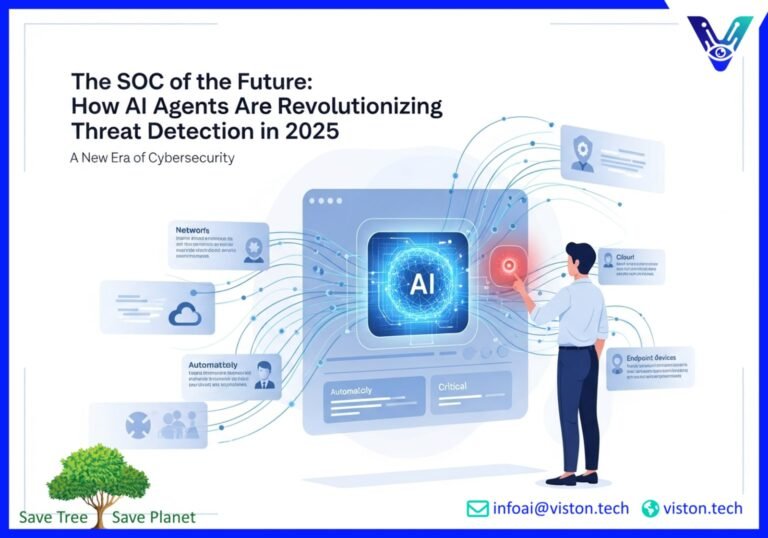
AI-Powered Cybersecurity: How Autonomous Agents are Revolutionizing Threat Detection in 2025
In the relentless battle against cyber threats, Security Operations Centers (SOCs) are on the front lines. Every day, they face a deluge of alerts, a sophisticated adversary, and the constant pressure to protect critical assets. For years, the model has been human-centric, relying on the skill and intuition of analysts. But in 2025, the sheer volume and velocity of threats have pushed this model to its breaking point, leading to widespread alert fatigue and the risk of critical threats slipping through the cracks.
Enter the game-changer: AI-powered cybersecurity. We are not talking about another dashboard or a complex tool that requires more human attention. We are talking about a new class of digital team members—autonomous AI agents designed to think, learn, and act. These agents are transforming the modern SOC, handling the monotonous, high-volume tasks that overwhelm humans and freeing up experts to focus on what they do best: strategic defense. This evolution, known as SOC automation, is empowering organizations to move from a reactive to a proactive security posture.
This post explores how these intelligent agents work. We will break down their data sources, the technology stacks that power them, the specific tasks they perform, and, most importantly, how they collaborate with human experts to create a formidable, hybrid defense. Understanding this synergy is key to building a resilient cybersecurity strategy for the future.
The Foundation: Where AI Gets Its Intelligence
An AI agent is only as smart as the data it learns from. For an AI in cybersecurity, that means consuming a massive and continuous stream of information from across the entire digital ecosystem. Think of it as giving your security team millions of eyes and ears, all working in unison. The goal is to build a comprehensive, real-time understanding of what constitutes “normal” activity within your organization. Only then can it accurately spot the abnormal—the potential threat.
These sophisticated anomaly detection agents pull data from a wide array of sources, including:
- Network Traffic: Monitoring data flowing in and out of the network helps detect unusual communication patterns, unauthorized data transfers, or connections to malicious servers.
- Endpoint Data: Information from laptops, servers, and mobile devices is crucial. This includes running processes, file modifications, and login activities, which can reveal signs of malware or a compromised account.
- Cloud Environments: With more assets moving to the cloud (like AWS, Azure, and Google Cloud), AI agents ingest logs from these services to monitor configurations, access patterns, and API calls for suspicious behavior.
- Identity and Access Management (IAM) Systems: Logs from tools like Active Directory show who is logging in, from where, and what they are accessing. AI can spot impossible travel scenarios or unusual privilege escalations.
- Security Tool Alerts: Data from firewalls, intrusion detection systems (IDS), and antivirus software is aggregated and correlated, turning a flood of individual alerts into a single, coherent incident.
- Email Communications: By analyzing metadata and communication patterns (not the content itself, to preserve privacy), AI can detect sophisticated phishing and business email compromise (BEC) attacks that traditional filters miss.
By continuously processing this diverse data, the AI builds a dynamic, ever-evolving baseline of your organization’s unique digital heartbeat. This rich context is the foundation for all effective AI-driven threat detection.
Building the Modern Cyber Shield: Inside AI Detection Stacks
An AI agent doesn’t operate in a vacuum. It is the intelligent core of a sophisticated technology architecture known as a detection stack. This stack is an integrated system of technologies designed to collect data, analyze it for threats, and enable a swift response. In 2025, these stacks are moving beyond siloed tools and toward unified platforms that make AI cybersecurity a seamless reality.
Here are the essential layers of a modern AI detection stack:
- Data Ingestion and Normalization: The first step is to collect data from all the sources mentioned above. A powerful data pipeline ingests this information and translates it into a standardized format. This ensures the AI can compare apples to apples, whether the data comes from a firewall log or a cloud service.
- Behavioral Analytics Engine: This is the heart of the system where the anomaly detection agents live. Using advanced statistical analysis and machine learning, this engine constantly analyzes the normalized data to understand behavioral patterns. It learns how your users, devices, and networks typically operate, allowing it to flag even the most subtle deviations that could signal a threat.
- Machine Learning (ML) and Deep Learning Models: The stack employs a variety of ML models for specific tasks. For instance, unsupervised learning models are perfect for finding novel anomalies without prior training, while supervised learning models can be trained to recognize known malware signatures or phishing tactics with incredible accuracy.
- Threat Intelligence Integration: The AI’s internal knowledge is enriched with external, real-time threat intelligence. This global data on new attack methods, malicious IP addresses, and malware indicators gives the AI crucial context to understand if a local anomaly is part of a wider, known attack campaign.
- Orchestration and Response Layer: Detection is only half the battle. This layer connects the AI’s findings to your response tools. Modern AI agents integrate directly with SOAR (Security Orchestration, Automation, and Response) and XDR (Extended Detection and Response) platforms, enabling true SOC automation by triggering predefined actions.
For more on how agentic AI is becoming a focus for security operations, see this insightful analysis from S&P Global Market Intelligence.
The AI Agent on Duty: Key Tasks in Threat Detection
With access to rich data and a powerful technology stack, what does an AI agent actually do hour by hour? It becomes a tireless Tier-1 and Tier-2 analyst, performing critical tasks at machine speed and scale, 24/7. This elevates the entire security operation, allowing human analysts to focus on higher-value strategic work.
Automated Triage and Prioritization
The single biggest challenge in a traditional SOC is alert fatigue. Human analysts are flooded with thousands of alerts daily, most of which are false positives. AI agents excel at this initial filtering process.
- Sifting the Noise: The agent instantly analyzes every incoming alert, cross-referencing it with historical data and threat intelligence to determine its credibility.
- Enriching the Signal: For alerts that appear genuine, the AI automatically gathers relevant context—such as user details, device information, and recent network activity—to create a complete picture.
- Prioritizing the Threat: The agent scores and ranks the validated alerts based on severity and potential business impact, ensuring human analysts always work on the most critical threats first.
Real-Time Anomaly Detection
This is where the agent’s continuous learning pays off. It moves beyond signature-based detection, which can only catch known threats, to identify novel and sophisticated attacks through behavioral analysis.
- User and Entity Behavior Analytics (UEBA): The agent can spot a compromised user account by detecting behavior that deviates from the user’s established patterns—for example, logging in at an unusual time, accessing sensitive data for the first time, or attempting to escalate privileges.
- Network Anomalies: It can identify subtle signs of an attack, such as a device suddenly communicating with a command-and-control server or an internal server attempting to scan other machines on the network.
Proactive Threat Hunting
Instead of just waiting for an alert to fire, advanced AI agents actively hunt for threats that may have evaded initial defenses. They act like a seasoned security researcher, constantly probing the environment for signs of compromise.
- Hypothesis Testing: The agent can test hypotheses based on the latest threat intelligence. For example, it might search for indicators of compromise (IoCs) associated with a newly emerged ransomware group.
- Pattern Discovery: By correlating seemingly minor, unrelated events across different data sources, the AI can uncover the faint trail of a “low-and-slow” attack campaign that would be invisible to a human analyst looking at isolated logs.
Human in the Loop: Escalation, Oversight, and Audit Trails
Perhaps the most critical aspect of modern AI cybersecurity is the “human-in-the-loop” model. The goal of SOC automation is not to replace human experts but to augment them. AI handles the scale, and humans provide the strategic oversight, intuition, and ethical judgment. This partnership creates a security posture that is both highly efficient and deeply intelligent.
Smart Escalation: When AI Calls for Backup
An intelligent AI agent understands its own limitations. When it encounters a highly complex, novel, or ambiguous threat, it doesn’t guess. Instead, it escalates the issue to a human analyst. But it doesn’t just forward an alert; it delivers a comprehensive incident report.
This report includes:
- A summary of the threat and its potential impact.
- A timeline of all related events.
- All the contextual data gathered during its investigation.
- A recommended course of action based on predefined playbooks.
This process transforms the role of the human analyst. Instead of spending hours on manual data collection, they can immediately begin high-level analysis and decision-making, drastically reducing the Mean Time to Respond (MTTR).
The Importance of the Audit Trail
Trust is paramount in cybersecurity. For leaders to embrace AI, every action the agent takes must be transparent, traceable, and accountable. This is achieved through comprehensive audit trails.
Every decision and action performed by an AI agent is meticulously logged, providing a clear record of:
- What data the agent analyzed.
- What anomaly it detected.
- Why it classified the anomaly as a threat.
- What actions it took or recommended.
- Which human analyst was notified and when.
This level of transparency is essential for several reasons. It provides the evidence needed for regulatory compliance audits (e.g., GDPR, CCPA). It allows security leaders to review and refine the AI’s logic and automated playbooks. And most importantly, it builds the necessary trust between human teams and their new AI counterparts. The security firm Securitas offers excellent insights into why keeping humans in control of critical decisions is an operational mandate.
The Future-Ready SOC: Actionable Insights for Leaders
Integrating AI into your security operations is a strategic move that delivers immense value beyond just threat detection. It is about building a more resilient, efficient, and forward-looking security program.
- For the C-Suite: View AI not as a cost center but as a strategic enabler. It directly reduces business risk by identifying threats faster and more accurately. The efficiencies gained through SOC automation also optimize your security budget, allowing your expert team to focus on proactive initiatives like risk management and security architecture improvement.
- For IT and Security Leaders: When evaluating solutions, prioritize platforms that offer seamless integration with your existing tools and champion the human-in-the-loop philosophy. The most effective AI cybersecurity platforms are those that empower your team, not replace them. Plan a phased adoption, starting with a specific use case like alert triage, to build trust and demonstrate value before expanding the AI’s responsibilities.
- For All Stakeholders: The rise of AI necessitates a cultural shift. Invest in upskilling your security professionals to become AI supervisors and advanced threat hunters. Their roles will evolve from being in the weeds of every alert to managing an AI-driven system and handling the most sophisticated escalations.
Conclusion: Your Strongest Defender is a Human-AI Partnership
The cybersecurity landscape of 2025 is too fast, too complex, and too vast for any human team to manage alone. The question is no longer *if* organizations should adopt AI, but *how* they can do so intelligently. AI-powered agents are proving to be the indispensable partner that security teams need, handling the overwhelming scale of data and alerts with superhuman speed and precision.
By automating triage, hunting for hidden threats with powerful anomaly detection agents, and seamlessly integrating into a human-led response workflow, these systems are redefining what is possible in cyber defense. The result is a stronger, smarter, and more resilient Security Operations Center—one where human expertise is amplified, not sidelined, creating a formidable defense ready for the challenges of tomorrow.
Ready to Build Your Future-Ready SOC? Contact Viston AI Today.
The journey to an AI-powered SOC begins with the right partner. At Viston AI, we specialize in developing intelligent, transparent, and collaborative AI agents that integrate seamlessly with your team. Our solutions are designed to reduce alert fatigue, accelerate threat response, and empower your analysts to stay ahead of adversaries. Contact us today to learn how Viston AI can help you harness the power of AI-powered cybersecurity and build a more secure future for your organization.
Frequently Asked Questions (FAQs)
- 1. Will AI-powered agents replace our cybersecurity analysts?
- No, the goal is augmentation, not replacement. AI agents handle repetitive, high-volume tasks like alert triage and data gathering, which frees up human analysts to focus on complex threat hunting, strategic planning, and incident response decision-making. This human-in-the-loop model is proven to be the most effective approach.
- 2. How does AI specifically reduce “alert fatigue”?
- AI reduces alert fatigue by acting as an intelligent filter. It analyzes thousands of raw alerts from various security tools, automatically dismisses false positives, consolidates related alerts into single incidents, and prioritizes the genuine threats based on severity and context. This means analysts only see a small fraction of the initial alert volume—the ones that truly matter.
- 3. What is the main difference between traditional antivirus/firewalls and AI-powered agents?
- Traditional tools are primarily rule-based or signature-based, meaning they look for known threats. AI-powered anomaly detection agents are behavior-based. They learn what is “normal” for your specific environment and can therefore detect novel or “zero-day” attacks that have never been seen before, simply by identifying activity that deviates from the established baseline.
- 4. How can we trust the AI’s decisions and ensure they are not biased?
- Trust is built on transparency and oversight. Every action and decision made by an AI agent is recorded in a detailed audit log that human analysts can review. Furthermore, the AI’s models are continuously monitored and can be refined based on feedback from human experts. This ensures the AI’s logic aligns with the organization’s security policies and reduces the risk of bias.
- 5. What is the first practical step to integrating AI into our security operations?
- A great first step is to implement an AI agent in “shadow mode” for a specific, high-impact use case like email threat detection or alert triage. In shadow mode, the AI analyzes data and makes recommendations without taking automated actions. This allows your team to validate its accuracy, build confidence in its capabilities, and fine-tune its logic in a controlled environment before granting it more autonomy.
- 6. How does SOC automation improve incident response times?
- SOC automation dramatically speeds up the initial stages of incident response. AI agents can detect, investigate, and correlate threat data in seconds—a process that can take a human analyst hours. By the time an incident is escalated to a human, all the necessary information has already been collected and organized, allowing for immediate decision-making and remediation.
- 7. Can anomaly detection agents find insider threats?
- Yes, this is a key strength of anomaly detection. By establishing a baseline of normal behavior for each user, these agents can quickly identify suspicious activities that may indicate an insider threat—such as an employee accessing sensitive files they have never touched before, logging in from a strange location, or attempting to download large amounts of data.
- 8. Is AI cybersecurity only for large enterprises?
- While it was once the domain of large enterprises, AI cybersecurity is becoming increasingly accessible to mid-sized businesses. Many solutions are now offered as scalable, cloud-based services, allowing organizations of all sizes to leverage advanced threat detection capabilities without a massive upfront investment in hardware or specialized staff.
#AICybersecurity #SOCAutomation #ThreatDetection #AnomalyDetection #Cybersecurity #AIinCyber #InfoSec #ThreatHunting #VistonAI
