
Supply Chain Optimization with Agentic AI: Real-Time Decision-Making at Enterprise Scale
In today’s volatile global market, supply chains are under constant pressure. From geopolitical disruptions and trade tensions to unpredictable consumer demand, the challenges are relentless. Traditional, reactive supply chain management is no longer enough to stay competitive. The future belongs to businesses that can anticipate, adapt, and act in real time. This is where Agentic AI enters the picture, transforming supply chain operations from a cost center into a strategic advantage.
Agentic AI goes beyond simple automation or predictive analytics. It represents a new frontier of intelligent systems composed of autonomous “agents” that can perceive their environment, make decisions, and take actions to achieve specific goals. Think of them as a digital workforce operating 24/7 to optimize every facet of your supply chain. The impact is significant, with early adopters reporting up to a 30% reduction in transportation costs, 20% fuel savings, and a staggering 90% reduction in disruption-resolution latency. As the U.S. Agentic AI market is projected to reach approximately USD 65 billion by 2034, the time to embrace this technology is now.
The Persistent Pain Points in Modern Supply Chains
Despite advancements in technology, many enterprises still grapple with fundamental supply chain challenges. These issues create inefficiencies, drive up costs, and ultimately impact customer satisfaction. Do any of these sound familiar?
- Lack of Real-Time Visibility: Data is often siloed in disparate systems like ERPs and WMS, leading to a fragmented view of inventory, shipments, and supplier status.
- Reactive Decision-Making: When disruptions occur—a delayed shipment, a supplier shortage, or a sudden demand spike—teams are often left scrambling to react, leading to costly expedited orders and manual interventions.
- Inefficient Routing and Logistics: Manual or static route planning fails to account for real-time variables like traffic, weather, or last-minute order changes, resulting in wasted fuel and missed delivery windows.
- Poor Demand Forecasting: Inaccurate forecasts lead to either stockouts, which mean lost sales, or overstocking, which ties up capital in excess inventory.
- Fragmented Communication: Coordinating between suppliers, carriers, and warehouses is often a manual process involving emails and phone calls, creating delays and opportunities for miscommunication.
These pain points highlight the limitations of traditional systems that rely on historical data and human intervention. In a world that moves at machine speed, you need a solution that can think and act just as fast.
Understanding the Agentic AI Architecture: Your Digital Workforce
So, how does Agentic AI work in a supply chain context? Imagine a team of highly specialized digital employees, each with a specific role and the autonomy to execute tasks. This is the core of an agentic architecture. It is not about replacing human expertise but augmenting it, allowing your team to focus on strategic initiatives while the AI handles the operational complexities.
Here’s a simplified breakdown of the architecture:
- Data and Events Layer: This is the foundation. It ingests a continuous stream of real-time data from various sources: IoT sensors on shipments, GPS data from vehicles, warehouse inventory systems, supplier portals, and even external sources like weather forecasts and traffic reports.
- Reasoning and Decision Layer: This is the “brain” of the operation. Here, specialized AI agents analyze the incoming data. For example, a “Demand Forecasting Agent” identifies shifts in consumer behavior, while a “Risk Detection Agent” flags potential disruptions.
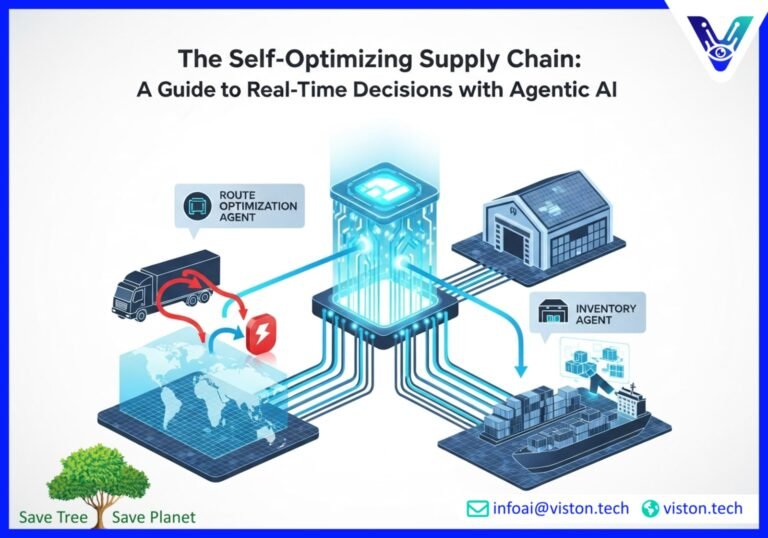
- Optimization and Action Layer: Based on the insights from the reasoning layer, other agents take action. A “Route Optimization Agent” might recalculate the most efficient delivery path in real time, while an “Inventory Agent” could automatically reorder stock to prevent a shortage.
- Supervision and Learning Layer: This ensures human oversight and continuous improvement. All actions taken by the AI agents are logged and transparent. The system learns from every decision, constantly refining its models to become more effective over time.
This structure allows for a level of agility and responsiveness that is impossible to achieve with manual processes alone. It transforms your supply chain from a rigid, linear process into a dynamic, self-optimizing ecosystem.
Agentic AI in Action: Real-World Examples
Theory is one thing, but what does this look like in practice? Let’s explore two common and high-impact use cases: routing and inventory management.
Dynamic Route Optimization
Consider a large logistics company with a fleet of hundreds of vehicles making thousands of deliveries daily. Traditionally, routes are planned at the beginning of the day and rarely change. But what happens when a major accident closes a highway, or a priority customer adds an urgent, last-minute order?
With Agentic AI, the process is transformed:
- A Logistics Agent continuously monitors real-time data feeds for traffic, weather, and new orders.
- When the agent detects a significant traffic jam on a planned route, it instantly assesses the potential delay and its impact on all subsequent deliveries for that vehicle.
- The agent then collaborates with a Route Optimization Agent to calculate the best alternative path, considering factors like distance, fuel consumption, and delivery windows for other customers.
- The new, optimized route is automatically sent to the driver’s navigation device, along with updated ETAs for downstream customers.
This entire process happens in seconds, without any human intervention. The result is a dramatic reduction in fuel costs, improved on-time delivery rates, and enhanced customer satisfaction. Industry leaders like UPS and DHL have leveraged similar AI-powered systems to save millions annually and significantly cut their carbon footprint.
Intelligent Inventory Management
For retailers and manufacturers, managing inventory is a delicate balancing act. Too little, and you risk losing sales. Too much, and you tie up valuable capital. Agentic AI brings a new level of precision to this critical function.
Here’s how it works:
- A Demand Forecasting Agent analyzes historical sales data, seasonality, current market trends, and even social media sentiment to predict demand with incredible accuracy.
- Simultaneously, an Inventory Monitoring Agent keeps track of stock levels in real time across all warehouses and distribution centers.
- When the agent detects that inventory for a popular product is projected to fall below a critical threshold, it doesn’t just send an alert. It communicates with a Procurement Agent.
- The Procurement Agent then autonomously evaluates different suppliers based on price, lead time, and reliability, and can even automatically generate a purchase order for the optimal quantity.
This proactive approach prevents stockouts, minimizes carrying costs, and frees up your procurement team to focus on strategic sourcing and supplier relationships. Companies like Amazon and Walmart have pioneered the use of AI in their fulfillment centers to achieve unparalleled efficiency and inventory turnover.
Calculating the ROI: What to Expect from Your Investment
Implementing Agentic AI is a significant investment, but the returns can be substantial. To build a compelling business case, it’s essential to focus on clear, quantifiable metrics. Here’s a simple framework for calculating the potential ROI:
- Identify Direct Cost Savings:
- Reduced Transportation Costs: Factor in fuel savings from optimized routes and lower maintenance costs from reduced mileage.
- Lower Inventory Carrying Costs: Calculate savings from reduced overstock and minimized warehousing needs.
- Decreased Labor Costs: Account for the automation of manual tasks like order processing, route planning, and supplier communication.
- Quantify Efficiency Gains:
- Improved On-Time Delivery Rates: This leads to higher customer retention and potentially opens opportunities for premium shipping services.
- Increased Asset Utilization: Measure the increase in the number of deliveries per vehicle or the throughput of a warehouse.
- Reduced Disruption Resolution Time: Quantify the financial impact of resolving issues in minutes instead of hours or days.
- Factor in Strategic Value:
- Increased Revenue: Attribute sales growth to fewer stockouts and improved product availability.
- Enhanced Resilience: While harder to quantify, a more resilient supply chain can be a significant competitive differentiator during industry-wide disruptions.
By focusing on these key areas, you can build a robust ROI model that clearly demonstrates the financial benefits of adopting Agentic AI. For a deeper dive into measuring AI’s impact, this article from Forbes offers valuable insights.
A Phased Rollout: Your Roadmap to an Autonomous Supply Chain
Transforming your entire supply chain overnight isn’t realistic. A phased approach allows you to demonstrate value, build internal expertise, and scale your implementation effectively. Here’s a suggested roadmap:
Phase 1: Logistics and Transportation (Quick Wins)
This is often the best place to start, as the ROI is clear and measurable.
- Focus: Implement AI-powered route optimization and real-time shipment tracking.
- Goal: Achieve immediate cost savings in fuel and labor, and improve on-time delivery performance.
- Key Action: Start with a pilot program in a specific region or for a particular fleet to prove the concept before a full-scale rollout.
Phase 2: Warehousing and Inventory Management (Building Intelligence)
Once you have optimized your logistics, the next logical step is to bring greater intelligence to your warehouses.
- Focus: Deploy AI for demand forecasting, automated replenishment, and warehouse slotting optimization.
- Goal: Reduce stockouts, minimize excess inventory, and improve warehouse efficiency.
- Key Action: Integrate your AI platform with your existing WMS and ERP systems to ensure seamless data flow.
Phase 3: Procurement and Supplier Collaboration (Expanding the Ecosystem)
In this phase, you extend the power of AI beyond your own four walls to your network of suppliers.
- Focus: Use AI agents for autonomous supplier evaluation, automated purchase order generation, and real-time supplier performance monitoring.
- Goal: Improve supplier reliability, reduce procurement costs, and build a more resilient supplier base.
- Key Action: Develop secure, API-driven connections with your key suppliers to enable real-time data sharing.
The Future is Autonomous: Are You Ready?
The shift toward Agentic AI in supply chain management is not a matter of “if,” but “when.” This technology is moving from a competitive advantage to an operational necessity. By embracing autonomous, real-time decision-making, you can build a supply chain that is not only more efficient and cost-effective but also more resilient and responsive to the challenges of tomorrow.
The journey to a fully autonomous supply chain may seem daunting, but with the right strategy and a phased approach, it is well within reach. The key is to start now, identify the areas of your operation with the most to gain, and partner with experts who can guide you through the process.
Ready to transform your supply chain with the power of Agentic AI? Contact Viston AI today to learn how our AI-powered solutions can help you achieve real-time decision-making at enterprise scale.
Frequently Asked Questions (FAQs)
- What is Agentic AI and how is it different from traditional AI?
Agentic AI refers to systems of autonomous AI “agents” that can perceive their environment, make decisions, and take actions to achieve goals. Unlike traditional AI, which often focuses on prediction or classification, Agentic AI is about autonomous execution and real-time problem-solving. - Will Agentic AI replace human jobs in the supply chain?
The goal of Agentic AI is not to replace humans but to augment their capabilities. By automating repetitive and data-intensive tasks, AI agents free up supply chain professionals to focus on more strategic activities like relationship management, long-term planning, and handling complex exceptions. - What kind of data is needed to implement Agentic AI in logistics?
Effective implementation requires access to a variety of data sources, including real-time GPS and telematics data from vehicles, inventory levels from warehouse management systems (WMS), order information from enterprise resource planning (ERP) systems, and external data like traffic and weather feeds. - How long does it take to see a return on investment (ROI) from an Agentic AI implementation?
While it varies depending on the scale and complexity of the project, many companies begin to see a positive ROI within the first 12-18 months, particularly from initial use cases like route optimization which can deliver immediate fuel and labor cost savings. - Is Agentic AI only for large enterprises like Amazon and Walmart?
While large enterprises have been early adopters, the technology is becoming increasingly accessible. Cloud-based solutions and more flexible pricing models are making it possible for mid-sized companies to leverage the power of Agentic AI to compete more effectively. - How does Agentic AI improve demand forecasting accuracy?
Agentic AI improves demand forecasting by analyzing a much broader set of data than traditional methods. It can process historical sales data, seasonality, promotional calendars, and real-time external factors like market trends, social media sentiment, and even competitor pricing to create highly accurate and dynamic forecasts. - What are the biggest challenges when implementing Agentic AI in the supply chain?
The primary challenges often include data integration (ensuring clean, accessible data from multiple systems), change management (training employees to work alongside a new intelligent system), and ensuring the security and privacy of sensitive supply chain data. - How can Agentic AI contribute to sustainability goals?
By optimizing delivery routes, Agentic AI significantly reduces fuel consumption and carbon emissions. It can also minimize waste by improving inventory management and reducing overproduction, helping companies achieve their environmental, social, and governance (ESG) objectives.
#supplychainAI #logisticsoptimization #demandforecasting #agenticAI #supplychainmanagement #AIinlogistics #enterprisescaleAI #realtimeanalytics
