
Domain-Specific AI Agents Outperform Generic Models: The Strategic Shift
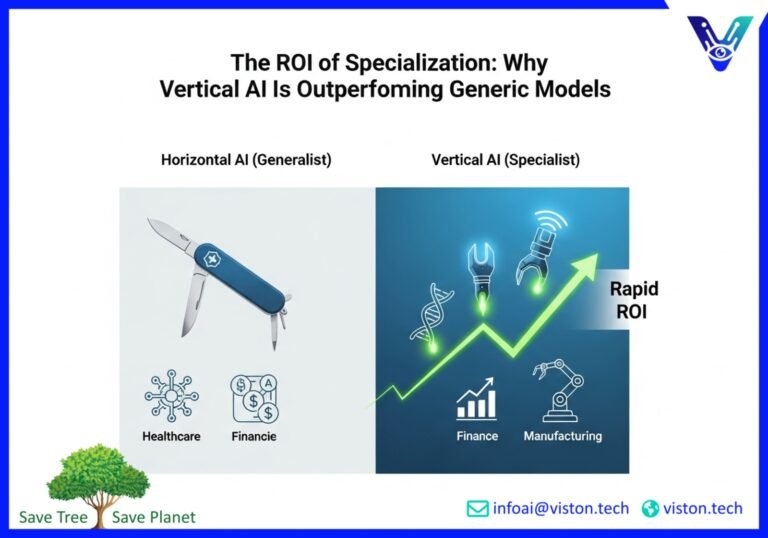
The artificial intelligence landscape is undergoing a seismic shift. For years, the focus was on creating broad, general-purpose AI models. Think of these as a Swiss Army knife – versatile, but not always the best tool for a specific job. Now, in 2025, the smart money is on Vertical AI. These are domain-specific AI agents, meticulously crafted for one industry, and they are delivering a return on investment (ROI) in weeks, not months.
This strategic shift isn’t just a trend; it’s a competitive necessity. Businesses are realizing that to truly unlock the power of AI, they need solutions that speak the language of their industry. Generic models require extensive training and often fall short in understanding niche terminology and complex, industry-specific workflows. The result? Slower time-to-value, higher costs, and less impressive outcomes. Industry-specific models, on the other hand, come with built-in domain expertise, leading to superior accuracy and a significantly faster path to profitability.
Horizontal vs. Vertical AI: A Tale of Two Models
To understand the power of specialization, let’s break down the two main types of AI.
- Horizontal AI: These are the generalists. They are designed to perform a wide range of tasks across various industries. While flexible, they lack the deep knowledge required for specialized functions. Think of them as a recent graduate with a broad education but no specific work experience.
- Vertical AI: These are the specialists. They are pre-trained on industry-specific data and designed to excel at a narrow set of tasks within a particular sector. This is your seasoned professional with decades of experience in their field.
While horizontal AI has its place, the future of impactful business AI lies in vertical solutions. Why? Because industry-specific models understand the nuances, regulations, and unique challenges of your business from day one.
Deep Dive: Vertical AI in Action Across Industries
The theoretical advantages of Vertical AI are impressive, but their real-world impact is what’s truly turning heads in boardrooms. Let’s explore how pre-trained, domain-specific agents are revolutionizing three key sectors.
1. Healthcare: Precision, Personalization, and Predictive Power
The healthcare industry is a minefield of complex terminology, strict regulations, and critical, life-or-death decisions. A generic AI model simply cannot keep up. Vertical AI agents in healthcare, however, are driving transformative change.
- Accelerated Diagnostics: AI models trained on vast libraries of medical images can identify anomalies in X-rays, MRIs, and CT scans with a level of accuracy that often surpasses human radiologists. This leads to earlier disease detection and better patient outcomes.
- Streamlined Administrative Tasks: Healthcare professionals are bogged down by paperwork. AI agents can automate tasks like medical coding, patient scheduling, and insurance claim processing. This frees up valuable time for patient care, reducing burnout and operational costs. For instance, some administrative automation saves clinicians 4-6 hours per week.
- Personalized Treatment Plans: By analyzing a patient’s genetic data, lifestyle, and medical history, industry-specific AI can help doctors create highly personalized treatment plans, leading to more effective therapies.
2. Finance: Enhancing Security, Compliance, and Customer Experience
In the high-stakes world of finance, accuracy and security are paramount. Vertical AI is becoming an indispensable tool for financial institutions looking to gain a competitive edge.
- Advanced Fraud Detection: AI agents trained on financial data can identify unusual transaction patterns in real-time, flagging potential fraud with incredible speed and accuracy. This proactive approach saves financial institutions and their customers millions in losses.
- Automated Compliance: The financial industry is heavily regulated. Vertical AI can monitor transactions and communications to ensure compliance with ever-changing regulations, significantly reducing the risk of costly penalties.
- Hyper-Personalized Banking: By understanding a customer’s spending habits and financial goals, AI-powered chatbots and robo-advisors can offer tailored financial advice and product recommendations, leading to a more engaging and valuable customer experience.
3. Manufacturing: Optimizing Production and Predicting Maintenance Needs
The manufacturing sector is all about efficiency. Every second of downtime and every defective product translates to lost revenue. Vertical AI is creating smarter, more efficient factories.
- Predictive Maintenance: AI agents can analyze data from sensors on factory equipment to predict when a machine is likely to fail. This allows for proactive maintenance, preventing costly, unplanned downtime.
- Quality Control Automation: AI-powered computer vision systems can inspect products on the assembly line with a level of detail and consistency that is impossible for the human eye to match. This ensures higher product quality and reduces waste.
- Supply Chain Optimization: By analyzing market trends, weather patterns, and shipping logistics, industry-specific AI models can predict demand and optimize inventory levels, ensuring that manufacturers have the right materials at the right time. For more on the future of AI, see this overview of the latest AI initiatives.
The Build vs. Buy Decision: A New Paradigm
For businesses looking to leverage the power of Vertical AI, the classic “build vs. buy” dilemma takes on a new dimension. Building a domain-specific AI model from scratch is a monumental undertaking. It requires:
- Massive, high-quality, industry-specific datasets for training.
- A team of highly specialized and expensive AI talent.
- Significant time and capital investment with no guarantee of success.
Buying a pre-trained agent from a specialized provider like Viston AI offers a much more strategic and efficient path to AI adoption. These solutions are:
- Ready to Deploy: They come with the domain expertise already built-in, drastically reducing implementation time.
- Cost-Effective: Buying a proven solution is significantly cheaper than the cost of building and maintaining an in-house model.
- Continuously Improving: Specialized AI providers are constantly updating and refining their models, ensuring you always have access to the latest technology.
For an in-depth look at AI’s growing role in business, explore the latest state of AI report from McKinsey.
The ROI Timeline: Weeks, Not Months
Perhaps the most compelling argument for domain-specific AI is the accelerated ROI timeline. Generic AI projects can take months, or even years, to show a return. The extensive data gathering, training, and fine-tuning required create a long and uncertain path to value. In contrast, pre-trained agents can start delivering measurable results in a matter of weeks. The ability to bypass the lengthy development cycle means that businesses can begin optimizing processes, reducing costs, and increasing revenue almost immediately.
Organizations that have adopted Vertical AI are reporting significant gains in operational efficiency, with some seeing cost reductions of 15-35%. This rapid time-to-value is not just a benefit; it’s a game-changer in today’s fast-paced business environment.
Your Strategic Advantage in the AI-Powered Future
The debate is over. For businesses that are serious about leveraging AI for a real competitive advantage, the strategic shift to domain-specific models is clear. The superior accuracy, faster time-to-value, and accelerated ROI of Vertical AI make it the intelligent choice for forward-thinking enterprises. While generic models have laid the groundwork, the future of business AI is specialized, pre-trained, and ready to deliver results from day one.
Don’t get left behind in the AI revolution. Embrace the power of specialization and unlock the true potential of artificial intelligence for your business. For more information on business innovation, check out this resource from Harvard Business Review.
Take the Next Step with Viston AI
Ready to see how a domain-specific AI agent can transform your business? The team at Viston AI specializes in developing cutting-edge, industry-specific AI-powered solutions that deliver rapid ROI. We understand the unique challenges of your industry and have pre-trained agents ready to tackle your most complex problems.
Contact Viston AI today to schedule a consultation and discover how our vertical AI solutions can give you a strategic advantage in 2025 and beyond. #VerticalAI #DomainSpecificAI #IndustryAI #AIforBusiness #FutureofAI #TechTrends2025
Frequently Asked Questions (FAQs)
1. What is the primary difference between Vertical AI and Horizontal AI?
Vertical AI is specialized for a specific industry or task, offering deep domain expertise. Horizontal AI is a general-purpose solution designed to work across multiple industries but lacks specialized knowledge.
2. Why are domain-specific AI agents considered more accurate?
They are trained on vast amounts of high-quality, industry-specific data. This allows them to understand the unique terminology, patterns, and complexities of a particular domain, leading to more accurate and relevant outputs.
3. How can Vertical AI deliver a faster ROI?
By using pre-trained agents, businesses can skip the lengthy and expensive process of building and training a model from scratch. This means faster implementation and a quicker path to realizing the benefits of AI, such as cost savings and increased efficiency.
4. Is it better to build our own industry-specific model or buy a pre-trained one?
For most businesses, buying a pre-trained model from a specialized provider is more strategic. It’s more cost-effective, faster to deploy, and you benefit from the provider’s ongoing research and development.
5. What are some industries where Vertical AI is having a major impact?
Healthcare, finance, and manufacturing are three of the leading sectors. However, Vertical AI is also transforming industries like retail, logistics, legal, and agriculture.
6. Will we still need our own data if we use a pre-trained agent?
While pre-trained agents come with a wealth of knowledge, they can often be fine-tuned with your own data to provide even more personalized and accurate results. This combines the power of a robust, pre-trained model with the specifics of your business.
7. How does the implementation of a pre-trained AI agent work?
Implementation typically involves an initial consultation to understand your specific needs, followed by the integration of the AI agent into your existing workflows. The process is generally much faster and less disruptive than building a custom solution.
8. Can Vertical AI help smaller businesses compete with larger enterprises?
Absolutely. By providing access to powerful, industry-specific AI without the need for massive in-house development teams, Vertical AI levels the playing field, allowing smaller businesses to leverage the same advanced technology as their larger competitors.
