
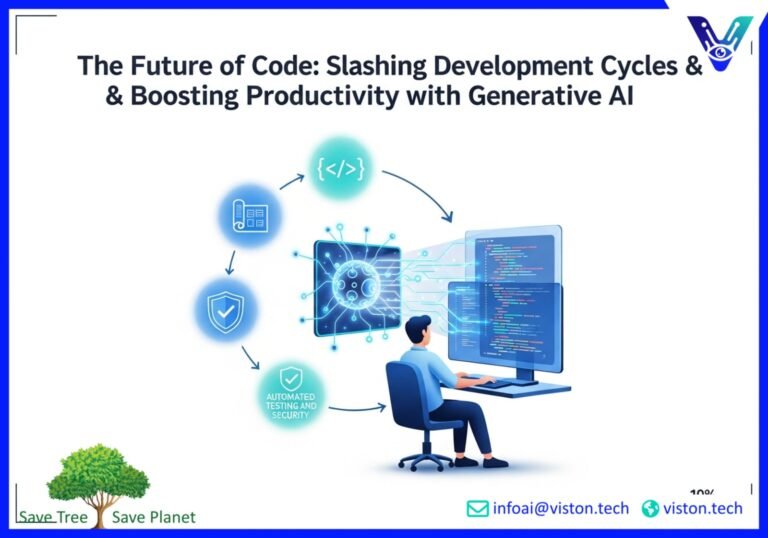
Generative AI for Code Generation: Reducing Development Cycles and Boosting Productivity
The world of software development is undergoing a seismic shift. Generative AI is no longer a futuristic concept; it’s a powerful tool that’s reshaping how we build, test, and deploy applications. For business leaders and tech innovators, understanding this transformation is key to staying competitive. AI-powered code generation tools are at the forefront of this revolution, promising to drastically cut down development time, enhance code quality, and unlock new levels of productivity. This isn’t just about writing code faster; it’s about fundamentally changing the economics of software creation.
Imagine slashing your development cycles by up to 78%. Think about your development teams focusing on complex problem-solving and innovation, rather than getting bogged down in repetitive, boilerplate code. This is the reality that generative AI is bringing to the table. Real-world data from 2025 shows that AI is not just a developer’s assistant but an integral part of the workflow, with some studies indicating that developers can complete coding tasks up to twice as fast with AI assistance. This article will explore the transformative impact of generative AI on code generation, from the foundational concepts to practical applications and the future it heralds for businesses of all sizes.
The New Tech Landscape: AI as a Co-Developer
The integration of AI into the software development lifecycle (SDLC) has moved beyond simple code completion. Today’s AI tools act as sophisticated partners, capable of understanding natural language prompts and generating complex code snippets, functions, and even entire application scaffolds. This shift is democratizing software development, making it more accessible to individuals with less traditional coding experience. The result is a more agile and efficient development process, where ideas can be turned into functional prototypes at an unprecedented speed.
The numbers speak for themselves. By 2025, a significant majority of developers are using AI tools in their daily workflows. This widespread adoption is driven by tangible benefits, including a significant reduction in the time spent on mundane coding tasks. For enterprises, this translates to faster time-to-market for new products and features, a crucial advantage in today’s fast-paced digital economy. The ability to automate repetitive coding allows developers to dedicate more of their cognitive energy to higher-value activities like system architecture and user experience design.
Key Takeaways:
- AI is transitioning from a simple assistant to a collaborative partner in software development.
- The democratization of coding is accelerating, enabling faster prototyping and innovation.
- Businesses are realizing significant time and cost savings through AI-driven development.
Unleashing Efficiency: Key AI Code Generation Tools in 2025
The market for AI-assisted coding tools is vibrant and rapidly evolving. Several platforms have emerged as leaders, each offering unique capabilities to enhance developer productivity and code quality. These tools are not just about generating code; they are about creating a more intelligent and intuitive development environment.
One of the most prominent tools is GitHub Copilot, which integrates directly into popular Integrated Development Environments (IDEs) and provides real-time code suggestions. It’s like having a seasoned pair programmer available 24/7. Another powerful player is Amazon CodeWhisperer, which is particularly adept at generating code for AWS services, streamlining cloud application development. For those looking for a more conversational and context-aware coding experience, tools like Tabnine adapt to individual coding styles, offering personalized suggestions.
Beyond these, a new wave of AI-native IDEs like Cursor are emerging, providing a development environment built from the ground up with AI at its core. These platforms offer a more holistic and integrated AI experience, from initial project scaffolding to debugging and deployment. The right tool often depends on the specific needs of the development team and the nature of the project.
Here’s a quick look at some of the leading AI code generation tools in 2025:
- GitHub Copilot: For its deep integration with the developer workflow and powerful code completion capabilities.
- Amazon CodeWhisperer: Ideal for developers working within the AWS ecosystem.
- Tabnine: Known for its ability to learn and adapt to individual and team coding styles.
- Replit: A browser-based IDE with powerful AI features for collaborative coding and rapid prototyping.
- Cursor: An AI-first code editor designed for a deeply integrated AI-assisted development experience.
A Modern Development Symphony: The AI-Assisted Workflow
To truly appreciate the impact of generative AI, it’s helpful to walk through a sample workflow. This process illustrates how AI can be seamlessly integrated into every stage of development, from initial concept to final testing.
Step 1: From Requirements to Actionable Plan
The journey begins with a product manager outlining the requirements for a new feature. Instead of manually translating these into technical specifications, they can use an AI tool to generate user stories, acceptance criteria, and even initial architectural suggestions. This not only saves time but also ensures a clearer and more consistent understanding of the project goals across the team.
Step 2: Scaffolding an Entire Application with a Single Prompt
With the requirements defined, a developer can use a natural language prompt to ask an AI tool to generate the entire boilerplate and foundational structure of the application. This includes creating the necessary files, setting up the database schema, and establishing the basic API endpoints. What used to take days of manual setup can now be accomplished in a matter of minutes, allowing developers to immediately start working on the core business logic.
Step 3: Writing and Refining Code with an AI Partner
As the developer begins to implement the core features, the AI code generation tool provides real-time suggestions, autocompletes complex functions, and even helps to refactor existing code for better performance and readability. If a developer encounters a bug, they can simply describe the problem to the AI, which can then suggest potential solutions and even generate the code to fix it. This interactive process dramatically speeds up the coding and debugging cycle.
Step 4: Automated Testing for Robust Quality Assurance
Once the code for a feature is complete, generative AI can be used to automatically create a comprehensive suite of unit tests. By analyzing the code and the initial requirements, the AI can generate test cases that cover a wide range of scenarios, including edge cases that a human tester might overlook. This automated approach to testing not only reduces the time spent on quality assurance but also leads to more robust and reliable software.
Measuring the Gains: Productivity and Quality Metrics
The adoption of AI in software development is not just a qualitative improvement; it delivers quantifiable results. Companies that have integrated AI-assisted coding into their workflows are reporting significant gains in both productivity and the quality of their code. These metrics provide compelling evidence for the return on investment in these powerful technologies.
Studies have shown that developers using AI tools can experience up to a 55% increase in their coding speed. This acceleration is not just about writing code faster but also about reducing the cognitive load on developers, allowing them to focus on more creative and strategic aspects of their work. Furthermore, the automation of repetitive tasks has been shown to improve developer satisfaction and reduce burnout.
In terms of quality, AI-powered tools are helping to catch bugs earlier in the development process, leading to a reduction in the number of defects that make it into production. Some AI tools can even analyze code for potential security vulnerabilities, helping to build more secure and resilient applications from the outset. The ability of AI to enforce coding standards and best practices across a team also contributes to a more consistent and maintainable codebase.
Key performance indicators (KPIs) to track the impact of AI in your development workflow:
- Development Cycle Time: The total time from the start of a project to its deployment.
- Code Churn: The frequency with which code is modified after being written.
- Mean Time to Resolution (MTTR): The average time it takes to fix a bug after it’s been identified.
- Developer Velocity: The rate at which a team delivers value to the business.
For more in-depth statistics and trends, you can explore resources like the Stack Overflow Developer Survey and various industry reports on AI in software development.
Navigating the New Frontier: Governance and Security in AI-Assisted Coding
While the benefits of generative AI in code generation are undeniable, it’s crucial for organizations to adopt these tools with a clear understanding of the associated governance and security implications. The speed and scale at which AI can generate code necessitate a robust framework for ensuring that the output is secure, compliant, and aligned with organizational standards.
A primary concern is the potential for AI models to generate code with security vulnerabilities. Because these models are trained on vast amounts of public code, they may inadvertently reproduce insecure coding patterns. Therefore, it is essential to have a human in the loop to review and validate all AI-generated code, especially for critical applications. Organizations should also implement automated security scanning tools that can analyze code for potential flaws before it is deployed.
From a governance perspective, it’s important to establish clear guidelines on the use of AI coding tools. This includes policies on data privacy, intellectual property, and the responsible use of AI. Teams should be trained on the limitations of these tools and encouraged to critically evaluate the code they produce. By fostering a culture of responsible AI use, organizations can mitigate the risks while maximizing the benefits.
Best practices for secure and responsible AI-assisted development:
- Human Oversight: Always have a qualified developer review and approve AI-generated code.
- Automated Security Testing: Integrate static and dynamic application security testing (SAST and DAST) into your CI/CD pipeline.
- Clear Governance Policies: Establish and enforce clear guidelines for the use of AI coding tools.
- Continuous Training: Educate your development teams on the latest security best practices for AI-assisted coding.
- Use Enterprise-Grade Tools: Opt for AI coding solutions that offer robust security and compliance features.
For more information on the latest in AI and machine learning, a great resource to follow is the MIT Technology Review’s AI section.
The Future is Now: Embracing AI for a Competitive Edge
The era of AI-assisted software development is here, and it’s transforming the way businesses innovate and compete. Generative AI for code generation is no longer a niche technology; it’s a fundamental driver of efficiency, productivity, and quality. By embracing these powerful tools, organizations can empower their development teams to build better software, faster. The ability to rapidly prototype, iterate, and deploy new applications is a significant competitive advantage in a market that demands constant innovation.
The journey with AI is just beginning. As these technologies continue to evolve, we can expect to see even more sophisticated capabilities that will further augment the skills of human developers. The future of software development is a collaborative one, where human creativity and strategic thinking are enhanced by the speed and power of artificial intelligence. For businesses ready to embrace this future, the possibilities are limitless.
Are you ready to accelerate your development cycles and boost your team’s productivity? Viston AI offers a suite of AI-powered solutions designed to help your organization harness the full potential of generative AI. Contact us today to learn how we can help you build the future of your business.
Frequently Asked Questions (FAQs)
What is generative AI for code generation?
Generative AI for code generation is a type of artificial intelligence that can automatically write, complete, and even debug software code. It uses large language models (LLMs) trained on vast amounts of existing code to understand natural language prompts and produce functional code in various programming languages. This technology acts as an intelligent assistant for developers, helping to automate repetitive tasks and accelerate the development process.
How does AI-assisted coding improve developer productivity?
AI-assisted coding significantly boosts developer productivity by automating time-consuming and repetitive tasks such as writing boilerplate code, generating unit tests, and debugging. This allows developers to focus on more complex and creative aspects of software development, such as architecture design and problem-solving. Real-world data shows substantial reductions in development time and an increase in the overall output of development teams.
What are some of the key AI code generation tools available in 2025?
In 2025, the landscape of AI code generation tools is rich and diverse. Some of the leading tools include GitHub Copilot, known for its seamless integration into popular IDEs; Amazon CodeWhisperer, which excels in generating code for AWS services; and Tabnine, which offers personalized code suggestions by learning from a team’s codebase. Other notable tools include Replit for collaborative, browser-based development and Cursor, an AI-native code editor.
Is AI-generated code secure?
The security of AI-generated code is a critical consideration. While AI tools can produce high-quality code, they can also inadvertently introduce security vulnerabilities if not properly managed. It is essential to have human developers review and validate all AI-generated code. Additionally, organizations should implement robust security practices, including automated security scanning and adherence to secure coding guidelines, to mitigate these risks.
Can generative AI replace human developers?
No, generative AI is not intended to replace human developers but rather to augment their capabilities. AI excels at handling repetitive and well-defined coding tasks, which frees up human developers to focus on higher-level activities that require creativity, critical thinking, and a deep understanding of business context. The future of software development is a collaborative partnership between humans and AI.
How does generative AI make full-app scaffolding feasible?
Generative AI makes full-application scaffolding feasible by automating the creation of the entire foundational structure of a new application from a simple natural language prompt. This includes setting up the directory structure, creating configuration files, defining the database schema, and generating boilerplate code for different components. This drastically reduces the initial setup time, allowing developers to begin working on the core application logic almost immediately.
What kind of productivity gains can be expected from using AI in development workflows?
Organizations that have integrated generative AI into their development workflows have reported significant productivity gains. Real-world data suggests that development cycles can be shortened considerably, with some reports indicating a reduction of up to 78%. Developers often experience a significant increase in their coding speed, and teams can deliver features and products to market much faster.
What is the role of governance in AI-assisted coding?
Governance plays a crucial role in the successful and responsible adoption of AI-assisted coding. It involves establishing clear policies and guidelines for the use of AI tools, including data privacy, intellectual property rights, and security standards. A strong governance framework ensures that AI is used in a way that aligns with the organization’s goals and values, while also mitigating potential risks.
#AICodeGeneration #DevProductivity #AIassistedCoding #GenerativeAI #SoftwareDevelopment #FutureOfTech #Innovation #VistonAI
