
#
The AI Revolution is Not One-Size-Fits-All: Why Vertical AI is the Future
Generic AI is Failing Businesses. Industry-Specific Solutions are Delivering ROI in Weeks.
You’ve heard the hype about Artificial Intelligence. It promises to revolutionize industries, streamline operations, and unlock unprecedented growth. Yet, many businesses are left disappointed. They invest in generic, one-size-fits-all AI platforms only to find them clunky, inaccurate, and unable to grasp the nuances of their specific industry. The problem isn’t the AI; it’s the approach.
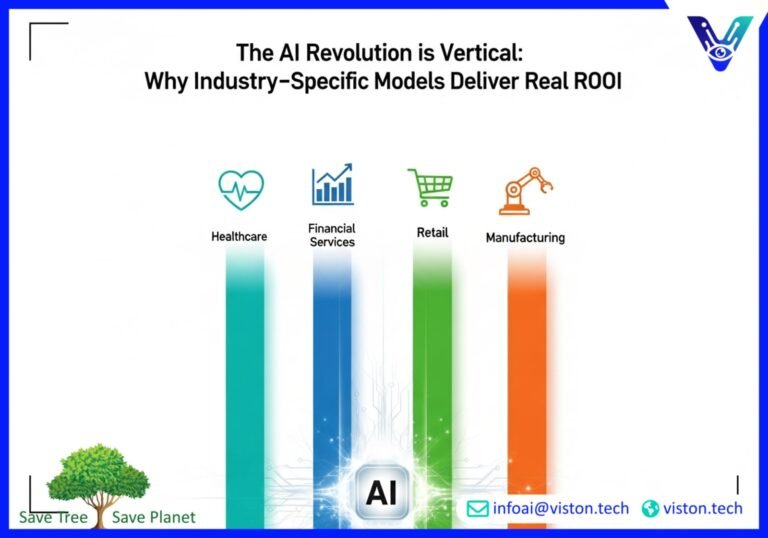
The era of horizontal AI is ending. The future belongs to Vertical AI—intelligent systems designed, trained, and optimized for the unique challenges and data of a specific industry. These domain-specific solutions are not just a marginal improvement; they are a quantum leap forward, delivering tangible results and a significant return on investment in a matter of weeks, not years.
This is not just about smarter technology. It’s about faster innovation, superior accuracy, and a competitive edge that generic models simply cannot provide. Let’s explore why your business needs to move beyond generic AI and embrace the power of industry-specific solutions.
Why One-Size-Fits-All AI Models Fail
Imagine trying to use a generic map for a specialized purpose, like navigating the complexities of the Amazon rainforest or the intricate subway system of Tokyo. A general world map gives you a basic overview but lacks the detail needed for effective navigation. You need a specialized map, one that understands the specific terrain, landmarks, and routes.
General-purpose AI models are like that generic map. They are trained on vast, diverse datasets from the public internet. While impressive in their breadth of knowledge, they lack the depth required for specialized industries. Here’s why they fall short:
- Lack of Contextual Understanding: A generic AI doesn’t understand the specific language, jargon, and intricate processes of your industry. It can’t differentiate between a “patient” in healthcare and a “client” in finance, leading to critical errors.
- Inaccurate and Irrelevant Outputs: Without industry-specific training, these models often produce results that are too general, irrelevant, or just plain wrong. This inaccuracy can have serious consequences, from flawed financial forecasts to incorrect medical diagnoses.
- Inability to Meet Regulatory Requirements: Industries like healthcare and finance are bound by strict compliance and data privacy regulations. Generic AI models are not built with these complex regulatory frameworks in mind, creating significant compliance risks.
- Slow and Costly Customization: Adapting a generic model to your specific needs requires extensive and expensive customization. This process can take months, or even years, erasing any initial cost savings.
Deep Dive: Vertical AI in Action Across Industries
Vertical AI solutions are pre-trained on industry-specific datasets and ontologies. This means they already understand the language, entities, and relationships unique to your sector. This built-in expertise leads to faster deployment, higher accuracy, and a quicker path to ROI.
Healthcare: Improving Patient Outcomes and Operational Efficiency
The healthcare industry is a prime example of where generic AI fails and Vertical AI excels. The stakes are incredibly high; accuracy and compliance are not just business metrics—they can be a matter of life and death. A generic AI model simply cannot comprehend the complexities of medical terminology, diagnostic procedures, or the stringent requirements of HIPAA.
Domain-specific solutions in healthcare are transforming the industry by:
- Accelerating Drug Discovery: AI models trained on biomedical data can analyze complex biological systems and identify potential drug candidates much faster than traditional methods.
- Enhancing Diagnostic Accuracy: Vertical AI algorithms trained on medical imaging can detect diseases like cancer with a level of accuracy that often surpasses human radiologists. For an in-depth look at AI’s role in medical imaging, see this article from Nature Reviews Cancer.
- Personalizing Treatment Plans: By analyzing a patient’s genetic information, lifestyle, and medical history, AI can help clinicians develop highly personalized and effective treatment plans.
- Streamlining Administrative Tasks: AI-powered solutions can automate tedious tasks like medical coding, billing, and patient scheduling, freeing up healthcare professionals to focus on patient care.
Financial Services: Mitigating Risk and Enhancing Customer Experience
In the fast-paced world of financial services, speed, accuracy, and security are paramount. The industry is governed by a complex web of regulations, and the financial and reputational costs of errors can be staggering. Vertical AI is purpose-built to navigate this intricate landscape.
Here’s how use-case optimization with Vertical AI is making a difference:
- Advanced Fraud Detection: AI models trained on vast datasets of financial transactions can identify subtle patterns and anomalies that indicate fraudulent activity in real-time, preventing significant losses.
- Algorithmic Trading: Vertical AI algorithms can analyze market data, predict price movements, and execute trades at speeds and volumes impossible for human traders.
- Personalized Financial Advice: AI-powered robo-advisors can analyze an individual’s financial situation and goals to provide tailored investment advice.
- Automated Compliance Monitoring: Domain-specific AI can continuously monitor transactions and communications to ensure compliance with anti-money laundering (AML) and know-your-customer (KYC) regulations.
Retail: Personalizing the Shopping Experience and Optimizing Supply Chains
The retail industry is fiercely competitive. Success hinges on understanding customer behavior and delivering a seamless, personalized experience. Generic AI offers generic insights, but Vertical AI provides the deep, actionable intelligence needed to win over customers and optimize operations.
Industry benchmarks are being redefined by Vertical AI in retail through:
- Hyper-Personalized Recommendations: AI algorithms trained on customer data can provide highly relevant product recommendations, significantly increasing conversion rates and customer loyalty.
- Dynamic Pricing Strategies: Vertical AI can analyze competitor pricing, demand, and inventory levels in real-time to set optimal prices that maximize profit margins.
- Intelligent Inventory Management: By accurately forecasting demand, AI helps retailers optimize inventory levels, reducing both stockouts and overstock situations. Learn more about how AI is revolutionizing retail supply chains in this report from McKinsey & Company.
- Enhanced Customer Service: AI-powered chatbots and virtual assistants, trained on retail-specific language, can provide instant and accurate support to customers 24/7.
Manufacturing: Driving Efficiency and Innovation on the Factory Floor
In manufacturing, efficiency, quality control, and safety are top priorities. The Industrial Internet of Things (IIoT) generates a massive amount of data from sensors and machinery. Vertical AI is essential for turning this data into actionable insights that drive real-world improvements.
Vertical AI is enabling a new era of smart manufacturing by:
- Predictive Maintenance: AI models can analyze data from machinery to predict when equipment is likely to fail, allowing for proactive maintenance that prevents costly downtime.
- Automated Quality Control: AI-powered computer vision systems can inspect products on the assembly line with greater speed and accuracy than human inspectors, identifying defects in real-time.
- Supply Chain Optimization: Vertical AI can analyze data from across the supply chain to optimize logistics, reduce transportation costs, and improve delivery times.
- Generative Design: AI algorithms can generate thousands of potential product designs based on specified constraints, helping engineers create lighter, stronger, and more efficient products.
Compliance Integration and Data Governance: The Vertical AI Advantage
For many industries, navigating the complex landscape of regulatory requirements is a major challenge. Regulations like GDPR, HIPAA, and CCPA impose strict rules on how data is collected, stored, and used. A breach can result in massive fines and irreparable damage to a company’s reputation.
Generic AI models are often a compliance nightmare. They are not designed with these specific regulations in mind. Vertical AI, on the other hand, is built from the ground up with compliance at its core. These solutions are designed to adhere to industry-specific regulations, ensuring that your AI initiatives are not only effective but also legally sound.
Furthermore, robust data governance is crucial for any successful AI implementation. Vertical AI solutions provide a framework for managing data quality, security, and access, ensuring that your data is accurate, reliable, and protected. This focus on data governance not only mitigates risk but also builds trust with your customers and stakeholders.
Faster Innovation Cycles and Superior Accuracy
The business world is moving faster than ever. The ability to innovate quickly is essential for survival. Generic AI, with its long implementation times and extensive customization requirements, can be a major bottleneck to innovation. Vertical AI, in contrast, acts as an accelerator.
Because these solutions are pre-trained on industry-specific data and come with pre-built models and workflows, they can be deployed in a fraction of the time. This means you can start seeing results and iterating on your AI strategy much faster. This accelerated timeline allows for more agile and responsive innovation, enabling you to stay ahead of the competition.
Ultimately, the most important benefit of Vertical AI is its superior task-specific accuracy. By focusing on a specific domain, these models develop a much deeper understanding of the nuances and complexities of that industry. This deep understanding translates into more accurate predictions, more insightful recommendations, and more reliable automation. In a world where data-driven decisions are critical, this superior accuracy is a game-changer.
The Future is Vertical: Your Path to AI Success
The evidence is clear: for businesses that are serious about leveraging the power of AI, a one-size-fits-all approach is no longer viable. The future of AI is vertical. It’s about specialized, domain-specific solutions that are built to address the unique challenges and opportunities of your industry.
By embracing Vertical AI, you can unlock a new level of performance, efficiency, and innovation. You can move beyond the hype and start delivering real, measurable results. It’s time to stop trying to fit a square peg into a round hole. It’s time to invest in an AI solution that speaks your language, understands your business, and is designed to help you succeed.
Ready to unlock the power of industry-specific AI?
At Viston AI, we specialize in developing cutting-edge, vertical AI solutions that deliver rapid ROI and a sustainable competitive advantage. Our team of experts understands the unique challenges of your industry and can help you build and deploy an AI strategy that drives real business value.
Contact Viston AI today to learn how our domain-specific AI solutions can transform your business. Let us show you the future of AI.
Frequently Asked Questions (FAQs)
1. What is Vertical AI?
Vertical AI refers to artificial intelligence solutions that are designed, trained, and optimized for a specific industry or domain. Unlike general-purpose (horizontal) AI, which has a broad but shallow knowledge base, Vertical AI has a deep, specialized understanding of the language, processes, and data unique to a particular sector, such as healthcare, finance, or manufacturing.
2. How does Vertical AI differ from Horizontal AI?
The primary difference lies in their training and application. Horizontal AI models are trained on vast, general datasets from the internet and are designed for a wide range of tasks. Vertical AI models are trained on curated, industry-specific datasets, which gives them a much deeper contextual understanding and higher accuracy for tasks within that specific domain.
3. What are the key benefits of using Vertical AI?
The main benefits include significantly higher accuracy for specific tasks, faster deployment times due to pre-trained models, quicker ROI (often in weeks), built-in compliance with industry regulations, and the ability to drive faster innovation cycles. They are tailored to solve specific business problems, making them more effective than generic solutions.
4. Can Vertical AI be integrated with our existing systems?
Yes, leading Vertical AI solutions are designed for seamless integration with existing enterprise systems, such as CRM, ERP, and other industry-specific software. This allows businesses to enhance their current workflows and leverage their existing data infrastructure without needing a complete overhaul.
5. Is Vertical AI only for large enterprises?
While large enterprises are significant adopters, Vertical AI is increasingly accessible to startups and mid-sized businesses. The faster ROI and more focused application can make it a more cost-effective and impactful investment for smaller companies looking to solve specific, high-value problems with AI.
6. How does Vertical AI handle data privacy and security?
Vertical AI solutions are built with industry-specific data privacy and security requirements in mind. For example, a healthcare AI solution will be designed for HIPAA compliance, while a finance AI will adhere to financial data regulations. This focus on regulatory compliance and robust data governance is a core advantage over generic AI platforms.
#VerticalAI #IndustryAI #DomainSpecificAI #AISolutions #FutureOfAI #HealthcareAI #FinanceAI #RetailAI #ManufacturingAI #ArtificialIntelligence #BusinessAI #TechInnovation
