
AI Agents in Healthcare: Revolutionizing Data Processing and Diagnostics in 2025
The healthcare industry is navigating a seismic shift. As we move through 2025, the sheer volume of patient data, clinical notes, and diagnostic images is overwhelming legacy systems. This data explosion creates significant bottlenecks, delaying patient care and straining resources. But a new generation of technology is rising to the challenge: healthcare AI agents. These sophisticated systems are not just another software update; they are autonomous partners designed to process, analyze, and support clinical decisions with unprecedented speed and accuracy.
For leaders in pharmaceutical and clinical settings, the message is clear. The outsized return on investment (ROI) from automated triage, intelligent data extraction, and AI-powered decision support is no longer a future promise—it’s a present-day reality. A recent Google Cloud survey revealed that nearly three-quarters of healthcare executives deploying generative AI are already seeing a positive ROI. These intelligent agents are streamlining workflows, reducing administrative burdens, and empowering clinicians to focus on what matters most: patient outcomes.
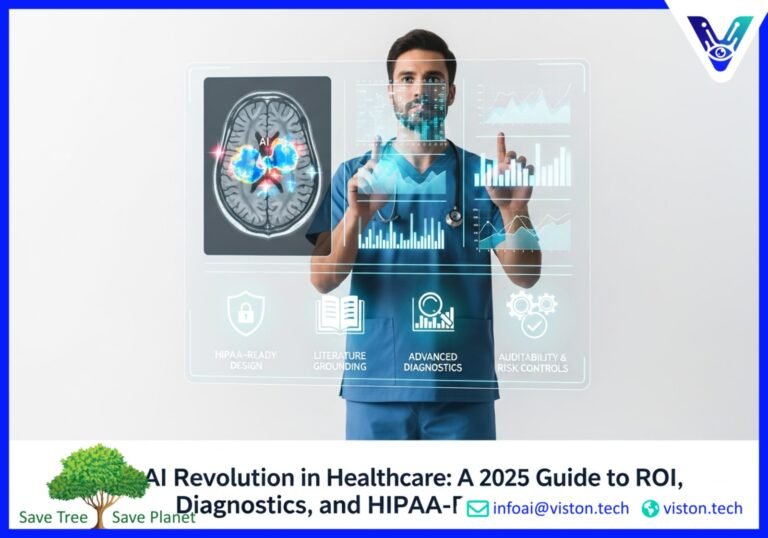
This post explores how AI agents are transforming healthcare, focusing on the foundational pillars that make this revolution possible and trustworthy: HIPAA-ready design, evidence-based grounding, advanced diagnostic support, and robust auditability and risk controls.
The New Engine of Healthcare ROI: AI in Clinical and Pharma Workflows
In both pharmaceutical research and clinical care, administrative tasks consume an enormous amount of time and resources. Manual data entry, sifting through thousands of pages of medical records, and managing trial documentation are inefficient and prone to error. This is where medical document automation powered by clinical AI delivers transformative value.
Imagine an AI agent that can read, understand, and categorize thousands of unstructured documents—like faxes, scanned reports, and clinical notes—in minutes. These systems extract critical information, such as patient demographics, diagnoses, and lab results, and integrate it directly into Electronic Health Records (EHRs). This automation delivers a powerful ROI by:
- Accelerating Triage and Intake: AI agents can automatically sort and prioritize incoming patient information, flagging urgent cases for immediate review. This ensures faster response times and better resource allocation in busy clinical environments.
- Enhancing Data Extraction Accuracy: By eliminating manual data entry, AI significantly reduces the risk of human error. Advanced AI models achieve near-perfect accuracy in extracting data, ensuring that clinical decisions are based on reliable information.
- Streamlining Clinical Trials: In the pharmaceutical sector, AI agents accelerate drug discovery and development. They can analyze vast datasets to identify ideal candidates for clinical trials, monitor trial data in real-time, and automate the collation of regulatory submission documents. This can shorten development timelines by years.
- Powering Decision Support: Beyond simple automation, these agents provide clinicians with critical insights. By analyzing a patient’s complete record against a vast library of medical knowledge, they can highlight potential drug interactions, suggest evidence-based treatment pathways, and predict patient risk factors.
The financial impact is staggering. Some healthcare providers report that AI-powered solutions can reduce documentation time by over 70%, freeing up clinicians to see more patients and perform higher-value work. In pharma, the acceleration of clinical trials could generate billions in revenue and save even more in development costs.
Building on Bedrock: The Critical Role of HIPAA-Ready Design
In healthcare, innovation cannot come at the expense of patient privacy. The Health Insurance Portability and Accountability Act (HIPAA) sets the gold standard for protecting sensitive patient health information (PHI). Any AI solution handling PHI must be architected from the ground up for compliance. A truly HIPAA-ready AI agent is not just a feature—it’s a core design principle.
For C-suite executives and IT leaders, understanding what “HIPAA-ready” means is crucial for risk management. Key components include:
- End-to-End Encryption: All data, whether it’s being processed, transmitted, or stored, must be encrypted. This ensures that even if data is intercepted, it remains unreadable and secure.
- Strict Access Controls: AI systems must enforce role-based access. Only authorized personnel should be able to view or interact with specific patient data, based on the “minimum necessary” principle.
- Comprehensive Audit Trails: Every interaction with PHI must be logged. The system must record who accessed the data, what they did, and when. This traceability is essential for security audits and breach investigations.
- Business Associate Agreements (BAAs): When working with a third-party AI vendor, a BAA is a legal necessity. This contract ensures the vendor is also obligated to protect PHI according to HIPAA standards.
- Data Anonymization and De-identification: Whenever possible, AI models should be trained on de-identified data. This process removes personal identifiers, allowing the model to learn without exposing sensitive patient information.
Building a HIPAA-compliant AI solution is non-negotiable. It fosters patient trust and protects the organization from severe financial penalties and reputational damage. For more information on navigating these regulations, the U.S. Department of Health & Human Services provides extensive guidance on its Security Rule.
Grounded in Science: AI That Understands Medical Literature
An AI agent is only as smart as the data it’s trained on. In healthcare, this principle is paramount. A “black box” AI that cannot explain its reasoning is not just unhelpful—it’s dangerous. That’s why leading-edge clinical AI systems are grounded in a deep understanding of established medical literature, clinical guidelines, and peer-reviewed research.
This concept, known as literature grounding, ensures that the AI’s outputs are not based on random correlations but on validated medical science. Here’s how it works:
- Training on High-Quality Data: Instead of just raw patient data, these AI models are trained on curated datasets that include medical textbooks, research papers from journals like The Lancet and NEJM, and established clinical practice guidelines.
- Natural Language Processing (NLP): Advanced NLP allows the AI to read and interpret the complex, nuanced language of medical texts. It understands context, terminology, and the relationships between different medical concepts.
- Evidence-Based Recommendations: When the AI provides a diagnostic suggestion or a treatment recommendation, it can cite the specific research or guideline that supports its conclusion. This makes the AI’s reasoning transparent and verifiable for the clinician.
Literature-grounded AI acts as an intelligent partner for physicians. It can instantly cross-reference a patient’s symptoms and biomarkers with the latest medical research, presenting the clinician with a summarized, evidence-based overview. This augments the physician’s expertise, ensuring decisions are informed by the most current and comprehensive medical knowledge available.
A New Frontier in Diagnostics: AI as a Clinical Co-pilot
One of the most exciting applications of healthcare AI agents is in diagnostic support. These systems are becoming indispensable tools for clinicians, helping them detect diseases earlier and with greater accuracy. AI excels at identifying subtle patterns in complex data that may be imperceptible to the human eye.
The role of AI is not to replace the clinician but to augment their abilities—acting as a vigilant co-pilot. In 2025, we are seeing this partnership flourish in several key areas:
- Medical Imaging Analysis: AI algorithms trained on millions of X-rays, MRIs, and CT scans can detect early signs of conditions like cancer, diabetic retinopathy, and neurological disorders with remarkable precision. Some AI models have demonstrated accuracy rates exceeding 90%, helping radiologists prioritize and confirm diagnoses more efficiently.
- Predictive Analytics: By analyzing a patient’s EHR data—including lab results, clinical notes, and medical history—AI can predict the risk of future health events. For example, it can identify patients at high risk for sepsis, heart failure, or hospital readmission, allowing for proactive intervention.
- Pathology and Genomics: In pathology, AI helps analyze tissue samples to identify cancerous cells more quickly. In genomics, it processes vast amounts of genetic data to identify disease-linked mutations and predict patient responses to specific therapies, paving the way for truly personalized medicine.
By automating the initial analysis and flagging potential areas of concern, diagnostic AI agents reduce the cognitive load on clinicians. This allows them to focus their expertise on complex cases and patient interaction, ultimately improving the quality and speed of care.
Ensuring Trust and Safety: Auditability and Risk Controls
For any high-stakes technology, trust is paramount. In clinical settings, every decision must be traceable, verifiable, and safe. As AI becomes more autonomous, establishing robust governance, auditability, and risk controls is a critical priority for every healthcare organization. The goal is to create transparent, explainable AI (XAI) that clinicians and regulators can trust.
A comprehensive risk management framework for clinical AI includes several key layers:
- Full Auditability: Every action taken by an AI agent—from the data it accessed to the recommendation it made—must be logged in an immutable audit trail. This ensures that in the event of an adverse outcome, a full investigation can be conducted to understand the AI’s decision-making process.
- Explainability and Transparency: Clinicians need to understand *why* an AI made a particular recommendation. XAI techniques provide clear, human-understandable explanations for the model’s outputs. This transparency is crucial for clinical validation and user adoption. Learn more about the importance of explainable AI from thought leaders at the World Economic Forum.
- Continuous Performance Monitoring: AI models are not static. Their performance can degrade over time, a phenomenon known as “model drift.” Organizations must implement systems to continuously monitor the AI’s accuracy and reliability in real-world clinical settings.
- Human-in-the-Loop Oversight: For critical clinical decisions, AI should function as a support tool, not the final authority. A “human-in-the-loop” approach ensures that a qualified clinician always reviews and validates the AI’s output before any action is taken. This maintains clinical accountability and patient safety.
- Proactive Risk Assessment: Before deploying any AI agent, organizations must conduct a thorough risk assessment to identify potential failure points, biases in the training data, and cybersecurity vulnerabilities. This proactive approach helps mitigate risks before they can impact patient care.
By embedding these controls into the AI lifecycle, healthcare organizations can deploy powerful AI agents responsibly, ensuring they are safe, effective, and fully aligned with regulatory and ethical standards.
The Future is Autonomous, Accountable, and Actionable
The era of AI agents in healthcare is here. In 2025, these intelligent systems are already delivering significant ROI in pharmaceutical and clinical environments by automating complex data processing and providing powerful diagnostic support. Built on a foundation of HIPAA-ready design, grounded in scientific literature, and governed by strict auditability and risk controls, these AI agents are poised to redefine efficiency and effectiveness in healthcare.
For enterprise leaders, the path forward is clear. Embracing these technologies is no longer optional—it’s essential for staying competitive and delivering the highest standard of care. By partnering with experts in clinical AI, you can unlock new levels of performance and drive better outcomes for patients and your organization.
Ready to harness the power of AI for your clinical and pharmaceutical workflows? Contact Viston AI today to learn how our intelligent, HIPAA-ready solutions can transform your data processing and decision support capabilities.
Frequently Asked Questions (FAQs)
1. What are healthcare AI agents?
Healthcare AI agents are advanced software programs designed to perform specific tasks autonomously within clinical or pharmaceutical workflows. They can process vast amounts of medical data, automate documentation, assist in diagnostics by analyzing images and patient records, and provide decision support to clinicians, all while learning and adapting over time.
2. How does medical document automation create ROI?
Medical document automation uses AI to read, understand, and extract key information from unstructured documents like physician’s notes, lab reports, and faxes. This delivers ROI by dramatically reducing manual data entry time, minimizing costly human errors, accelerating billing cycles, and freeing up highly skilled medical professionals to focus on patient care instead of paperwork.
3. Is clinical AI a replacement for doctors?
No, clinical AI is designed to be a powerful tool that augments, rather than replaces, human clinicians. It acts as a “co-pilot,” handling time-consuming data analysis and flagging potential issues that require expert review. The final diagnostic and treatment decisions remain firmly in the hands of qualified medical professionals.
4. What makes an AI system “HIPAA-ready”?
A HIPAA-ready AI system is designed from the ground up to protect patient health information (PHI). This includes features like end-to-end data encryption, strict role-based access controls, comprehensive and immutable audit trails of all data interactions, and the ability to operate under a Business Associate Agreement (BAA) that legally binds it to HIPAA standards.
5. What is “literature grounding” in AI?
Literature grounding is the practice of training healthcare AI models on a foundation of established, peer-reviewed medical literature, clinical guidelines, and scientific research. This ensures that the AI’s recommendations are based on evidence-based medicine, making its outputs more reliable, transparent, and trustworthy for clinicians.
6. How does AI improve diagnostic accuracy?
AI algorithms can analyze complex medical data, such as radiological images or genomic sequences, and detect subtle patterns that are often invisible to the human eye. By comparing this data against millions of other cases, AI can identify early indicators of disease with high precision, helping clinicians make faster, more accurate diagnoses.
7. What are auditability and risk controls for AI in healthcare?
Auditability refers to the ability to trace every decision an AI system makes back to the data and logic it used. Risk controls are the policies and technical safeguards put in place to ensure the AI operates safely, effectively, and ethically. This includes continuous performance monitoring, ensuring transparency (explainable AI), and maintaining human oversight for critical decisions.
8. What are the first steps to implementing AI agents in a clinical setting?
A successful implementation starts with identifying a specific, high-impact use case, such as automating patient intake or streamlining prior authorizations. The next steps involve ensuring data readiness, choosing a HIPAA-compliant AI partner, and running a pilot program to measure impact and refine the workflow before scaling across the organization.
