
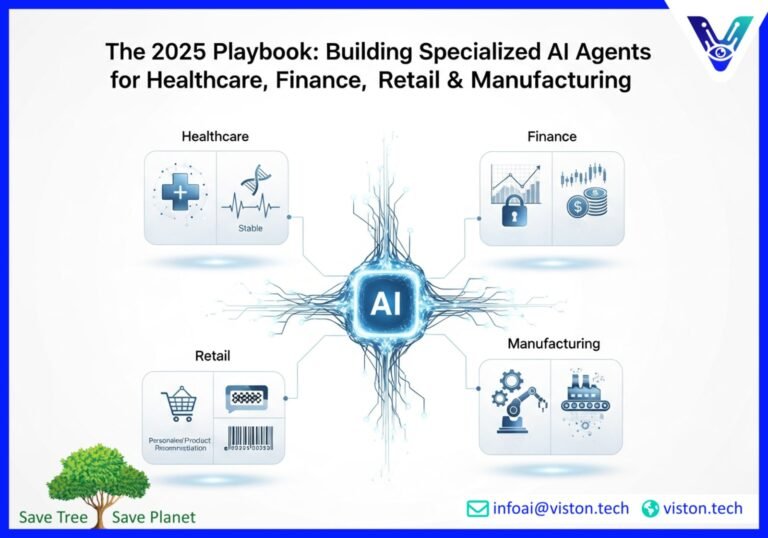
Building Specialized Domain Agents: A 2025 Guide for Healthcare, Finance, Retail & Manufacturing
The era of generic AI is over. As we move further into 2025, the business world is witnessing a transformative shift towards specialized, domain-specific agents. These are not your everyday chatbots; they are sophisticated AI systems trained on industry-specific data and designed to handle complex, end-to-end workflows. Industry data reveals a significant trend: the adoption of these autonomous agents is delivering remarkable efficiency improvements, with some reports showing gains of around 35–42% in sectors like healthcare, manufacturing, and financial services. This isn’t just about automation; it’s about intelligent, autonomous action that drives real business value.
From automating patient intake in hospitals to optimizing production lines in factories, industry agents are revolutionizing core business processes. They are built to understand the unique language, regulations, and challenges of their specific domains, making them incredibly effective. For any enterprise C-suite executive, IT leader, or product manager, understanding the potential of these specialized agents is no longer optional—it’s essential for staying competitive. This blog post will explore the practical applications of domain-specific agents across four key verticals, providing a clear roadmap for implementation and success.
For a deeper dive into how AI is reshaping industries, check out this insightful article from Forbes on the rise of domain-specific AI.
Healthcare: Enhancing Patient Care and Operational Efficiency
The healthcare industry is under immense pressure to deliver better patient outcomes while managing rising costs and administrative burdens. Specialized AI agents are emerging as a powerful solution to these challenges, automating complex workflows and freeing up medical professionals to focus on what matters most: patient care.
Detailed Workflows Automated by Healthcare Agents
- Patient Intake and Onboarding: AI agents can automate the entire patient intake process. This includes collecting patient information, verifying insurance details, and even conducting initial symptom assessments through conversational interfaces. This not only speeds up the process but also ensures data accuracy from the start.
- Appointment Scheduling and Management: Autonomous agents can manage appointment bookings, send reminders, and handle rescheduling requests without human intervention. This significantly reduces no-shows and optimizes clinic schedules for maximum efficiency.
- Clinical Documentation and Summarization: One of the most time-consuming tasks for clinicians is documentation. AI agents can listen to doctor-patient conversations and automatically generate clinical notes, summaries, and reports, drastically reducing the administrative workload on medical staff.
- Claims Processing and Management: By automating the claims submission and verification process, AI agents can help reduce errors, minimize denials, and accelerate reimbursement cycles, improving the financial health of healthcare organizations.
Integration Patterns for Healthcare AI
To be effective, healthcare agents must seamlessly integrate with existing systems. Common integration patterns include:
- EHR/EMR Integration: Connecting with Electronic Health Record (EHR) and Electronic Medical Record (EMR) systems is crucial for accessing patient data and updating records in real-time.
- API-Based Connectivity: Using APIs to connect with various hospital information systems (HIS), laboratory systems, and pharmacy management software.
- Cloud and On-Premise Hybrid Models: Deploying AI agents in a hybrid environment that allows for the secure processing of sensitive patient data while leveraging the scalability of the cloud.
Key Performance Indicators (KPIs) for Success
- Reduction in Patient Wait Times: Measuring the decrease in the time it takes for a patient to be seen from the moment they initiate contact.
- Improved Data Accuracy: Tracking the reduction in errors in patient records and billing information.
- Increased Staff Productivity: Monitoring the amount of time saved by medical staff on administrative tasks.
- Faster Claims Processing Cycles: Measuring the time from claim submission to reimbursement.
Implementation Roadmap for Healthcare
- Phase 1 (Months 1-3): Start with a pilot project focusing on a single workflow, such as patient appointment scheduling. This allows for a controlled rollout and quick wins.
- Phase 2 (Months 4-6): Expand the implementation to include patient intake and data verification, integrating with key EMR systems.
- Phase 3 (Months 7-12): Roll out AI-powered clinical documentation support and begin automating aspects of the revenue cycle management process.
- Phase 4 (Ongoing): Continuously monitor performance, gather feedback from staff and patients, and explore new use cases for autonomous agents across the organization.
Finance: Revolutionizing Risk Management and Customer Service
In the fast-paced and highly regulated financial services industry, accuracy, speed, and security are paramount. Domain-specific AI agents are helping financial institutions to not only meet these demands but also to gain a significant competitive edge. From automating complex risk assessments to providing personalized customer experiences, these agents are transforming the financial landscape.
Detailed Workflows Automated by Finance Agents
- Credit Risk Scoring: AI agents can analyze vast amounts of traditional and alternative data to provide more accurate and dynamic credit risk assessments. This allows for faster and more informed lending decisions.
- Fraud Detection and Prevention: By monitoring transactions in real-time, autonomous agents can identify and flag suspicious activities with incredible speed and accuracy, helping to prevent fraud before it happens.
- Automated Underwriting: In the insurance sector, AI agents can automate the underwriting process, from data collection and analysis to policy issuance, significantly reducing processing times.
- Personalized Financial Advisory: AI-powered agents can act as virtual financial advisors, offering personalized investment advice and portfolio management based on an individual’s financial goals and risk tolerance.
Integration Patterns for Financial AI
Seamless integration is key to the success of AI in finance. This includes:
- Core Banking System Integration: Connecting with core banking platforms to access customer account information and transaction histories.
- CRM and Customer Data Platforms: Integrating with CRM systems to provide a unified view of the customer and deliver personalized services.
- Secure Cloud Deployment: Utilizing secure and compliant cloud environments to process and store sensitive financial data.
Key Performance Indicators (KPIs) to Track
- Improved Accuracy of Risk Models: Measuring the reduction in loan defaults and fraudulent transactions.
- Faster Loan Approval Times: Tracking the time from loan application to disbursement.
- Increased Customer Satisfaction: Monitoring customer feedback and engagement with AI-powered services.
- Reduced Operational Costs: Calculating the cost savings from automating manual processes.
Implementation Roadmap for Finance
- Phase 1 (Initial 3 Months): Begin with a focused use case like automating the initial stages of loan application processing to demonstrate value quickly.
- Phase 2 (Months 4-8): Implement AI-driven fraud detection models and integrate them with real-time transaction monitoring systems.
- Phase 3 (Months 9-14): Develop and deploy automated underwriting agents for specific insurance products.
- Phase 4 (Ongoing): Expand the use of AI agents to customer-facing applications, such as personalized financial advisory services, and continuously refine risk models.
Retail: Optimizing Inventory and Personalizing the Customer Journey
The retail industry is undergoing a massive transformation, driven by changing consumer expectations and the rise of e-commerce. To succeed in this competitive environment, retailers need to be agile, efficient, and customer-centric. Specialized AI agents are providing the tools to achieve this, from optimizing supply chains to delivering hyper-personalized shopping experiences.
Detailed Workflows Automated by Retail Agents
- Inventory Management: AI agents can analyze sales data, market trends, and even weather forecasts to predict demand and automate inventory replenishment. This helps to prevent stockouts and reduce excess inventory.
- Personalized Product Recommendations: By analyzing a customer’s browsing history, purchase behavior, and preferences, AI agents can provide highly relevant product recommendations, increasing sales and customer loyalty.
- Dynamic Pricing and Promotions: Autonomous agents can adjust prices and promotions in real-time based on factors like demand, competitor pricing, and inventory levels to maximize profitability.
- Automated Customer Support: AI-powered chatbots and virtual assistants can handle a wide range of customer inquiries, from order tracking to product questions, freeing up human agents to handle more complex issues.
Integration Patterns for Retail AI
Effective integration in retail involves:
- E-commerce Platform Integration: Connecting with platforms like Shopify, Magento, and BigCommerce to access product and customer data.
- POS and Inventory System Integration: Linking with point-of-sale and inventory management systems for a real-time view of stock levels and sales.
- Marketing Automation and CRM Systems: Integrating with marketing tools to deliver personalized campaigns and communications.
Key Performance Indicators (KPIs) for Retail
- Increased Sales Conversion Rates: Measuring the impact of personalized recommendations and dynamic pricing on sales.
- Improved Inventory Turnover: Tracking the efficiency of inventory management and the reduction in carrying costs.
- Enhanced Customer Lifetime Value: Monitoring the long-term value of customers acquired and retained through personalized experiences.
- Higher Customer Satisfaction Scores: Assessing feedback from customer interactions with AI-powered support channels.
Implementation Roadmap for Retail
- Phase 1 (First 2 Months): Implement an AI-powered product recommendation engine on your e-commerce website.
- Phase 2 (Months 3-5): Deploy an AI agent for inventory forecasting and automated replenishment for a specific product category.
- Phase 3 (Months 6-10): Roll out automated customer support chatbots to handle common inquiries and integrate dynamic pricing models.
- Phase 4 (Ongoing): Continuously optimize personalization algorithms, expand inventory automation across all categories, and explore in-store AI applications.
Discover more about how AI is transforming retail inventory management in this comprehensive guide from Forbes.
Manufacturing: Driving Production Optimization and Quality Control
In the manufacturing sector, efficiency, quality, and safety are the pillars of success. The rise of Industry 4.0 has paved the way for smart factories, and at the heart of this revolution are domain-specific AI agents. These agents are enabling manufacturers to move from reactive to proactive operations, optimizing every aspect of the production process.
Detailed Workflows Automated by Manufacturing Agents
- Production Optimization: AI agents can analyze data from sensors on the factory floor to identify bottlenecks, optimize production schedules, and improve overall equipment effectiveness (OEE).
- Predictive Maintenance: By monitoring the health of machinery in real-time, autonomous agents can predict when a piece of equipment is likely to fail and schedule maintenance proactively, preventing costly downtime.
- Quality Control and Inspection: AI-powered computer vision systems can inspect products on the assembly line with greater speed and accuracy than human inspectors, identifying defects and ensuring consistent quality.
- Supply Chain Management: AI agents can optimize the supply chain by forecasting demand, managing inventory levels, and even automating procurement processes, ensuring a smooth and efficient flow of materials.
Integration Patterns for Manufacturing AI
Successful AI implementation in manufacturing relies on:
- IIoT and Sensor Integration: Connecting with Industrial Internet of Things (IIoT) devices and sensors on the factory floor to collect real-time data.
- MES and ERP Integration: Integrating with Manufacturing Execution Systems (MES) and Enterprise Resource Planning (ERP) systems to align production with business operations.
- Edge Computing: Deploying AI agents at the edge of the network to enable real-time decision-making and reduce latency.
Key Performance Indicators (KPIs) to Measure
- Increased Overall Equipment Effectiveness (OEE): Tracking improvements in equipment availability, performance, and quality.
- Reduced Unplanned Downtime: Measuring the decrease in production interruptions due to equipment failure.
- Improved Product Quality: Monitoring the reduction in defect rates and customer complaints.
- Optimized Supply Chain Costs: Calculating the savings from more efficient inventory management and procurement.
Implementation Roadmap for Manufacturing
- Phase 1 (Months 1-4): Implement a predictive maintenance solution for a critical piece of machinery to demonstrate the ROI of preventing downtime.
- Phase 2 (Months 5-9): Deploy an AI-powered quality inspection system on a single production line.
- Phase 3 (Months 10-15): Roll out a production optimization agent to analyze data from across the factory floor and provide real-time scheduling recommendations.
- Phase 4 (Ongoing): Expand the use of autonomous agents to supply chain management and explore the creation of a fully autonomous “lights-out” manufacturing environment.
The Future is Specialized: Partner with Viston AI
The message for 2025 and beyond is clear: to unlock the full potential of AI, businesses must move beyond generic solutions and embrace the power of domain-specific agents. These specialized AI systems are not just a technological trend; they are a fundamental shift in how industries operate, delivering tangible improvements in efficiency, productivity, and profitability.
At Viston AI, we specialize in building custom, industry-specific AI solutions that drive real business results. Our team of experts understands the unique challenges and opportunities within your vertical. We work with you to develop and deploy autonomous agents that are tailored to your specific workflows and integrated seamlessly with your existing systems.
Are you ready to harness the power of specialized domain agents and transform your business? Contact Viston AI today to learn how our AI-powered solutions can help you achieve your goals and stay ahead of the competition.
Frequently Asked Questions (FAQs)
What are domain-specific agents?
Domain-specific agents are specialized AI systems that are trained on industry-specific data and designed to perform complex tasks within a particular business vertical, such as healthcare, finance, or manufacturing. Unlike general-purpose AI, they have a deep understanding of the unique terminology, workflows, and regulations of their specific domain.
How do industry agents differ from traditional automation?
While traditional automation typically follows a set of pre-defined rules, industry agents are autonomous and intelligent. They can analyze data, make decisions, and adapt to changing conditions without human intervention. This allows them to handle more complex and dynamic workflows.
What are the key benefits of implementing specialized domain agents?
The primary benefits include significant efficiency improvements, reduced operational costs, improved accuracy, and enhanced decision-making. By automating end-to-end workflows, these agents free up employees to focus on more strategic and value-added activities.
What is the typical ROI for adopting domain-specific AI agents?
While the ROI can vary depending on the industry and specific use case, many organizations report significant returns on their investment. Industry data suggests efficiency improvements in the range of 35-42% in sectors like healthcare, manufacturing, and financial services, leading to substantial cost savings and revenue growth.
How long does it take to implement a specialized AI agent?
The implementation timeline can range from a few months to over a year, depending on the complexity of the workflow and the level of integration required. A phased approach, starting with a pilot project, is often recommended to demonstrate value quickly and ensure a smooth rollout.
What are the main challenges in adopting industry agents?
The main challenges include ensuring data quality and security, integrating with legacy systems, and managing the change within the organization. Partnering with an experienced AI solutions provider like Viston AI can help overcome these challenges and ensure a successful implementation.
How do I get started with building a specialized domain agent for my business?
The first step is to identify a specific business process or workflow that is ripe for automation and has the potential for a high impact. From there, it’s important to partner with an AI expert who can help you define the requirements, develop a roadmap, and build a solution that is tailored to your unique needs.
Can domain-specific agents be customized for my company’s specific needs?
Yes, one of the key advantages of domain-specific agents is that they can be highly customized. At Viston AI, we work closely with our clients to understand their unique processes and challenges, and we build custom AI solutions that are designed to meet their specific requirements.
