
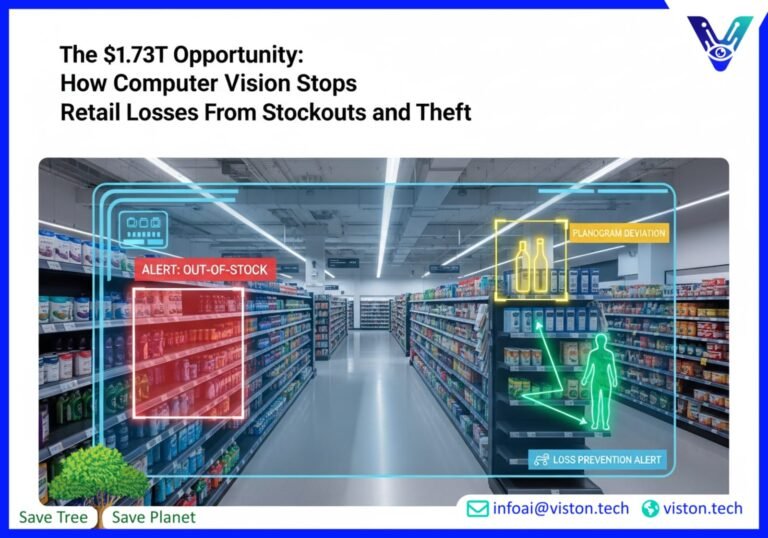
Computer Vision for Retail: A $1.73 Trillion Opportunity to Stop Annual Losses
The retail industry is facing a monumental challenge. Each year, a staggering $1.73 trillion is lost due to stockouts, inefficient inventory management, and theft. This isn’t just a number; it’s a direct hit to your bottom line. But what if you could reclaim a significant portion of that loss? The answer lies in a transformative technology: Computer Vision.
This isn’t science fiction. AI-powered solutions are already revolutionizing retail analytics, offering unprecedented accuracy and efficiency. Imagine having a digital eye in your store, constantly monitoring your shelves, ensuring products are always available, and preventing losses before they happen. This is the power of computer vision, and it’s more accessible than you think.
The Real Pain Points in Retail
Every retailer, from global chains to emerging startups, grapples with a set of persistent challenges. These are not minor inconveniences; they are significant financial drains that erode profits and damage customer loyalty.
The High Cost of Empty Shelves
Out-of-stock situations are more than just a missed sale. Research shows that stockouts cost retailers over $1.2 trillion annually in lost sales. When a customer walks into your store and can’t find the product they’re looking for, you don’t just lose that one transaction. You risk losing that customer forever. In today’s competitive market, a negative experience can easily send shoppers to a competitor, both online and in-person.
The Chaos of Disorganized Shelves
A messy, disorganized store is a silent revenue killer. It creates a poor shopping experience and makes it difficult for customers to find what they need. More importantly, it signals operational inefficiency. When products are in the wrong place, it disrupts your inventory data and makes it impossible to know what you truly have in stock. This leads to inaccurate forecasting, overstocking of the wrong items, and understocking of your bestsellers.
The Persistent Threat of Shrinkage
Shrinkage, the industry term for inventory loss due to theft, fraud, or error, is a multi-billion dollar problem. In 2022 alone, retailers lost an estimated $112.1 billion to shrinkage. Traditional security measures are often reactive and unable to keep up with sophisticated theft methods. This constant leakage of inventory directly impacts your profitability and can be a major obstacle to growth.
The Computer Vision Solution: Your Eyes on the Prize
So, how can computer vision address these deeply entrenched problems? At its core, computer vision gives machines the ability to “see” and interpret the world around them. In a retail setting, this means leveraging your existing camera infrastructure to gather real-time data about your store’s environment. Let’s break down the key components of a robust computer vision architecture.
Shelf Detection: The Foundation of Retail Analytics
The first step is teaching the AI to recognize your shelves. This is more than just identifying a physical object. The system learns to differentiate between various types of shelving, understand their dimensions, and locate them within the store’s layout. This foundational layer is crucial for all subsequent analysis.
Think of it like building a house. Before you can add the walls, roof, and furniture, you need a solid foundation. In the world of retail analytics, shelf detection is that foundation. Without it, any further analysis would be inaccurate and unreliable.
Planogram Compliance: Ensuring a Picture-Perfect Store
A planogram is a visual diagram that dictates how and where specific retail products should be placed on shelves. It’s the blueprint for an optimal shopping experience and a key driver of sales. However, ensuring that your planogram is consistently followed across all your stores is a significant challenge.
Computer vision automates this process with incredible precision. The AI compares the real-time image of your shelf with the designated planogram and instantly identifies any discrepancies. This could be anything from a misplaced product to an incorrect number of facings. By ensuring planogram compliance, you can:
- Maximize Product Visibility: Key products are always in the optimal position to catch the customer’s eye.
- Improve Brand Consistency: Your brand is presented in a consistent and professional manner across all locations.
- Boost Sales: A well-organized and visually appealing shelf has been proven to increase sales.
For more insights into the importance of planogram compliance, check out this informative article from Shelvz.
Shrinkage Prevention: Proactive Loss Mitigation
Instead of just reacting to theft, computer vision allows you to prevent it. The system can be trained to recognize suspicious behavior, such as a customer lingering in a high-theft area or attempting to conceal an item. When such an event is detected, the system can send an alert to your staff in real-time, allowing them to intervene before a theft occurs.
Furthermore, computer vision can help identify instances of internal theft and operational errors that contribute to shrinkage. By analyzing footage of your stockroom and checkout areas, you can uncover inefficiencies and fraudulent activities that would otherwise go unnoticed.
The ROI of Computer Vision: A Numbers Game You Can Win
Implementing any new technology requires a careful consideration of the return on investment (ROI). With computer vision, the numbers speak for themselves. The ROI drivers for computer vision in retail inventory extend beyond direct labor savings to encompass multiple value streams. While labor efficiency was initially perceived as the primary benefit, research demonstrates that sales increases from improved product availability and shrinkage reduction often deliver greater financial impact.
Calculating Your Potential ROI
To give you a better idea of the potential financial benefits, let’s look at a hypothetical ROI calculation for a mid-sized retailer:
- Annual Revenue: $50 million
- Average Gross Margin: 30%
- Shrinkage Rate: 2% of sales ($1 million)
- Out-of-Stock Rate: 8%
Potential Gains:
- Increased On-Shelf Availability: A 20% improvement in on-shelf availability could lead to a 4% increase in sales, adding $2 million to your top line.
- Reduced Shrinkage: A 30% reduction in shrinkage would save you $300,000 annually.
- Improved Operational Efficiency: Automating manual tasks like shelf monitoring and inventory counts can save thousands of hours in labor costs.
While this is a simplified example, it illustrates the significant financial impact that computer vision can have on your business. For a deeper dive into the ROI of retail technology, this article from Forbes offers valuable insights.
The Future is Now: AI-Powered Solutions for 2025 and Beyond
The retail landscape is constantly evolving, and the technologies that power it are advancing at an exponential rate. As we look towards 2025 and beyond, AI-powered computer vision will become an indispensable tool for any retailer who wants to stay competitive. The ability to gather and analyze real-time data from your physical stores will be a key differentiator, enabling you to make smarter, more informed decisions that drive growth and profitability.
The accuracy of these systems is already exceeding 99% in shelf monitoring, and this will only continue to improve as the technology matures. Early adopters of this technology will gain a significant competitive advantage, while those who wait may find themselves left behind.
Take Action Today with Viston AI
The $1.73 trillion problem of retail losses is not insurmountable. With the right technology and the right partner, you can turn this challenge into an opportunity. At Viston AI, we specialize in developing cutting-edge computer vision solutions that are tailored to the unique needs of the retail industry. Our team of AI and machine learning experts will work with you to design and implement a system that delivers real, measurable results.
Don’t let another year of preventable losses pass you by. Contact Viston AI today to learn how our AI-powered solutions can help you stop the leaks in your revenue stream and build a more profitable and efficient retail business. #ComputerVision #RetailAnalytics #ShelfMonitoring #InventoryAutomation #AIinRetail #FutureofRetail #LossPrevention
Frequently Asked Questions (FAQs)
What is computer vision and how does it work in a retail setting?
Computer vision is a field of artificial intelligence that enables computers to interpret and understand the visual world. In retail, it uses cameras to analyze what’s happening in your store in real-time. This includes monitoring shelves for out-of-stock items, ensuring products are displayed correctly, and detecting potential theft.
How accurate are computer vision systems for shelf monitoring?
Modern computer vision systems for shelf monitoring can achieve an accuracy rate of over 99%. This high level of accuracy ensures that you have reliable, real-time data about the state of your shelves, allowing you to take immediate action to address any issues.
What kind of ROI can I expect from implementing a computer vision solution?
The return on investment (ROI) for computer vision in retail can be significant. It’s driven by several factors, including increased sales from improved on-shelf availability, reduced losses from shrinkage, and enhanced operational efficiency. Many retailers see a positive ROI within the first 12-18 months of implementation.
Is computer vision difficult to implement?
While the technology behind computer vision is complex, implementing a solution from a provider like Viston AI is a streamlined process. We handle the technical aspects, from system design and integration to training and support. Our goal is to make it as easy as possible for you to start reaping the benefits of this powerful technology.
Can computer vision be integrated with my existing systems?
Yes, our computer vision solutions are designed to integrate seamlessly with your existing retail management systems, such as your inventory management software and point-of-sale (POS) system. This ensures a smooth flow of data across your entire operation.
How does computer vision help with loss prevention?
Computer vision can help prevent losses in several ways. It can detect suspicious behavior in real-time and alert your staff, allowing them to intervene before a theft occurs. It can also identify operational errors and internal theft that may be contributing to your shrinkage problem.
What are the privacy implications of using computer vision in my store?
We take privacy very seriously. Our computer vision systems are designed to focus on products and shelves, not on identifying individual customers. We work with you to ensure that your implementation is fully compliant with all relevant privacy regulations.
How can I get started with computer vision for my retail business?
The first step is to contact us for a consultation. We’ll discuss your specific challenges and goals and provide you with a customized proposal that outlines how our computer vision solutions can help your business. You can reach out to us through our website at Viston AI.
