
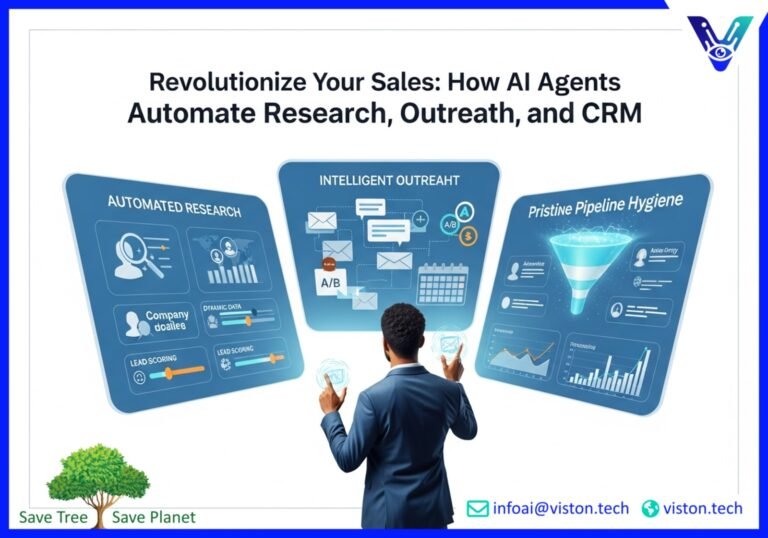
AI Agents for Sales Operations: Automating Research, Outreach, and Pipeline Hygiene
In the competitive landscape of 2025, artificial intelligence (AI) is no longer a futuristic concept but a present-day reality revolutionizing business operations. AI business trend reports consistently highlight sales, customer support, and marketing as the top domains embracing AI agents as “digital coworkers.” This shift is not just about automation; it’s about augmenting human capabilities to drive unprecedented efficiency and growth. For enterprise C-suite executives, AI/ML engineers, IT leaders, and sales professionals, understanding and leveraging AI agents in sales operations is paramount. This blog post delves into how AI agents are transforming the daily sales workflow, from initial research to closing deals and maintaining a healthy pipeline.
The Modern Sales Workflow: A Day in the Life
Before we explore the impact of AI, let’s outline a typical day for a sales professional. The daily grind often involves a mix of strategic and administrative tasks:
- Morning (9 AM – 12 PM): Prospecting and Research. This involves identifying potential customers, researching their business needs, and understanding their pain points. It’s a time-consuming but crucial step for personalized outreach.
- Afternoon (1 PM – 4 PM): Outreach and Follow-ups. Crafting and sending personalized emails, making calls, and connecting on social media platforms are core activities. Diligent follow-up is key to staying top-of-mind.
- End of Day (4 PM – 5 PM): CRM Updates and Reporting. Manually updating the Customer Relationship Management (CRM) system with every interaction is vital for tracking progress and forecasting. However, it’s often a tedious and error-prone task.
This traditional workflow, while effective, is fraught with inefficiencies. Sales representatives spend a significant portion of their time on non-selling activities, which is where AI agents come in to change the game.
Supercharging Sales with AI Agents
AI agents are autonomous systems that can perform tasks and make decisions without direct human intervention. In sales, they act as intelligent assistants, automating and optimizing various aspects of the sales cycle. Here’s how they are making a difference:
Automated Account Research: Know Your Customer Instantly
In-depth account research is the bedrock of effective sales. AI agents can automate this process by:
- Gathering Intelligence: AI agents can scan websites, news articles, social media, and financial reports to gather comprehensive information about a target account. This includes company size, revenue, key decision-makers, and recent business developments.
- Identifying Pain Points: By analyzing the collected data, AI agents can identify potential challenges and needs of a prospect, enabling sales reps to tailor their pitch effectively. Manual prospect research can take 15-20 minutes per account, whereas AI can do the same in seconds.
- Lead Scoring: AI algorithms can score leads based on their likelihood to convert, helping sales teams prioritize their efforts on the most promising prospects.
With AI-powered research, sales reps can walk into a conversation armed with deep insights, fostering more meaningful and productive interactions.
Intelligent Email Drafting: Personalized Outreach at Scale
Personalization is key to cutting through the noise in a prospect’s inbox. AI agents are revolutionizing email outreach by:
- Hyper-Personalization: AI can draft highly personalized emails by incorporating details from its research, such as a recent company announcement or a shared connection. This level of personalization significantly increases open and response rates. Personalized emails have been shown to generate 26% higher open rates.
- A/B Testing and Optimization: AI agents can test different email subject lines, body copy, and calls-to-action to determine what resonates best with different audience segments. This continuous optimization improves campaign performance over time.
- Automated Follow-ups: AI can schedule and send follow-up emails at optimal times, ensuring persistent yet non-intrusive communication. This frees up sales reps to focus on engaging with warm leads.
By automating the heavy lifting of email creation and management, AI empowers sales teams to engage more prospects with a personal touch.
Pristine Pipeline Hygiene: The Power of CRM Automation
A clean and up-to-date CRM is the single source of truth for any sales organization. However, manual data entry is a common bottleneck. Poor data quality can cost businesses millions annually. AI agents ensure CRM data hygiene through:
- Automated Data Entry: AI can automatically log all sales activities, including emails, calls, and meetings, in the CRM. This eliminates the need for manual data entry and ensures that the CRM is always current.
- Data Cleansing: AI agents can identify and merge duplicate records, correct inconsistencies, and standardize data formats. This ensures the integrity and reliability of the sales data.
- Predictive Insights: By analyzing CRM data, AI can provide predictive insights, such as forecasting sales trends and identifying at-risk deals, enabling proactive intervention. AI-driven forecasting can reduce errors by up to 30%.
With CRM automation, sales teams can trust their data, leading to more accurate forecasting and better decision-making.
Measuring Success: Key Metrics for AI Sales Agents
To justify the investment in AI, it’s crucial to track the right metrics. Here are some key performance indicators (KPIs) to measure the impact of AI sales agents:
- Increased Sales Productivity: Measure the time saved on administrative tasks and the increase in the number of prospects engaged per sales rep. Companies using AI have reported a 10-20% increase in ROI due to streamlined processes.
- Higher Conversion Rates: Track the percentage of leads that convert into customers. Early successes with AI in sales have shown a 30% or better improvement in win rates.
- Improved Forecast Accuracy: Compare the accuracy of sales forecasts before and after implementing AI.
- Enhanced Customer Engagement: Monitor email open rates, response rates, and meeting booking rates to gauge the effectiveness of AI-powered outreach.
Consistently tracking these metrics will provide a clear picture of the return on investment (ROI) and help in fine-tuning the AI strategy.
Your Playbook for Rolling Out AI Sales Agents
Implementing AI in your sales operations requires a strategic approach. Here’s a playbook to guide you through a successful rollout:
- Start with a Pilot Program: Begin with a small team to test and refine the AI tools. Select a specific use case, such as automated lead research or email follow-ups, to demonstrate early wins.
- Choose the Right Tools: Evaluate different AI solutions based on your specific needs, existing tech stack, and scalability. Look for platforms that offer seamless integration with your CRM.
- Train Your Team: Provide comprehensive training to your sales team on how to use the new AI tools effectively. Emphasize that AI is a tool to augment their skills, not replace them.
- Define Clear Processes: Establish clear workflows and best practices for using AI agents. This includes guidelines for reviewing AI-generated content and managing automated communications. For more in-depth strategies, consider this Bain & Company technology report.
- Monitor and Iterate: Continuously monitor the performance of your AI agents and gather feedback from your sales team. Use these insights to make necessary adjustments and optimize your AI strategy.
The Future is Here: Embrace Your Digital Coworkers
The integration of AI agents into sales operations is not a matter of ‘if’ but ‘when’. By automating research, personalizing outreach, and ensuring pristine pipeline hygiene, AI is empowering sales teams to work smarter, not harder. This shift allows sales professionals to focus on what they do best: building relationships and closing deals. As AI technology continues to evolve, the collaboration between humans and their “digital coworkers” will only become more seamless and impactful.
Ready to Transform Your Sales Operations?
At Viston AI, we specialize in developing cutting-edge AI-powered solutions that drive business growth. Our expertise in AI chatbot development, generative AI, and predictive analytics can help you automate your sales processes and unlock new levels of efficiency and performance. Contact Viston AI today to learn how our AI-powered solutions can be tailored to meet your unique business needs.
Frequently Asked Questions (FAQs)
1. Will AI agents replace human sales representatives?
No, AI agents are designed to augment the capabilities of human sales reps, not replace them. They handle repetitive and time-consuming tasks, freeing up sales professionals to focus on strategic activities like building relationships and complex negotiations.
2. How does CRM automation improve sales performance?
CRM automation improves sales performance by ensuring data accuracy, reducing administrative workload, and providing valuable insights. This leads to better lead prioritization, more effective follow-ups, and more accurate sales forecasting.
3. What are the first steps to implementing AI in our sales process?
Start by identifying the most significant bottlenecks in your current sales workflow. Then, research AI tools that address these specific challenges. A pilot program with a small team is a great way to test the waters and demonstrate the value of AI before a full-scale rollout.
4. How can we measure the ROI of AI sales agents?
Measure the ROI by tracking key metrics such as increased sales productivity, higher conversion rates, improved forecast accuracy, and enhanced customer engagement. Comparing these metrics before and after implementation will provide a clear picture of the financial impact.
5. Are AI sales tools difficult for non-technical users to adopt?
Most modern AI sales tools are designed with user-friendliness in mind. They often feature intuitive interfaces and seamless integrations with existing CRM systems. With proper training, even non-technical users can quickly learn to leverage the power of these tools.
6. What is the difference between generative AI and other types of AI in sales?
Generative AI, like that used in email drafting, creates new content. Other types of AI in sales might focus on analytical tasks like lead scoring or predictive forecasting based on existing data. Both are valuable for a comprehensive AI sales strategy.
7. How secure is our data when using third-party AI sales tools?
Reputable AI vendors prioritize data security and comply with regulations like GDPR. When choosing a tool, it’s essential to review their security policies and ensure they have robust measures in place to protect your sensitive customer data.
8. Can AI help with sales training and coaching?
Yes, AI can analyze sales calls and interactions to provide personalized feedback and coaching to sales reps. It can identify areas for improvement and suggest best practices, helping to upskill the entire sales team.
