
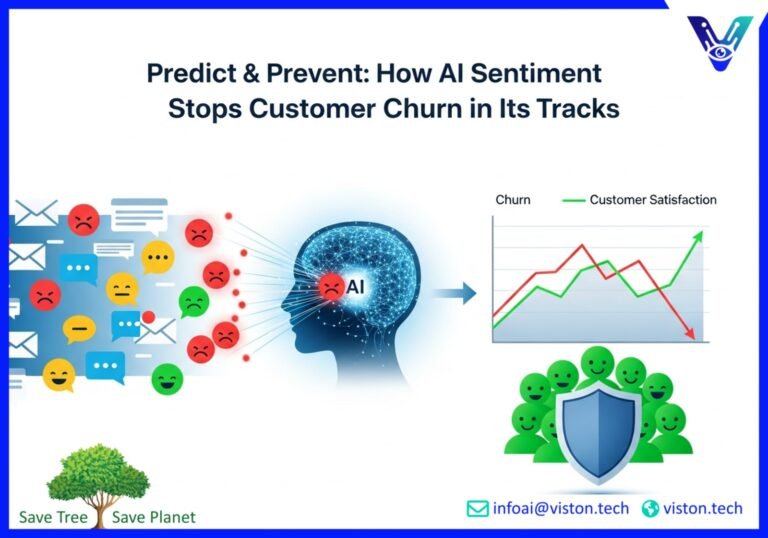
Sentiment Analysis in Customer Service: Using NLP to Predict Churn Before It Happens
In the fast-paced digital landscape of 2025, customer experience is the ultimate brand differentiator. Enterprises are in a relentless race to not just meet but anticipate customer needs. What if you could know a customer was unhappy before they told you? What if you could predict churn before it even becomes a consideration for them? This isn’t science fiction; it’s the power of sentiment analysis, driven by the latest advancements in Natural Language Processing (NLP).
Today’s AI is more than just a chatbot answering basic queries. Modern NLP models are profoundly context-aware and increasingly cross-lingual, capable of understanding the subtle nuances of human emotion across text, voice, and even video. For businesses, this translates into a powerful tool for proactive customer service and a strategic weapon against customer churn. Companies are leveraging real-time sentiment analysis to intelligently route support tickets, escalate at-risk customers for white-glove treatment, and fine-tune their marketing messages for maximum impact. This blog post explores how your enterprise can harness this technology to build stronger customer relationships and protect your bottom line.
Learn more about the fundamentals of sentiment analysis.
NLP Fundamentals: Understanding the Engine Behind Sentiment Analysis
At its core, Natural Language Processing is a field of artificial intelligence that gives computers the ability to understand, interpret, and generate human language. Think of it as teaching a machine to read and comprehend text or listen and understand spoken words, much like a person does. For a non-technical audience, here’s a simple breakdown:
- Text as Data: NLP models treat words and sentences as data points. They analyze patterns, relationships, and context to derive meaning.
- Learning from Examples: These models are trained on vast amounts of text and speech data. This training allows them to learn grammar, syntax, semantics, and the subtle nuances of language.
- Sentiment as a Key Insight: Sentiment analysis is a specific application of NLP. It focuses on identifying and categorizing the emotions or opinions expressed in a piece of text—classifying them as positive, negative, or neutral.
Early NLP models were often rule-based and struggled with the complexities of human language like sarcasm or cultural context. However, the NLP of 2025 is a different beast entirely. Powered by advanced architectures like transformers, modern models can grasp context with remarkable accuracy, making them incredibly effective for customer service applications.
Key Trends Shaping Sentiment Analysis in 2025
The field of NLP is evolving at an astonishing pace. Here are the trends that are making sentiment analysis an indispensable tool for enterprises today:
Multilingual and Cross-Lingual Capabilities
The global marketplace is more interconnected than ever. Modern NLP models are no longer confined to English. They are trained on diverse datasets encompassing numerous languages, enabling them to perform sentiment analysis on a global scale. This means you can understand how your customers in Japan feel about a new product launch with the same accuracy as your customers in North America, all without needing separate models for each language.
Multimodal Sentiment Analysis
Customer interactions are not limited to text. People express their feelings through their tone of voice on a support call or their facial expressions in a video testimonial. Multimodal sentiment analysis is an emerging frontier that combines NLP with audio and video analysis to create a holistic understanding of customer emotions. By analyzing not just what a customer says, but how they say it, businesses can gain much deeper insights into their true feelings.
Emotion-Aware AI
Sentiment analysis is moving beyond simple positive, negative, and neutral classifications. The latest models can detect a wide spectrum of emotions, including frustration, joy, anger, and disappointment. This level of emotional granularity allows for incredibly nuanced customer service. An AI chatbot, for instance, can detect a customer’s rising frustration and proactively escalate the conversation to a human agent before the situation worsens.
Discover the strategic importance of churn prediction in business.
A Customer Support Case Study: From Reactive to Proactive
Imagine a large e-commerce company, “Global Retail Inc.,” struggling with a high customer churn rate. Their support team is overwhelmed with tickets, and by the time they identify an unhappy customer, it’s often too late. They decide to implement an AI-powered sentiment analysis solution.
The Challenge: Global Retail Inc. had a reactive customer service model. They would only address customer issues after a negative review was posted or a customer explicitly stated their dissatisfaction. This led to a significant loss of customers who would simply leave without giving the company a chance to rectify the problem.
The Solution: They integrated a real-time sentiment analysis tool into their CRM and helpdesk software. This tool, powered by a 2025-era NLP model, analyzed every incoming email, chat message, and social media mention. The system was designed to:
- Score Sentiment in Real-Time: Every interaction was assigned a sentiment score.
- Automated Ticket Routing: Messages with highly negative sentiment were automatically flagged and routed to a specialized team of senior support agents.
- Proactive Escalation: The system identified customers who had a history of declining sentiment over multiple interactions, even if they hadn’t explicitly complained. These customers were flagged as “at-risk,” and a customer success manager would proactively reach out to them.
- Sentiment-Aware Chatbots: Their AI chatbots were upgraded to be emotion-aware. If a chatbot detected frustration in a customer’s messages, it would adjust its tone to be more empathetic and offer to connect the customer with a human agent immediately.
The Results: Within six months of implementation, Global Retail Inc. saw a 25% reduction in customer churn. Their customer satisfaction scores (CSAT) increased by 15%, and their support team reported being able to resolve issues more efficiently. By predicting and addressing customer dissatisfaction before it escalated, they transformed their customer service from a cost center into a powerful retention engine.
Integrating Sentiment Analysis into Your CRM and Customer Service Tools
The true power of sentiment analysis is unlocked when it is seamlessly integrated into your existing workflows. Modern AI solutions are designed to work with the tools your teams use every day.
Connecting with Your CRM
Integrating sentiment analysis with your Customer Relationship Management (CRM) platform, such as Salesforce or HubSpot, enriches your customer profiles with valuable emotional data. This allows your sales and marketing teams to:
- Personalize Outreach: A sales representative can see a prospect’s sentiment towards the company and tailor their communication accordingly.
- Optimize Marketing Campaigns: Marketing teams can analyze sentiment around specific campaigns to understand what resonates with their audience and what doesn’t.
- Identify Upsell Opportunities: A customer consistently expressing positive sentiment might be a prime candidate for an upsell or a request for a positive review.
Enhancing Customer Support Platforms
When integrated with helpdesk platforms like Zendesk or Freshdesk, sentiment analysis can revolutionize your support operations. The benefits include:
- Prioritizing Tickets: Urgent issues from highly frustrated customers can be automatically moved to the front of the queue.
- Agent Coaching: Managers can use sentiment data to identify coaching opportunities for agents, helping them improve their communication and empathy skills.
- Performance Tracking: You can track sentiment trends over time to measure the effectiveness of your support team and identify areas for improvement.
Metrics for Success: How to Measure the Impact of Sentiment Analysis
Implementing any new technology requires a clear understanding of how you will measure its success. For sentiment analysis, key metrics to track include:
- Churn Rate: The most direct measure of success. A significant decrease in customer churn is a strong indicator that your sentiment analysis initiatives are working.
- Customer Satisfaction (CSAT) and Net Promoter Score (NPS): Track these scores to see if your proactive, sentiment-driven approach is leading to happier customers.
- First Contact Resolution (FCR): By routing tickets more effectively and providing agents with better context, you should see an improvement in the number of issues resolved in the first interaction.
- Average Handling Time (AHT): While not the primary goal, improved efficiency from better routing and context can lead to a reduction in the average time it takes to handle a support ticket.
The Future is Now: Embracing a Proactive Customer Service Model
The days of waiting for customers to tell you they are unhappy are over. In 2025, the technology exists to not only understand your customers’ sentiment in real-time but to predict their future behavior. By leveraging the power of advanced NLP and sentiment analysis, your enterprise can move from a reactive to a proactive customer service model, building stronger, more loyal customer relationships and securing a competitive advantage in the market.
Frequently Asked Questions (FAQs)
What is sentiment analysis?
Sentiment analysis is a subfield of Natural Language Processing (NLP) that involves identifying and categorizing opinions expressed in a piece of text to determine whether the writer’s attitude towards a particular topic, product, etc., is positive, negative, or neutral.
How does NLP help in predicting customer churn?
NLP models can analyze customer communications (like emails, chat logs, and reviews) to detect negative sentiment or signs of frustration. By identifying these patterns early, businesses can intervene and address the customer’s concerns before they decide to leave, thus predicting and preventing churn.
Is sentiment analysis only for large enterprises?
While large enterprises have been early adopters, the technology is becoming increasingly accessible to businesses of all sizes. Many CRM and helpdesk platforms now offer built-in or easily integrated sentiment analysis features, and cloud-based AI services make it affordable for startups as well.
Can sentiment analysis understand sarcasm and complex language?
Yes, modern NLP models, especially those developed in recent years, have become much more sophisticated at understanding context, including sarcasm and idiomatic expressions. While no model is perfect, the accuracy of sentiment analysis in these areas has improved dramatically.
What is multimodal sentiment analysis?
Multimodal sentiment analysis is an advanced form of sentiment analysis that goes beyond text. It analyzes multiple data types simultaneously, such as text, audio (tone of voice), and video (facial expressions), to get a more complete and accurate picture of a person’s emotional state.
How can sentiment-aware chatbots improve customer service?
Sentiment-aware chatbots can detect the emotional tone of a customer’s messages. If a customer seems frustrated or angry, the chatbot can adjust its language to be more empathetic, offer to escalate the issue to a human agent, or prioritize the query, leading to a more positive customer experience.
What are the key metrics to measure the success of a sentiment analysis implementation?
Key metrics include a reduction in customer churn rate, an increase in Customer Satisfaction (CSAT) and Net Promoter Scores (NPS), improved First Contact Resolution (FCR) rates, and potentially a decrease in Average Handling Time (AHT) for support tickets.
How does cross-lingual sentiment analysis work?
Cross-lingual sentiment analysis uses advanced NLP models that have been trained on vast amounts of data from multiple languages. This allows them to understand and analyze sentiment in different languages without needing to translate the text first, which preserves the original context and nuance.
Ready to transform your customer service and get ahead of churn? Contact Viston AI today to learn how our AI-powered solutions can help you harness the power of sentiment analysis.
#SentimentAnalysis #NLP #CustomerService #ChurnPrediction #AI #ArtificialIntelligence #CustomerExperience #TechTrends2025
