
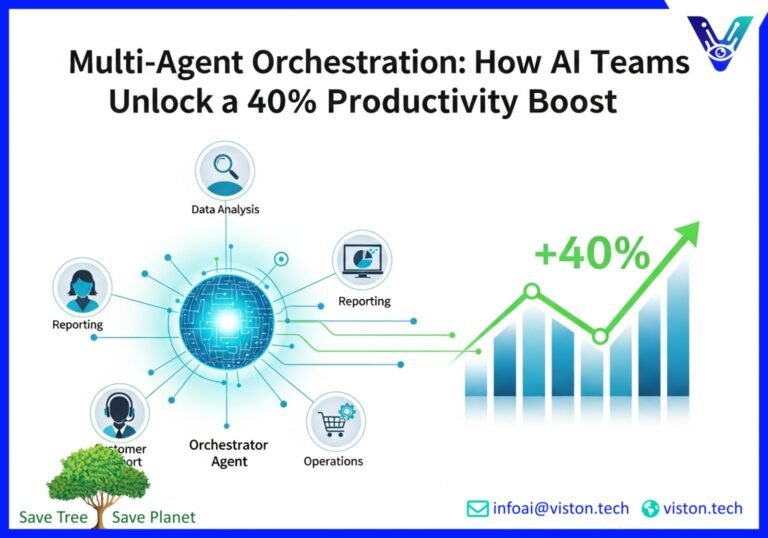
Multi-Agent Orchestration: Why Coordinated AI Teams Beat Single Agents
The world of Artificial Intelligence is experiencing a seismic shift. While single, monolithic AI models have dominated the conversation, a new, more powerful paradigm is emerging: Multi-Agent Orchestration. Businesses are rapidly discovering that complex challenges are best solved not by a single “genius” AI, but by a coordinated team of specialized AI agents working in concert. The proof is in the numbers: enterprises are reporting a staggering 1,445% surge in multi-agent inquiries from the first quarter of 2024 to the second quarter of 2025. Early adopters are already reaping the rewards, with some achieving as much as a 40% increase in productivity.
This isn’t just an incremental improvement; it’s a fundamental change in how we architect and deploy AI. If you’re still thinking about AI in terms of a single, all-powerful model, you’re already falling behind. This post will break down what multi-agent orchestration is, why it’s a game-changer, and how you can start implementing it in your organization.
Think Microservices, But for AI
For those familiar with modern software development, the concept of multi-agent systems will feel intuitive. Think of it like the shift from monolithic applications to microservices. A decade ago, developers built large, all-in-one applications. This made them difficult to update, scale, and maintain. The solution was to break down the application into smaller, independent services that communicate with each other. This is precisely the principle behind multi-agent orchestration.
Instead of relying on one massive, generalist Large Language Model (LLM) to handle every task, a multi-agent system deploys a team of specialized agents. Each agent is an expert in its domain, equipped with the specific tools, data, and context it needs to excel. This approach offers numerous advantages:
- Enhanced Specialization: Each agent can be fine-tuned for a specific task, leading to greater accuracy and efficiency.
- Increased Capabilities: By dividing complex problems, AI teams can tackle challenges far beyond the scope of a single agent.
- Scalability: It’s easy to add new agents to the team as your needs evolve, without disrupting the entire system.
- Resilience: If one agent fails, the others can continue to function, making the entire system more robust.
The Architecture of Collaboration: How It Works
At the heart of a multi-agent system is the orchestrator. This central agent acts as a project manager or a conductor, coordinating the efforts of the specialized agents. It receives an initial request, breaks it down into sub-tasks, and delegates those tasks to the appropriate agents. The orchestrator ensures that information flows smoothly between agents and that everyone is working towards the same goal.
Imagine a user asks for a comprehensive report on market trends for a new product. Here’s how a multi-agent system would handle it:
- The Orchestrator Agent receives the request and breaks it down into several tasks: data collection, sentiment analysis, competitor analysis, and report generation.
- It then assigns these tasks to specialized agents: a Data-Mining Agent scours the web and internal databases for relevant information, a Sentiment Analysis Agent gauges public opinion on social media, a Competitor Analysis Agent investigates what rivals are doing, and a Reporting Agent compiles all the findings into a coherent document.
- Each agent works in parallel, sharing its findings with the orchestrator, which then synthesizes the information for the final report.
This distributed intelligence approach is not only more efficient but also leads to a more comprehensive and accurate result than a single agent could produce on its own.
Real-World Use Cases: Transforming Industries
The practical applications of multi-agent orchestration are vast and are already making a significant impact across various sectors. Let’s explore a few examples:
1. Sales and Marketing Automation
A multi-agent system can revolutionize the sales pipeline. A Lead Generation Agent can identify potential customers, a Personalization Agent can tailor marketing messages to individual prospects, and a CRM Agent can keep all customer information up-to-date. This coordinated effort leads to more effective outreach and higher conversion rates.
2. Hyper-Personalized Customer Support
In customer support, a Triage Agent can initially assess a customer’s issue and route it to the appropriate specialized agent. This could be a Technical Support Agent for troubleshooting, a Billing Agent for payment inquiries, or a Product Specialist Agent for detailed questions. This ensures that customers get to the right expert quickly, dramatically improving satisfaction.
3. Streamlined Financial Operations
In finance, multi-agent systems can automate complex processes like financial reporting and fraud detection. An Invoice Processing Agent can handle accounts payable, a Financial Analysis Agent can generate quarterly reports, and a Fraud Detection Agent can monitor transactions in real-time for suspicious activity, all communicating seamlessly.
4. Intelligent Supply Chain Management
Perhaps one of the most powerful applications is in supply chain management. An Inventory Management Agent can track stock levels, a Demand Forecasting Agent can predict future needs, and a Logistics Agent can optimize shipping routes. This interconnected system can anticipate disruptions and automatically adjust to keep the supply chain running smoothly.
Coordination Patterns: The Playbook for AI Teamwork
Effective multi-agent systems rely on well-defined coordination patterns. These are the established strategies for how agents interact and collaborate. Some of the most common patterns include:
- Supervisor-Worker: A central “supervisor” agent delegates tasks to “worker” agents and synthesizes their results. This is a common and straightforward pattern.
- Peer-to-Peer: Agents communicate and collaborate directly with each other without a central orchestrator. This allows for more dynamic and flexible interactions.
- Blackboard System: Agents share information by writing to a common, shared space (the “blackboard”). This is useful when multiple agents need to contribute to a shared understanding of a problem.
- Sequential Pipeline: Tasks are passed from one agent to the next in a predefined sequence, with each agent adding its specialized contribution.
The choice of coordination pattern depends on the specific use case and the complexity of the task. For more insights into how these patterns are being implemented, you can explore resources from industry leaders like Anthropic’s research on multi-agent systems and Microsoft’s approach to AI agent orchestration.
Your Implementation Roadmap: Getting Started with Multi-Agent Systems
Adopting a multi-agent approach doesn’t have to be an overwhelming endeavor. Here’s a simple, four-week roadmap to get you started:
Week 1: Identify and Prioritize. Start by identifying a critical workflow in your organization that is complex and involves multiple steps or data sources. This is a prime candidate for a multi-agent solution. Begin with a small team of 2-3 specialized agents to tackle this workflow.
Week 2: Design and Develop. Define the roles and responsibilities of each agent. Develop the prompts and logic that will guide their behavior. Establish clear communication protocols between the agents and the orchestrator. Consider using frameworks like LangChain or AutoGen to accelerate development.
Week 3: Integrate and Test. Connect your agents to the necessary tools and data sources. Implement robust monitoring and error-handling to ensure the system is production-ready. Thoroughly test the system in a controlled environment to identify and resolve any issues.
Week 4: Deploy and Optimize. Deploy your multi-agent system and closely monitor its performance. Gather feedback from users and stakeholders to identify areas for improvement. Continuously optimize your agents and their coordination to maximize efficiency and effectiveness.
As you scale, remember to focus on a solid governance framework to ensure your AI systems are transparent, accountable, and aligned with your business objectives. To dive deeper into the technical aspects, Google’s Agent Development Kit offers valuable resources for building multi-agent applications.
The Future is Collaborative
The era of the solitary AI genius is over. The future of artificial intelligence in the enterprise is collaborative, distributed, and orchestrated. Multi-agent systems offer a path to solving more complex problems, achieving greater efficiency, and unlocking unprecedented levels of productivity. The companies that embrace this new paradigm will be the leaders of tomorrow.
Don’t let your organization get left behind. The surge in interest and the impressive productivity gains being reported are clear indicators that this is not a trend to be ignored. It’s time to start thinking about how a team of coordinated AI agents can transform your business.
Ready to build your AI team?
Contact Viston AI today to learn how our AI-powered solutions can help you harness the power of multi-agent orchestration and drive real business results.
Frequently Asked Questions (FAQs)
1. What is the main difference between a single AI agent and a multi-agent system?
A single AI agent is a monolithic model designed to handle a wide range of tasks, often leading to generalized and sometimes suboptimal results. A multi-agent system, on the other hand, is a collection of specialized AI agents that collaborate to solve complex problems, with each agent focusing on a specific sub-task, resulting in higher accuracy and efficiency.
2. What is an orchestrator agent?
An orchestrator agent acts as the “manager” of a multi-agent system. It receives a high-level goal, breaks it down into smaller, manageable tasks, and delegates these tasks to the appropriate specialized agents. It also facilitates communication and coordination among the agents.
3. Are multi-agent systems more expensive to implement?
While the initial setup of a multi-agent system may seem more complex, it can be more cost-effective in the long run. By using smaller, specialized models for specific tasks, you can often reduce the computational resources and token consumption associated with running a single, massive model for everything. Furthermore, the productivity gains can lead to a significant return on investment.
4. What are some of the challenges of implementing multi-agent systems?
The primary challenges include designing effective communication protocols between agents, ensuring seamless coordination, and managing the increased complexity of the system. However, with modern frameworks and well-defined orchestration patterns, these challenges are becoming increasingly manageable.
5. How does distributed intelligence relate to multi-agent systems?
Distributed intelligence is a core concept of multi-agent systems. It refers to the idea that the “intelligence” of the system is not centralized in a single entity but is distributed across multiple autonomous agents. This allows for parallel processing, greater resilience, and the ability to solve more complex problems.
6. Can LLMs be used in multi-agent systems?
Absolutely. Large Language Models (LLMs) are often the foundation of the individual agents within a multi-agent system. Each agent can be powered by an LLM that has been specifically prompted or fine-tuned for its specialized role.
7. How do I know if my business needs a multi-agent system?
If your business processes involve complex workflows with multiple steps, require the integration of various data sources and tools, or could benefit from the automation of collaborative tasks, then a multi-agent system is likely a good fit. If a single AI agent struggles with the complexity or accuracy of a task, it’s a strong indicator that a multi-agent approach is needed.
8. What is the role of workflow coordination in multi-agent orchestration?
Workflow coordination is the essence of multi-agent orchestration. It is the process of managing the sequence of tasks, the flow of information, and the interactions between agents to ensure that the overall workflow is executed efficiently and correctly. The orchestrator agent is primarily responsible for this coordination.
#MultiAgentSystems #AgentOrchestration #DistributedIntelligence #WorkflowCoordination #LLMs #AI #ArtificialIntelligence #FutureOfWork #Productivity
