
“`html
Low-Code/No-Code AI Automation: Democratizing Intelligent Workflow Development
The Rise of a New Era in Enterprise Application Development
In today’s fast-paced digital landscape, the demand for custom applications and automated workflows is skyrocketing. Businesses are under immense pressure to innovate faster, streamline operations, and deliver exceptional customer experiences. However, a persistent shortage of skilled developers has created a significant bottleneck. This is where low-code/no-code (LCNC) platforms are stepping in, not just as a temporary fix, but as a fundamental shift in how we approach software development. By 2025, a staggering 50–70% of new enterprise applications are expected to be built on these revolutionary platforms. This isn’t just a trend; it’s the future of business process automation.
The core idea behind low-code/no-code is simple yet powerful: empower more people to build and automate. These platforms provide intuitive, drag-and-drop interfaces and pre-built templates that allow users with little to no coding experience to create sophisticated applications and workflows. Now, with the integration of Artificial Intelligence (AI), LCNC is evolving into something even more transformative: Low-Code/No-Code AI Automation. This powerful combination is at the heart of the hyperautomation movement, a disciplined, business-driven approach to rapidly identify, vet, and automate as many business and IT processes as possible.
Market Trends: The Unstoppable Growth of LCNC and AI
The statistics speak for themselves. The low-code development technologies market is projected to reach incredible new heights, driven by several key factors:
- Addressing the Developer Shortage: The demand for software developers far outstrips the supply. LCNC platforms bridge this gap by enabling a new wave of “citizen developers” to build the solutions they need.
- Fueling Hyperautomation: Businesses are no longer just automating simple, repetitive tasks. They are looking to automate complex, end-to-end processes. AI-powered LCNC is the engine driving this hyperautomation trend, enabling intelligent decision-making, data analysis, and predictive insights within automated workflows.
- The Rise of the Citizen Developer: By 2026, it’s projected that a remarkable 80% of LCNC users will be non-IT professionals. This democratization of development is empowering employees across all departments to become agents of innovation.
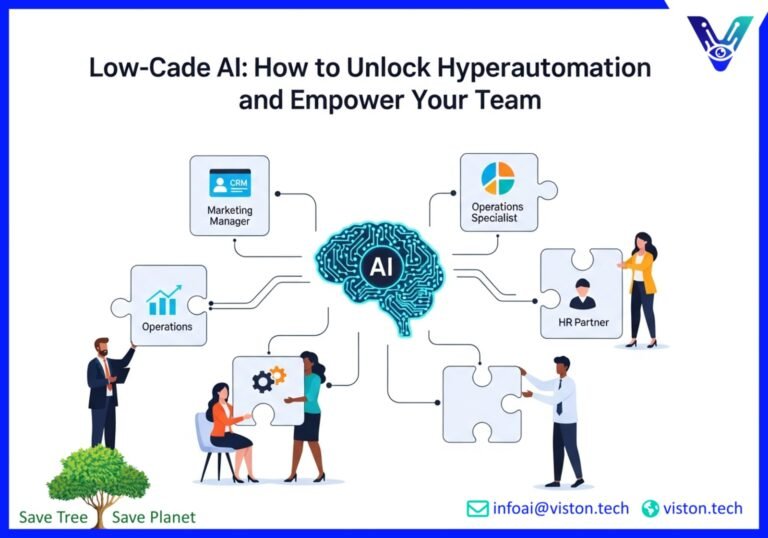
Meet the Citizen Developers: Personas of the New Innovators
The term “citizen developer” refers to a user who creates new business applications for consumption by others using development and runtime environments sanctioned by corporate IT. They are not professional developers, but they have a deep understanding of their business needs and processes. Here are a few common personas:
- The Marketing Maestro: Sarah, a marketing manager, needs to automate lead nurturing campaigns. Instead of waiting for the IT department, she uses a no-code platform to build a workflow that automatically segments leads based on their behavior, sends personalized emails, and scores them for sales-readiness. She integrates her CRM, email marketing tool, and social media platforms with just a few clicks.
- The Operations Optimizer: John, an operations specialist in a manufacturing company, wants to streamline the inventory management process. He uses a low-code platform to create an application that tracks inventory levels in real-time, automatically generates purchase orders when stock is low, and notifies the warehouse team. This reduces manual errors and prevents stockouts.
- The HR Hero: Maria, an HR business partner, is tasked with improving the employee onboarding experience. She leverages a no-code platform to build an automated onboarding workflow. New hires automatically receive welcome emails, are enrolled in training programs, and have their access to various systems provisioned, all without manual intervention from the IT team.
Enterprise Case Studies: LCNC AI Automation in Action
The theoretical benefits of low-code AI automation are compelling, but its real-world impact is even more impressive. Here are a few examples of how enterprises are leveraging these platforms to drive significant business outcomes:
1. A Financial Services Giant Automates Loan Processing
A leading bank was struggling with a slow and error-prone manual loan application process. By implementing a low-code AI automation platform, they were able to build a new workflow in a matter of weeks. The new system uses AI-powered optical character recognition (OCR) to extract data from application documents, a machine learning model to assess credit risk, and automated communication to keep applicants informed of their status. The result? A 70% reduction in loan processing time and a significant improvement in customer satisfaction.
2. A Retail Behemoth Personalizes the Customer Experience
A large retail company wanted to deliver more personalized marketing campaigns to its millions of customers. Using a no-code platform with built-in AI capabilities, their marketing team created a system that analyzes customer purchase history, browsing behavior, and demographic data. This system then automatically generates personalized product recommendations and targeted promotions, leading to a 15% increase in online sales and a more engaged customer base.
3. A Healthcare Provider Streamlines Patient Intake
A major hospital network needed to improve the efficiency of its patient intake process. They used a low-code platform to develop a mobile application that allows patients to pre-register and submit their medical history and insurance information before their appointment. The application uses AI to validate the data and flag any potential issues for the administrative staff. This has led to a 50% reduction in patient wait times and a more streamlined experience for both patients and staff.
Choosing the Right Platform: A Comparison of Leading LCNC Tools
With a growing number of low-code/no-code platforms on the market, choosing the right one for your organization can be challenging. Here’s a brief comparison of some of the most popular options, with a focus on their AI capabilities:
Microsoft Power Automate
- Best for: Enterprises already invested in the Microsoft ecosystem (Office 365, Azure, Dynamics 365).
- AI Capabilities: Power Automate boasts a robust suite of AI features through AI Builder. This includes capabilities like sentiment analysis, object detection, text recognition (OCR), and predictive models. Its deep integration with Azure AI services further extends its power.
- Ease of Use: It offers a user-friendly interface for both simple and complex workflows.
Make (formerly Integromat)
- Best for: Visually-minded users who prefer a more graphical and flexible workflow builder.
- AI Capabilities: Make allows for easy integration with various third-party AI services like OpenAI (for generative AI), Google Cloud AI, and others. This provides a high degree of flexibility in incorporating advanced AI functionalities into workflows.
- Ease of Use: Its visual “scenario” builder is intuitive and powerful, but can have a slightly steeper learning curve for very complex automations compared to some competitors.
Zapier
- Best for: Small to medium-sized businesses and users who need to connect a vast array of web applications quickly and easily.
- AI Capabilities: Zapier has been actively integrating AI features, including AI-powered steps that can format text, summarize content, and generate responses. It also offers seamless integrations with leading AI platforms like OpenAI, allowing users to easily incorporate generative AI into their “Zaps.”
- Ease of Use: Zapier is renowned for its simplicity and ease of use, making it an excellent entry point for no-code automation. For more information, you can explore the Zapier AI Automation Integrations page.
n8n
- Best for: Technical users and businesses looking for a self-hosted, open-source, and highly customizable solution.
- AI Capabilities: n8n’s open-source nature allows for deep customization and the ability to integrate with virtually any AI API. It offers pre-built nodes for popular AI services and the flexibility to create custom nodes for proprietary models.
– Ease of Use: While more powerful and flexible, n8n generally requires a bit more technical know-how compared to Zapier or Make. You can learn more about its capabilities at the official n8n website.
The Importance of a Robust Governance Model
The democratization of development is a powerful force for innovation, but it also introduces new risks. Without proper oversight, the proliferation of citizen-developed applications can lead to data security issues, compliance breaches, and a lack of consistency. A strong governance model is essential to mitigate these risks while still empowering your employees. Key components of a successful LCNC governance model include:
- Establishing a Center of Excellence (CoE): A dedicated team that provides training, best practices, and support to citizen developers. The CoE is also responsible for setting standards and ensuring compliance.
- Implementing Role-Based Access Control: Not all users need access to all data and features. Implementing granular access controls ensures that employees only have the permissions they need to perform their jobs.
- Creating a Review and Approval Process: Before an application or workflow is deployed, it should be reviewed and approved by the CoE or IT department to ensure it meets security, compliance, and quality standards.
- Providing Standardized Templates and Components: Offering a library of pre-approved templates and reusable components can help ensure consistency and adherence to best practices.
Your Path to Intelligent Automation Starts Here
The convergence of low-code/no-code development and artificial intelligence is not a distant future; it’s a present reality that is reshaping industries. By embracing low-code AI automation, your organization can unlock new levels of efficiency, innovation, and agility. You can empower your employees to solve their own business problems, accelerate your digital transformation initiatives, and gain a significant competitive advantage.
The journey to hyperautomation may seem daunting, but with the right strategy and the right partners, it is well within your reach. Don’t let the developer shortage hold your business back. Embrace the power of citizen developers and low-code AI automation to build the future of your enterprise.
Ready to unlock the full potential of AI-powered automation for your business? The team at Viston AI is here to help. Contact us today to learn how our cutting-edge AI solutions can help you streamline your workflows, empower your teams, and drive unprecedented growth.
Frequently Asked Questions (FAQs)
1. What is the difference between low-code and no-code?
No-code platforms are designed for users with no technical background, offering purely drag-and-drop functionality. Low-code platforms provide a similar visual approach but also allow users with some coding knowledge to add custom code for more complex functionalities, offering greater flexibility.
2. How does AI enhance low-code/no-code platforms?
AI introduces intelligent capabilities into LCNC-built applications and workflows. This includes features like natural language processing (NLP) to understand human language, machine learning for predictive analytics, computer vision for image and video analysis, and intelligent document processing to extract data from documents.
3. Is low-code/no-code AI automation secure for enterprise use?
Yes, when implemented with a strong governance model. Leading LCNC platforms offer robust enterprise-grade security features, including role-based access control, data encryption, and audit logs. It is crucial for organizations to establish clear policies and oversight to ensure secure and compliant application development.
4. Can low-code applications scale to meet enterprise demands?
Absolutely. Modern enterprise-grade low-code platforms are built on scalable cloud architectures. They are designed to handle high volumes of users and data, making them suitable for building mission-critical applications that can grow with the business.
5. How do I get started with low-code/no-code in my organization?
Start with a small, well-defined pilot project to demonstrate value and build momentum. Identify a specific business problem that can be solved with LCNC automation. Establish a Center of Excellence (CoE) to provide guidance and support, and choose a platform that aligns with your organization’s existing technology stack and future goals.
6. Will low-code/no-code replace traditional developers?
No, LCNC is not intended to replace professional developers. Instead, it frees them up from working on routine application development and maintenance, allowing them to focus on more complex, strategic, and high-value projects that require their deep technical expertise.
7. What is hyperautomation?
Hyperautomation is a business-driven, disciplined approach that organizations use to rapidly identify, vet, and automate as many business and IT processes as possible. It involves the orchestrated use of multiple technologies, including AI, machine learning, and low-code platforms, to achieve end-to-end process automation. For a deeper dive, consider this Gartner article on hyperautomation.
8. What kind of ROI can be expected from implementing low-code AI automation?
The return on investment (ROI) can be substantial and multifaceted. It includes direct cost savings from increased efficiency and reduced development costs, as well as indirect benefits such as faster time-to-market for new products and services, improved customer satisfaction, and enhanced employee productivity and morale.
#lowcode #nocode #AIautomation #hyperautomation #citizendeveloper #digitaltransformation #VistonAI #PowerAutomate #Make #Zapier #n8n
“`
