
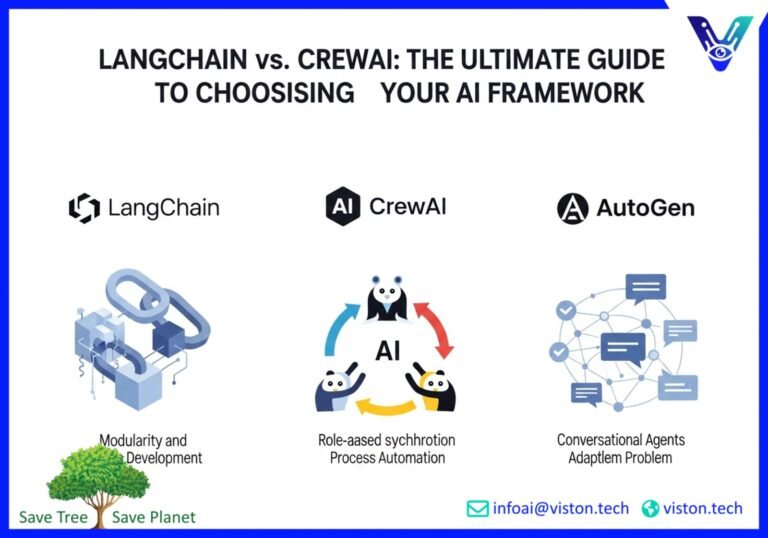
LangChain vs CrewAI vs AutoGen: Choosing the Right AI Agent Framework for Your Business
In the rapidly evolving landscape of artificial intelligence, AI agents are no longer a futuristic concept but a tangible asset for businesses. These intelligent systems are automating complex workflows, personalizing customer experiences, and driving operational efficiency. However, the key to unlocking their full potential lies in choosing the right framework. This guide provides a comprehensive comparison of three leading AI agent frameworks: LangChain, CrewAI, and AutoGen, to help you make an informed decision for your business in 2025.
The Rise of AI Agent Frameworks
Before we delve into the specifics of each framework, it’s essential to understand what AI agent frameworks are and why they are crucial. An AI agent framework provides the foundational architecture for building and deploying AI agents. These frameworks offer pre-built components and a structured approach to creating agents that can perceive their environment, make decisions, and take actions to achieve specific goals. The right framework can significantly accelerate development, improve scalability, and ensure the reliability of your AI solutions.
LangChain: The Modular Leader in LLM Applications
LangChain has established itself as a frontrunner in the AI agent framework space. It is renowned for its modularity and extensive library of integrations, making it a versatile choice for a wide range of applications.
What is LangChain?
LangChain is an open-source framework designed to simplify the creation of applications powered by large language models (LLMs). It provides a standard interface for chains, agents, and memory modules, allowing developers to build complex applications by composing these modular components. With over 100 tool integrations, LangChain enables seamless connection to various data sources, APIs, and other services.
Key Features of LangChain
- Modularity: LangChain’s component-based architecture allows for flexible and scalable application development.
- Extensive Integrations: It supports a vast ecosystem of tools and integrations, enabling connectivity to a wide array of external resources.
- LangSmith: A platform for debugging, testing, evaluating, and monitoring your LLM applications, ensuring reliability and performance.
- LangGraph: An extension of LangChain that allows for the creation of stateful, multi-agent applications with cyclical workflows.
- LangFlow: A visual, no-code interface for LangChain, making it accessible to both technical and non-technical users.
Pros and Cons of LangChain
Pros:
- Flexibility and Control: Offers deep control over the development process, making it ideal for custom and complex AI solutions.
- Vibrant Community: A large and active community provides extensive documentation, tutorials, and support.
- Versatility: Suitable for a wide range of use cases, from simple chatbots to sophisticated, multi-step agentic workflows.
Cons:
- Steep Learning Curve: The sheer number of features and the level of control can be overwhelming for beginners.
- Potential for Complexity: Building and maintaining complex chains can become challenging without proper planning and architecture.
CrewAI: Powering Role-Based Multi-Agent Collaboration
CrewAI has carved a niche for itself by focusing on simplifying the orchestration of multiple AI agents. It’s designed to facilitate seamless collaboration between agents, each with a specific role and expertise.
What is CrewAI?
CrewAI is an open-source framework for orchestrating role-playing, autonomous AI agents. It promotes collaborative intelligence, allowing agents to work together to tackle complex tasks. This role-based approach mirrors a human team, where each member contributes their specialized skills to achieve a common goal.
Key Features of CrewAI
- Role-Based Agents: Define agents with specific roles, goals, and tools to create a specialized team for any task.
- Autonomous Inter-Agent Delegation: Agents can autonomously delegate tasks to other agents, fostering a dynamic and efficient workflow.
- Flexible Task Management: Supports sequential and parallel task execution, allowing you to design workflows that fit your specific needs.
- Focus on Simplicity: Aims to provide a more intuitive and streamlined developer experience compared to more complex frameworks.
Pros and Cons of CrewAI
Pros:
- Ease of Use: Its straightforward, role-based approach makes it relatively easy for developers to get started with multi-agent systems.
- Effective for Process Automation: Ideal for automating well-defined business processes that can be broken down into distinct roles and tasks.
- Collaborative Intelligence: The framework’s design inherently promotes effective collaboration between AI agents.
Cons:
- Less Mature Ecosystem: Being a newer framework, its community and the number of available tools are not as extensive as LangChain’s.
- Potential for Rigidity: The role-based structure, while simplifying development, can be less flexible for highly dynamic or unpredictable tasks.
AutoGen: The Microsoft-Backed Multi-Agent Conversation Framework
AutoGen, developed by Microsoft, is a powerful framework for building multi-agent applications. It is particularly favored in environments where integration with the Microsoft ecosystem is a key consideration.
What is AutoGen?
AutoGen is a framework that enables the development of LLM applications using multiple agents that can converse with each other to solve tasks. It simplifies the orchestration, automation, and optimization of complex LLM workflows. AutoGen’s conversational approach to agent interaction allows for more natural and flexible problem-solving.
Key Features of AutoGen
- Conversational Agents: Agents interact through conversation, allowing for dynamic and adaptive task execution.
- Customizable and Conversable Agents: Offers a collection of customizable agents that can be tailored to specific needs and can seamlessly integrate human feedback.
- Microsoft Ecosystem Integration: Benefits from strong ties to Microsoft’s suite of tools and services, including Azure AI.
- Multi-Agent Collaboration: Designed to facilitate complex workflows by enabling multiple agents to work together.
Pros and Cons of AutoGen
Pros:
- Strong for Research and Complex Problem-Solving: Its conversational and flexible nature makes it well-suited for research and development and for tackling complex, open-ended problems.
- Microsoft Support: Backed by Microsoft, it benefits from the resources and stability of a major tech company.
- Human-in-the-Loop: Easily allows for human participation in the agent conversation, providing oversight and guidance.
Cons:
- Higher Barrier to Entry: The conceptual model of conversational agents can be more abstract and challenging to grasp for newcomers.
- Can Be Overkill for Simple Tasks: For straightforward, linear workflows, the complexity of AutoGen might be unnecessary.
Comparison Table: LangChain vs. CrewAI vs. AutoGen
| Feature | LangChain | CrewAI | AutoGen |
|---|---|---|---|
| Core Concept | Modular components for building LLM applications. | Role-based, collaborative multi-agent orchestration. | Conversational multi-agent framework. |
| Best For | A wide range of applications requiring flexibility and extensive integrations. | Automating structured business processes with specialized agent roles. | Complex problem-solving and research with dynamic agent conversations. |
| Learning Curve | Moderate to high. | Low to moderate. | Moderate to high. |
| Ecosystem | Vast and mature, with a large community and numerous integrations. | Growing, with a focus on ease of use and process automation. | Strong, with the backing of Microsoft and integration with its ecosystem. |
Code-Level Patterns: A Glimpse into Development
While this post is for a non-technical audience, a brief look at the code-level patterns can provide a clearer understanding of how these frameworks differ in practice.
LangChain development often involves creating “chains” of LLM calls and other components. This can be done programmatically, providing a high degree of control over the workflow. For those who prefer a more visual approach, LangFlow offers a drag-and-drop interface to build these chains.
CrewAI simplifies the process by focusing on defining agents and their tasks. Developers create a `Crew` and assign `Agents` with specific roles and `Tasks`. This high-level abstraction makes the code more readable and easier to manage for multi-agent systems.
AutoGen‘s code involves setting up a “conversation” between agents. You define the agents and a “user proxy” that can initiate the conversation and inject human feedback. The interaction between agents is more fluid and less explicitly defined than in the other frameworks.
Recommended Stack by Use Case
Choosing the right framework and tools depends heavily on your specific needs. Here are some recommended stacks for common business use cases:
For Startups and Rapid Prototyping:
- Framework: CrewAI
- Why: Its simplicity and focus on process automation allow for quick development and iteration of AI-powered workflows. It’s an excellent choice for building a minimum viable product (MVP) and validating ideas.
For Enterprise-Level, Complex Applications:
- Framework: LangChain with LangGraph
- Why: LangChain’s modularity, extensive integrations, and the ability to create stateful, multi-agent systems with LangGraph make it the ideal choice for building robust, scalable, and highly customized enterprise-grade solutions.
For Research and Development in the Microsoft Ecosystem:
- Framework: AutoGen
- Why: AutoGen’s conversational approach and strong integration with Microsoft’s tools and services make it the preferred framework for research and development teams that are already invested in the Microsoft ecosystem.
For Teams with Varying Technical Expertise:
- Framework: LangChain with LangFlow
- Why: The combination of LangChain’s powerful backend and LangFlow’s user-friendly visual interface empowers both developers and non-developers to contribute to the creation of AI agents. To learn more about how to get started with no-code AI agent development, check out this insightful video tutorial on LangFlow.
The Future of AI Agent Frameworks
The field of AI agent frameworks is continuously evolving. As we look towards the future, we can expect to see even more powerful and user-friendly tools that will further democratize the development of AI agents. The trend is moving towards more autonomous, collaborative, and specialized agents that can tackle increasingly complex tasks. For a deeper dive into the technical aspects of CrewAI, their official documentation is an excellent resource.
Conclusion: Making the Right Choice for Your Business
The decision between LangChain, CrewAI, and AutoGen is not about which framework is definitively “the best,” but which is the best fit for your specific business needs, technical capabilities, and long-term goals.
- Choose LangChain if you need a versatile, modular, and highly customizable framework with a vast ecosystem of integrations.
- Choose CrewAI if you want to quickly automate well-defined business processes with a team of specialized AI agents.
- Choose AutoGen if your focus is on complex problem-solving and you operate within the Microsoft ecosystem.
As you embark on your AI agent journey, remember that the right framework is the one that empowers you to build effective, scalable, and reliable AI solutions that drive real business value.
Ready to harness the power of AI agents for your business? The world of AI-powered solutions can be complex, but you don’t have to navigate it alone. Contact Viston AI today to discover how our expertise in AI agent development can help you build the perfect solution to meet your unique business challenges.
Frequently Asked Questions (FAQs)
1. What is the main difference between LangChain and CrewAI?
The primary difference lies in their approach to building AI applications. LangChain is a highly modular and flexible framework that provides the building blocks for a wide range of LLM applications. CrewAI, on the other hand, is more specialized, focusing on orchestrating multiple, role-based AI agents to collaborate on tasks.
2. Is AutoGen a good choice for a small business?
AutoGen can be a powerful tool for any size of business, but its complexity might be more than what a small business with limited resources needs for simpler tasks. For smaller businesses looking to automate straightforward processes, CrewAI might be a more accessible starting point.
3. Can I use LangChain and CrewAI together?
Yes, it’s possible to integrate these frameworks. For instance, you could use LangChain to build a powerful tool that a CrewAI agent can then utilize to perform its tasks. However, it’s essential to carefully consider the complexity of such an integration.
4. Do I need to be a programmer to use these frameworks?
While the core frameworks (LangChain, CrewAI, and AutoGen) are code-based and require programming knowledge, tools like LangFlow provide a no-code, visual interface for LangChain. This makes it possible for non-programmers to build AI agents, although a basic understanding of AI concepts is still beneficial.
5. How do these frameworks handle data privacy and security?
All three frameworks are open-source, which means the responsibility for data privacy and security largely falls on the developer implementing them. It’s crucial to follow best practices for secure coding and data handling, especially when connecting agents to sensitive internal data sources. When using cloud-based LLMs through these frameworks, you should also be aware of the data privacy policies of the LLM provider.
6. What are the costs associated with using these AI agent frameworks?
The frameworks themselves (LangChain, CrewAI, AutoGen) are open-source and free to use. However, you will incur costs for the underlying LLMs (e.g., from OpenAI, Anthropic, or Google) that power your agents. These costs are typically based on the number of tokens processed. Additionally, there may be costs associated with hosting your AI applications and any other paid services or APIs you integrate.
7. What is LangGraph and how does it relate to LangChain?
LangGraph is an extension of the LangChain ecosystem that allows developers to build more complex, stateful multi-agent applications. While LangChain’s core abstraction is the “chain” (a linear sequence of calls), LangGraph introduces the concept of a “graph,” which enables cyclical workflows. This is particularly useful for creating more sophisticated agentic systems where agents need to loop, make decisions, and interact in more dynamic ways.
8. Can I switch between these frameworks if my needs change?
While it is technically possible to switch frameworks, it would likely require a significant rewrite of your application’s logic. Each framework has its own unique architecture and way of defining agents and their interactions. Therefore, it’s advisable to carefully consider your long-term needs and choose the framework that best aligns with your strategic goals from the outset.
