
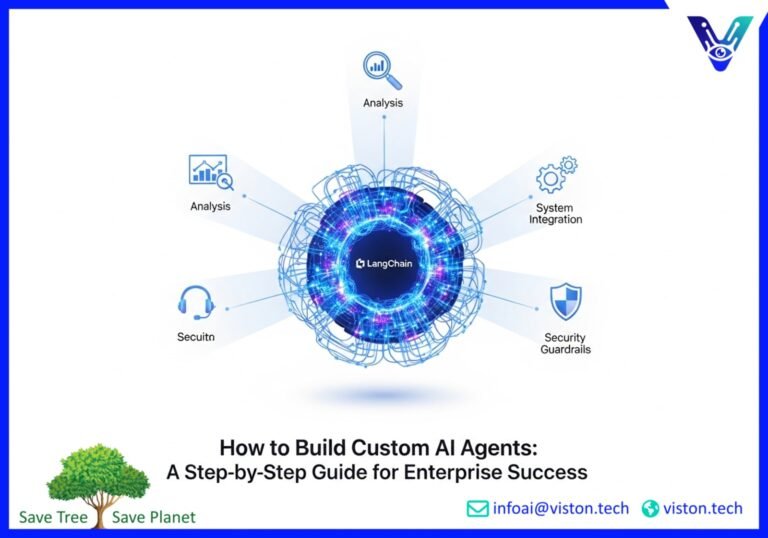
Building Custom AI Agents: A Step-by-Step Tutorial
The era of AI is no longer on the horizon; it’s here, transforming enterprises from the ground up. Businesses are moving beyond simple automation to deploy intelligent, autonomous systems that can reason, plan, and act. These are not your average chatbots. We’re talking about sophisticated AI agents capable of executing complex, multi-step tasks that drive real business value. The best part? Modern API and workflow patterns make enterprise-grade agent orchestration feasible without costly, from-scratch R&D.
This tutorial will guide you through the essential steps to build AI agents that are robust, reliable, and ready for the enterprise landscape of 2025. We will explore how to design their goals, integrate powerful tools, establish critical reasoning and guardrails, and finally, deploy and monitor them for success. Forget the hype and complex theory; this is a practical guide to creating AI agents that deliver tangible results.
The Power of Custom AI Agents in the Enterprise
So, why is there so much excitement around custom AI agents? Unlike traditional software that follows a rigid, predefined script, AI agents are dynamic. They can perceive their digital environment, make decisions, and take actions to achieve specific goals. Think of them as autonomous digital employees who can handle everything from customer service inquiries to complex data analysis and supply chain optimization.
For C-suite executives and IT leaders, this translates to tangible benefits:
- Increased Efficiency: Automate complex processes and free up human teams to focus on strategic initiatives.
- Enhanced Customer Experience: Provide 24/7, personalized support and resolve issues proactively.
- Improved Accuracy: Reduce human error in data-driven tasks and decision-making.
- Scalability: Effortlessly scale operations to meet fluctuating demand without a proportional increase in headcount.
A Modern Approach: No From-Scratch R&D Needed
One of the biggest misconceptions about building AI agents is the belief that it requires a massive, in-house research and development team. Today, that’s simply not the case. The maturation of AI frameworks and the proliferation of APIs have democratized the development of sophisticated AI. Modern tools and platforms provide the building blocks, allowing enterprises to focus on customization and integration rather than reinventing the wheel.
Frameworks like LangChain have emerged as powerful tools for developers, simplifying the creation of applications powered by large language models (LLMs). LangChain provides a modular framework for chaining together different components, making it easier to build complex agentic workflows. This approach, centered on orchestration, allows you to leverage the power of pre-existing models and services, drastically reducing development time and cost.
Step 1: Goal Design – Charting Your Agent’s Course
Before writing a single line of code, the most critical step is defining what you want your AI agent to accomplish. A well-defined goal is the North Star that will guide every subsequent decision in the development process.
Defining Clear Objectives
Start by asking fundamental questions. What specific problem will this agent solve? What tasks will it perform? Vague goals lead to ineffective agents. Be as specific as possible. For example, instead of “improve customer service,” a clearer objective would be “autonomously handle 80% of incoming customer queries related to order status and returns.”
Consider the agent’s role within your existing workflows. Will it be a research assistant for your marketing team, a code review agent for your developers, or a procurement specialist for your finance department? Each role requires a unique set of skills and objectives.
Identifying Key Performance Indicators (KPIs)
Once you have a clear objective, you need a way to measure success. Define concrete KPIs to track your agent’s performance. For a customer service agent, KPIs might include:
- Resolution rate
- Average handling time
- Customer satisfaction score (CSAT)
- Escalation rate to human agents
These metrics will be invaluable for understanding your agent’s effectiveness and identifying areas for improvement post-deployment.
Step 2: Tool Integrations – Equipping Your Agent for Success
An AI agent’s true power comes from its ability to interact with the outside world. Without integrations, an agent is just a brain in a jar, capable of thinking but not acting. Tools give your agent the “hands and feet” it needs to perform tasks in your digital environment.
Leveraging APIs and Internal Systems
APIs (Application Programming Interfaces) are the key to unlocking an agent’s potential. They allow your agent to connect to and interact with other software and data sources. Think of APIs as the universal language that enables different systems to talk to each other.
Your agent can be equipped with tools to:
- Access real-time data: Connect to weather APIs, stock market data, or internal sales dashboards.
- Interact with enterprise software: Integrate with your CRM, ERP, or project management tools to update records, create tasks, or send notifications.
- Communicate with users: Send emails, post messages in Slack, or interact with customers through a chat interface.
The Role of Frameworks like LangChain
This is where a framework like LangChain truly shines. LangChain makes it incredibly easy to “wrap” an API or any other function into a `Tool` that your agent can use. You define what the tool does in a clear, natural language description, and the agent’s underlying LLM can then intelligently decide when and how to use it. This simplifies the process of building complex agentic workflows where the agent might need to use multiple tools in a sequence to achieve its goal.
Step 3: Reasoning and Guardrails – Ensuring Reliable Performance
An autonomous agent needs more than just goals and tools; it needs a brain. The reasoning engine, typically a powerful LLM, allows the agent to plan, make decisions, and adapt to new information. However, with this power comes the need for control. Guardrails are essential for ensuring your agent operates safely, ethically, and predictably.
Implementing Logic and Decision-Making
The agent’s reasoning process involves breaking down a complex goal into a series of smaller, manageable steps. It then decides which tools to use and in what order to execute those steps. This planning capability is what differentiates a true agent from a simple automation script. For instance, if a user asks to “book a flight to New York for next Tuesday,” the agent must reason that it needs to check the user’s calendar, search for available flights, compare prices, and then potentially hold a booking.
Establishing Safety and Ethical Boundaries
Guardrails are the safety bumpers that keep your AI agent on the right track. They are a set of rules and constraints that prevent the agent from taking undesirable actions. This is a critical component for any enterprise-grade application. Key guardrails to implement include:
- Content Filters: Prevent the agent from generating inappropriate or harmful content.
- Topic Restrictions: Confine the agent’s conversations and actions to its designated purpose.
- PII Redaction: Automatically identify and remove personally identifiable information to protect user privacy.
- Human-in-the-Loop: Establish triggers for when an agent should escalate a task to a human for review or approval, especially for high-stakes decisions.
Services like Amazon Bedrock Guardrails are now offering advanced capabilities, including automated reasoning checks to mathematically validate the accuracy of an LLM’s response and prevent factual errors.
Step 4: Deploy and Monitor – Your Go-Live Checklist
Building the agent is only half the battle. A successful deployment and a robust monitoring strategy are crucial for realizing its full value and ensuring it continues to perform optimally over time.
Deployment Strategies
You have several options for deploying your AI agent, each with its own trade-offs:
- Cloud Deployment: Leveraging services from providers like AWS, Google Cloud, or Azure offers scalability, reliability, and access to powerful infrastructure without the need for on-premises hardware.
- On-Premises Deployment: For organizations with strict data sovereignty or security requirements, deploying on your own servers provides maximum control.
- Hybrid Deployment: A combination of cloud and on-premises deployment can offer the best of both worlds.
Automating the deployment process using CI/CD (Continuous Integration/Continuous Deployment) pipelines is a best practice that ensures you can release updates and improvements quickly and reliably.
Continuous Monitoring and Improvement
Once your agent is live, your work isn’t done. Continuous monitoring is essential to ensure it’s performing as expected and to identify any issues before they impact users. Key areas to monitor include:
- Performance Metrics: Track the KPIs you defined in the goal design phase in real-time.
- Cost and Latency: Monitor API usage costs and the time it takes for the agent to respond.
- Error Rates: Log and analyze any failures in the agent’s reasoning or tool usage.
- User Feedback: Implement mechanisms for users to provide feedback on the agent’s performance, which can be invaluable for iterative improvement.
Platforms like Langfuse offer open-source observability for LLM applications, providing detailed tracing and analytics to help you debug and improve your agents.
The Future is Agentic: Embracing Orchestration
As we look to 2025 and beyond, the trend is moving from single, monolithic agents to multi-agent systems. This is the core idea behind orchestration: coordinating multiple specialized agents to collaborate on complex tasks. Imagine a “team” of AI agents where one specializes in research, another in data analysis, and a third in content generation, all working together seamlessly.
This approach allows for greater modularity, scalability, and specialization. By applying proven architectural patterns, enterprises can build resilient and intelligent systems that transform fragmented AI capabilities into a collaborative, enterprise-grade ecosystem. Mastering AI agent orchestration will be the key to unlocking the next wave of intelligent automation and maintaining a competitive edge.
Conclusion: Your Partner in AI Innovation
Building custom AI agents is no longer a futuristic concept reserved for tech giants. With modern frameworks, APIs, and a clear, step-by-step methodology, it is an achievable and highly valuable endeavor for any forward-thinking enterprise. By focusing on clear goal design, strategic tool integration, robust reasoning with strong guardrails, and diligent monitoring, you can deploy powerful AI solutions that drive efficiency, enhance customer experiences, and unlock new opportunities for growth.
The journey to building effective AI agents can be complex, but you don’t have to go it alone. Ready to transform your enterprise with custom AI agents that deliver measurable ROI? Contact Viston AI today to explore how our enterprise-grade AI-powered solutions can position your organization at the forefront of digital innovation.
FAQs about Building Custom AI Agents
- What is the difference between an AI agent and a chatbot?
A chatbot typically follows a predefined, scripted workflow. An AI agent is more autonomous; it can reason, plan, and use tools to achieve a goal in a dynamic, multi-step process. - Do I need a team of AI PhDs to build a custom agent?
No. Frameworks like LangChain and low-code platforms have made agent development much more accessible. The key is a clear understanding of your business problem and access to developers who can work with APIs and modern software patterns. - What is “agentic workflow”?
An agentic workflow is a sequence of tasks performed by one or more AI agents to achieve a complex goal. It involves planning, tool use, and decision-making, moving beyond simple, single-response interactions. - How does LangChain help in building AI agents?
LangChain is an open-source framework that simplifies the development of applications powered by large language models. It provides modular components for creating chains of actions, integrating tools, and managing memory, which are the core building blocks of an AI agent. - What are “guardrails” in the context of AI agents?
Guardrails are safety measures and policies implemented to ensure an AI agent operates within desired boundaries. They can include content filters, restrictions on actions, and rules for escalating to human oversight to ensure safe and reliable performance. - How do you ensure an AI agent doesn’t “hallucinate” or provide false information?
This is a key challenge. Strategies to mitigate this include using Retrieval-Augmented Generation (RAG) to ground the agent in factual data, implementing strict guardrails, using fact-checking tools, and designing workflows that require validation before taking critical actions. - What is AI agent orchestration?
AI agent orchestration is the coordination of multiple, specialized AI agents to work together on a complex task. This allows for a more scalable and robust system, where each agent contributes its unique skills to achieve a common objective. - How can I measure the ROI of a custom AI agent?
Measure ROI by tracking the KPIs you established during the goal design phase. This could include cost savings from automation, revenue increases from improved sales processes, or efficiency gains measured in time saved.
#buildAIagents #agenticworkflows #LangChain #orchestration #EnterpriseAI #AIStrategy #DigitalTransformation #FutureOfWork
