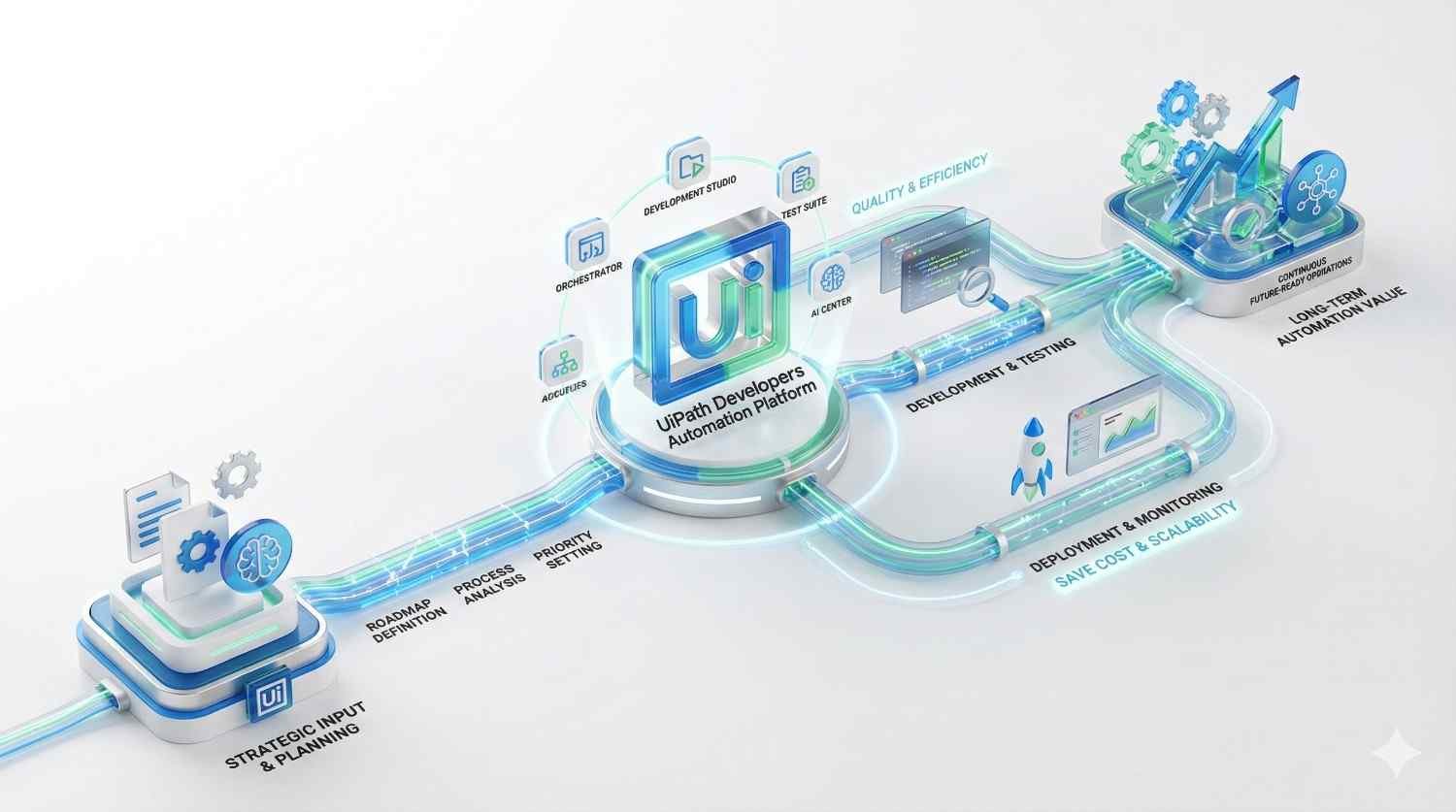
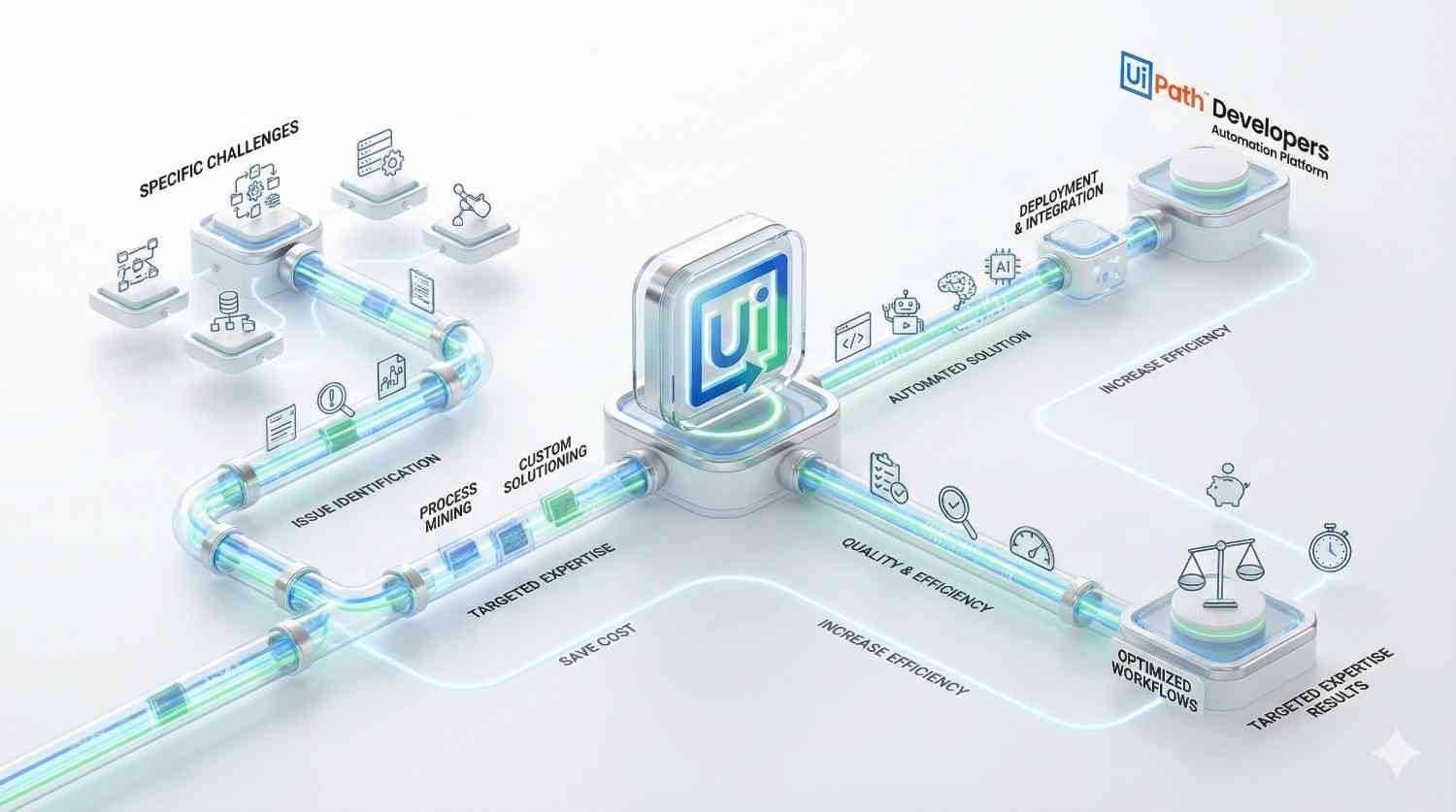
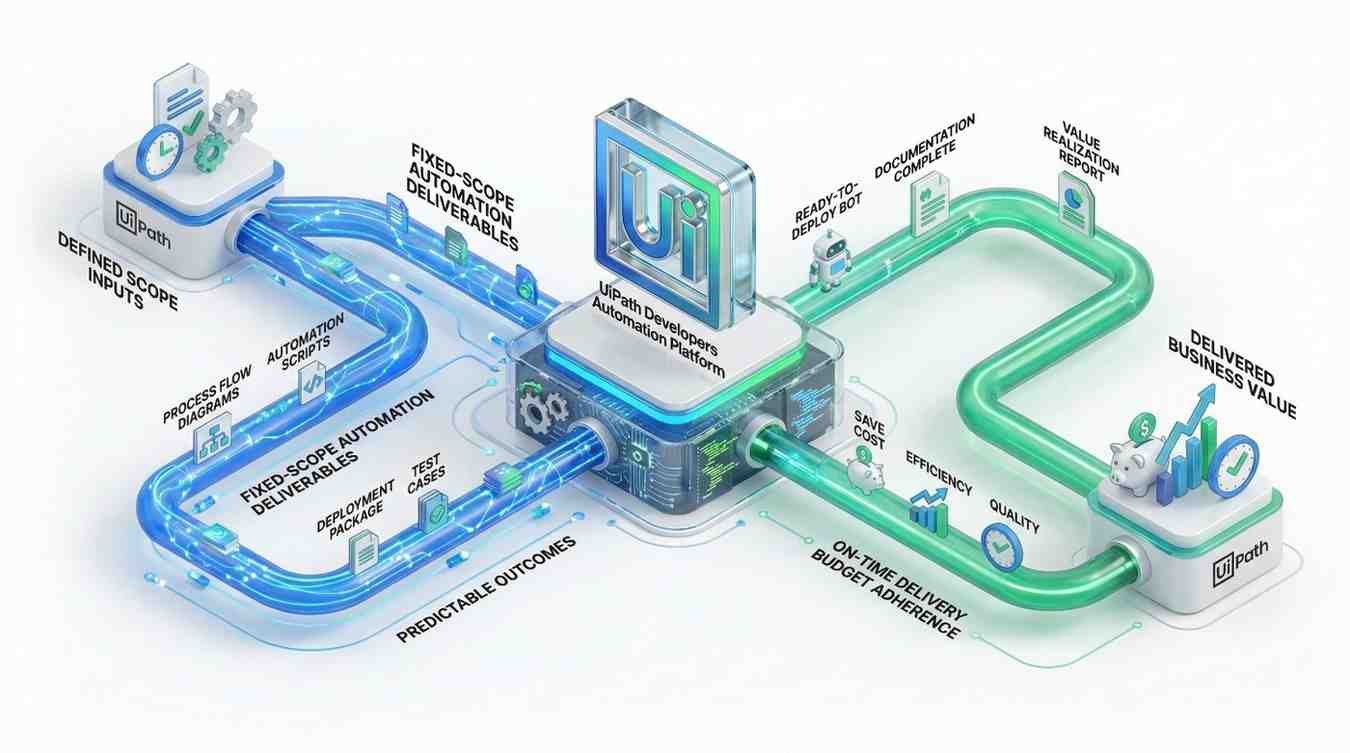
Viston delivers enterprise-grade UiPath developers who architect self-governing automation systems—from attended desktop bots to unattended cloud orchestrations with agentic decision-making. With 15+ years in AI-driven automation, 2,860+ clients across USA, UK, Germany, France, Nordics, and Australia, we deploy secure, scalable RPA solutions that integrate seamlessly into your existing infrastructure while maintaining full compliance and operational transparency.
In the era of Generative AI, standard RPA is no longer enough. To maintain a competitive edge, organizations require intelligent automation that can handle unstructured data, make decisions, and adapt to changing interfaces. When you hire UiPath developers from Viston, you gain access to engineering talent capable of building “Hybrid Automations”—workflows that seamlessly toggle between high-speed API integrations and UI interaction for legacy apps (Citrix, SAP, Mainframes).
We specialize in deploying Agentic AI, where bots don’t just follow rules; they reason. By integrating LLMOps directly into UiPath, our developers create digital workers that can read emails, interpret intent, validate compliance, and execute complex transactions without human intervention.
Time-zone aligned teams for North America, Europe, and APAC ensuring 24/7 development cycles.
Experts in UiPath AI Center, Document Understanding, and Python-based ML model invocation.
Strict adherence to SOC2, GDPR, and HIPAA standards with on-premise or cloud-air-gapped deployment options.
All automations are built using the Robotic Enterprise Framework (REFramework) to ensure error handling and transaction security.

Experience
Availability
Completed

Experience
Availability
Projects Completed

Experience
Availability
AI Agent Deployments
Background: A Midwest regional bank processed 1,200+ mortgage applications monthly through 14 separate legacy systems, requiring 47 manual data entries per application with 18% error rates causing compliance delays.
Tech Stack Used: UiPath Studio Pro, Orchestrator Enterprise, Document Understanding, SAP GUI Connector, Salesforce API, Oracle Database Activities, Autopilot AI, REFramework Architecture, Credential Vault
Challenge: Integrate data across Fiserv core banking, FICO decisioning, Salesforce CRM, county records databases, Traditional RPA failed on exception scenarios requiring judgment calls on document discrepancies.
Solution: Deployed agentic automation with Document Understanding models trained on 12,000+ historical applications. Integrated 14 systems via hybrid UI/API approach with secure credential rotation.
Results: 89% straight-through processing rate, 72% reduction in application completion time (from 11 days to 3 days), $840K annual cost savings, zero compliance violations in 18-month audit period. Exception resolution time dropped 64% through Autopilot predictive alerts.
Testimonial: “Viston’s developers built automation that actually thinks. Their agentic approach handles document variations we never anticipated, and the REFramework architecture scales beautifully across our three processing centers.” – VP of Operations, Regional Banking
Background: A multinational health insurer across Germany, France, and Netherlands manually processed 85,000+ claims monthly through disparate systems with 22-day average turnaround and 31% rejection rates due to coding errors.
Tech Stack Used: UiPath Apps, Attended Automation, Communications Mining, EPIC EMR Integration, HL7 Message Parser, Azure Cognitive Services, Multi-Language OCR, GDPR Compliance Framework
Challenge: Automate claims validation across three countries with different regulatory requirements, multiple EMR systems in German, French, and Dutch. Required GDPR-compliant processing with full data residency controls and encryption.
Solution: Built multi-tenant Orchestrator architecture with country-specific processing rules and language models. Created attended automation workflows supporting claims adjusters with real-time coding suggestions and regulatory checks.
Results: 68% reduction in claims processing time, €2.1M annual operational savings, 100% GDPR audit compliance. Adjuster productivity increased 3.4x with AI-assisted workflows.
Testimonial:Viston’s team understood our data sovereignty requirements better than our internal IT.” – Chief Digital Officer, European Health Insurance
Background: A national logistics operator handled 450+ daily shipment exceptions requiring coordination across warehouses, carriers, customs brokers, and customers through phone calls and email chains.
Tech Stack Used: UiPath Action Center, Triggered Automation, Twilio SMS Integration, Computer Vision OCR, Mobile Device Management, Australian Privacy Principles Compliance
Challenge: Create intelligent exception routing system that could interpret unstructured communications , and orchestrate multi-party workflows without human bottlenecks. Required compliance with Australian Privacy Principles for customer data handling.
Solution: Deployed Action Center with dynamic form generation based on exception type detected via Communications Mining. Integrated SMS notifications via Twilio for driver updates and customer confirmations. Created escalation logic with business rules engine determining when to involve human decision-makers versus autonomous resolution.
Results: 81% of exceptions resolved without human intervention, 4.2-hour average resolution time , 92% customer satisfaction score, AUD $1.3M annual savings. Exception backlog eliminated within 6 weeks of deployment.
Testimonial: “We went from drowning in exception emails to having an intelligent system that handles routine issues better than our senior staff. The ROI was undeniable within the first quarter.” – COO, National Logistics
UiPath Studio
Autopilot AI
Task Capture
Automate
REFramework
Unattended Automation
REST API
HTTP Activities
OAuth 2.0
Salesforce
SMTP Email
Office 365
VB.NET Expressions
Python Integration
Regular Expressions
LINQ Queries
OCR Engines
SQL Server
MySQL
Azure Data Lake
Oracle database
PostgreSQL
ML Skill
Computer Vision
Custom ML Models
Intelligent OCR
Natural Language Processing
SSL/TLS
Audit Logging
Custom ML Models
SOC 2
GDPR
MFA Integration
CI/CD Pipelines
Azure DevOps
Release Management
CI/CD Pipelines
Git Version Control
Discover the perfect balance of features and pricing to enhance your voice generation experience, offering flexible plans that cater to a range of needs and projects.
/month
/month
/month
Our developers build every production automation on Robotic Enterprise Framework—the proven design pattern for scalable, exception-resilient workflows. This ensures transactional processing with automatic retry logic, granular logging, queue-based work distribution, and graceful error handling. Unlike basic linear workflows prone to cascading failures, REFramework architectures maintain operational continuity during system outages, process 24/7 unattended operations reliably, and provide detailed audit trails meeting SOC 2 requirements.
Move beyond rigid if-then automation with developers who implement Document Understanding ML models, Communications Mining for unstructured text interpretation, and custom prediction models through ML Skill framework. This enables bots to handle document variations, interpret contextual meaning, resolve ambiguous scenarios autonomously, and learn from human feedback. Organizations achieve 80–90% straight-through processing rates on workflows previously requiring constant human intervention for exceptions.
Deploy automation within your infrastructure perimeter using on-premise Orchestrator instances with air-gapped environments for sensitive workflows. Our developers configure role-based access control, credential vaulting through Azure Key Vault or CyberArk integration, encrypted asset storage, and comprehensive audit logging. Maintain complete control over bot credentials, process data, and automation logic while meeting GDPR data residency requirements, HIPAA compliance, and industry-specific security mandates.
Overcome the brittleness of pure UI automation through intelligent API-first approaches with UI fallback strategies. Developers architect solutions attempting fast, reliable API calls before reverting to screen automation only when necessary. This dramatically improves execution speed (API calls complete in seconds versus minutes for UI navigation), reduces maintenance burden as API contracts remain stable despite UI redesigns, and enables headless execution.
Connects incoming tickets to a vector database (Pinecone) via n8n to retrieve internal documentation context. The workflow passes this context to an LLM (OpenAI/Claude) to generate a technical response, drafts it in the helpdesk, and alerts a human for final approval.
Uses webhooks to listen for changes in Salesforce. The n8n workflow transforms the payload using custom JavaScript to match the ERP schema, handles complex nested JSON arrays, and updates the SAP/NetSuite database, ensuring inventory counts match sales commitments instantly.
Scheduled n8n cron jobs pull audit logs from 15+ distinct SaaS tools. The workflow parses, normalizes, and formats the data into a standardized PDF report, encrypts the file, and uploads it to a secure cold storage bucket while notifying the DPO (Data Privacy Officer).
Ingests high-frequency MQTT streams from factory floor machinery. The n8n workflow utilizes a Python node to run a lightweight statistical deviation model. If a threshold is breached, it triggers an urgent PagerDuty alert and creates a maintenance work order in Jira.
Viston’s UiPath developers don’t build disposable bots—they architect enterprise automation platforms. Every implementation follows REFramework design patterns ensuring transactional integrity, exception resilience, and operational transparency. Our teams have deployed automation processing millions of transactions monthly with 99%+ uptime across healthcare claims adjudication, financial services reconciliation, and supply chain orchestration.
Key advantages of our approach:
UiPath developers employ hybrid integration strategies combining REST/SOAP APIs, database direct connections, and UI automation as needed. For modern cloud applications, API-first approaches using HTTP Request activities with OAuth 2.0 authentication provide fast, reliable connectivity. Legacy systems lacking APIs utilize UI automation with image recognition or SAP GUI connector activities. Credentials are secured through Orchestrator Assets and Azure Key Vault integration. Developers create reusable component libraries for common integrations like Salesforce, ServiceNow, and SAP, accelerating development while maintaining consistency. All integrations include error handling, retry logic, and logging for production reliability.
Every UiPath deployment includes role-based access control within Orchestrator, encrypted credential storage through Orchestrator Assets or Azure Key Vault, comprehensive audit logging of all bot actions, and separation of environments for development, testing, and production. Developers implement data masking for sensitive information in logs, configure SSL/TLS for all network communications, and enable multi-factor authentication for Orchestrator access. For regulated industries, we provide SOC 2, HIPAA, GDPR, and industry-specific compliance documentation. Self-hosted Orchestrator deployments keep all automation logic and process data within your infrastructure perimeter, supporting data sovereignty requirements across USA, European Union, and Australia.
Timeline varies by process complexity and integration requirements. Simple desktop automation for individual users can be production-ready in 2–3 weeks including requirements, development, testing, and deployment. Mid-complexity workflows involving 3–5 system integrations and Document Understanding typically require 6–8 weeks. Enterprise-scale implementations with REFramework architecture, multiple exception scenarios, and Orchestrator queue management span 10–14 weeks. We follow Agile methodology with bi-weekly sprint demos, allowing incremental value delivery and requirement refinement. PoC engagements demonstrating feasibility and ROI complete within 4–6 weeks. Post-deployment hypercare support continues for 4 weeks ensuring stability before transitioning to ongoing maintenance.
Most organizations achieve positive ROI within 6–9 months for mid-complexity automation. High-volume transactional processes like invoice processing, claims adjudication, or report generation often break even within 3–4 months due to immediate labor cost reduction and error elimination. Strategic automation improving customer experience or enabling new capabilities may have longer payback periods but deliver competitive advantages beyond direct cost savings. ROI factors include FTE hours saved, error reduction costs, faster processing times enabling revenue acceleration, compliance risk mitigation, and employee redeployment to higher-value work. We provide detailed ROI calculations during solution design including both tangible cost savings and intangible benefits.
Viston offers flexible maintenance models from full managed services to knowledge transfer for internal teams. Proactive monitoring through Autopilot AI alerts us to potential issues like credential expirations, API changes, or performance degradation before they impact operations. Monthly health checks review execution logs, exception rates, and system integration stability. When applications undergo UI changes or API updates, developers quickly adjust automation logic and deploy updates through CI/CD pipelines minimizing disruption. We maintain separate development and production environments allowing testing before production deployment. Documentation includes architecture diagrams, process flow documentation, and troubleshooting guides enabling smooth handoffs to internal teams if desired.
Yes, UiPath excels at integrating with custom applications through multiple approaches. For applications with APIs or web services, developers use HTTP Request activities with appropriate authentication methods. Applications exposing COM interfaces or .NET libraries integrate through Invoke Method activities. Legacy applications lacking programmatic interfaces utilize UI automation with screen scraping, though API approaches are preferred for reliability. Developers can create custom activities using C# or VB.NET for specialized integration requirements not covered by standard activities. Database-driven applications often integrate at the database layer using SQL activities for read/write operations when application-layer integration isn’t feasible.
Attended automation runs on user desktops, triggered manually or by user actions, assisting employees with repetitive tasks like data entry, form filling, or system navigation. These bots work alongside humans, pausing for input and resuming when needed—ideal for customer service, help desk, or sales processes requiring human judgment. Unattended automation runs autonomously on server infrastructure, scheduled or queue-triggered, processing high-volume transactional work 24/7 without human intervention—perfect for invoice processing, report generation, or data migration. Orchestrator manages unattended bots centrally with queue-based work distribution, while attended bots typically run standalone. Many organizations implement hybrid approaches where attended bots handle front-office tasks and unattended bots process back-office operations.
Production-grade UiPath automation includes comprehensive exception handling using REFramework’s built-in mechanisms. Business rule exceptions (data validation failures, missing information) trigger application exceptions with item-level retry and logging—these transactions move to exception queues for human review through Action Center workflows. System exceptions (application crashes, network timeouts) trigger automatic retries with exponential backoff before marking transactions as failed. Developers implement ML-based exception prediction using historical patterns, pre-emptively flagging likely failure cases. Each exception logs detailed context including screenshots, variables, and execution path for troubleshooting. Autopilot AI analyzes exception patterns suggesting process improvements and automation enhancements to reduce exception rates over time.
Financial services leverage UiPath for loan processing, KYC verification, regulatory reporting, and fraud detection across banking, insurance, and investment management. Healthcare organizations automate claims processing, patient scheduling, prior authorization, and medical records management. Manufacturing and supply chain use UiPath for order processing, inventory management, shipment tracking, and quality documentation. Retail and e-commerce automate order fulfillment, customer service, pricing updates, and inventory synchronization. Professional services including legal, accounting, and consulting automate document processing, time tracking, invoicing, and compliance reporting. Technology and telecom companies deploy UiPath for customer provisioning, billing, network management, and technical support workflows.
Every engagement includes structured knowledge transfer regardless of duration. Developers document solution architecture, process flows, exception handling logic, and system integration details using standardized templates. Code follows naming conventions and includes inline comments explaining complex logic. Weekly sync meetings review progress, discuss design decisions, and address questions from internal teams. For long-term engagements, we conduct formal training sessions on REFramework patterns, Orchestrator administration, and maintenance procedures. Recorded video walkthroughs demonstrate bot operation and troubleshooting techniques. Post-deployment, we provide 30–60 days of hypercare support including on-call assistance as internal teams gain operational confidence. Many clients transition from Viston-managed operations to hybrid support models before fully internalizing automation management.


Ready to eliminate manual bottlenecks and scale operations with intelligent automation that combines UI orchestration, API integration, and agentic reasoning? Viston’s UiPath developers architect enterprise-grade RPA solutions handling judgment-based workflows traditional automation cannot address.
With 15+ years delivering AI-driven automation across 2,860+ clients in USA, UK, Germany, France, Nordics, and Australia, we deploy secure, compliant automation meeting SOC 2, GDPR, HIPAA standards while delivering measurable ROI within months.