
#
From Pilots to “AI Factories”: Turning Agent Experiments into Scalable Production Lines
The era of isolated artificial intelligence experiments is over. For years, businesses have treated AI as a series of ad-hoc pilot programs—innovative, yet disconnected from the core operational fabric. While these early forays demonstrated potential, they often failed to deliver scalable, enterprise-wide impact. The year 2025 marks a pivotal shift in this paradigm. Leading organizations, as noted by research from institutions like MIT, are moving beyond bespoke models and embracing a far more powerful concept: the “AI factory.”
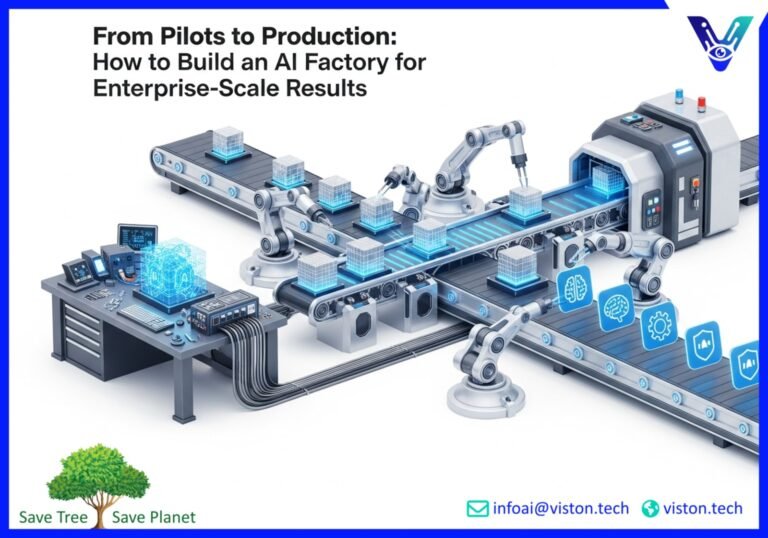
This approach industrializes AI and agent development, transforming it from a craft into a repeatable, high-volume production process. An AI factory is not a physical building but a dynamic, end-to-end system for churning out and managing AI-powered solutions. It’s about creating a production line for intelligence, enabling businesses to deploy sophisticated AI agents across various functions with speed, efficiency, and consistency. For C-suite executives, IT leaders, and AI engineers, understanding this shift is no longer optional—it’s the new competitive imperative. This transition from one-off projects to a continuous, automated assembly line of AI models is becoming a key strategic advantage.
What is an AI Factory? A New Engine for Growth
At its core, an AI factory is a standardized, centralized platform that automates the entire lifecycle of AI model development—from data ingestion and training to deployment and continuous monitoring. Think of it as a manufacturing plant for AI; raw data goes in one end, and refined, intelligent business solutions come out the other. This model is designed for efficiency, scale, and continuous improvement, allowing organizations to reliably produce high-quality AI capabilities.
The primary goal is to move away from the slow, manual, and often inconsistent processes of traditional AI development. Instead of data scientists working in silos, the AI factory provides a collaborative environment with standardized tools and repeatable pipelines. This ensures that every AI agent or model is built on a solid foundation, can be deployed quickly, and delivers measurable ROI. By 2028, it’s expected that a majority of large enterprises will operate AI factories as a core part of their infrastructure, highlighting the rapid move towards industrializing AI.
This structured approach allows businesses to tackle complex challenges like fraud detection, supply chain optimization, and personalized customer engagement at an unprecedented scale. The AI factory becomes the engine of innovation, consistently delivering intelligent solutions that drive business value.
The Journey from Idea to Product: The AI Factory Production Line
Bringing an AI agent from a concept to a fully integrated product is a multi-stage process. The AI factory streamlines this journey, providing a clear and efficient path for every project.
Stage 1: Ideation and Business Case Development
Every successful AI initiative begins with a clear business problem. In this initial phase, stakeholders from different departments collaborate to identify high-impact use cases. This isn’t just about what AI *can* do, but what it *should* do to advance strategic goals. Key activities include:
- Problem Identification: Pinpointing specific operational bottlenecks or market opportunities.
- Feasibility Analysis: Assessing data availability, technical requirements, and potential ROI.
- Goal Setting: Defining clear, measurable objectives for the AI agent.
Stage 2: The Pilot Program – A Controlled Experiment
Once a promising idea is identified, the next step is to build a pilot. This is a small-scale experiment designed to test the core assumptions of the project in a controlled environment. The pilot phase is crucial for validating the concept and demonstrating its potential value without committing significant resources. The focus here is on learning and iteration, with the understanding that not all pilots will move forward.
Stage 3: Development and Productionization
If the pilot proves successful, the project moves into the full development and productionization phase. This is where the AI factory’s repeatable pipelines come into play. Standardized workflows for data preparation, model training, and validation ensure that the AI agent is built to enterprise-grade standards. “Productionization” is the critical step of taking a model that works in a lab environment and making it robust, scalable, and reliable enough for real-world deployment.
Stage 4: Deployment and Integration
With the AI agent fully developed, it’s time for deployment. This involves integrating the model into existing business processes and IT systems. A well-designed AI factory includes automated deployment mechanisms that make this process seamless and minimize disruption. The goal is to make the AI agent a natural part of the workflow, whether it’s powering a customer-facing application or optimizing backend operations.
Stage 5: Monitoring and Continuous Improvement
The work doesn’t stop once an AI agent is deployed. The real world is dynamic, and the model’s performance must be continuously monitored to ensure it remains accurate and effective. The AI factory provides the tools to track key metrics, detect performance degradation (a concept known as “model drift”), and trigger automated retraining pipelines when necessary. This creates a continuous learning loop, ensuring that the AI agent adapts to new data and evolving business needs.
Building Your AI Factory: Essential Platform Requirements
An effective AI factory is built on a robust and scalable technology platform. This platform must provide the necessary infrastructure and tools to support the entire AI lifecycle.
Core Infrastructure Components
- High-Performance Computing: AI, especially deep learning, requires significant computational power. This means access to powerful GPUs (Graphics Processing Units) and specialized AI accelerators, whether on-premises or in the cloud.
- Scalable Storage: AI models are trained on massive datasets. The platform must offer scalable and high-throughput storage solutions that can handle petabytes of data without creating bottlenecks.
- High-Speed Networking: Fast and reliable networking is essential for moving large volumes of data between storage and compute resources, especially in distributed training scenarios.
Key Software and MLOps Capabilities
- Data Management and Governance: A centralized data platform is needed to ingest, store, and process data from various sources. Strong data governance is crucial to ensure data quality, security, and compliance.
- Repeatable Pipelines: The heart of the AI factory is the concept of repeatable pipelines. These are automated workflows that standardize the process of building, testing, and deploying AI models, ensuring consistency and reliability.
- Model Versioning and Management: A system for tracking different versions of models, data, and code is essential for reproducibility and auditing.
- Automated Deployment and Monitoring: The platform should automate the deployment of models into production and provide tools for continuous monitoring of their performance and health.
Case Vignette: A Global Retailer’s AI Factory in Action
A large, multinational retailer was struggling with inventory management. Their ad-hoc approach to demand forecasting resulted in frequent stockouts of popular items and overstocking of others, leading to lost sales and increased carrying costs. They decided to build an AI factory to industrialize their approach to predictive analytics.
Their first step was to create a centralized data platform, bringing together sales data, supply chain information, and even external data like local weather forecasts and social media trends. They then developed a standardized, repeatable pipeline for building and deploying demand forecasting models. This pipeline automated everything from data cleaning and feature engineering to model training and validation.
With the AI factory in place, they were able to quickly develop and deploy customized forecasting models for thousands of individual stores and products. The system continuously monitors the accuracy of these models and automatically retrains them as new data becomes available. The results were transformative. The retailer saw a significant reduction in stockouts, a decrease in excess inventory, and a marked improvement in overall profitability. This success story illustrates the power of moving from isolated AI projects to a systematic, factory-like approach.
Measuring Success: KPIs and Governance in the AI Factory
To ensure that an AI factory is delivering real business value, it’s essential to establish clear Key Performance Indicators (KPIs) and a robust governance framework.
Essential KPIs for AI Initiatives
- Business Impact Metrics: These KPIs measure the direct impact of AI on the bottom line. Examples include revenue uplift, cost savings, customer lifetime value, and operational efficiency gains.
- Model Performance Metrics: These are technical metrics that gauge the accuracy and reliability of the AI models. Examples include precision, recall, F1-score, and mean absolute error.
- Operational Metrics: These KPIs track the efficiency of the AI factory itself. Examples include model training time, deployment frequency, and system uptime.
The Importance of a Strong Governance Framework
AI governance is about ensuring that AI is used responsibly, ethically, and in compliance with regulations. A strong governance framework is a critical component of any AI factory. Key elements include:
- Ethical Guidelines and Bias Detection: Establishing clear principles for the ethical use of AI and implementing tools to detect and mitigate bias in models.
- Regulatory Compliance: Ensuring that all AI activities adhere to relevant data privacy and industry regulations.
- Risk Management: Identifying and mitigating potential risks associated with AI, such as security vulnerabilities and reputational damage.
- Transparency and Explainability: Making AI decision-making processes as transparent and understandable as possible to build trust with stakeholders.
A well-defined governance structure turns AI from a potential liability into a trusted and scalable business asset.
The Future is a Production Line of Intelligence
The transition from standalone AI pilots to fully functional AI factories is more than just a technological upgrade; it’s a fundamental shift in business strategy. Companies that successfully make this transition will be able to innovate faster, make smarter decisions, and create a significant competitive advantage. The future belongs to those who can build, manage, and scale intelligence effectively. The AI factory is the blueprint for that future.
Ready to build your own AI factory? The journey from experimentation to industrialization is complex, but the rewards are immense. It requires a clear vision, the right technology, and a commitment to building a culture of data-driven innovation.
Take the next step in your AI journey. Contact Viston AI today to learn how our AI-powered solutions can help you build your AI factory and turn your data into a strategic asset.
—
Frequently Asked Questions (FAQs)
1. What is the main difference between an AI pilot and an AI factory?
An AI pilot is a small-scale, often isolated experiment designed to test a specific AI concept. An AI factory, on the other hand, is an enterprise-wide platform for industrializing the development and deployment of multiple AI solutions. It focuses on creating repeatable pipelines and standardized processes to scale AI across the organization.
2. Is building an AI factory only for large enterprises?
While large enterprises have been the early adopters, the principles of the AI factory can be applied to businesses of all sizes. Cloud-based platforms and MLOps tools are making it increasingly accessible for startups and mid-sized companies to build their own scalable AI capabilities.
3. What are “repeatable pipelines” and why are they important?
Repeatable pipelines are automated workflows that standardize the steps involved in building and deploying an AI model (e.g., data ingestion, training, validation, deployment). They are crucial for ensuring consistency, reliability, and efficiency in the AI development process, allowing organizations to produce high-quality models at scale.
4. How do I measure the ROI of an AI factory?
The ROI of an AI factory can be measured through a combination of business, model, and operational KPIs. This includes tracking direct financial impacts like cost savings and revenue growth, as well as improvements in operational efficiency and customer satisfaction. It’s also important to measure the increased speed and capacity for innovation that the factory enables.
5. What are the biggest challenges in implementing an AI factory?
The main challenges include securing the necessary high-performance infrastructure, establishing robust data governance, and fostering the right skills and culture within the organization. Overcoming these hurdles requires a strategic, top-down commitment to AI industrialization.
6. How does an AI factory help with “model drift”?
Model drift occurs when an AI model’s performance degrades over time due to changes in the real-world data. An AI factory addresses this through continuous monitoring and automated retraining pipelines. When the system detects a drop in performance, it can automatically trigger a process to retrain the model on new data, ensuring it remains accurate and relevant.
7. What kind of talent is needed to run an AI factory?
Running an AI factory requires a multidisciplinary team, including data scientists, machine learning engineers, data engineers, and MLOps specialists. It also requires strong leadership with a clear vision for how AI can drive business value.
8. How can Viston AI help my company build an AI factory?
Viston AI provides cutting-edge, AI-powered solutions and expertise to help organizations at every stage of their AI journey. We can assist with developing a strategic roadmap, implementing the necessary platform infrastructure, and creating the repeatable pipelines needed to build and scale your own AI factory.
