
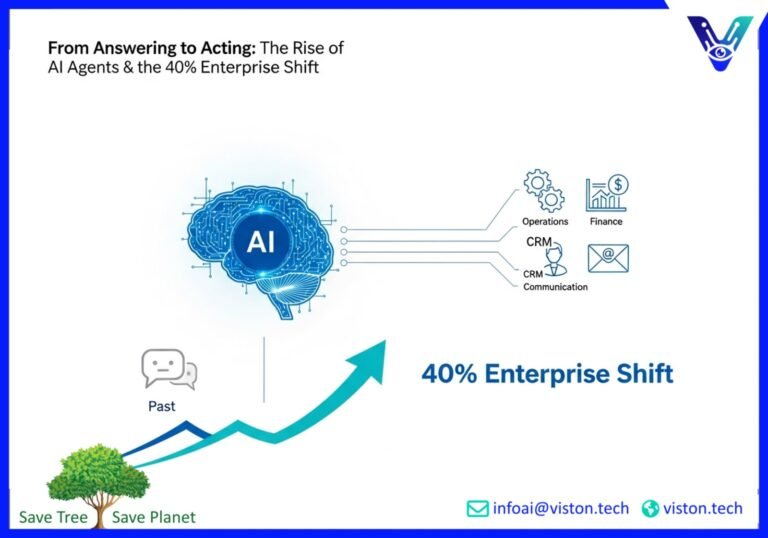
# From Chatbots to Agents: The 40% Enterprise Shift Coming in 2026
The world of enterprise technology is on the brink of a monumental shift. By 2026, a staggering 40% of enterprise applications will embed AI agents, a massive leap from less than 5% in 2025. This isn’t just an incremental update; it’s a fundamental transformation in how businesses operate, automate, and innovate. This wave of **agentic AI** is poised to redefine enterprise automation, unlock unprecedented efficiency, and drive the next phase of digital transformation.
The market numbers tell a compelling story. The AI agents market is projected to soar from **$7.8 billion to an astonishing $52.6 billion by 2030**, boasting a compound annual growth rate (CAGR) of 46.3%. For C-suite executives, IT leaders, and product managers, this isn’t a trend to watch from the sidelines. It’s a strategic imperative to understand and embrace.
This blog post will demystify the transition from chatbots to AI agents, explore their architectural differences, and provide a clear roadmap for implementation and ROI.
## The Evolution: From Answering to Acting
For years, chatbots have been the face of AI in customer service and internal support. They are excellent at what they do: answering questions based on a predefined script or knowledge base. But their capabilities are inherently limited. They are reactive, waiting for a human prompt to provide a response.
AI agents, on a deeper level, are a significant leap forward. They are proactive, autonomous, and goal-oriented. Think of it this way:
* A **chatbot** can tell you the steps to reset your password.
* An **AI agent** can understand your request, navigate to the system, reset your password for you, and notify you when it’s done.
This shift from conversational partner to autonomous worker is the core of the agentic AI revolution. These agents can perform multi-step tasks, interact with various applications, and make decisions to achieve a specific outcome with minimal human intervention.
### Key Differences at a Glance
| Feature | Chatbot | AI Agent |
| :— | :— | :— |
| **Functionality** | Conversational, informational | Task-oriented, action-driven |
| **Autonomy** | Human-dependent | Autonomous and proactive |
| **Capability** | Answers questions | Completes multi-step tasks |
| **Integration** | Typically single-channel | Interacts with multiple systems |
| **Decision Making**| Follows predefined rules | Makes decisions to achieve goals|
## Under the Hood: Architectural Distinctions
The leap from chatbots to AI agents is not just about enhanced capabilities; it’s rooted in fundamental architectural differences. Understanding these distinctions is crucial for anyone involved in enterprise technology strategy.
* Chatbot Architecture: Traditional chatbots rely on a relatively simple architecture. They use Natural Language Processing (NLP) to understand user intent and match it to a response from a knowledge base. Their “memory” is often limited to the current conversation, and they operate within a closed system.
* AI Agent Architecture: AI agents boast a far more sophisticated and dynamic architecture. At their core is a decision-making engine, often powered by advanced machine learning models. This engine allows them to:
* Perceive their environment: They can access and understand data from various sources, including databases, APIs, and other applications.
* Plan a course of action: Based on a goal, they can break down a complex task into a series of smaller, manageable steps.
* Execute tasks: They can interact with different systems and applications to perform actions, such as sending emails, updating records, or running diagnostics.
* Learn and adapt: Through feedback loops, they can continuously improve their performance over time.
This ability to create and execute **autonomous workflows** is what sets AI agents apart and makes them a game-changer for enterprise automation. For more on the technical underpinnings, IBM offers an excellent deep dive into AI agent architecture.
## Real-World Implementation Timelines: A Phased Approach
The journey to integrating AI agents into your enterprise doesn’t happen overnight. It’s a strategic process that can be broken down into manageable phases. Here are three realistic implementation timelines for different levels of adoption:
### 1. The Quick Win: Pilot Project (3-6 Months)
This initial phase is about testing the waters and demonstrating value quickly.
* Months 1-2: Discovery and Scoping. Identify a high-impact, low-complexity use case. This could be automating IT ticket resolution for common issues or streamlining a specific lead qualification process in your CRM. Define clear success metrics.
* Months 3-4: Development and Integration. Build or configure the AI agent to handle the chosen workflow. This involves connecting it to the necessary systems and data sources.
* Months 5-6: Testing and Deployment. Conduct thorough testing in a controlled environment before a limited rollout to a pilot group of users. Gather feedback and make necessary adjustments.
### 2. The Departmental Rollout: Scaling a Solution (6-12 Months)
Once the pilot proves successful, the next step is to expand the AI agent’s capabilities across a specific department.
* Months 1-3: Analysis and Planning. Analyze the results of the pilot and identify other processes within the department that can be automated. Develop a comprehensive roadmap for the departmental rollout.
* Months 4-9: Iterative Development and Expansion. Incrementally add new skills and workflows to the AI agent. This could involve handling more complex customer service inquiries or automating month-end reporting for the finance team.
* Months 10-12: Full Departmental Deployment and Optimization. Roll out the enhanced AI agent to the entire department. Continuously monitor its performance and gather user feedback for ongoing optimization.
### 3. The Enterprise-Wide Transformation: Full Integration (18-24+ Months)
This is the most ambitious phase, where AI agents become an integral part of your enterprise’s digital fabric.
* Months 1-6: Strategic Planning and Governance. Develop a comprehensive enterprise-wide AI agent strategy. Establish a center of excellence and create governance frameworks to manage security, compliance, and ethical considerations.
* Months 7-18: Phased Multi-Departmental Implementation. Begin a phased rollout of AI agents across various business functions. This requires careful coordination and change management to ensure smooth adoption.
* Months 19-24+: Ecosystem of Agents and Continuous Innovation. The ultimate goal is to create an ecosystem of specialized AI agents that can collaborate to handle complex, cross-functional workflows. This phase is about continuous innovation and exploring new ways to leverage agentic AI for competitive advantage.
For further reading on navigating this journey, Deloitte’s insights on the State of AI in the Enterprise provide a valuable strategic perspective.
## The ROI of Agentic AI: Tangible Business Outcomes
The investment in AI agents is not just about embracing new technology; it’s about driving real, measurable business results. Here are some key ROI scenarios that enterprises can expect:
* Drastic Cost Reduction: By automating repetitive and time-consuming tasks, AI agents can significantly reduce operational costs. Imagine the savings from automating 60-70% of your IT help desk tickets or a significant portion of your accounts payable processing.
* Enhanced Productivity and Efficiency: AI agents work 24/7 without fatigue, handling tasks at a speed and scale that humans cannot match. This frees up your human workforce to focus on more strategic, creative, and high-value activities. Companies have reported a 20-40% increase in employee productivity after implementing AI agents.
* Improved Customer Experience: In customer service, AI agents can provide instant, personalized support at any time of day. They can handle a wide range of queries, from simple account updates to complex troubleshooting, leading to higher customer satisfaction and loyalty.
* Accelerated Decision-Making: AI agents can gather and analyze vast amounts of data in real-time, providing business leaders with the insights they need to make faster, more informed decisions. This agility is a critical competitive advantage in today’s fast-paced market.
* Innovation and New Revenue Streams: By automating core business processes, AI agents can free up resources for innovation. They can also enable new business models and revenue streams that were not previously possible.
## Your Path to an Agent-Powered Future Starts Now
The rise of agentic AI is more than a technological evolution; it’s a business revolution. The 40% shift in enterprise applications is not a distant forecast—it’s a near-term reality that demands immediate attention. Companies that act now to develop a clear strategy for adopting AI agents will be the leaders of tomorrow’s digital landscape. Those that hesitate risk being left behind.
The journey from chatbots to autonomous agents is the next logical step in the **digital transformation** journey. It’s about moving from simply providing information to driving action and delivering outcomes.
## Ready to Harness the Power of AI Agents?
The transition to an agent-powered enterprise can seem daunting, but you don’t have to navigate it alone. At Viston AI, we specialize in developing cutting-edge, AI-powered solutions that are tailored to your unique business needs. Our team of experts can help you identify the right use cases, develop a strategic implementation roadmap, and build the AI agents that will drive your business forward.
Contact Viston AI today to schedule a consultation and discover how our AI-powered solutions can transform your enterprise.
—
### Frequently Asked Questions (FAQs)
1. What is the main difference between an AI assistant and an AI agent?
An AI assistant, like a chatbot, typically responds to user queries with information. An AI agent goes a step further by taking action and performing tasks autonomously to achieve a specific goal.
2. Are AI agents secure for enterprise use?
Security is a critical consideration. Reputable AI agent platforms and providers prioritize security through measures like data encryption, access controls, and compliance with industry standards. It’s essential to have a robust governance framework in place.
3. What are some of the top use cases for enterprise AI agents?
Top use cases include IT service management automation, autonomous customer support, intelligent document processing, supply chain optimization, and proactive financial analysis.
4. Will AI agents replace human jobs?
The goal of AI agents is to augment human capabilities, not replace them. By automating repetitive tasks, agents free up employees to focus on more strategic, creative, and complex problem-solving that requires human ingenuity.
5. How do we measure the ROI of implementing AI agents?
ROI can be measured through various metrics, including cost savings from automation, productivity gains, increased customer satisfaction scores, faster task completion times, and the value of new business insights generated.
6. What skills are needed to manage and develop AI agents?
A combination of skills is beneficial, including AI/ML engineering, data science, business process analysis, and strong project management. Many modern AI agent platforms also offer low-code or no-code interfaces, making them accessible to a broader range of users.
7. How long does it take to see a return on investment from an AI agent project?
The time to ROI varies depending on the complexity of the project. However, many pilot projects can demonstrate a positive ROI within 6 to 12 months by focusing on high-impact, quick-win use cases.
8. Can AI agents work with our existing enterprise systems?
Yes, a key feature of enterprise-grade AI agents is their ability to integrate with a wide range of existing systems, such as CRMs, ERPs, and other business applications, through APIs and other integration methods.
#agenticAI #AIagents #enterpriseautomation #autonomousworkflows #digitaltransformation #futureofwork #AIstrategy #VistonAI
