
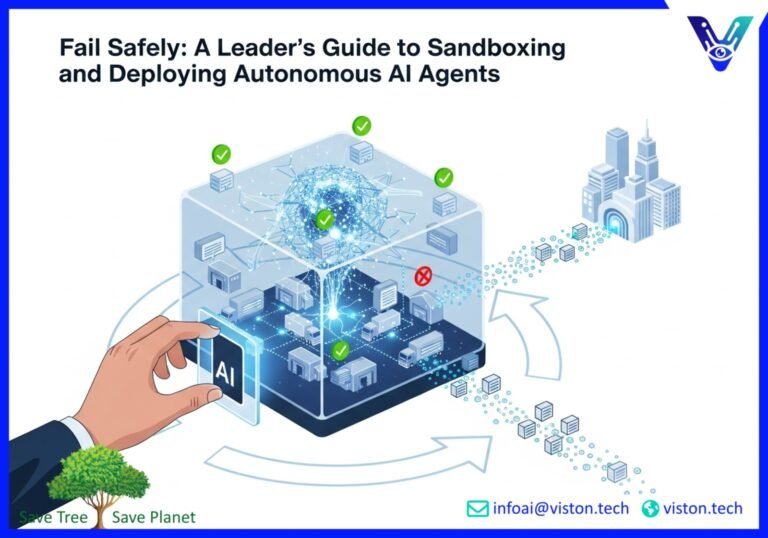
Designing Safe Sandbox Environments for Autonomous Agents to Learn and Fail
Autonomous AI agents are rapidly moving beyond simple automation. They are now poised to enter more critical workflows in businesses. This evolution brings immense potential. However, it also introduces significant risks if not managed correctly. As these intelligent agents take on more responsibilities, the need for controlled environments where they can learn, experiment, and inevitably fail without real-world consequences becomes paramount. This is where the concept of sandboxes, or isolated testing environments, becomes a cornerstone of safe AI development and deployment. Staged rollouts further ensure that any unforeseen issues have minimal impact.
For enterprise C-suite executives, AI and machine learning engineers, and IT leaders, understanding and implementing robust sandbox strategies is no longer optional. It is a critical component of a responsible and successful AI integration strategy. This blog post will explore the importance of designing safe sandbox environments. We will cover everything from simulation environments and test scenarios to release criteria and the continuous improvement loop that drives AI safety forward.
The Pressing Need for Sandboxes in the Age of Agentic AI
Imagine an AI agent designed to optimize a complex supply chain. If it makes an error in the real world, the consequences could be catastrophic. It could lead to massive financial losses, disrupt global logistics, and damage a company’s reputation. This is why sandboxes are essential. They provide a secure and isolated space for AI agents to be tested and trained. This controlled environment allows them to interact with simulated data and systems that mimic real-world operations. In this space, failures are valuable learning opportunities, not costly disasters. The increasing autonomy of AI agents makes rigorous testing in sandboxed environments a non-negotiable aspect of development.
The core idea of a sandbox is to create a digital playground. Within this playground, the AI agent can explore the full range of its capabilities. It can make decisions, take actions, and experience the consequences of those actions. All of this happens in a setting that is completely detached from live production systems. This isolation is crucial for safety and security. It prevents any accidental or malicious actions by the agent from affecting actual business operations or data. As AI agents become more sophisticated, the need for comprehensive sandboxing strategies becomes even more critical.
Crafting Realistic Simulation Environments for Effective Agent Training
The effectiveness of a sandbox is directly tied to the quality of its simulation environment. A well-designed simulation provides a high-fidelity representation of the real-world conditions the AI agent will encounter. This includes not just the data it will process, but also the systems it will interact with and the dynamic nature of the environment itself. For instance, a simulation for a financial trading agent should not only include historical market data but also model the behavior of other market participants and the impact of the agent’s own trades.
AI-powered solutions are playing an increasingly important role in the creation of these sophisticated simulations. Machine learning can be used to generate realistic synthetic data that captures the statistical properties of real-world data without exposing sensitive information. AI can also be used to create more dynamic and adaptive simulation environments. These environments can react to the agent’s actions in a more realistic manner, providing a more challenging and effective training ground. The goal is to create a simulation that is so realistic that the agent’s behavior in the sandbox is a reliable predictor of its behavior in the real world.
Key components of a robust simulation environment include:
- High-Fidelity Data Models: The simulation should be populated with data that accurately reflects the complexity and variability of the real world.
- Realistic System Interactions: The agent should be able to interact with simulated versions of the actual systems it will encounter in production.
- Dynamic Scenarios: The environment should be able to generate a wide range of scenarios, including both common situations and rare but critical edge cases.
You can learn more about how simulation is revolutionizing AI agent testing by reading this insightful article from LangWatch.
Defining Test Scenarios and Metrics for Comprehensive Evaluation
Once a realistic simulation environment is in place, the next step is to design a comprehensive set of test scenarios. These scenarios should be designed to push the AI agent to its limits. They should test its ability to handle a wide variety of situations, including those it was not explicitly trained on. This is where creativity and a deep understanding of the potential risks are crucial. It’s not enough to test for expected behavior; you also need to test for unexpected and potentially harmful behavior.
Alongside these test scenarios, it is essential to define a clear set of metrics for evaluating the agent’s performance. These metrics should go beyond simple accuracy. They should also assess the agent’s safety, reliability, and efficiency. Some key metrics to consider include:
- Task Success Rate: How often does the agent successfully complete its assigned tasks?
- Error Rate: How often does the agent make mistakes, and what is the severity of those mistakes?
- Adversarial Robustness: How well does the agent perform when faced with malicious or unexpected inputs?
- Resource Consumption: How efficiently does the agent use computational resources?
AI-powered testing tools are becoming increasingly valuable in this phase of the process. They can be used to automatically generate a vast number of test cases, covering a much wider range of possibilities than would be feasible with manual testing alone. These tools can also help to identify subtle patterns in the agent’s behavior that might indicate potential safety concerns. For a deeper dive into AI-powered quality assurance, Quash provides a great overview of the leading tools in the space.
Establishing Clear Release Criteria for Safe Deployment
Before an AI agent can be deployed into a production environment, it must meet a stringent set of release criteria. These criteria serve as a final quality gate. They ensure that the agent has been thoroughly tested and is ready for real-world operation. The release criteria should be defined upfront and should be based on the specific risks associated with the agent’s intended application. For high-stakes applications, the release criteria will naturally be much stricter than for less critical tasks.
A key aspect of the release process is a staged rollout, often referred to as a canary release. This involves deploying the new agent to a small subset of users or a limited part of the production environment. This allows for close monitoring of the agent’s performance in a real-world setting with minimal risk. If the agent performs as expected, its deployment can be gradually expanded. If any issues arise, the rollout can be quickly rolled back with minimal disruption. This iterative approach to deployment is a critical safety practice for agentic AI.
Key elements of a robust release process include:
- A comprehensive test report: This should detail the results of all the testing that has been performed.
- A formal review and approval process: This should involve all relevant stakeholders, including business leaders, IT experts, and legal and compliance teams.
- A detailed rollback plan: This should outline the steps to be taken if the agent needs to be taken out of production quickly.
The Continuous Improvement Loop: Learning from Failure
The deployment of an AI agent is not the end of the safety journey. It is the beginning of a continuous improvement loop. Once an agent is in production, it is essential to monitor its performance closely. This includes tracking its successes and, more importantly, its failures. Every failure is an opportunity to learn and improve the agent’s safety and reliability. This feedback loop is what allows AI systems to adapt and evolve over time, becoming more robust and trustworthy with each iteration.
AI-powered monitoring and observability platforms are invaluable for this ongoing process. They can help to automatically detect anomalies in the agent’s behavior and alert human operators to potential issues. They can also provide detailed insights into the root causes of failures, making it easier to identify and address the underlying problems. By embracing a culture of continuous learning and improvement, organizations can ensure that their AI agents remain safe and effective over the long term. For more information on the importance of continuous improvement in AI, Praxie.com offers a compelling perspective.
Fostering a Culture of Safety in AI Development
Ultimately, designing safe sandbox environments and implementing robust testing and deployment processes are not just technical challenges. They are also cultural challenges. It requires a commitment to safety from the very top of the organization. Everyone involved in the development and deployment of AI agents, from the C-suite to the individual engineers, must understand and prioritize safety. By fostering a culture that values responsible AI, organizations can unlock the immense potential of autonomous agents while mitigating the associated risks.
Conclusion: The Path to Trustworthy Autonomous Agents
The rise of agentic AI presents both a huge opportunity and a significant challenge. To harness the power of these advanced systems safely, a new paradigm of development and deployment is required. At the heart of this new paradigm lies the concept of the sandbox. By creating safe, realistic, and comprehensive testing environments, we can allow autonomous agents to learn and fail without real-world consequences. This, combined with rigorous test scenarios, clear release criteria, and a commitment to continuous improvement, is the path to building AI systems that are not only powerful but also trustworthy.
As we look towards 2025 and beyond, the importance of these safety practices will only continue to grow. The organizations that succeed in this new era of AI will be those that embrace a safety-first mindset. They will be the ones that invest in the tools, processes, and culture necessary to ensure that their autonomous agents are a force for good.
Ready to build safe and reliable AI-powered solutions? Contact Viston AI today to learn how our expertise can help you navigate the complexities of autonomous agent development and deployment.
Frequently Asked Questions (FAQs)
What is an AI sandbox?
An AI sandbox is an isolated and controlled virtual environment where autonomous AI agents can be tested and trained without affecting live production systems. It allows developers to safely observe and evaluate an agent’s behavior in a simulated version of the real world.
Why is testing in a sandbox crucial for autonomous agents?
Testing in a sandbox is crucial because autonomous agents have the potential to take actions with real-world consequences. A sandbox provides a safe space for these agents to make mistakes and for developers to identify and fix potential issues before the agent is deployed in a live environment, preventing potential financial, reputational, or physical harm.
What are the key components of a good simulation environment for AI testing?
A good simulation environment should have high-fidelity data that mirrors the complexity of the real world, realistic models of the systems the agent will interact with, and the ability to generate a wide range of dynamic scenarios, including both common and rare “edge case” events.
What kind of metrics are used to evaluate an AI agent’s performance in a sandbox?
Evaluation metrics for AI agents in a sandbox go beyond simple accuracy. They often include task success rates, error rates and severity, the agent’s robustness against adversarial or unexpected inputs, its efficiency in using resources, and its adherence to pre-defined safety constraints.
What is a “staged rollout” and why is it important for AI agents?
A staged rollout, or canary release, is the practice of deploying a new AI agent to a small, limited part of the production environment before releasing it to all users. This allows for close monitoring of its performance with real-world interactions and minimizes the potential impact of any unforeseen problems, as the rollout can be quickly reversed if issues arise.
How does the concept of a “continuous improvement loop” apply to AI safety?
The continuous improvement loop in AI safety refers to the ongoing process of monitoring an AI agent’s performance after deployment, learning from any failures or unexpected behaviors, and using that information to update and improve the agent’s programming and safety protocols. This iterative process is vital for the long-term safety and reliability of autonomous systems.
What are the latest advancements in AI-powered solutions for creating sandbox environments?
Recent advancements include the use of generative AI to create more realistic and diverse synthetic data for training, machine learning models that can simulate more complex and dynamic environmental responses, and AI-powered testing tools that can autonomously generate and execute a vast array of test scenarios to uncover vulnerabilities.
How can a non-technical C-suite executive ensure their organization is following best practices for AI agent safety?
C-suite executives can champion a culture of safety by asking their technical leaders about their sandboxing and staged rollout strategies, ensuring that dedicated resources are allocated for rigorous testing, establishing clear governance and oversight for AI projects, and insisting on transparent reporting of safety-related metrics and incidents.
