
Governance & Compliance in 2026: EU AI Act and Beyond
The clock is ticking. By August 2, 2026, the European Union’s landmark Artificial Intelligence Act will be fully applicable. This sweeping regulation will redefine the landscape for any organization developing, deploying, or utilizing AI systems within the EU. The stakes are incredibly high. Non-compliance can trigger staggering fines of up to €35 million or 7% of a company’s global annual revenue. Despite these consequences, a concerning gap in preparedness exists. Recent studies reveal that only 31% of enterprises have a comprehensive AI governance framework in place. This is happening even though 78% of business leaders recognize AI governance as a top priority. As 2026 approaches, the time for discussion is over. It’s time for decisive action. This blog post will serve as your guide to navigating the complexities of the EU AI Act and building a robust AI governance strategy that not only ensures regulatory compliance but also unlocks the full, responsible potential of artificial intelligence.
The EU AI Act: A New Era of AI Governance
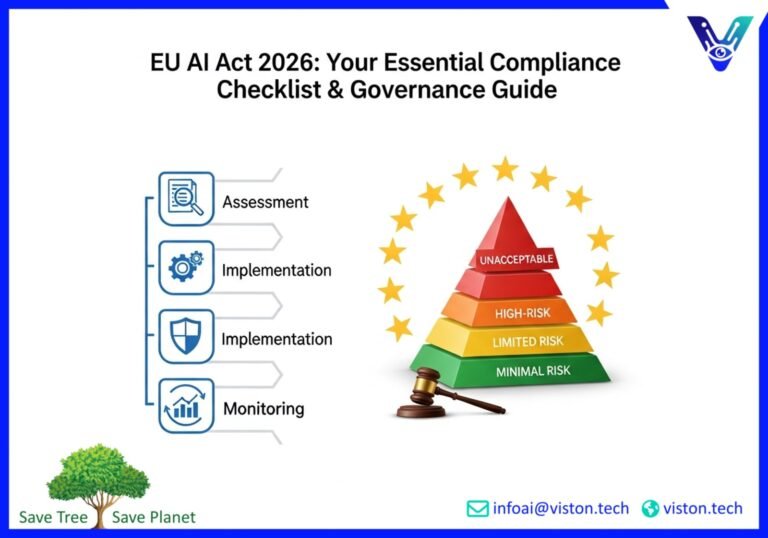
The EU AI Act is the world’s first comprehensive legal framework for artificial intelligence. Its primary goal is to foster the development and uptake of safe and trustworthy AI across the EU’s single market. The act establishes a risk-based approach, categorizing AI systems into four tiers: unacceptable risk, high risk, limited risk, and minimal risk. This classification determines the level of regulatory scrutiny and the specific obligations that organizations must meet.
Understanding the Risk-Based Approach
The cornerstone of the EU AI Act is its classification of AI systems based on the potential risk they pose to individuals’ health, safety, and fundamental rights. This tiered approach ensures that regulatory burdens are proportionate to the level of risk.
Unacceptable Risk: These are AI systems that are deemed a clear threat to the safety, livelihoods, and rights of people. Such systems are outright banned under the Act. Examples include:
- AI systems that use subliminal techniques to materially distort a person’s behavior in a manner that causes or is likely to cause physical or psychological harm.
- Systems that exploit the vulnerabilities of a specific group of persons due to their age, physical or mental disability.
- Social scoring systems used by public authorities.
- Real-time remote biometric identification systems in publicly accessible spaces for law enforcement purposes, with limited exceptions.
High-Risk AI Systems: This category includes AI systems that could have a significant adverse impact on people’s safety or fundamental rights. These systems are not banned but are subject to strict requirements before they can be placed on the market. High-risk systems are further divided into two main groups:
- AI systems intended to be used as a safety component of products that are subject to third-party conformity assessments under existing EU health and safety legislation. This includes AI in medical devices, elevators, and machinery.
- Stand-alone AI systems in specific areas listed in Annex III of the Act, which are considered high-risk due to their intended purpose. These include systems used for:
- Biometric identification and categorization of natural persons.
- Management and operation of critical infrastructure.
- Education and vocational training.
- Employment, workers management, and access to self-employment.
- Access to and enjoyment of essential private and public services and benefits.
- Law enforcement.
- Migration, asylum, and border control management.
- Administration of justice and democratic processes.
Organizations developing or deploying high-risk AI systems will face the most significant compliance obligations under the Act.
Limited Risk: AI systems in this category must comply with minimal transparency obligations. This is to ensure that users are aware they are interacting with an AI system. For example, chatbots must disclose that they are not human. The use of deepfakes must also be disclosed. The goal is to empower individuals to make informed decisions.
Minimal Risk: The vast majority of AI systems are expected to fall into this category. These include applications like AI-powered video games or spam filters. The Act does not impose any legal obligations on these systems, though providers are encouraged to voluntarily adopt codes of conduct.
Your EU AI Act Compliance Checklist for 2026
With the August 2, 2026 deadline looming, it’s crucial to have a clear and actionable compliance checklist. Here’s a breakdown of the essential steps your organization should be taking right now to prepare for the EU AI Act.
Phase 1: Assessment and Classification (Months 1-6)
- Create an AI System Inventory: The first step is to identify and document all AI systems currently in use or under development within your organization. This inventory should be comprehensive, covering systems developed in-house, procured from third-party vendors, and embedded in larger products or services.
- Classify Your AI Systems: Once you have a complete inventory, you need to classify each AI system according to the risk categories defined in the EU AI Act. This is a critical step, as it will determine your specific compliance obligations. Pay close attention to the criteria for high-risk systems.
- Determine Your Role: The Act defines different roles in the AI value chain, including providers, deployers, importers, and distributors. Your obligations will vary depending on your role. Clearly define your organization’s role for each AI system in your inventory.
- Conduct a Gap Analysis: With a clear understanding of your AI systems, their risk classifications, and your roles, you can now conduct a gap analysis. Compare your current AI governance practices against the requirements of the Act to identify areas where you need to improve.
Phase 2: Implementation and Governance (Months 7-18)
- Establish a Robust AI Governance Framework: If you don’t already have one, now is the time to establish a comprehensive AI governance framework. This framework should be integrated with your existing risk management and compliance structures. It should define clear roles and responsibilities for AI oversight.
- Implement a Risk Management System: For high-risk AI systems, you are required to establish, implement, document, and maintain a risk management system. This system should be a continuous iterative process planned and run throughout the entire lifecycle of a high-risk AI system.
- Ensure Data Quality and Governance: High-risk AI systems must be trained, validated, and tested on high-quality datasets. You need to implement strong data governance practices to ensure that your training data is relevant, representative, free of errors, and complete. You also need to be mindful of potential biases in your data.
- Prepare Technical Documentation: The Act requires detailed technical documentation for high-risk AI systems. This documentation must be drawn up before the system is placed on the market or put into service and must be kept up-to-date. It should provide all the necessary information to demonstrate the system’s compliance with the Act.
- Implement Human Oversight: High-risk AI systems must be designed and developed in such a way that they can be effectively overseen by humans. You need to implement appropriate human-machine interface measures to ensure that a human can intervene and override the system if necessary.
Phase 3: Audit, Monitoring, and Continuous Improvement (Months 19-24 and beyond)
- Conduct Conformity Assessments: Before a high-risk AI system can be placed on the market, it must undergo a conformity assessment. This is to demonstrate that it meets the requirements of the Act. For some high-risk systems, this will require the involvement of a notified body.
- Establish Post-Market Monitoring: Your obligations don’t end once a high-risk AI system is on the market. You must establish and document a post-market monitoring system to proactively collect and analyze data about the performance of your AI systems. This will help you to identify any potential risks and to take corrective action when necessary.
- Maintain Records and Logs: High-risk AI systems must be designed to automatically generate logs of their activity. These logs are crucial for ensuring the traceability of the system’s results and for monitoring its operation. You need to ensure that these logs are kept for a period of time that is appropriate for the intended purpose of the system.
- Stay Informed and Adapt: The field of AI is constantly evolving, and so is the regulatory landscape. It’s essential to stay informed about any updates to the EU AI Act, as well as emerging best practices in AI governance. Your AI governance framework should be a living document that is regularly reviewed and updated.
Leveraging AI-Powered Solutions for Compliance
Navigating the complex requirements of the EU AI Act can be a daunting task, especially for organizations with a large and diverse portfolio of AI systems. The good news is that there are a growing number of AI-powered solutions that can help to streamline and automate many aspects of AI governance and regulatory compliance. These tools can provide a more efficient and effective way to manage your AI risks and to demonstrate your compliance with the Act.
Here are some of the ways that AI-powered solutions can help:
- Automated AI Discovery and Inventory: AI-powered tools can scan your IT environment to automatically discover and inventory all of your AI systems. This can save you a significant amount of time and effort compared to a manual inventory process.
- AI Model Risk Management: These solutions can help you to assess and manage the risks associated with your AI models. They can identify potential biases in your models, test them for fairness and accuracy, and provide you with a clear picture of their overall risk profile.
- Automated Documentation and Reporting: Many AI governance platforms can automatically generate the technical documentation and reports that are required under the EU AI Act. This can help to ensure that your documentation is complete, accurate, and up-to-date.
- Continuous Monitoring and Auditing: AI-powered tools can continuously monitor your AI systems for any changes in their performance or risk profile. They can also provide you with a complete audit trail of all of your AI governance activities.
By leveraging these AI-powered solutions, you can not only simplify your compliance efforts but also gain deeper insights into your AI systems and make more informed decisions about their development and deployment. For more information on navigating the regulatory landscape, you can explore resources from organizations like the U.S. Federal Trade Commission which provides guidance on AI for businesses, or the National Institute of Standards and Technology (NIST), which develops AI risk management frameworks.
Beyond the EU AI Act: The Future of AI Governance
The EU AI Act is just the beginning. As AI becomes more and more integrated into our lives, we can expect to see a growing number of regulations and standards for AI governance around the world. Organizations that take a proactive approach to AI governance will be better positioned to navigate this evolving regulatory landscape and to build a sustainable and successful AI program. A robust AI governance framework is not just about compliance. It’s also about building trust with your customers, employees, and other stakeholders. It’s about ensuring that your AI systems are fair, transparent, and accountable. And it’s about unlocking the full potential of AI to create a better future for everyone.
The journey to AI governance excellence is a marathon, not a sprint. It requires a long-term commitment and a willingness to adapt to change. But the rewards are well worth the effort. By embracing AI governance, you can not only mitigate your risks but also build a competitive advantage and position your organization as a leader in the responsible use of AI.
Take the Next Step with Viston AI
The road to EU AI Act compliance and robust AI governance can be complex. Don’t navigate it alone. Viston AI offers a comprehensive, AI-powered solution designed to simplify your journey. Our platform can help you to automate your AI inventory, assess and manage your AI risks, and generate the documentation you need to demonstrate your compliance. Contact us today to learn how Viston AI can help you to build a foundation of trust and responsibility for your AI-driven future.
Frequently Asked Questions (FAQs)
What is the official date for the full applicability of the EU AI Act?
The EU AI Act will be fully applicable on August 2, 2026. However, some provisions have earlier application dates. For example, the rules on prohibited AI practices came into effect in early 2025.
What are the main differences between high-risk and low-risk AI systems under the Act?
High-risk AI systems are those that could have a significant negative impact on people’s safety or fundamental rights. They are subject to strict requirements, including risk management, data governance, technical documentation, and human oversight. Low-risk AI systems, on the other hand, pose minimal or no risk and are not subject to any legal obligations under the Act.
What are the penalties for non-compliance with the EU AI Act?
The penalties for non-compliance can be severe. For the most serious violations, such as the use of prohibited AI systems, organizations can face fines of up to €35 million or 7% of their global annual turnover, whichever is higher.
Does the EU AI Act apply to companies outside of the EU?
Yes, the EU AI Act has an extraterritorial scope. It applies to any provider or deployer of AI systems that are placed on the market or put into service within the EU, regardless of where the provider or deployer is based.
How can I determine if my AI system is high-risk?
The Act provides a clear set of criteria for classifying AI systems as high-risk. You should carefully review Annex III of the Act, which lists the specific use cases that are considered high-risk. If you are unsure, it is best to consult with a legal expert.
What is the role of the AI Office?
The European AI Office is a new body that has been established within the European Commission to oversee the implementation and enforcement of the AI Act. It will play a key role in developing guidance, promoting standards, and coordinating the activities of national supervisory authorities.
Are there any resources available to help with compliance?
Yes, the European Commission has launched the AI Pact, a voluntary initiative to support companies in preparing for the AI Act. There are also a growing number of consulting firms and technology vendors that offer services and solutions to help with AI Act compliance.
How does the EU AI Act relate to other regulations like GDPR?
The EU AI Act is designed to complement existing EU laws, including the General Data Protection Regulation (GDPR). While the GDPR focuses on the protection of personal data, the AI Act has a broader scope, covering the risks that AI systems can pose to a wide range of fundamental rights. There are some areas of overlap, and organizations will need to ensure that they comply with both regulations.
