
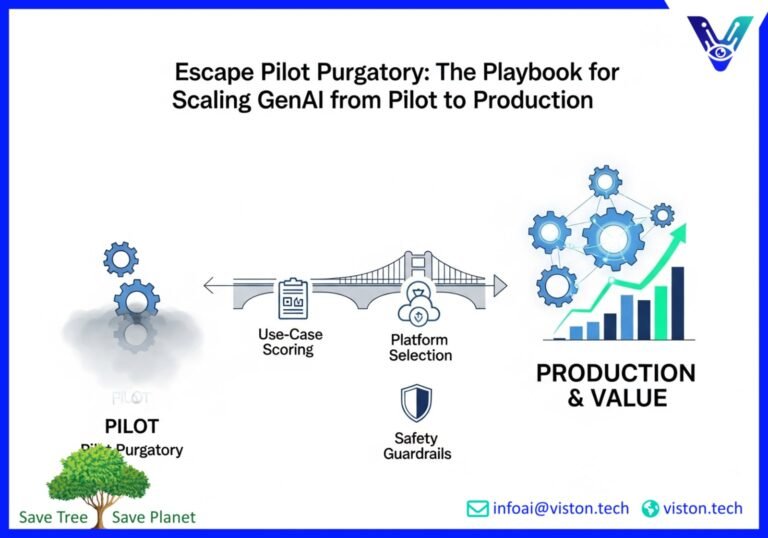
From GenAI Pilot to Production: The Scaling Playbook
The era of generative AI is here, and businesses are racing to move beyond the pilot stage. While many succeed with initial proofs-of-concept, a staggering number find themselves stuck in “pilot purgatory,” unable to scale their AI initiatives to deliver real business value. The secret to breaking free? A unified strategy that aligns marketing, product, and operations around tangible, value-driven outcomes and robust safety measures.
This playbook provides a clear roadmap for navigating the journey from a promising GenAI pilot to a fully operational, value-generating production system. We’ll explore the critical stages of this process, from initial use-case scoring to the final steps of adoption and value realization.
Scoring and Prioritizing GenAI Use-Cases for Maximum Impact
Not all GenAI applications are created equal. To ensure your resources are invested wisely, a rigorous scoring and prioritization framework is essential. This process involves a detailed evaluation of each potential use-case to ensure alignment with your organization’s strategic objectives and its potential for a significant return on investment (ROI).
A successful framework moves beyond simple impact-effort matrices to incorporate the unique characteristics of generative AI. Consider a multi-criteria evaluation using a weighted scoring model that assesses factors like:
- User Demand and Value Proposition: How well does the solution address customer needs and what unique value does it offer?
- Cost and ROI Analysis: What are the financial implications of implementation and what is the potential for revenue generation or cost reduction?
- Strategic Alignment: Does the use-case support broader business goals and long-term strategy?
- Technical Feasibility: Can the proposed solution be realistically developed and implemented with available resources and technology?
- Ethical Considerations and Risk: What are the potential ethical implications and how can they be mitigated?
By systematically scoring each potential use-case, you can confidently prioritize initiatives with the highest strategic value and market relevance, ensuring your GenAI projects are set up for success from the very beginning.
Choosing the Right Platform: The Foundation of Your AI Scale
Your choice of a generative AI platform is a critical decision that will impact the scalability, security, and overall success of your initiatives. The right platform provides the necessary tools and infrastructure to not only build and deploy your models but also to manage and monitor them effectively in a production environment.
Key Considerations for Platform Selection:
- Security and Privacy: Ensure the platform offers robust security measures, including role-based access, data encryption, and comprehensive audit logs. Data privacy controls, especially for handling personally identifiable information (PII), are non-negotiable.
- Governance and Compliance: Look for platforms with policy controls for prompts and outputs, as well as features for redaction and filtering to maintain compliance with regulations like GDPR and HIPAA.
- Scalability and Flexibility: The platform should be able to grow with your needs, supporting deployments across cloud, edge, and data centers to avoid vendor lock-in.
- MLOps for GenAI Capabilities: A mature platform will include tools for experiment tracking, model versioning, continuous integration and deployment (CI/CD), and performance monitoring.
- Integration and RAG Fit: The platform should seamlessly integrate with your existing systems and offer robust Retrieval-Augmented Generation (RAG) capabilities with connectors for various data sources. For more on this, learn about RAG from IBM.
Take the time to assemble a shortlist of platforms and run the same pilot against each to compare their performance and features fairly. This hands-on approach will provide invaluable insights into which platform is the best fit for your organization’s specific needs.
Implementing Guardrails: Ensuring Safe and Responsible AI
As generative AI models become more powerful, the need for robust guardrails becomes increasingly critical. These safeguards are essential for defining how your models behave, preventing the exposure of sensitive data, and ensuring that all outputs align with your company’s ethical guidelines and policies.
Without well-defined guardrails, your innovative AI tools can quickly become liabilities. Implementing comprehensive safety measures is not just a best practice; it’s a necessity for any organization looking to deploy GenAI responsibly. For a deeper dive into responsible AI, explore Google’s Responsible AI practices.
Pillars of Effective GenAI Guardrails:
- Data Privacy Controls: Restrict access to sensitive information through encryption, role-based access, and context-aware policies.
- Input and Output Validation: Sanitize both user inputs and model outputs to prevent malicious use and ensure reliability.
- Policy Enforcement: Implement controls to protect against prompt injection and monitor for any behavioral drift from your established policies.
- Content Filtering: Ground responses in verifiable data and require source attribution to reduce the risk of false or fabricated outputs.
The Adoption and Value Realization Roadmap
Moving from a successful pilot to full-scale production requires a clear and strategic roadmap for adoption and value realization. This is where the alignment of marketing, product, and operations truly comes to the forefront. A phased approach ensures a smooth transition and maximizes the long-term benefits of your GenAI investment.
A Phased Approach to Success:
- Define a Clear Value Hypothesis: Start with a well-defined hypothesis that outlines how your GenAI initiative will drive tangible business value.
- Prioritize High-Impact Use Cases: Focus on the initiatives that are most likely to deliver significant returns and align with your strategic goals.
- Deploy, Learn, and Scale: Begin with a limited deployment to gather feedback and learn from real-world usage. Use these insights to refine your models and scale your deployment incrementally.
- Measure and Communicate ROI: Continuously track key metrics to measure the return on your investment. Clearly communicate the value being generated to all stakeholders to build momentum and support for future initiatives.
By following a structured roadmap, you can ensure that your GenAI projects deliver measurable, sustainable value and contribute to the long-term success of your organization. For further reading on AI in business, McKinsey’s State of AI report offers valuable insights.
The Future is AI-Powered
The journey from a GenAI pilot to full-scale production is a complex but achievable endeavor. By focusing on a value-driven approach that prioritizes strategic alignment, robust governance, and a clear roadmap for adoption, your organization can successfully navigate the challenges of AI scale and unlock the transformative potential of this powerful technology.
Ready to escape pilot purgatory and start realizing the true value of your AI initiatives? The future is now, and the opportunities are limitless.
Contact Viston AI Today!
Unlock the full potential of your business with our cutting-edge, AI-powered solutions. Let Viston AI be your partner in navigating the complexities of AI productionization and driving real, measurable growth. Contact us to learn more about how we can help you on your AI journey.
Frequently Asked Questions (FAQs)
What is “pilot purgatory” in the context of GenAI?
“Pilot purgatory” refers to the common scenario where a company successfully develops a generative AI proof-of-concept or pilot project but struggles to scale it into a full production system that delivers tangible business value. This often happens due to a lack of strategic alignment, unclear ROI, or inadequate infrastructure and governance.
How do we select the most promising GenAI use-cases to pursue?
A structured use-case scoring framework is essential. This involves evaluating potential projects against a set of criteria that includes strategic alignment, potential for ROI, technical feasibility, and ethical considerations. A weighted scoring model can help to objectively prioritize the use-cases with the highest potential for success.
What are the most critical features to look for in a GenAI platform?
When choosing a platform, prioritize security, governance, and scalability. Look for features like role-based access control, data encryption, policy enforcement tools, and the flexibility to deploy across different environments. Strong MLOps capabilities for model versioning, monitoring, and CI/CD are also crucial for production readiness.
Why are guardrails so important for generative AI?
Guardrails are essential safety measures that define the behavior of your AI models. They prevent the generation of harmful or inappropriate content, protect sensitive data, and ensure that your AI operates within your organization’s ethical and policy guidelines. Without them, you risk significant reputational and legal damage.
What is MLOps for GenAI and why is it important for scaling?
MLOps for GenAI is a specialized set of practices for managing the lifecycle of large language models and other generative AI systems. It extends traditional MLOps to address the unique challenges of GenAI, such as prompt engineering, fine-tuning, and the need for continuous monitoring of model behavior. It is critical for the reliable and efficient deployment of GenAI at scale.
How can we effectively measure the ROI of our GenAI initiatives?
Measuring the ROI of GenAI involves a combination of quantitative and qualitative metrics. Track cost savings from increased efficiency, revenue generation from new products or services, and improvements in customer satisfaction. It’s also important to consider the long-term strategic benefits, such as competitive advantage and innovation.
What is a value realization roadmap and why do we need one?
A value realization roadmap is a strategic plan that outlines the steps for moving a GenAI project from pilot to full production and ensuring it delivers on its promised value. It includes defining a clear value hypothesis, prioritizing use-cases, and a phased approach to deployment, learning, and scaling. This roadmap is crucial for keeping your project on track and aligned with business objectives.
How can we ensure the successful adoption of our GenAI solutions across the organization?
Successful adoption requires a clear change management strategy. This includes communicating the benefits of the new technology, providing adequate training and support, and involving stakeholders from across the organization in the development and deployment process. A user-centric approach that focuses on creating intuitive and valuable tools is key to driving widespread adoption.
