
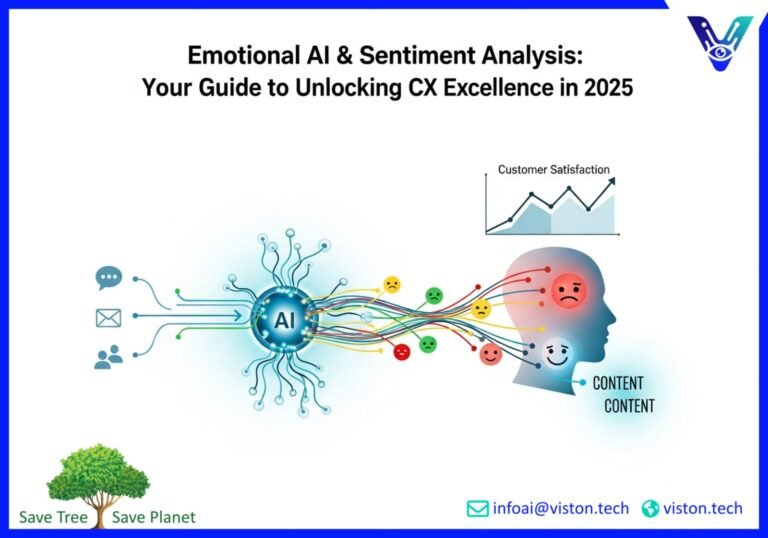
Sentiment Analysis and Emotional AI: The Secret to Unlocking CX Excellence in 2025
In today’s hyper-competitive landscape, customer experience (CX) is the ultimate battleground. Companies are no longer just competing on price or product; they are competing on how they make their customers feel. This is where the powerful combination of sentiment analysis and emotional AI comes into play, revolutionizing how businesses understand and interact with their clientele. By leveraging the nuances of human language, these technologies offer a direct line to the heart of your customer base, powering measurable gains in everything from ticket routing to the quality of your support responses.
For enterprise leaders, AI engineers, and product managers, harnessing these tools is no longer a futuristic vision—it’s a present-day necessity. This deep dive will explore how a blend of classic Natural Language Processing (NLP) and modern embeddings is creating a new paradigm for customer support, and how your organization can capitalize on it.

The Evolution of Understanding: From Keywords to True Emotion
Customer feedback has always been a goldmine of information. The challenge has been in mining it effectively. Traditional methods, like keyword spotting, were a good first step, but they often missed the mark. A customer might use the word “great,” but sarcasm can flip the meaning entirely. This is where modern NLP for support shines, moving beyond simple words to understand context, tone, and true sentiment.
Think of it as the difference between hearing the words and understanding the music. Classic NLP provides the lyrics, but modern embeddings and emotional AI capture the melody—the underlying emotional current of the conversation. This deeper understanding allows for a more empathetic and effective customer experience.
Building the Engine: Data Pipelines for Sentiment and Emotion
To unlock the power of sentiment analysis and emotional AI, you need a robust data pipeline. This is the foundation upon which all your insights will be built. For a non-technical audience, think of it as a sophisticated plumbing system for data.
- Data Ingestion: This is the starting point, where you collect customer feedback from various sources. This includes emails, chat logs, social media mentions, and call transcripts. The goal is to create a single, unified stream of customer voice.
- Data Preprocessing: Raw data is often messy. This stage involves cleaning and structuring the data to make it usable. This includes removing irrelevant information, correcting typos, and standardizing formats. It’s like preparing your ingredients before you start cooking.
- Feature Extraction: Here, the cleaned data is transformed into a format that AI models can understand. This is where techniques like embeddings come in, converting words and sentences into numerical representations that capture their meaning and relationships.
- Data Storage: Finally, the processed data is stored in a secure and accessible location, ready to be used for model training and analysis.
A well-designed data pipeline ensures that your AI models are fed with high-quality, relevant data, leading to more accurate and actionable insights.
Choosing Your Tools: Model Selection in the Age of AI
With a solid data pipeline in place, the next step is to choose the right AI models. This isn’t a one-size-fits-all solution. The best approach often involves a hybrid model, combining the strengths of classic NLP techniques with the power of modern deep learning.
Classic NLP models are excellent at tasks like identifying keywords and basic sentiment. They are computationally efficient and can provide a good baseline understanding. However, they can struggle with the subtleties of human language.
This is where modern embeddings and transformer-based models, like BERT and GPT, come in. These models are trained on vast amounts of text data, allowing them to understand context, nuance, and even sarcasm with a high degree of accuracy. For a deeper dive into how these models work, check out this insightful article on The Power of Natural Language Processing from Harvard Business Review.
By combining these approaches, you can create a powerful system that not only understands what your customers are saying but also how they are feeling. This allows for a much more sophisticated and effective approach to customer interaction.
The Human Element: Navigating Bias and Ethics in Emotional AI
As we delve deeper into the realm of emotional AI, it’s crucial to address the ethical considerations. AI models are trained on data, and if that data contains biases, the models will learn and amplify them. This can lead to unfair or inaccurate interpretations of customer emotions, particularly for underrepresented groups.
To mitigate this, it’s essential to be proactive about fairness, transparency, and accountability.
- Diverse and Representative Data: Ensure that your training data reflects the diversity of your customer base. This helps to minimize bias and ensure that your models are fair and equitable.
- Transparency and Explainability: It’s important to understand how your AI models are making decisions. Techniques like SHAP (SHapley Additive exPlanations) can help to provide insights into the inner workings of your models, making them more transparent and trustworthy.
- Human-in-the-Loop: AI should augment, not replace, human agents. By keeping a human in the loop, you can provide oversight, handle complex or sensitive cases, and ensure that your customers are always treated with empathy and respect. Learn more about the importance of ethical AI from this article by the World Economic Forum on responsible AI.
By addressing these ethical considerations head-on, you can build an AI-powered CX solution that is not only effective but also fair and responsible.
Putting It All Together: Integration into Support Workflows
The true power of sentiment analysis and emotional AI is realized when it is seamlessly integrated into your existing support workflows. This is where the rubber meets the road, and you start to see tangible improvements in your CX metrics.
Intelligent Routing and Triage
Imagine a world where customer queries are automatically routed to the best-equipped agent based on the sentiment and emotion of the message. A frustrated customer could be immediately escalated to a specialized retention team, while a simple query could be handled by a chatbot. This not only improves efficiency but also ensures that your customers get the right help at the right time.
By analyzing the emotional content of incoming requests, you can prioritize urgent issues, identify at-risk customers, and allocate your resources more effectively. This leads to faster resolution times, reduced customer churn, and a more streamlined support operation.
Enhancing Response Quality
Emotional AI can also be used to assist your agents in real-time, providing them with insights and suggestions to improve the quality of their responses. For example, an AI assistant could analyze an agent’s draft response and suggest a more empathetic tone or provide relevant information to address the customer’s underlying concerns.
This “co-pilot” approach empowers your agents to be more effective and confident in their roles. It can also be used to identify coaching opportunities and provide personalized feedback to help your team continuously improve.
The Future is Empathetic: Your Path to CX Excellence
The integration of sentiment analysis and emotional AI into your CX strategy is no longer a luxury—it’s a competitive imperative. By moving beyond simple keywords and embracing a deeper understanding of customer emotions, you can unlock a new level of customer satisfaction, loyalty, and advocacy.
The journey starts with a solid data foundation, followed by a thoughtful approach to model selection and a steadfast commitment to ethical principles. By seamlessly integrating these technologies into your support workflows, you can create a customer experience that is not only efficient and effective but also genuinely empathetic.
Ready to unlock the power of emotional AI for your business? The team at Viston AI is here to help you navigate this exciting new landscape. #SentimentAnalysis #EmotionalAI #NLPforSupport #CustomerExperience #AIforCX
Frequently Asked Questions (FAQs)
What is the difference between sentiment analysis and emotional AI?
Sentiment analysis typically categorizes text as positive, negative, or neutral. Emotional AI goes a step further by identifying more nuanced emotions like joy, anger, sadness, and surprise. Think of sentiment analysis as understanding the “what” and emotional AI as understanding the “why” behind customer feelings.
How can NLP for support improve my company’s bottom line?
By automating tasks like ticket routing and providing real-time assistance to agents, NLP for support can significantly improve efficiency and reduce operational costs. More importantly, by enhancing the customer experience, it can lead to increased customer loyalty, reduced churn, and a stronger brand reputation, all of which contribute to long-term revenue growth.
What are the first steps to implementing sentiment analysis?
The first step is to identify your key sources of customer feedback. This could be emails, social media, surveys, or chat logs. Once you have a clear understanding of your data sources, you can begin to build a data pipeline to collect, clean, and process this information. Starting with a clear business objective, such as reducing response times, is also crucial.
Is emotional AI accurate enough to be reliable?
The accuracy of emotional AI has improved dramatically in recent years, thanks to advancements in deep learning and the availability of large datasets. While no system is perfect, modern emotional AI models can achieve high levels of accuracy in identifying a wide range of emotions. It’s important to continuously monitor and retrain your models to ensure they remain accurate and relevant.
How do I ensure the ethical use of emotional AI?
Ethical use starts with a commitment to transparency, fairness, and accountability. This includes using diverse and representative training data, being transparent about how your AI models are used, and having a human-in-the-loop to oversee and intervene when necessary. It’s also important to have clear governance policies in place to guide the development and deployment of emotional AI.
Can sentiment analysis be used for proactive customer support?
Absolutely. By monitoring social media and other public channels for negative sentiment, you can identify and address potential issues before they escalate. This proactive approach to customer support can help you to turn a negative experience into a positive one and demonstrate your commitment to customer satisfaction.
What kind of training is required for my team to use these tools?
Many modern AI-powered CX platforms are designed to be user-friendly and require minimal training for support agents. The focus is often on intuitive dashboards and real-time suggestions that are easy to understand and act upon. For the team implementing the solution, some technical expertise in data science and AI will be beneficial.
How does Viston AI approach sentiment analysis and emotional AI?
At Viston AI, we believe in a holistic approach that combines cutting-edge technology with a deep understanding of your business needs. We work with you to build a custom solution that is tailored to your specific challenges and goals. Our focus is on delivering measurable results and empowering you to create exceptional customer experiences.
Ready to transform your customer experience with the power of AI? Contact Viston AI today to learn how our advanced sentiment analysis and emotional AI solutions can help you build stronger customer relationships and drive business growth.
