
Edge AI vs. Cloud AI: The New Frontier of Business Intelligence in 2025
The conversation is no longer about if you should adopt artificial intelligence, but where you should run it. As we move through 2025, the choice between processing AI workloads on local devices (Edge AI) versus centralized servers (Cloud AI) has become one of the most critical strategic decisions for modern enterprises. This isn’t just a technical detail; it’s a choice that fundamentally impacts your business’s speed, security, cost, and ability to innovate.
The numbers paint a clear picture: the global edge AI market is projected to reach an impressive $25.65 billion in 2025, with explosive growth expected to continue. This surge is driven by an explosion of data from IoT devices and the urgent need for real-time decision-making in everything from manufacturing to healthcare. The old model of sending every piece of data to the cloud is becoming too slow, too expensive, and too risky.
This post will demystify Edge AI and Cloud AI, explore the critical tradeoffs between them, and provide actionable insights to help you decide on the right architecture for your business. We’ll examine real-world use cases and the power of hybrid models that offer the best of both worlds.
What’s the Difference? Edge AI vs. Cloud AI Explained
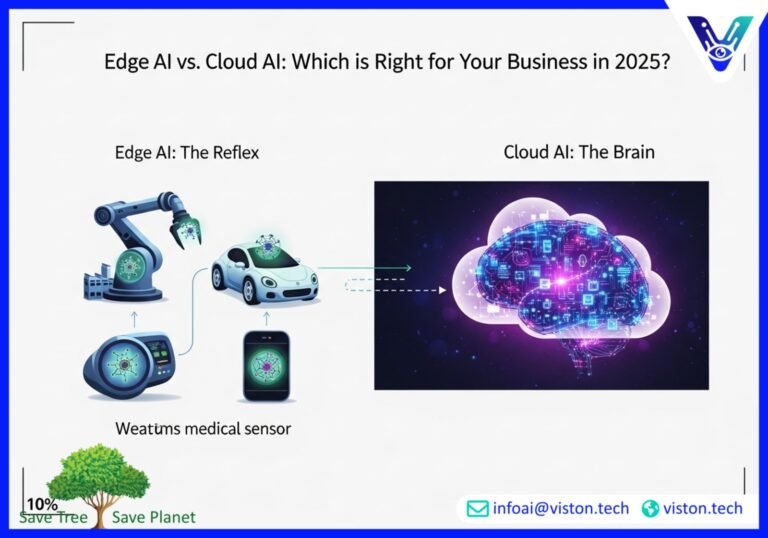
Imagine the difference between a reflex and a considered thought. A reflex—like pulling your hand from a hot surface—is instant and happens locally without thinking. A considered thought—like planning your next business move—requires deep analysis and access to vast information. This is the core difference between Edge AI and Cloud AI.
- Edge AI: The Reflex. Edge AI processes data directly on the device where it is created, like a smart camera, a factory sensor, or a vehicle. This is also known as on-device inference. Because the “thinking” happens locally, the response is almost instantaneous.
- Cloud AI: The Brain. Cloud AI sends data to powerful, centralized data centers for processing. This approach leverages virtually unlimited computing power, making it ideal for training complex AI models and analyzing massive datasets.
The fundamental distinction is the location of the data processing. Edge AI is decentralized and local; Cloud AI is centralized and remote. This single difference has profound implications for how your applications perform.
The Latency and Privacy Matrix: Key Tradeoffs
Choosing between the edge and the cloud involves a direct tradeoff between speed (latency) and data exposure (privacy). Understanding this matrix is the first step to making an informed decision.
Latency: The Need for Speed
Latency is the delay between a query and a response. In many modern applications, milliseconds matter.
- Edge AI: Ultra-Low Latency. By processing data on-device, Edge AI eliminates the round-trip to the cloud. This delivers near-instantaneous results, which is non-negotiable for applications like autonomous vehicles, real-time medical monitoring, and industrial robotics.
- Cloud AI: Variable Latency. Cloud AI is subject to network speed and server load. While powerful, the time it takes to send data to the cloud and receive a response can range from hundreds of milliseconds to seconds—too slow for safety-critical systems.
Privacy: Keeping Data Secure
Data is your most valuable asset, and protecting it is paramount, especially with tightening regulations like GDPR.
- Edge AI: Enhanced Privacy. With Edge AI, sensitive data can be processed and analyzed without ever leaving the device. This dramatically reduces the risk of data breaches during transmission and helps ensure compliance with data sovereignty laws. Processing data locally is a significant competitive advantage for privacy-focused companies.
- Cloud AI: Centralized Risk. Sending data to a third-party cloud introduces potential vulnerabilities. While cloud providers offer robust security, the data is still exposed during transit and resides on external servers, increasing the potential attack surface.
The bottom line: If your application demands real-time responses and handles sensitive information, Edge AI is the clear winner. If it requires massive computational power for deep analysis and latency is less critical, Cloud AI is the go-to solution.
Explore Edge Computing in-depth with this resource from IBM.
Hybrid Patterns: Getting the Best of Both Worlds
For a growing number of businesses in 2025, the choice isn’t “either/or” but “both/and.” A hybrid AI architecture strategically combines the strengths of edge and cloud, creating a powerful, flexible, and efficient system.
In a hybrid model, the roles are clearly defined:
- The Edge handles the “now”: Real-time tasks like on-device inference, immediate anomaly detection, and initial data filtering happen instantly on local devices.
- The Cloud handles the “big picture”: It receives aggregated, often anonymized, insights from edge devices. This data is then used for heavy-duty tasks like training and retraining AI models, performing large-scale analytics, and long-term strategic planning.
Consider a smart factory. Edge AI cameras on the assembly line can detect product defects in real-time and alert the system to remove a faulty item instantly. This prevents slowdowns and ensures quality. Meanwhile, the data on defect types and frequency is sent to the cloud. There, a powerful AI model analyzes trends across all production lines to predict potential machine failures or identify systemic issues, enabling predictive maintenance. This synergy of immediate action and deep insight is the hallmark of a successful hybrid strategy.
The Modern AI Deployment Toolchain
Deploying AI, especially at the edge, requires a sophisticated toolchain to manage the lifecycle from development to deployment. While the details can be technical, leaders should understand the core components:
- Model Optimization: AI models trained in the cloud are often too large and power-hungry for edge devices. Techniques like quantization (reducing model precision) and pruning (removing unnecessary parts) make them smaller and faster without significant accuracy loss.
- Deployment and Orchestration: Once optimized, models need to be deployed to thousands or even millions of devices. Platforms like Azure IoT Edge and AWS IoT Greengrass help manage this process, ensuring the right models are running on the right devices.
- Monitoring and Management: The toolchain must also monitor the performance of deployed models, manage updates, and ensure security across a distributed network of devices.
Leading hardware providers like NVIDIA (with its Jetson platform) and Google (with Coral TPUs) offer powerful chips and software development kits (SDKs) specifically designed to accelerate on-device inference, making Edge AI more accessible and powerful than ever.
Case Studies by Vertical: Edge AI in Action
Edge AI is not a future concept; it’s delivering tangible ROI across industries today. Here’s how leading sectors are leveraging its power.
Manufacturing & Industry 4.0
In smart factories, Edge AI is the engine of efficiency and safety.
- Predictive Maintenance: Sensors on machinery analyze vibration and temperature data in real-time. Edge AI algorithms detect anomalies that signal an impending failure, allowing for maintenance before a costly breakdown occurs.
- Quality Control: High-resolution cameras with on-device AI scan products on the assembly line, identifying defects with superhuman speed and accuracy, ensuring only perfect products leave the factory.
Healthcare
Edge AI is revolutionizing patient care by making diagnostics faster, more accessible, and more private.
- Real-Time Patient Monitoring: Wearable medical devices use Edge AI to continuously analyze vital signs. They can detect early signs of a critical event, like a heart attack or seizure, and alert medical staff instantly.
- On-Device Diagnostics: Portable medical imaging devices, like AI-powered ultrasounds, can perform initial analyses on-device. This is transformative for remote and underserved areas, providing critical diagnostic capabilities without relying on a stable internet connection.
Retail
Brick-and-mortar retailers are using Edge AI to create smarter, more efficient, and personalized shopping experiences.
- Smart Checkouts: Systems like Amazon Go use cameras and sensors with Edge AI to track what shoppers pick up, allowing them to walk out without ever waiting in a checkout line.
- In-Store Analytics: On-device AI can analyze foot traffic and shopper behavior—without collecting personal data—to optimize store layouts, manage inventory, and reduce wait times.
Automotive
Perhaps the most visible use case, Edge AI is the core technology enabling autonomous vehicles and advanced driver-assistance systems (ADAS).
- Autonomous Driving: A vehicle must process vast amounts of sensor data (from cameras, LiDAR, radar) in milliseconds to navigate safely. This level of responsiveness is only possible with powerful on-board Edge AI processors.
Learn more about AI in robotics and autonomous machines from NVIDIA.
Your Path Forward: Building a Future-Ready AI Strategy
The debate between Edge AI and Cloud AI is evolving. As we move further into 2025, the conversation is shifting from competition to collaboration. A hybrid approach that leverages the real-time, private processing of the edge with the immense analytical power of the cloud offers the most robust and flexible path forward for nearly every enterprise.
Start by asking these questions:
- Do my applications require millisecond response times?
- Am I handling sensitive customer or operational data that should not leave the premises?
– Do my operations need to function reliably even with intermittent connectivity?
If you answered yes to any of these, it’s time to seriously explore integrating Edge AI into your strategy. By doing so, you can build systems that are not only smarter but also faster, safer, and more efficient.
Frequently Asked Questions (FAQs)
1. What is the main difference between Edge AI and Cloud AI?
The primary difference is where the AI algorithms process data. Edge AI processes data locally on a device (e.g., a smartphone or IoT sensor), while Cloud AI sends data to a centralized remote server for processing.
2. Is Edge AI more secure than Cloud AI?
Generally, yes. Edge AI enhances privacy and security because sensitive data is processed on-device and doesn’t need to be transmitted over a network, reducing the risk of it being intercepted or breached.
3. Which is faster, Edge AI or Cloud AI?
Edge AI is significantly faster for real-time applications. Its key benefit is reducing latency by eliminating the delay of sending data to the cloud and waiting for a response.
4. Can Edge AI models be updated?
Yes. In a hybrid model, improved AI models are trained in the cloud and then deployed to edge devices through over-the-air (OTA) updates, ensuring they are always running the latest and most accurate algorithms.
5. Is Edge AI more expensive than Cloud AI?
It’s a tradeoff. Edge AI can require a higher upfront investment in capable hardware. However, it can lead to significant long-term savings by reducing bandwidth usage and cloud processing fees, especially for applications that generate large amounts of data.
6. What are the biggest challenges for Edge AI adoption?
The main challenges include the limited computational power and memory of edge devices, managing the deployment and updates for a large number of distributed devices, and ensuring energy efficiency, especially for battery-powered devices.
7. Do I have to choose between Edge AI and Cloud AI?
No, and you probably shouldn’t. A hybrid approach that uses the edge for real-time on-device inference and the cloud for model training and heavy analytics offers the most powerful and flexible solution for most businesses.
8. What industries benefit most from Edge AI?
Industries where real-time decision-making, low latency, and data privacy are critical see the most benefit. This includes manufacturing, healthcare, automotive, retail, and smart cities.
Ready to Harness the Power of AI?
Navigating the complexities of Edge and Cloud AI requires a partner with deep expertise and a clear vision. At Viston AI, we specialize in creating custom AI-powered solutions that drive efficiency, enhance security, and unlock new opportunities for your business.
Contact Viston AI today to discover how our tailored AI strategies can accelerate your digital transformation and give you a competitive edge.
#EdgeAI #CloudAI #OnDeviceInference #ArtificialIntelligence #Latency #Privacy #DigitalTransformation #TechTrends2025 #VistonAI
