
Computer Vision for Retail: Taming the $1.73 Trillion Giant of Inventory Distortion
Picture this: a customer walks into your store, ready to buy. They search for a specific product, can’t find it on the shelf, and leave empty-handed. You just lost a sale. Now, multiply that scenario thousands of times a day across thousands of stores. The result? A staggering USD 1.73 trillion in annual losses for the global retail industry due to inventory distortion—the costly combination of overstocking and understocking. But what if you could see everything, everywhere, all at once? Welcome to the future of retail, powered by Computer Vision.
In 2025, artificial intelligence is no longer a futuristic buzzword; it’s the core engine driving operational excellence. For retailers, AI-powered computer vision is a game-changer, transforming standard cameras into intelligent sensors that automate inventory management and monitor shelf health in real time. This isn’t just about reducing losses; it’s about creating a more efficient, profitable, and customer-centric retail environment.
Overview: The Dawn of a Smarter Shelf
At its heart, computer vision technology trains computers to interpret and understand the visual world. In a retail setting, this means cameras and AI algorithms work together to “see” and analyze what’s happening on your shelves. They can identify products, count them, detect empty spaces, and even spot items that are in the wrong place. This continuous, automated monitoring provides a live, accurate picture of your inventory—something manual checks could never achieve.
The impact is profound. Retailers using computer vision are reporting significant sales lifts, sometimes between 3-5%, simply by ensuring products are available when customers want them. They’re also slashing labor costs associated with manual inventory counts by 20-30% and drastically reducing shrinkage. This technology empowers retailers to shift from reactive problem-solving to proactive, data-driven management.
The Pain of Inventory and Loss Prevention
The traditional approach to inventory management is broken. Manual counts are slow, expensive, and notoriously inaccurate. This leads to a phenomenon known as “phantom inventory,” where your system believes an item is in stock, but the shelf is bare. These discrepancies are a primary driver of stockouts, which cost retailers an estimated trillion dollars globally in lost sales each year.
When a customer encounters an out-of-stock item, the consequences are immediate:
- Lost Sales: Nearly half of all intended purchases are lost when a product is unavailable.
- Damaged Loyalty: A significant percentage of shoppers will switch to a competitor after just one poor stock experience.
- Reduced Basket Size: A missing item can lead to the abandonment of the entire shopping cart.
Beyond stockouts, shrinkage—loss due to theft, fraud, or error—is another massive drain on profitability. AI-powered computer vision tackles this head-on. By analyzing video feeds in real time, these systems can detect suspicious behaviors, such as a customer concealing an item or unscanned products at self-checkout, and alert staff instantly. This proactive approach to loss prevention can reduce shrinkage by up to 30%, turning a major liability into a manageable operational metric.
Shelf Monitoring and Planogram Compliance: The Key to On-Shelf Availability
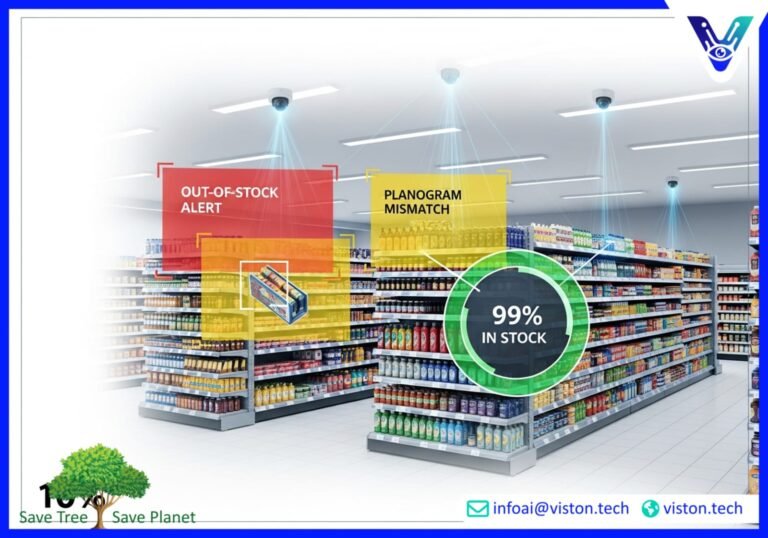
An empty shelf is a retailer’s worst nightmare. Real-time shelf monitoring using computer vision ensures this nightmare doesn’t become a reality. Cameras constantly scan the shelves, and AI algorithms detect out-of-stocks the moment they happen. Alerts are automatically sent to store associates’ handheld devices, pinpointing the exact location and product that needs replenishment. This transforms shelf stocking from a guessing game into a precise, efficient workflow, improving on-shelf availability by up to 30%.
But having products on the shelf is only half the battle. They also need to be in the right place. A planogram is the visual blueprint for product placement, designed to maximize visibility and drive sales. However, maintaining planogram compliance across hundreds or thousands of stores is a monumental challenge. Studies have shown that planograms can deviate by as much as 10% per week.
Computer vision automates planogram compliance verification. The AI compares the actual shelf layout to the prescribed planogram, instantly flagging misplaced items, incorrect facings, or pricing errors. This ensures a consistent brand experience for customers and maximizes the effectiveness of your merchandising strategies. Retailers have found that achieving perfect planogram compliance can complete store audits 75% faster and directly contribute to increased sales.
A Phased Implementation: Your Roadmap to AI-Powered Retail
Integrating computer vision into your operations doesn’t have to be an overwhelming, high-risk endeavor. A phased implementation allows you to realize value quickly while minimizing disruption. This strategic approach ensures a smooth transition and builds momentum for a full-scale rollout.
Phase 1: Pilot Program and Validation
Start small. Select a few high-traffic stores and a specific use case, such as monitoring a key product category for out-of-stocks. This allows you to:
- Test the Technology: Evaluate the performance and reliability of the computer vision solution in a real-world environment.
- Measure Initial ROI: Collect data on key metrics like stockout reduction, sales lift, and labor savings to build a strong business case.
- Gather Feedback: Involve store associates early to understand how the technology fits into their daily workflows and gather valuable feedback for refinement.
Phase 2: Expansion and Integration
Once the pilot program has proven successful, the next step is to expand. Roll out the solution to more stores and begin integrating it with other core systems, such as your inventory management and point-of-sale (POS) systems. This integration creates a powerful, unified data ecosystem where insights from the shelf can inform decisions across your entire supply chain.
Phase 3: Scale and Optimization
In the final phase, the computer vision solution is deployed across the entire retail chain. At this stage, the focus shifts to optimization. The vast amount of data collected from your shelves can be used to refine demand forecasting, optimize supply chain logistics, and even inform future store layouts and merchandising strategies. This continuous feedback loop ensures that your operations are always adapting and improving.
ROI and Risk: The Business Case for Computer Vision
The return on investment for computer vision in retail is compelling and multifaceted. The financial benefits extend far beyond simply reducing stockouts and theft.
Tangible ROI:
- Increased Sales: A 3-5% increase in revenue by improving on-shelf availability.
- Reduced Labor Costs: Automation of manual inventory counts can reduce associated labor hours by 60-85%.
- Decreased Shrinkage: Real-time monitoring can cut losses from theft and fraud by 15-30%.
- Optimized Inventory: Lower carrying costs by reducing overstock and minimizing waste.
Retailers often see a full return on their investment within 12 to 18 months of implementation. While any technology adoption involves some level of risk, these can be effectively managed. Concerns around implementation costs can be mitigated by leveraging existing camera infrastructure and opting for cloud-based AI solutions that reduce the need for significant upfront hardware investment. A strategic, phased rollout, as outlined above, further de-risks the process by allowing for validation and refinement at each stage.
The Future is Visual
The era of managing retail stores based on outdated, inaccurate data is over. In 2025, the competitive edge belongs to retailers who can see and act on the reality of their shelves in real time. Computer vision is not just another technology; it is a fundamental shift in how physical retail is managed. It provides the clarity and automation needed to conquer the multi-trillion-dollar problem of inventory distortion, freeing up your team to focus on what they do best: serving your customers.
By embracing shelf analytics and automated retail inventory management, you are not just investing in a solution; you are investing in a more resilient, efficient, and profitable future.
Ready to transform your retail operations with the power of AI? Contact Viston AI today to learn how our industry-leading computer vision solutions can help you unlock new levels of efficiency and growth.
Frequently Asked Questions (FAQs)
1. What is computer vision in retail?
Computer vision in retail is a field of artificial intelligence that uses cameras and AI algorithms to enable computers to interpret and understand the visual information from a physical store. It automates tasks like monitoring inventory levels on shelves, ensuring products are placed correctly according to planograms, and detecting potential theft, all in real time.
2. How does computer vision help with inventory management?
Instead of relying on periodic manual counts, computer vision systems continuously monitor shelves. They automatically detect when stock levels are low or when a shelf is empty and can instantly alert staff to restock. This real-time, automated process significantly reduces the risk of stockouts, minimizes human error, and ensures inventory data is always accurate.
3. What is planogram compliance and why is it important?
A planogram is a diagram that dictates how and where specific products should be placed on retail shelves to maximize visibility and sales. Planogram compliance is the measure of how well a store adheres to this layout. It’s crucial because consistent and strategic product placement enhances the customer shopping experience, improves brand presentation, and can lead to higher sales.
4. Can computer vision technology be integrated with our existing camera systems?
Yes, many modern computer vision solutions are designed to be hardware-agnostic, meaning they can often integrate with your existing security and surveillance cameras. This can significantly lower the initial investment and speed up the implementation process by leveraging infrastructure that is already in place.
5. What is the typical return on investment (ROI) for implementing computer vision in retail?
The ROI can be substantial. Retailers often report a 3-5% increase in sales due to improved product availability, a 20-30% reduction in labor costs from automating manual tasks, and a 15-30% decrease in shrinkage. Most businesses see a full return on their investment within 12 to 18 months.
6. How does real-time shelf monitoring improve the customer experience?
By preventing out-of-stock situations, real-time shelf monitoring ensures that customers can find the products they are looking for. This reliability builds trust and loyalty. It also helps maintain a well-organized and tidy store appearance, which contributes to a more positive and less frustrating shopping journey.
7. How does computer vision reduce retail shrinkage?
AI-powered cameras can analyze video feeds to identify behaviors associated with theft, such as concealing items or bypassing checkout scanners. The system can flag these suspicious activities in real time, allowing store personnel to intervene. This proactive approach to security is far more effective than reviewing footage after an incident has already occurred.
8. Is this technology difficult for store employees to learn and use?
Leading computer vision platforms are designed with the end-user in mind. Typically, store associates interact with the system through simple, intuitive dashboards on mobile devices or tablets. Alerts are clear and actionable (e.g., “Restock 5 units of Product X at Aisle 4, Section B”), making it easy for staff to integrate the technology into their daily routines with minimal training.
