
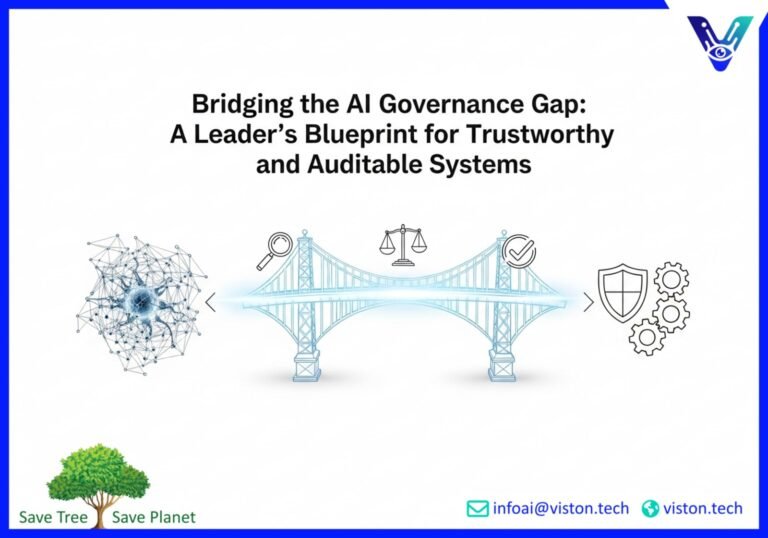
AI Governance & Compliance: Building Trustworthy, Auditable Autonomous Systems
Artificial intelligence is no longer on the horizon; it’s embedded in our daily business operations. Yet, a critical gap exists between adoption and oversight. While 78% of enterprises rate AI governance as a top priority, a mere 31% have a comprehensive framework in place. This disconnect creates significant risk in an era where emerging guidelines and regulations demand “compliance by design.” For leaders in 2025, building trustworthy, auditable AI is not just a technical challenge—it’s a strategic imperative.
As AI systems become more autonomous, the need for clear audit trails, robust incident databases, and continuous verification is non-negotiable. This blog post demystifies AI governance and compliance for a non-technical audience. We will explore the shifting regulatory landscape, break down practical governance frameworks, provide an actionable checklist, and explain the technical controls that build trust into the DNA of your autonomous systems.
The Shifting Sands: Understanding the AI Regulatory Landscape
Navigating the world of AI regulation can feel like trying to read a map in a sandstorm. The landscape is fragmented and evolving at lightning speed. However, clear patterns are emerging, primarily centered around risk-based approaches that prioritize transparency, fairness, and accountability.
The EU AI Act: A Global Benchmark
The most significant piece of legislation shaping the global conversation is the European Union’s AI Act. It establishes a risk-based framework, categorizing AI systems based on their potential for harm. The Act is being implemented in phases, with key deadlines taking effect throughout 2025 and beyond.
- Unacceptable Risk: Systems that pose a clear threat to safety and rights, such as social scoring by governments, are banned outright. This ban has been in effect since February 2025.
- High-Risk: This category includes AI used in critical sectors like healthcare, finance, and law enforcement. These systems face strict requirements, including rigorous testing, clear documentation, and human oversight.
- Limited Risk: Systems like chatbots must be transparent, ensuring users know they are interacting with an AI.
- Minimal Risk: The vast majority of AI applications, such as AI-enabled video games or spam filters, fall into this category with no additional legal obligations.
The EU AI Act’s influence extends far beyond Europe, creating a “Brussels Effect” where global companies adopt its standards to streamline their compliance efforts worldwide.
Sector-Specific Regulations: A Deeper Dive
Alongside broad frameworks like the EU AI Act, individual industries are developing their own AI regulations. This sectoral approach addresses the unique risks and use cases within specific fields.
- Financial Services: Regulators are intensely focused on AI used for credit scoring, fraud detection, and algorithmic trading. The key concerns are algorithmic bias that could lead to discriminatory lending practices and the potential for AI-driven market instability. Frameworks often intersect with existing financial governance standards like Basel III.
- Healthcare: In healthcare, AI’s impact on patient safety is paramount. Regulations for AI in diagnostic tools, personalized treatment plans, and patient management systems are stringent. These rules often overlap with existing health data privacy laws like HIPAA in the US, demanding robust data governance and explainability to ensure clinical decisions can be justified.
From Policy to Practice: Implementing AI Governance Frameworks
An AI governance framework is the blueprint for responsible AI. It translates high-level principles into concrete policies, processes, and roles. A successful framework is not a static document but a living system that adapts to new technologies and regulations.
Core Components of an Effective Framework
A robust AI governance framework is built on several key pillars that work together to create a cohesive system for responsible AI deployment.
- Accountability and Ownership: Establish clear lines of responsibility. This often involves creating a cross-functional AI governance committee with members from legal, compliance, data science, and business units.
- Risk-Based Approach: Not all AI is created equal. Governance measures should be proportional to the risk level of a specific application. High-risk systems require more intensive oversight than low-risk ones.
- Ethical Principles: Define your organization’s values regarding AI. Core principles typically include fairness, transparency, accountability, and privacy.
- Compliance by Design: Integrate compliance checks and ethical reviews directly into the AI development lifecycle, from ideation to deployment. This proactive approach is far more effective than treating compliance as an afterthought.
- Continuous Monitoring: AI models can drift over time as data changes. Implement continuous monitoring to track performance, detect bias, and ensure the system operates as intended.
AI-Powered GRC Solutions
Managing governance, risk, and compliance (GRC) for AI can be complex and resource-intensive. Fortunately, AI itself offers a solution. AI-powered GRC platforms are emerging to automate and enhance these processes. These tools can continuously monitor AI systems for compliance breaches, automate audit evidence collection, and provide predictive insights into potential risks. By leveraging AI to govern AI, organizations can build more resilient and adaptive compliance programs.
A Practical Checklist for Building Trustworthy AI
Moving from theory to implementation requires a clear, actionable plan. This checklist provides a step-by-step guide to embedding trust and auditability into your AI systems from day one.
Phase 1: Foundation and Scoping
- ☑ Establish an AI Governance Committee: Assemble a cross-functional team to oversee the AI strategy and risk management.
- ☑ Conduct an AI Inventory: Identify and document all existing and planned AI systems across the organization.
- ☑ Define Your Risk Appetite: Determine your organization’s tolerance for AI-related risks, guided by your industry and values.
- ☑ Draft Ethical AI Principles: Create a clear statement of your company’s commitment to responsible AI.
Phase 2: Development and Deployment
- ☑ Perform Impact Assessments: For each new AI project, assess its potential impact on individuals and society.
- ☑ Ensure Data Quality and Provenance: Audit training data for biases and ensure you have a clear record of its origin.
- ☑ Implement Bias Detection and Mitigation: Use fairness testing tools to compare outcomes across different demographic groups.
- ☑ Build for Transparency: Document model logic and decision-making criteria in a way that is understandable to stakeholders.
- ☑ Incorporate Human Oversight: Design systems with a “human in the loop” to review and override critical AI decisions.
Phase 3: Monitoring and Auditing
- ☑ Implement Comprehensive Logging: Record all AI decisions, the data used to make them, and any human overrides.
- ☑ Monitor for Model Drift: Continuously track model performance to detect degradation or unexpected behavior.
- ☑ Establish an Incident Response Plan: Create a clear protocol for addressing AI-related incidents, from bias discovery to system failure.
- ☑ Conduct Regular Audits: Schedule periodic internal and third-party audits to verify compliance and identify areas for improvement.
The Nuts and Bolts: Key Technical Controls for Auditability
Trustworthy AI is not built on good intentions alone. It requires specific technical controls that make systems transparent and auditable. These mechanisms provide the verifiable evidence needed to satisfy regulators, build customer trust, and ensure accountability.
Comprehensive Logging and Audit Trails
At the heart of any auditable system is a detailed and immutable log. For AI, this means capturing more than just system errors. Effective AI audit logs should track:
- Data Lineage: Where the training and input data came from, and how it was transformed.
- Model Versioning: Which version of a model was used to make a specific decision.
- Decision Inputs and Outputs: The specific data points that led to a prediction and the prediction itself.
- Human Interventions: A record of every time a human operator overrides an AI’s decision.
These logs create a complete, time-stamped record that can be reviewed to understand why a system made a particular choice.
Explainability (XAI) and Transparency
For years, many advanced AI models operated as “black boxes,” making it impossible to understand their internal logic. The field of Explainable AI (XAI) is changing this. XAI provides techniques to interpret and present the reasoning behind an AI’s decision in a human-understandable format. Tools like SHAP (SHapley Additive exPlanations) and LIME (Local Interpretable Model-agnostic Explanations) can highlight which input features most influenced a particular outcome. This level of transparency is crucial for debugging, ensuring fairness, and meeting regulatory demands for explainability.
Real-World Scenarios: AI Governance in Action
Let’s look at how these principles apply in practice.
Case Example 1: A Financial Institution’s AI Loan Application System
A leading bank deploys an AI system to automate loan application reviews. To ensure compliance and fairness, they implement a robust governance framework. A dedicated AI ethics board reviews the model for bias before deployment. They use XAI tools to ensure that loan officers can understand and explain why an application was denied. Every decision is logged, creating a clear audit trail that can be reviewed by regulators. This “compliance by design” approach not only mitigates legal risk but also builds trust with customers.
Case Example 2: A Healthcare Provider’s AI Diagnostic Tool
A hospital group uses an AI tool to help radiologists identify potential tumors in medical images. Given the high-risk nature of this application, human oversight is critical. The AI system highlights areas of concern, but the final diagnosis is always made by a qualified radiologist. All AI suggestions and the radiologist’s final decision are recorded in the patient’s electronic health record. This ensures accountability and allows for continuous monitoring of the AI’s performance and its impact on patient outcomes.
For more in-depth information, you can explore resources from the National Institute of Standards and Technology (NIST) or the European Commission’s work on AI.
Conclusion: The Future is Trustworthy AI
The journey toward effective AI governance and compliance is not a simple one, but it is essential. As we stand on the cusp of an even greater wave of AI adoption in 2025, the organizations that thrive will be those that build trust into the very fabric of their autonomous systems. By embracing a “compliance by design” philosophy, implementing robust governance frameworks, and leveraging the right technical controls, businesses can unlock the immense potential of AI while managing its risks.
Building auditable, trustworthy autonomous systems is a marathon, not a sprint. It requires a sustained commitment from leadership and collaboration across all functions of the business. The time to build that foundation is now.
Ready to build trust into your AI strategy? Contact Viston AI today to learn how our AI-powered solutions can help you navigate the complexities of governance and compliance, and build autonomous systems that are not only intelligent but also trustworthy.
Frequently Asked Questions (FAQs)
- What is AI governance?
AI governance is the framework of rules, policies, processes, and technical controls that ensure an organization’s use of artificial intelligence is ethical, transparent, and compliant with laws and regulations. - Why is auditability so important for AI systems?
Auditability provides a verifiable trail of how an AI system makes decisions. This is crucial for debugging, ensuring fairness, demonstrating compliance with regulations like the EU AI Act, and building trust with users and stakeholders. - What does “compliance by design” mean for AI?
Compliance by design means embedding regulatory and ethical requirements directly into the AI development lifecycle from the very beginning, rather than treating compliance as a final checkbox. This proactive approach reduces risk and is more effective. - What is the EU AI Act?
The EU AI Act is a landmark piece of legislation that establishes a risk-based legal framework for AI systems in the European Union. It categorizes AI based on risk and imposes stricter rules on high-risk applications to ensure safety and fundamental rights. - How can a non-technical leader promote AI governance?
Leaders can champion AI governance by allocating resources for a dedicated governance team, asking critical questions about fairness and transparency in AI projects, and fostering a culture that prioritizes responsible innovation over speed at all costs. - What is Explainable AI (XAI)?
Explainable AI (XAI) refers to methods and techniques that make the results of an AI solution understandable to humans. It helps answer the “why” behind an AI’s decision, moving away from “black box” models. - What are the first steps to creating an AI governance framework?
Start by forming a cross-functional governance committee, creating an inventory of all AI systems in use or in development, and drafting a set of ethical principles that will guide your organization’s approach to AI. - How can my organization stay up-to-date with evolving AI regulations?
Designate a team or individual to monitor the regulatory landscape. Subscribe to legal and industry newsletters, participate in webinars, and consider partnering with specialized consultants or legal experts in the AI field.
#AIGovernance #AICompliance #TrustworthyAI #AuditableAI #ResponsibleAI #AIethics #AIRegulation #TechLeadership #EnterpriseAI #FutureofAI
