
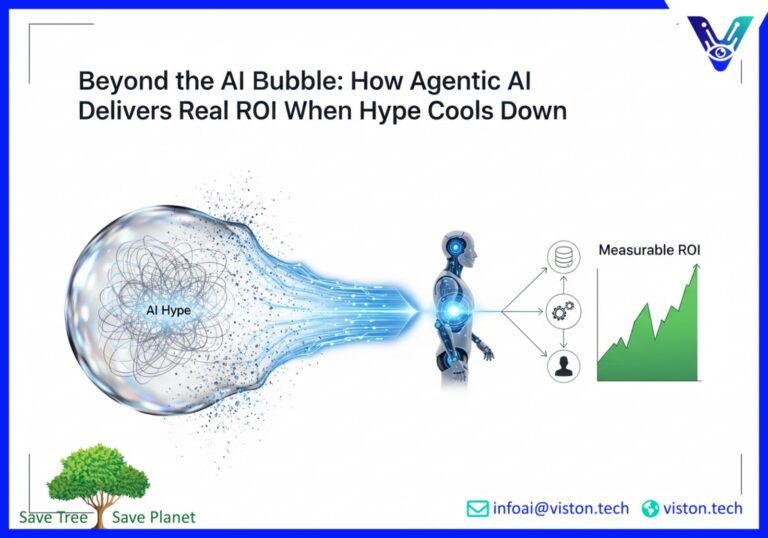
Agentic AI and the Deflating AI Bubble: Winning When Hype Cools Down
The relentless buzz around Artificial Intelligence has felt like a gold rush. Every organization, from startups to global enterprises, has scrambled to invest, experiment, and deploy. But the landscape is shifting. The initial, feverish excitement is meeting a dose of reality. Recent research from MIT signals a significant turning point: the AI bubble is beginning to deflate. This isn’t a sign of AI’s failure. It’s a signal of its maturation.
A sobering report from MIT in 2025 revealed that a staggering 95% of generative AI initiatives in business are failing to produce a measurable return on investment. This massive gap between expectations and reality is causing a market correction. The era of celebrating AI for its novelty is over. We are now entering a more pragmatic phase. A phase where real-world value, tangible ROI, and robust governance are the new metrics for success. For leaders who navigate this transition wisely, the greatest opportunities lie just ahead. This is the moment to move beyond the hype and build a durable competitive advantage with intelligent, action-oriented AI.
The Great AI Reality Check: Why the Bubble is Deflating
For the past few years, the narrative has been “invest in AI or be left behind.” This pressure led to massive spending, often without a clear strategy. Companies invested billions, but the profit and loss statements often remained unchanged. This disconnect is the primary reason the AI bubble is losing air. The market is separating the contenders from the pretenders.
Expectations vs. Reality: The Sobering Statistics
The gap between the promise of AI and its practical application has become a chasm. The MIT report, “The GenAI Divide,” highlights this perfectly. It found that only a tiny 5% of companies have successfully extracted significant value from their AI pilots. The other 95% are stuck in what’s known as “pilot purgatory,” unable to scale their projects or prove their financial worth.
This situation mirrors a classic pattern described in the Gartner Hype Cycle. Technologies often hit a “Trough of Disillusionment” after an initial peak of inflated expectations. Generative AI is now squarely in this phase. The initial awe has faded, replaced by tough questions from leadership about cost, complexity, and actual business impact. The reasons for these failures are not the technology itself, but how it has been applied:
- Lack of Clear Strategy: Many organizations adopted AI tools without first defining the specific business problem they needed to solve.
- Poor Workflow Integration: AI solutions were often bolted on to existing processes rather than being deeply embedded where they could create real change.
- The “Learning Gap”: A significant knowledge gap exists within organizations, making it difficult to identify the best use cases and manage implementation effectively.
- Failure to Measure ROI: Without clear key performance indicators (KPIs) set from the outset, proving the value of AI investments has been nearly impossible.
This reality check is forcing a necessary evolution in how we approach AI. It’s a move away from flashy demos and toward measurable, sustainable value creation.
Beyond the Buzzwords: Enter Agentic AI
As the hype around initial generative AI tools cools, the focus is shifting to a more powerful and promising frontier: Agentic AI. This represents the next logical step in artificial intelligence. If generative AI is about creating content and providing suggestions, agentic AI is about taking action and executing complex tasks autonomously.
What is Agentic AI? A Simple Explanation
Think of it this way: You can ask a generative AI chatbot to write an email draft. An agentic AI system, however, can be tasked with an outcome, like “resolve this customer’s shipping issue.”
The agent would then independently:
- Access the customer’s order history.
- Check the shipping carrier’s tracking data.
- Interface with the inventory management system.
- Compose and send a personalized update email to the customer.
- Initiate a replacement order if necessary.
Agentic AI combines large language models (for reasoning and communication) with the ability to use tools, access data, and execute multi-step workflows. These are not just chatbots; they are autonomous workers designed to achieve specific goals. As we look toward 2026, industry leaders see the development of multi-agent systems—specialized agents collaborating to handle even more complex business processes—as a critical trend.
The Post-Hype Playbook: How to Win When AI Cools Down
The deflation of the AI bubble is a healthy and necessary market correction. It clears out the noise, allowing serious organizations to focus on what truly matters. Companies that thrive in this new era will be those that treat AI not as a magic wand, but as a strategic capability that requires discipline, focus, and foresight. Here is a playbook for winning in the post-hype world.
1. Ditch the Hype, Define the Use Case
The most successful AI adopters start with the problem, not the technology. Instead of asking “where can we use AI?” they ask “what is our most pressing business challenge?” The goal is to find specific, high-value problems where AI can deliver a clear and measurable improvement. Avoid the temptation to boil the ocean. A focused, successful pilot project that solves a real pain point is infinitely more valuable than a dozen stalled, ambitious experiments.
Your Action Plan:
- Identify Pain Points: Where are your biggest operational bottlenecks? What repetitive, low-value tasks are consuming your team’s time? Where could better, faster decisions drive revenue or cut costs?
- Start Small and Focused: Choose one or two use cases where the path to value is clear and relatively short. Success here builds momentum and secures buy-in for future projects.
- Plan for Scale: Design your pilot with scalability in mind. Ensure the data pipelines, technology stack, and operational workflows can support a broader rollout once value is proven.
2. The ROI Imperative: Proving AI’s Worth
In the post-hype era, ROI is non-negotiable. According to Deloitte, while 91% of organizations plan to increase AI investment, leadership is under immense pressure to show financial returns. This means moving beyond vanity metrics and focusing on tangible business outcomes. The key is to define what success looks like before a single line of code is written.
Your Action Plan:
- Establish Clear KPIs: Define your metrics upfront. Are you trying to increase productivity, reduce operational costs, enhance customer satisfaction, or accelerate revenue growth? Assign specific, quantifiable targets to each goal.
- Measure a Baseline: You cannot prove improvement if you don’t know your starting point. Meticulously measure your current performance before implementing an AI solution.
- Think Beyond Cost Reduction: While efficiency is a key benefit, AI’s true transformative power often lies in value creation. Consider metrics like improved decision velocity, enhanced forecast accuracy, and new revenue opportunities unlocked by AI-driven insights.
3. Governance as a Guardrail, Not a Gatekeeper
As AI systems, particularly agentic ones, become more autonomous, governance becomes paramount. A recent Deloitte survey found that agentic AI adoption is rapidly outpacing the development of oversight frameworks. Strong AI governance isn’t about stifling innovation; it’s about enabling it safely and responsibly. It builds trust with customers, ensures compliance with regulations, and protects your brand from reputational risk.
Think of AI governance as the rules of the road for your AI initiatives. It ensures that your AI systems operate ethically, securely, and in alignment with your company’s values and legal obligations.
Your Action Plan:
- Create a Cross-Functional Team: AI governance is not just an IT issue. Your governance team should include representation from legal, compliance, operations, and business leadership.
- Prioritize Data Security and Privacy: Ensure your AI systems comply with data protection regulations like GDPR and CCPA. Classify your data and control access rigorously.
- Establish “Human-in-the-Loop” Protocols: For critical decisions, ensure there is a human checkpoint. This maintains accountability and allows for intervention when an AI agent’s actions could have significant consequences.
- Demand Transparency: Work with partners who provide explainable AI (XAI). You need to understand how your AI models are making decisions, especially in regulated industries.
Viston’s Perspective: Thriving in the New Age of Pragmatic AI
At Viston AI, we see the end of the AI hype cycle as an incredible opportunity. It marks the beginning of an era where substance triumphs over speculation. Our philosophy has always been grounded in the principles that are now becoming critical for survival: a relentless focus on value, a commitment to measurable ROI, and the implementation of robust, intelligent governance.
We believe the future is agentic. The greatest gains will not come from tools that simply assist humans, but from autonomous systems that execute entire business processes with speed, accuracy, and intelligence. However, building and deploying these systems requires a unique blend of strategic insight and technical expertise. This is where we excel.
Our approach is designed for the challenges of 2025 and beyond:
- Strategy First: We don’t start with technology. We start with your business. Our experts work with your leadership to pinpoint the highest-value opportunities for AI-driven transformation.
- Value-Driven Deployment: We specialize in building custom agentic AI solutions that are deeply integrated into your core workflows. We focus on solving complex operational challenges to unlock significant efficiency gains and create new avenues for growth.
- Governance by Design: We build governance into the DNA of our solutions. From data privacy to ethical considerations and human oversight, we ensure your AI is not only powerful but also safe, compliant, and trustworthy.
Navigating the post-hype AI landscape requires a partner who understands the difference between possibility and profitability. Viston AI is that partner. We build the AI-powered solutions that deliver on the promise of technology by focusing squarely on your bottom line.
Conclusion: The End of Hype is the Beginning of Value
The deflating AI bubble is not a crash; it is a clarification. It’s a powerful filter, removing the noise and leaving behind what is real and what is valuable. The organizations that will win in the coming years are not the ones who invested the most during the hype, but those who invest the smartest now that it has cooled.
The path forward is clear. Success depends on a disciplined focus on real-world use cases. It demands a rigorous commitment to measuring and achieving a return on investment. And it is built on a foundation of strong, strategic governance. The shift from generative AI to truly autonomous, agentic AI will accelerate this trend, widening the gap between companies that use AI as a tool and those that rebuild their operations around it.
This is a moment of tremendous opportunity. By embracing a pragmatic, value-driven approach, your organization can move beyond the hype and begin building a future where intelligent automation drives unprecedented growth and innovation. For more insights, we recommend this in-depth report on the state of AI in 2025 by McKinsey.
Frequently Asked Questions (FAQs)
1. What is the “AI bubble” and why is it deflating?
The “AI bubble” refers to the period of intense hype and massive investment in artificial intelligence, particularly generative AI, where market excitement outpaced actual financial returns. It is deflating now because, as a 2025 MIT report found, 95% of businesses are not seeing a measurable ROI from their AI initiatives. This reality check is causing a market correction, shifting focus from hype to tangible value.
2. What is Agentic AI and how is it different from Generative AI?
Generative AI is designed to create new content (text, images, code) based on prompts. Agentic AI is the next evolution; it is a system that can take autonomous action to achieve a specific goal. It can use tools, access data, and execute multi-step processes, essentially acting as an autonomous worker rather than just a creative assistant.
3. How can my business survive the post-hype AI landscape?
Survival and success depend on shifting your strategy. First, focus on solving specific, high-value business problems rather than adopting AI for its own sake. Second, make measuring ROI a mandatory part of every AI project. Finally, implement a strong AI governance framework to manage risks and ensure safe, ethical deployment.
4. Why is AI governance so important now?
As AI becomes more powerful and autonomous (especially with agentic AI), the risks associated with it increase. AI governance provides the necessary rules and oversight to manage data privacy, security, and ethical concerns. It ensures AI is used responsibly, builds trust with customers and stakeholders, and helps companies comply with a growing number of regulations.
5. What does a good AI use case look like?
A good AI use case targets a specific, well-defined business problem. It often involves automating repetitive, high-volume tasks, improving the speed and accuracy of complex decision-making, or personalizing customer experiences at scale. The key is that the potential for measurable improvement (in cost, efficiency, or revenue) is clear from the start.
6. Is it too late to start investing in AI?
Absolutely not. The end of the hype phase is actually the best time to make smart, strategic investments in AI. The market correction is clearing out ineffective solutions, and the focus is now on proven value. By learning from the mistakes of early adopters, companies can now invest more effectively and achieve a clearer path to ROI.
7. How do I measure the ROI of an AI implementation?
ROI can be measured through various KPIs, depending on the use case. Common metrics include productivity gains (e.g., tasks completed per hour), cost savings (e.g., reduced operational or labor costs), revenue growth (e.g., increased sales from personalization), and improvements in customer metrics (e.g., higher satisfaction or lower churn rates).
8. What is “human-in-the-loop” and why does it matter for agentic AI?
“Human-in-the-loop” is a governance practice where a human must review or approve certain actions taken by an AI system. It is crucial for agentic AI, especially in high-stakes situations, as it provides a critical layer of oversight and accountability, preventing autonomous systems from making errors with significant financial or reputational consequences.
Ready to Move Beyond the Hype and Drive Real Value with AI?
The next wave of competition will be defined by intelligent, value-driven AI. If you’re ready to build a pragmatic AI strategy and deploy solutions that deliver measurable ROI, the team at Viston AI can help. We specialize in creating powerful agentic AI systems designed to solve your most complex business challenges.
Contact Viston AI today to learn how our AI-powered solutions can transform your operations and secure your competitive advantage in the new age of AI.