
Agentic AI in the Contact Center: Measuring What Really Matters in 2026
The year is 2026, and the hum of the traditional contact center has been replaced by a symphony of seamless, intelligent interactions. The frantic scramble to answer calls is gone. In its place, a calm, strategic environment thrives, powered by a new kind of workforce: Agentic AI. These aren’t the clunky, rule-based chatbots of the past. These are autonomous, problem-solving agents that think, learn, and resolve complex issues around the clock, in any language.
For years, the promise of AI in customer experience (CX) felt just out of reach. We were told it would revolutionize everything, yet many early efforts resulted in frustrating bot loops and customer churn. But the conversation has shifted. Leaders are no longer asking, “What can AI do?” Instead, they’re focused on, “How do we measure its true impact?” The answer lies in moving beyond outdated metrics and embracing a new framework that captures the essence of a truly intelligent contact center.
This post explores the transformative power of Agentic AI in 2026. We will dissect the modern contact center stack, clarify the collaborative roles of AI and human agents, and introduce the critical new metrics that define success. Get ready to measure what really matters.
The New Face of Customer Service: The Modern Contact Center Stack
To understand the future, we must first understand the foundation. The modern contact center stack is no longer a siloed collection of tools. It’s a deeply integrated, cloud-native ecosystem designed for agility and intelligence. Think of it as a central nervous system connecting every customer touchpoint.
At its core, the stack is built on three pillars:
- Integrated Cloud Platforms (CCaaS): The backbone is a Contact Center as a Service (CCaaS) solution. This provides the flexibility to scale services up or down, manage remote teams, and unify channels like voice, chat, email, and social media into a single, cohesive experience.
- Intelligent Systems of Record (CRM): Your Customer Relationship Management (CRM) platform is more crucial than ever. Enriched with AI, it provides a complete, 360-degree view of every customer, logging interaction histories and predicting future needs to enable hyper-personalization.
- The Agentic AI Layer: This is the game-changer. This layer doesn’t just automate tasks; it orchestrates entire workflows. Agentic AI platforms connect to your existing systems, understand complex requests, and execute multi-step actions to resolve issues from end to end.
This unified stack empowers a new kind of workforce, where digital and human agents collaborate in perfect harmony.
The Unseen Workforce: Roles of Bots and AI Voice Agents
The true power of the 2026 contact center lies in its always-on, multilingual AI agents. These are not mere deflection tools; they are the frontline of your customer service operation, handling a vast majority of interactions with speed and precision.
Their roles are distinct and powerful:
- Instant Resolution: AI agents excel at handling high-volume, transactional inquiries. Think password resets, order tracking, and appointment scheduling. They resolve these issues instantly, 24/7, without wait times.
- Multilingual Fluency: Global business requires global support. AI voice and chat agents can communicate fluently in dozens of languages, eliminating barriers and providing a native-language experience for every customer. For more on this, check out this insightful guide to multilingual AI agents.
- Proactive Engagement: Modern AI doesn’t wait for the customer to reach out. By analyzing behavioral data, it can anticipate needs, flagging a potential delivery issue or offering help to a customer struggling on a checkout page.
- Complex Task Execution: This is what separates agentic AI from simple bots. An agentic AI can process a complex, multi-part request—like changing a flight, upgrading a seat, and applying a travel voucher—by interacting with multiple backend systems autonomously.
The Human Touch: The Evolving Role of the Contact Center Agent
With AI handling the bulk of routine inquiries, what becomes of human agents? They become more valuable than ever. Freed from repetitive tasks, human agents are elevated to roles that require uniquely human skills: empathy, complex problem-solving, and relationship-building.
In the agent+AI collaboration model, your human team becomes:
- Masters of Complexity: Human agents handle the nuanced, emotionally charged, or strategically important conversations that AI escalates. They are the experts your customers turn to when a personal touch is needed.
- Relationship Builders: With more time per interaction, agents can focus on building rapport and long-term customer loyalty. They become trusted advisors and brand ambassadors.
- AI Coaches and Supervisors: Humans-in-the-loop are essential for refining AI performance. Agents provide feedback on AI-led conversations, identify knowledge gaps, and help train the models to become even more effective over time, a practice explored in AI’s impact on customer journeys.
This hybrid model creates a powerful synergy. AI delivers efficiency and scale, while humans provide the high-touch, empathetic experiences that drive true customer loyalty.
Beyond Speed: Measuring What Really Matters in 2026
For decades, contact centers have been obsessed with metrics like Average Handle Time (AHT) and the sheer volume of calls answered. In an AI-powered world, these metrics are not just outdated; they’re counterproductive. Optimizing for speed alone often leads to poor outcomes and frustrated customers. If an AI resolves an issue in 30 seconds but the customer has to call back tomorrow, you haven’t saved time—you’ve destroyed trust.
The future of CX measurement is about outcomes, not activity. It requires a more holistic view that balances efficiency with effectiveness and customer satisfaction. In 2026, success is defined by a new quadfecta of metrics.
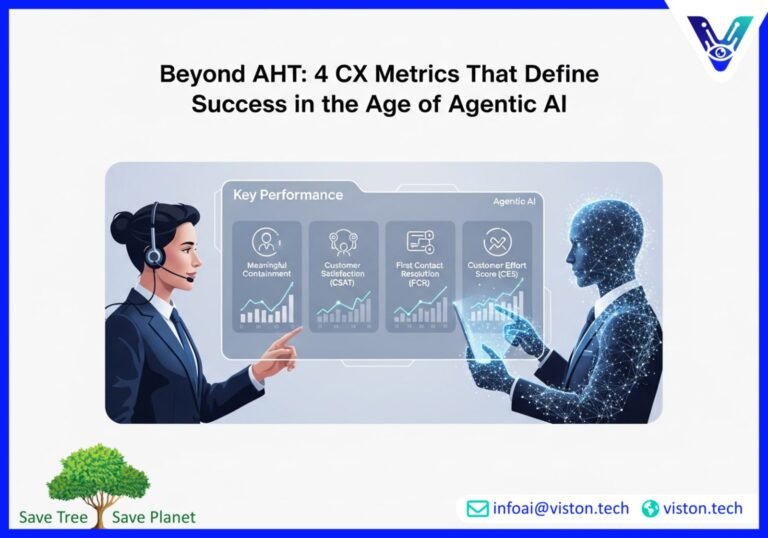
The Power of Four: Containment + CSAT + FCR + Effort
To get a true picture of your contact center’s performance, you must measure these four interconnected KPIs together. Looking at any one in isolation will give you a distorted view.
1. Meaningful Containment Rate
What it is: The percentage of customer issues resolved end-to-end by an AI agent without any human intervention.
Why it matters: This is the primary measure of AI efficiency and ROI. However, the key word is “meaningful.” True containment isn’t just about deflecting a call. It’s about successful, verified resolution. A customer hanging up on a bot in frustration should not count as a contained interaction.
How to improve it:
- Continuously train your AI on real conversation data.
- Grant AI agents secure access to backend systems to perform actions, not just provide information.
- Analyze failed containment attempts to identify and close knowledge gaps.
2. Customer Satisfaction (CSAT) Across All Interactions
What it is: The classic measure of how happy customers are with their interaction, but with a modern twist. CSAT must now be measured for both AI-only and human-assisted journeys.
Why it matters: High containment is meaningless if customers are unhappy with the automated experience. Tracking CSAT for AI interactions ensures your efficiency gains are not coming at the expense of customer relationships. A consistently high AI CSAT score is the ultimate sign of a well-tuned system.
How to improve it:
- Deploy post-interaction surveys for both AI and human-led conversations.
- Use sentiment analysis to gauge customer emotion in real-time.
- Ensure the handoff from AI to a human agent is seamless and context is preserved.
3. First Contact Resolution (FCR)
What it is: The percentage of customer issues resolved in a single interaction, regardless of the channel or whether it was handled by AI, a human, or both.
Why it matters: FCR is the gold standard of an effective contact center. A high FCR rate means you are respecting your customers’ time and resolving their issues correctly the first time. In an agent+AI model, this metric validates that your entire system—from the initial AI engagement to a potential human handoff—is working cohesively.
How to improve it:
- Empower AI and human agents with a unified knowledge base.
- Use intelligent routing to match customers to the agent (AI or human) best equipped to solve their specific problem.
- Analyze repeat contacts to identify the root causes of FCR failures.
4. Customer Effort Score (CES)
What it is: A measure of how easy it was for a customer to get their issue resolved.
Why it matters: Modern customers value ease above all else. Loyalty is driven by low-effort experiences. A great CES score proves that your processes are simple, intuitive, and customer-centric. Agentic AI should make it incredibly easy for customers to get help, and this metric proves it.
How to improve it:
- Proactively offer help on your website or app before a customer has to ask.
- Eliminate the need for customers to repeat information by preserving context across channels.
- Use conversational AI that understands natural language, not rigid command prompts.
Putting It Into Practice: A Real-World Example
Imagine a global retail brand in 2026. A customer in Japan wants to modify a complex online order, changing the size of one item, updating the shipping address for another, and applying a loyalty discount.
- The Old Way (Pre-Agentic AI): The customer struggles with a basic FAQ chatbot. They give up and call support, waiting 15 minutes on hold. They explain their request to a human agent, who then has to manually access three different systems, putting the customer on hold again. The total interaction takes 25 minutes and is prone to human error.
- The Agentic AI Way: The customer initiates a chat. An AI agent greets them in Japanese. It understands the entire multi-part request at once. It authenticates the customer, connects to the order management and shipping logistics systems, verifies the loyalty discount, and confirms all changes in seconds. The entire resolution is contained, the customer rates it “Very Satisfied” (high CSAT), it’s resolved in the first interaction (high FCR), and the process was incredibly simple (low CES).
This is the future—not just faster, but fundamentally smarter and more effective.
The Future is Here: Embracing Agent+AI Collaboration
The transition to an AI-powered contact center is not about replacing humans. It’s about elevating them. As a recent McKinsey report highlights, the goal is to find the right balance between automation and the human touch. Organizations that master this hybrid approach will be the undisputed CX leaders of tomorrow.
By implementing a modern technology stack and focusing on the four critical metrics—Containment, CSAT, FCR, and Effort—you can unlock unprecedented efficiency and build deeper, more meaningful relationships with your customers. The era of agentic AI is here. It’s time to stop measuring activity and start measuring what truly matters.
#ContactCenterAI #CXMetrics #AgentAICollaboration #CustomerExperience #AIin2026 #ConversationalAI #FutureofWork
Frequently Asked Questions (FAQs)
1. What is the main difference between a traditional chatbot and an Agentic AI?
A traditional chatbot follows a pre-programmed script or decision tree. It can only answer specific questions it has been trained on. An Agentic AI, on the other hand, is autonomous. It can reason, plan, and execute complex, multi-step tasks across different systems to achieve a goal, much like a human agent would.
2. Will Agentic AI replace all human contact center agents?
No. The future is a collaborative, hybrid model. Agentic AI will handle the majority of routine and transactional inquiries, which frees up human agents to focus on high-value, complex, and emotionally sensitive interactions that require empathy and critical thinking.
3. How does Agentic AI handle multiple languages?
Modern Agentic AI is built on advanced Large Language Models (LLMs) that can be trained to understand and respond fluently in dozens of languages. This allows businesses to offer consistent, high-quality support to a global customer base without hiring native speakers in every region.
4. Is it difficult to integrate Agentic AI with our existing CRM and other systems?
Leading Agentic AI platforms are designed with integration in mind. They use APIs (Application Programming Interfaces) to connect seamlessly with major CRM, ERP, and other business systems. While implementation requires planning, it’s far more accessible than building a custom solution from scratch.
5. Why is Customer Effort Score (CES) becoming such an important CX metric?
Research consistently shows that reducing customer effort is a stronger driver of loyalty than creating moments of “delight.” Customers want their problems solved quickly and easily. CES directly measures this, making it a powerful predictor of customer retention and lifetime value.
6. How can our business get started with implementing Agentic AI?
The best first step is to identify the most common, repetitive, and high-volume inquiries your contact center currently handles. These are the ideal candidates for automation. Partnering with an expert AI solutions provider can help you build a strategic roadmap for a phased and successful implementation.
7. How does Agentic AI improve the employee experience for human agents?
By automating monotonous and repetitive tasks, Agentic AI reduces agent burnout. It allows them to focus on more engaging and challenging work where they can use their skills to make a real impact. This leads to higher job satisfaction, better performance, and lower employee attrition.
8. What kind of ROI can we expect from investing in Contact Center AI?
The ROI from Agentic AI is multi-faceted. It includes significant operational cost savings from automating tasks, increased revenue through better customer retention and loyalty, and improved efficiency as both AI and human agents become more productive.
Ready to Transform Your Contact Center?
The future of customer experience is intelligent, efficient, and collaborative. If you’re ready to move beyond outdated metrics and unlock the true potential of your customer service operations, the time to act is now.
Contact Viston AI today to learn how our industry-leading, AI-powered solutions can help you build the contact center of 2026 and start measuring what really matters.
