
Designing Agentic Workflows: From Process Mining to Agent Orchestration
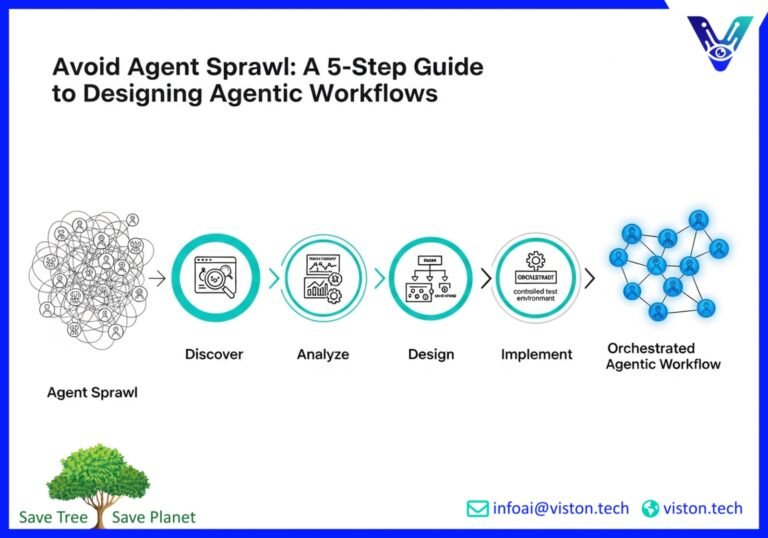
The age of AI is upon us, and with it comes a new paradigm for automation: agentic workflows. No longer are we just automating repetitive tasks. We are now orchestrating intelligent AI agents to handle complex, end-to-end processes. This shift promises unprecedented efficiency and innovation. However, it also introduces new challenges. Without a strategic approach, organizations risk creating a chaotic “agent sprawl,” where multiple, uncoordinated AI agents operate in silos, leading to complexity and inefficiency. This is where a methodical approach to workflow design, grounded in process mining, becomes crucial. By designing processes with AI agents in mind from the outset, you can prevent unnecessary complexity and ensure that your AI initiatives deliver tangible value.
This blog post presents a 5-step methodology for designing agentic workflows, from initial process discovery to sophisticated agent orchestration. We will explore how to identify the best opportunities for automation and how to design workflows that are efficient, scalable, and manageable. This guide is for you, whether you are a C-Suite executive aiming to drive digital transformation, an AI engineer building the future of automation, or a product manager looking to leverage AI in your offerings.
The Challenge of Agent Sprawl: Why a Cohesive Strategy is Essential
The excitement around AI has led many organizations to adopt a bottom-up approach to automation. Individual teams and departments, eager to innovate, start deploying AI agents to solve immediate problems. While this can lead to quick wins, it often results in a fragmented and chaotic technological landscape. This “agent sprawl” creates several significant challenges:
- Increased Complexity: A multitude of disconnected AI agents makes it difficult to understand and manage your overall automation ecosystem.
- Redundant Efforts: Different teams might build similar agents for similar tasks, leading to wasted resources and inconsistent processes.
- Lack of Governance: Without a centralized strategy, it’s challenging to enforce security, compliance, and ethical guidelines for your AI agents.
- Diminished ROI: The full potential of AI is realized when agents work together. A siloed approach limits the overall return on your AI investment.
A deliberate and strategic approach to designing agentic workflows is the key to avoiding these pitfalls. By starting with a clear understanding of your existing processes and a vision for how AI agents can enhance them, you can build a cohesive and effective automation ecosystem.
The 5-Step Methodology for Designing Agentic Workflows
To navigate the complexities of AI-powered automation, a structured methodology is essential. Our 5-step approach provides a clear roadmap for designing and implementing effective agentic workflows.
Step 1: Discover and Map Your Processes with Process Mining
Before you can automate a process, you need to understand it. Process mining offers a data-driven approach to discovering how your business processes actually operate. It analyzes the digital footprints left in your IT systems—such as timestamps, user IDs, and activity logs in your CRM or ERP—to create a detailed visual map of your workflows. This provides an objective view of your processes, often revealing surprising deviations from the “official” procedures.
User-Friendly Process Mining Tools for 2025:
- Celonis: A market leader that provides a powerful “digital twin” of your organization’s processes, allowing you to visualize and analyze workflows in real-time. Celonis is known for its robust features and enterprise-level capabilities.
- UiPath Process Mining: Seamlessly integrated with its broader automation platform, UiPath helps you identify automation opportunities and measure their impact. Its user-friendly interface makes it accessible to a wide range of users.
- SAP Signavio: For organizations heavily invested in the SAP ecosystem, Signavio offers deep integration and a collaborative approach to process modeling and improvement.
These tools can help you answer critical questions: Where are the bottlenecks? Which activities are the most time-consuming? Where do errors most frequently occur? The insights gained from process mining are the foundation for effective workflow design.
Step 2: Identify High-Impact Automation Opportunities
With a clear picture of your current processes, the next step is to identify the best candidates for automation. Not all processes are equally suited for AI agents. The ideal opportunities are those that are not only inefficient but also have a significant impact on your business objectives. When evaluating potential automation opportunities, consider the following:
- Repetitive and Rule-Based Tasks: These are the low-hanging fruit for automation. Tasks like data entry, invoice processing, and report generation are often prime candidates.
- High-Volume Processes: Automating processes that occur frequently can deliver substantial time and cost savings.
- Processes with High Error Rates: AI agents can perform tasks with a high degree of accuracy, reducing the risk of human error in critical processes.
- Complex Decision-Making: Modern AI agents are capable of handling complex decision-making processes, such as fraud detection or customer sentiment analysis.
A valuable tool for this step is the Impact-Feasibility Matrix. Plot potential automation opportunities based on their potential impact on your business and the technical feasibility of implementing them. This will help you prioritize your efforts and focus on the initiatives that will deliver the greatest return on investment.
Step 3: Design Agentic Workflows with a “Human-in-the-Loop” Approach
Once you’ve identified your target processes, it’s time to design the new, agent-powered workflow. A key principle here is to design with agents in mind from the very beginning. Instead of simply layering AI on top of existing processes, rethink the entire workflow to leverage the unique capabilities of AI. This is also the stage to consider the role of human oversight. A “human-in-the-loop” approach ensures that while agents handle the bulk of the work, humans can intervene at critical decision points, review outputs, and manage exceptions. This builds trust and ensures that your automation is both effective and responsible.
Key Considerations for Agent Design:
- Define Clear Roles and Responsibilities: Each agent in your workflow should have a specific purpose and a well-defined set of tasks.
- Modularity and Reusability: Design agents as modular components that can be reused across different workflows. This promotes scalability and reduces development time.
- Data and Tool Access: Determine what data and tools each agent needs to perform its tasks and ensure secure and efficient access.
Step 4: Implement and Test in a Controlled Environment
With the workflow design in place, the next phase is implementation. This involves developing or configuring the AI agents and integrating them with your existing systems. It’s crucial to start with a pilot project in a controlled environment. This allows you to test the workflow, identify and resolve any issues, and gather feedback from stakeholders before a full-scale rollout.
During the implementation and testing phase, pay close attention to:
- Performance Metrics: Track key performance indicators (KPIs) such as processing time, error rates, and cost savings to measure the impact of your new workflow.
- User Feedback: Gather feedback from the employees who will be interacting with the new system to ensure a smooth transition and high adoption rates.
- Scalability and Reliability: Ensure that your agentic workflow is robust enough to handle real-world volumes and can scale as your business grows.
For more on the future of AI in business, check out this insightful article from Harvard Business Review.
Step 5: Orchestrate and Continuously Optimize Your Agents
As you deploy more AI agents across your organization, the need for effective orchestration becomes paramount. Agent orchestration is the process of managing and coordinating the interactions between multiple AI agents to achieve a common goal. This is where you move from automating individual tasks to automating entire business processes.
Common Orchestration Patterns:
- Sequential Orchestration: Agents perform tasks in a predefined sequence, with the output of one agent serving as the input for the next. This is suitable for linear and predictable processes.
- Parallel Orchestration: Multiple agents work on different parts of a task simultaneously, significantly speeding up the overall process. This is ideal for tasks that can be broken down into independent sub-tasks.
- Hierarchical Orchestration: A “supervisor” agent breaks down a complex task into smaller sub-tasks and assigns them to specialized “worker” agents. The supervisor then coordinates the efforts of the worker agents and synthesizes their outputs.
Effective orchestration prevents agent sprawl and ensures that your AI agents work together harmoniously. Furthermore, the world of AI is constantly evolving. A successful agentic workflow is one that is continuously monitored and optimized. Use the data from your process mining tools and performance metrics to identify areas for improvement and refine your workflows over time.
For a deeper dive into process mining and automation, explore the resources available from industry leaders like Celonis and UiPath.
Conclusion: The Future of Work is Agentic
Designing and implementing agentic workflows is a transformative journey that requires a strategic and methodical approach. By starting with process mining, you can gain a deep understanding of your existing processes and identify the most promising opportunities for automation. Following a structured 5-step methodology will enable you to design and build efficient, scalable, and manageable agentic workflows that deliver real business value. By embracing this new paradigm of automation, you can not only avoid the pitfalls of agent sprawl but also unlock the full potential of AI to drive innovation and growth in your organization.
Take the Next Step with Viston AI
Ready to embark on your agentic workflow journey? At Viston AI, we specialize in helping businesses like yours leverage the power of AI to automate complex processes and drive transformative results. Our team of experts can guide you through every step of the process, from initial process discovery to the orchestration of sophisticated multi-agent systems. Contact us today to learn how our AI-powered solutions can help you design the future of work in your organization.
Frequently Asked Questions (FAQs)
- 1. What is the difference between traditional automation and agentic workflows?
- Traditional automation, like Robotic Process Automation (RPA), is typically rule-based and designed for simple, repetitive tasks. Agentic workflows, on the other hand, leverage AI to handle more complex, multi-step processes. AI agents can make decisions, learn from data, and collaborate with other agents to achieve goals.
- 2. How does process mining help in designing agentic workflows?
- Process mining provides a data-driven view of your existing processes, highlighting inefficiencies, bottlenecks, and deviations. This allows you to identify the best opportunities for automation and design workflows that address the root causes of problems.
- 3. What are some real-world examples of agentic workflows?
- Agentic workflows are being used across various industries. In finance, they are used for fraud detection and loan processing. In healthcare, they assist with patient scheduling and medical billing. In customer service, they power intelligent chatbots that can handle complex queries.
- 4. What is “agent sprawl” and how can I prevent it?
- “Agent sprawl” refers to the uncoordinated proliferation of AI agents within an organization, leading to complexity and inefficiency. You can prevent it by adopting a centralized and strategic approach to workflow design, focusing on modular and reusable agent components, and implementing effective orchestration and governance.
- 5. How do I get started with designing agentic workflows in my organization?
- A great starting point is to conduct a pilot project using a process mining tool to analyze a specific business process. This will help you understand the potential of this technology and build a business case for a broader implementation.
- 6. What skills are needed to design and manage agentic workflows?
- A combination of skills is beneficial, including business process knowledge, data analysis skills, and an understanding of AI and machine learning concepts. However, with the rise of user-friendly no-code and low-code platforms, designing agentic workflows is becoming more accessible to non-technical users.
- 7. How can I measure the ROI of my agentic workflow initiatives?
- You can measure the ROI by tracking key performance indicators (KPIs) such as cost savings from reduced manual labor, increased revenue from improved efficiency, and improvements in customer satisfaction and employee productivity.
- 8. What is the role of a “human-in-the-loop” in agentic workflows?
- A “human-in-the-loop” approach ensures that there is human oversight at critical points in the automated process. This can involve reviewing AI-driven decisions, handling exceptions that agents cannot manage, and providing feedback to help improve the AI models over time.
#ProcessMining #WorkflowDesign #AutomationPatterns #AgentDesign #AgenticWorkflows #AI #ArtificialIntelligence #Automation #DigitalTransformation #FutureOfWork
