
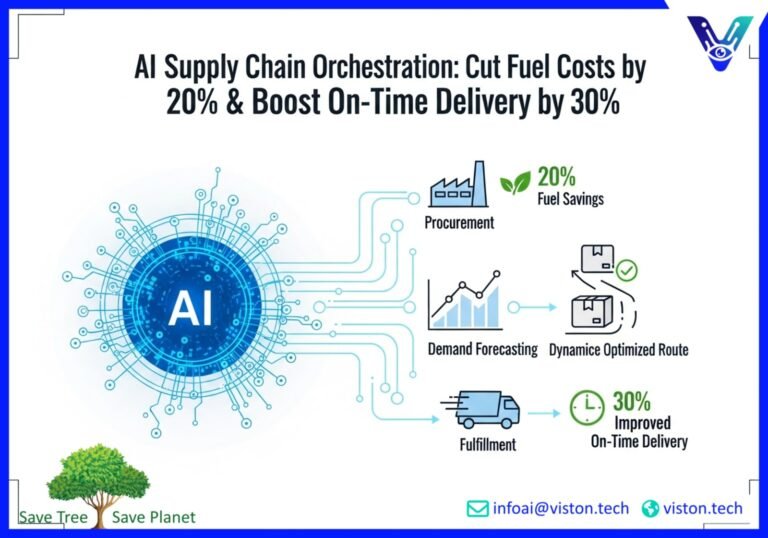
Supply Chain Orchestration with AI Agents: 20% Fuel Savings and 30% Improved On-Time Delivery
In today’s volatile market, supply chain disruptions are no longer a matter of if, but when. Traditional supply chains, often rigid and siloed, struggle to keep pace with fluctuating demand, geopolitical instability, and ever-increasing customer expectations. The result? Escalating costs, missed delivery windows, and a constant state of firefighting for logistics teams. But a new era of supply chain management is dawning, powered by the transformative capabilities of Artificial Intelligence (AI). Welcome to the age of Supply Chain Orchestration with AI Agents.
Imagine a supply chain that doesn’t just react to disruptions but anticipates and autonomously resolves them. A network so intelligent it optimizes every decision in real-time, from procurement to final-mile delivery. This isn’t science fiction; it’s the reality for businesses embracing AI-driven orchestration. The impact is staggering: companies are reporting up to a 30% improvement in on-time delivery, a 20% reduction in fuel costs, and a 90% decrease in latency when resolving disruptions. This blog post explores how AI agents are revolutionizing supply chain management and delivering a powerful competitive advantage.
The Core Problem: A Disconnected Supply Chain
For too long, supply chains have operated as a series of disconnected nodes. Procurement, inventory, transportation, and fulfillment each have their own systems and often, their own goals. This lack of integration creates blind spots and inefficiencies. A delay in one area can have a cascading effect across the entire network, but the information often arrives too late for an effective response. This reactive approach is costly, inefficient, and simply unsustainable in the modern economy.
Enter the AI Agent Ecosystem: Your Autonomous Supply Chain Team
AI-powered supply chain orchestration dismantles these silos, creating a unified, intelligent, and collaborative network. Think of it as a team of highly specialized AI agents, each an expert in its domain, working together in perfect harmony. This multi-agent ecosystem is the engine of the modern, resilient supply chain.
Key Players in the AI Agent Ecosystem:
- Procurement Agents: These agents continuously scan the market for the best suppliers, factoring in price, lead times, and reliability. They can even automate the reordering process when inventory levels reach a certain threshold, preventing stockouts and emergency procurement situations.
- Inventory Agents: By analyzing historical sales data, seasonal trends, and even external factors like weather patterns, these AI agents provide highly accurate demand forecasting. This allows for optimized inventory levels, reducing carrying costs and the risk of obsolete stock.
- Transportation Agents: These are the masters of logistics optimization. They analyze real-time traffic data, weather conditions, and fuel prices to determine the most efficient delivery routes. This dynamic routing can lead to significant fuel savings and a substantial reduction in carbon emissions.
- Fulfillment Agents: In the warehouse, fulfillment agents orchestrate the picking, packing, and shipping processes. They can direct robotic systems, optimize storage space, and ensure that orders are fulfilled with speed and accuracy.
Real-Time Decision-Making: The Power of Now
The true game-changer in AI-driven supply chain orchestration is the ability to make intelligent decisions in real-time. Traditional supply chains often rely on batch processing of data, leading to a lag between an event and the response. AI agents, however, process a constant stream of data from across the supply chain. This allows them to detect potential disruptions as they happen and take immediate corrective action. For more on this, Forbes offers valuable insights into real-time decision-making.
Consider a scenario where a key shipping lane is unexpectedly closed. In a traditional supply chain, this might not be discovered for hours, leading to significant delays. With AI orchestration, the transportation agent would immediately be aware of the closure, and in collaboration with the inventory and fulfillment agents, would already be rerouting shipments and adjusting delivery schedules. This autonomous disruption resolution can reduce the time it takes to resolve issues by up to 90%.
The Network Effect: A Smarter Supply Chain Every Day
One of the most powerful aspects of an AI-driven supply chain is the network effect. The more data the AI agents process, the smarter they become. Every shipment, every delay, and every successful delivery provides valuable information that is used to refine future decisions. This continuous learning process means that the supply chain is constantly improving, becoming more efficient and more resilient over time.
This creates a powerful competitive advantage. While your competitors are still struggling with manual processes and siloed data, your AI-powered supply chain is becoming faster, more reliable, and more cost-effective with each passing day. The World Economic Forum highlights how AI unlocks the full potential of supply chains through this interconnected intelligence.
The Tangible Benefits: Beyond the Buzzwords
The move to an AI-orchestrated supply chain isn’t just about adopting the latest technology; it’s about driving real, measurable results. Let’s break down the key benefits:
- 30% Improvement in On-Time Delivery: By proactively addressing potential delays and optimizing every step of the logistics process, AI agents ensure that your products reach your customers on time, every time. This leads to increased customer satisfaction and loyalty.
- 20% Fuel Savings: Dynamic route optimization, powered by AI, can significantly reduce fuel consumption. This not only lowers your transportation costs but also helps your organization achieve its sustainability goals by reducing its carbon footprint.
- Autonomous Disruption Resolution (90% Latency Reduction): The ability of AI agents to detect and resolve disruptions in real-time is a game-changer. This agility minimizes the impact of unforeseen events, ensuring the continuity of your operations.
Is Your Business Ready for the AI Revolution in Supply Chain?
The question is no longer whether AI will transform the supply chain, but when you will embrace this transformation. The benefits are too significant to ignore. From enterprise-level corporations to agile startups, businesses of all sizes can leverage the power of AI to create a more resilient, efficient, and customer-centric supply chain. To understand how your business can get started, consider this comprehensive guide from McKinsey on the future of supply chains.
Take the Next Step with Viston AI
The journey to a fully orchestrated, AI-powered supply chain may seem daunting, but it doesn’t have to be. At Viston AI, we specialize in developing cutting-edge AI-powered solutions that are tailored to the unique needs of your business. Our team of experts will work with you to design and implement an AI agent ecosystem that will unlock new levels of efficiency and resilience in your supply chain.
Don’t let your business be left behind. Contact Viston AI today to learn how our AI-powered solutions can help you achieve 20% fuel savings, a 30% improvement in on-time delivery, and a supply chain that is ready for the future.
#SupplyChainAI #LogisticsOptimization #DemandForecasting #AIagents #SupplyChainOrchestration #FutureOfLogistics #DigitalTransformation
Frequently Asked Questions (FAQs)
What is supply chain orchestration?
Supply chain orchestration is the real-time, data-driven coordination of all activities across the supply chain, from procurement and manufacturing to logistics and fulfillment. The goal is to create a seamless, efficient, and resilient flow of goods and information.
How do AI agents work in a supply chain?
AI agents are intelligent software programs that are designed to perform specific tasks within the supply chain. For example, a procurement agent might monitor supplier performance, while a transportation agent optimizes delivery routes. These agents communicate with each other to make coordinated, real-time decisions.
What are the main benefits of using AI in supply chain management?
The primary benefits include increased efficiency, reduced costs, improved on-time delivery rates, enhanced demand forecasting accuracy, and greater resilience to disruptions.
Is AI-powered supply chain orchestration suitable for small and medium-sized businesses?
Absolutely. While traditionally seen as a tool for large enterprises, cloud-based AI solutions are making this technology more accessible and affordable for businesses of all sizes.
What is the difference between supply chain automation and orchestration?
Automation focuses on using technology to perform repetitive tasks. Orchestration, on the other hand, is about intelligently coordinating all the different elements of the supply chain to work together as a unified whole.
How does AI improve demand forecasting?
AI algorithms can analyze vast amounts of data, including historical sales, market trends, weather patterns, and even social media sentiment, to create highly accurate demand forecasts. This helps businesses optimize inventory levels and avoid stockouts or overstock situations.
What is autonomous disruption resolution?
Autonomous disruption resolution is the ability of an AI-powered system to detect, analyze, and resolve supply chain disruptions without human intervention. This could involve rerouting shipments, finding alternative suppliers, or adjusting production schedules in real-time.
How can I get started with implementing AI in my supply chain?
The first step is to identify the key areas of your supply chain that could benefit most from AI. Partnering with a specialist provider like Viston AI can help you develop a clear roadmap for implementation and ensure a successful transition.
