
# AI Ethics and Governance: Building Trustworthy Enterprise AI in 2025
In the race to innovate, enterprises are rapidly embedding artificial intelligence into their core operations. From enhancing customer support to driving creative workflows, AI is no longer a futuristic concept but a present-day reality. However, as AI’s influence grows, so does the imperative for responsible implementation. The year 2025 marks a pivotal shift where the focus on AI is not just about advancing capabilities, but equally about ensuring governance, safety, and accountability. This evolution isn’t just a matter of compliance; it’s the foundation for building sustainable trust with customers, stakeholders, and the public.
For enterprises, the message is clear: robust AI ethics and governance are no longer optional—they are a business necessity. Organizations that prioritize creating trustworthy AI systems will not only mitigate significant risks but also unlock greater long-term value and cement their position as industry leaders.
## The Urgent Need for Responsible AI
The initial wave of AI adoption often outpaced traditional oversight, leading to a landscape fraught with potential risks. Algorithmic bias, data privacy breaches, and “black box” decision-making can trigger severe legal, ethical, and reputational damage. As a result, governments and regulatory bodies worldwide are introducing stricter guidelines. Frameworks like the EU AI Act are compelling organizations to move beyond surface-level compliance and adopt a more proactive stance on AI governance.
This new era of **responsible AI** is built on several key pillars:
* Accountability: Assigning clear ownership for the entire AI lifecycle, from development to deployment and ongoing monitoring.
* Transparency: Ensuring that AI-driven decisions are explainable, auditable, and traceable.
* Fairness: Actively identifying and mitigating harmful biases to prevent discriminatory outcomes.
* Privacy: Safeguarding personal and sensitive data through robust consent management and security protocols.
Enterprises that embrace these principles are better positioned to build trust and navigate the complex regulatory environment.
## Your 2025 AI Governance Blueprint
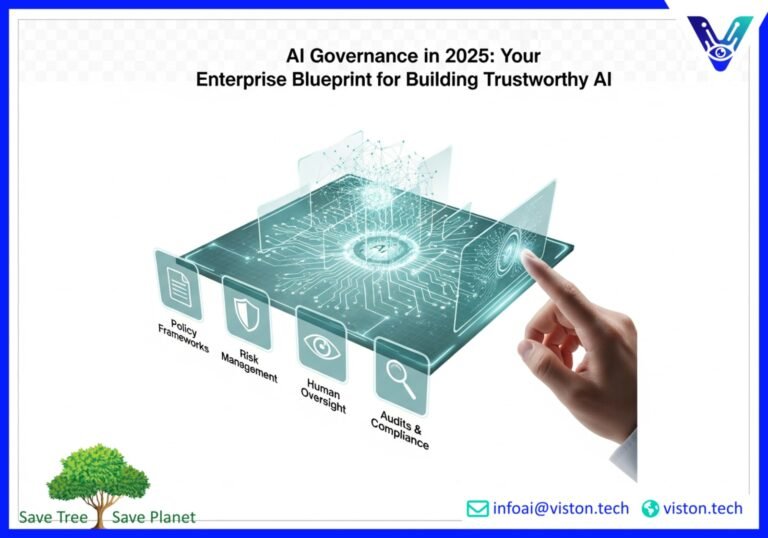
A successful AI governance strategy requires a structured and holistic approach. Here’s a breakdown of the essential components your enterprise should prioritize in 2025.
### 1. Establishing Comprehensive Policy Frameworks
Effective AI governance begins with a clear and actionable policy framework. This is the foundational document that aligns your organization’s AI initiatives with its core values and legal obligations. Gone are the days of ad-hoc guidelines; 2025 demands a formalized approach.
Your policy framework should explicitly define:
* Acceptable Use: Clearly outline the approved applications of AI within your organization and specify any prohibited uses.
* Data Governance: Establish strict rules for data sourcing, handling, and privacy to ensure the integrity and security of the data fueling your AI models.
* Ethical Principles: Codify your commitment to fairness, transparency, and accountability, providing a clear reference point for all AI-related projects.
* Compliance Requirements: Integrate global and industry-specific regulations into your framework to ensure all AI systems are compliant by design.
Developing a robust policy framework requires a collaborative effort, bringing together leaders from legal, IT, data science, and business units to ensure a comprehensive and practical approach.
### 2. Implementing Dynamic Risk Registers
As AI systems become more integrated into business processes, managing potential risks becomes a critical function. An AI-specific risk register is an essential tool for identifying, assessing, and mitigating potential issues before they escalate. This is a departure from traditional risk management, as AI introduces unique challenges such as algorithmic bias and model drift.
Your AI risk register should be a living document that tracks:
* Potential Risks: Identify a wide range of risks, including data privacy violations, biased decision-making, security vulnerabilities, and compliance gaps.
* Risk Likelihood and Impact: Evaluate the probability and potential severity of each identified risk to prioritize mitigation efforts.
* Mitigation Strategies: Develop and document clear strategies to address each risk, assigning ownership to specific teams or individuals.
* Monitoring and Review: Regularly review and update the risk register to reflect changes in your AI systems and the evolving regulatory landscape.
By proactively managing risks, you can prevent costly errors and build more resilient and trustworthy AI applications. For further reading on this, NIST’s AI Risk Management Framework offers comprehensive guidance.
### 3. Prioritizing Meaningful Human Oversight
While AI can automate complex tasks, the importance of human oversight cannot be overstated. In 2025, the focus is on creating a “human-in-the-loop” system where human judgment and ethical considerations remain central to the decision-making process. This is particularly crucial for high-stakes applications in sectors like healthcare, finance, and human resources.
Effective human oversight involves:
* Clear Accountability Structures: Establish a clear chain of command for AI-driven decisions, ensuring that a human is ultimately responsible for the outcomes.
* Intervention Protocols: Create mechanisms for human intervention to override or correct AI-generated decisions that may be flawed or biased.
* Specialized Training: Equip your teams with the necessary skills to understand, interpret, and challenge the outputs of AI systems. This includes training on identifying potential biases and understanding the limitations of the technology.
* Cross-functional Governance Committees: Form a dedicated committee with representatives from various departments to oversee the ethical implications of AI deployment and ensure alignment with organizational values.
By maintaining meaningful human oversight, you can mitigate the risks associated with fully automated decisions and ensure that your AI systems operate in a safe and ethical manner.
### 4. Implementing Robust Audits and Incident Response
Continuous monitoring and auditing are essential for maintaining the integrity of your AI systems over time. Models can degrade, and biases can emerge as data patterns shift. A proactive approach to audits and a well-defined incident response plan are critical components of a comprehensive AI governance strategy.
Your audit and incident response plan should include:
* Regular Audits: Conduct periodic audits of your AI systems to assess their performance, fairness, and compliance with internal policies and external regulations.
* Drift Detection: Implement monitoring tools to detect “model drift,” which occurs when the performance of an AI model degrades due to changes in the data.
* Incident Response Protocol: Develop a clear and actionable plan for responding to AI-related incidents, such as data breaches, biased outcomes, or system failures. This plan should outline roles, responsibilities, and communication strategies.
* Transparency Reporting: Be prepared to transparently report on the performance and impact of your AI systems to stakeholders and regulatory bodies.
A strong audit and incident response framework not only helps you identify and address issues quickly but also demonstrates a commitment to accountability and continuous improvement. Interested in learning more about AI regulations? The EU AI Act is a key piece of legislation to understand.
## The Future is Trustworthy AI
As we look ahead, the conversation around AI is maturing. The focus is no longer solely on what AI can do, but on how it should be done. For enterprises, this means embedding ethics and governance into the very fabric of their AI strategy. By prioritizing **responsible AI**, establishing robust **AI governance**, and diligently managing **risk and compliance**, organizations can build AI systems that are not only powerful but also trustworthy.
This commitment to ethical AI is not just about mitigating risk; it’s a strategic advantage. It builds stronger customer loyalty, enhances brand reputation, and fosters a culture of innovation that is both ambitious and accountable.
Ready to build trustworthy AI solutions for your enterprise? Contact Viston AI today to learn how our AI-powered solutions can help you navigate the future of AI with confidence.
—
### Frequently Asked Questions (FAQs)
What is AI governance and why is it important in 2025?
AI governance is the framework of policies, processes, and controls that ensure the responsible and ethical use of artificial intelligence. In 2025, it’s crucial because as AI becomes more integrated into business operations, the risks of bias, data breaches, and non-compliance have grown. Strong governance helps mitigate these risks, build trust, and ensure that AI aligns with business objectives and societal values.
What are the core components of a responsible AI framework?
A responsible AI framework is typically built on principles of accountability, transparency, fairness, and privacy. It includes clear policies for AI use, robust data governance, mechanisms for human oversight, and continuous monitoring to ensure that AI systems operate ethically and safely.
How can an enterprise begin to implement an AI governance strategy?
A great starting point is to form a cross-functional team with representatives from legal, IT, data, and business units. This team can begin by assessing the organization’s current AI usage, identifying potential risks, and drafting an initial policy framework. Starting with a clear charter and executive sponsorship is key to success.
What is an AI risk register and how does it differ from traditional risk management?
An AI risk register is a tool used to specifically track and manage risks associated with AI systems, such as algorithmic bias, model drift, and security vulnerabilities. Unlike traditional risk registers, it addresses the unique and dynamic challenges posed by AI, requiring continuous monitoring and specialized mitigation strategies.
Why is human oversight so critical in AI systems?
Human oversight ensures that there is ultimate accountability for AI-driven decisions. It provides a necessary check on automated systems, allowing for the correction of errors, the mitigation of biases, and the application of ethical judgment in complex situations. This is especially important in high-stakes decisions that directly impact individuals.
What does an AI audit typically involve?
An AI audit is a systematic evaluation of an AI system to assess its performance, fairness, transparency, and compliance. This can involve reviewing the training data for biases, testing the model’s accuracy and reliability, and ensuring that its decision-making processes are explainable and auditable.
How do evolving regulations like the EU AI Act impact enterprise AI?
Regulations like the EU AI Act are setting new global standards for AI governance. They require enterprises to adopt a risk-based approach, with stricter requirements for high-risk AI systems. This impacts how companies develop, deploy, and monitor their AI applications, making compliance a central part of their AI strategy.
What is the first step my company should take to improve its AI ethics?
The first step is to establish a clear set of ethical principles that will guide all AI development and deployment. This should be a collaborative process involving diverse stakeholders. Once these principles are defined, they can be translated into actionable policies and integrated into your AI governance framework.
