
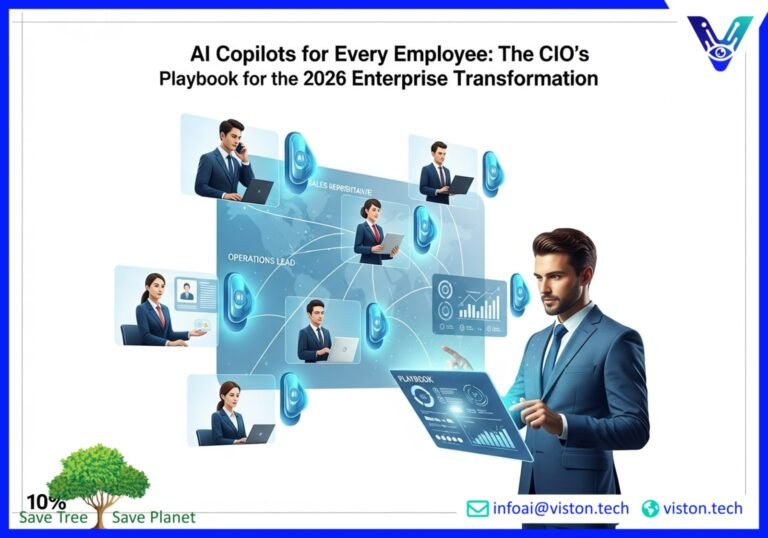
Every Employee Gets an AI Copilot: What CIOs Must Do in 2026
The year is 2026, and the modern workplace is on the cusp of its next great evolution. Leading analysts predict that within the next year, every employee will have a dedicated AI assistant. This isn’t just a chatbot for simple questions. We’re talking about a sophisticated, agentic AI copilot capable of handling complex, multi-step tasks, fundamentally changing how work gets done. For Chief Information Officers, this isn’t a distant future—it’s the immediate reality that demands a strategic response. The era of the enterprise copilot is here, and it’s time to prepare your organization for a seismic shift in productivity and innovation.
This transformation is moving beyond basic conversational interfaces. By 2026, AI assistants are expected to become as mainstream as ChatGPT is today, but with far greater capabilities. They will proactively surface information, manage workflows, and free up human talent to focus on strategic decision-making. For CIOs, the challenge and opportunity lie in leading this charge, ensuring that the integration of employee AI assistants is not just a technological upgrade, but a core driver of business value.
The Dawn of the Agentic AI: More Than Just Q&A
Let’s be clear: the AI copilots of 2026 are not glorified search bars. They are proactive, intelligent agents. Think of them as a digital chief of staff for every employee. These assistants will understand context, anticipate needs, and execute complex sequences of actions across multiple applications. Imagine an AI that not only drafts an email but also schedules the follow-up meeting, updates the CRM, generates a preparatory brief, and analyzes sentiment from previous interactions—all from a single voice command or text prompt.
This leap from passive assistance to active execution is what defines the next generation of enterprise AI. It’s about moving from a tool that answers questions to a teammate that gets things done. For organizations that get this right, the competitive advantage will be immense, unlocking new levels of efficiency and allowing employees to operate at the top of their cognitive abilities.
Mapping the Enterprise Copilot to Every Role
The true power of a universal AI assistant lies in its adaptability to specific roles and functions. A one-size-fits-all approach won’t cut it. The most successful implementations will tailor AI copilots to the unique workflows of different departments. Here’s how this could look across your organization:
Sales Teams Supercharged
For sales professionals, time is money. An enterprise copilot can automate many of the repetitive tasks that bog down a sales cycle, allowing them to focus on building relationships and closing deals. An AI assistant can:
- Automate Lead Qualification: Sift through incoming leads, score them based on predefined criteria, and assign them to the appropriate sales rep.
- Streamline Meeting Prep: Automatically generate pre-meeting briefs with key information about a prospect, their company, and past interactions.
- Draft Personalized Outreach: Create tailored email sequences and follow-up messages based on a prospect’s industry, role, and engagement history.
- Optimize CRM Management: Handle data entry, update contact records, and log activities, ensuring the CRM is always accurate and up-to-date.
Human Resources, Reimagined
HR departments can leverage AI to create a more efficient and personalized employee experience. From recruitment to retirement, an AI copilot can transform key HR functions:
- Enhance Recruiting: Assist in writing job descriptions, screening resumes, and scheduling interviews, freeing up recruiters to focus on candidate engagement.
- Streamline Onboarding: Guide new hires through the onboarding process, answer common questions about company policies and benefits, and schedule introductory meetings.
- Support Employee Development: Help employees identify career paths, suggest relevant training courses, and manage development goals. For an in-depth look at how AI is reshaping HR, read more on the future of AI in human resources.
- Improve Employee Engagement: Act as a self-service portal for HR-related queries, providing instant answers and freeing up HR professionals for more strategic initiatives.
Operations Optimized for Efficiency
In operations, the focus is on streamlined processes and flawless execution. An enterprise copilot can be the central nervous system that keeps everything running smoothly:
- Automate Workflow Management: Trigger multi-step workflows across different enterprise applications, ensuring tasks are completed in the right sequence and on time.
- Proactive Issue Resolution: Monitor systems for anomalies, predict potential issues, and initiate corrective actions before they impact the business.
- Simplify Project Management: Assist with task creation, deadline tracking, and progress reporting, providing a real-time view of project status.
- Enhance Data Analysis: Quickly analyze large datasets, identify trends, and generate reports, enabling data-driven decision-making.
The CIO’s Playbook for a Successful Rollout
Deploying an AI assistant to every employee is a monumental task that requires careful planning and execution. A thoughtful rollout strategy is crucial for success. This is not just an IT project; it’s a fundamental business transformation that requires strong leadership and a focus on the human element. For a detailed guide on navigating this transition, consider the principles of AI-driven change management.
1. Establish a Cross-Functional AI Council
The first step is to build a dedicated team to oversee the initiative. This AI council should include leaders from IT, HR, legal, and key business units. Their role is to define the vision, set strategic priorities, and ensure alignment across the organization. This team will be responsible for everything from selecting vendors to managing the change management process.
2. Start with a Pilot Program
Don’t try to boil the ocean. Begin with a pilot program in a single department or business unit. This allows you to test the technology in a controlled environment, gather feedback, and identify potential challenges before a full-scale rollout. Choose a team that is open to innovation and has clear use cases where an AI copilot can deliver immediate value.
3. Develop a Phased Implementation Plan
Based on the learnings from the pilot, develop a phased rollout plan for the entire organization. This plan should be broken down into manageable stages, with clear timelines, milestones, and success metrics for each phase. A gradual rollout minimizes disruption and allows you to refine your approach as you go.
4. Prioritize Data Governance and Security
AI copilots will have access to a vast amount of sensitive company data. It is imperative to have a robust data governance framework in place from day one. This includes clear policies on data access, usage, and retention. Work closely with your security team to address potential risks and ensure compliance with all relevant regulations.
Driving Adoption Through Training and Change Management
Technology is only as good as the people who use it. A successful enterprise copilot initiative hinges on effective training and a comprehensive change management strategy. The goal is to move employees from passive users to active collaborators with their AI assistants.
Customized Training for Every Role
Generic training programs will not suffice. Develop role-specific training that focuses on the practical application of the AI copilot in an employee’s day-to-day work. Use real-world examples and hands-on exercises to show them how the technology can help them be more effective and efficient in their roles.
Identify and Empower AI Champions
Within each team, identify early adopters who are enthusiastic about the new technology. These AI champions can act as evangelists, providing support to their peers and sharing success stories. Empower them with additional training and resources to help drive adoption from the ground up.
Communicate, Communicate, Communicate
Keep employees informed at every stage of the process. Be transparent about the goals of the initiative, the expected benefits, and the potential challenges. Address concerns head-on, particularly those related to job security, and emphasize that the goal is to augment human capabilities, not replace them.
Foster a Culture of Experimentation
Encourage employees to experiment with their AI copilots and discover new ways to leverage the technology. Create a feedback loop where they can share their experiences, ask questions, and suggest improvements. This not only helps refine the system but also gives employees a sense of ownership over the transformation.
Navigating the Risks: Controls and Governance
With great power comes great responsibility. The deployment of agentic AI across the enterprise introduces new risks that must be carefully managed. A proactive approach to risk control and governance is essential to ensure that the technology is used safely and ethically.
Establish a Responsible AI Framework
Develop a clear set of principles for the responsible use of AI within your organization. This framework should address issues such as fairness, transparency, and accountability. It should also include guidelines for the ethical use of AI, particularly in sensitive areas like hiring and performance management.
Implement Robust Monitoring and Auditing
Put systems in place to monitor the performance of your AI copilots and audit their actions. This is crucial for identifying and mitigating potential biases, errors, and unintended consequences. Regular audits will help ensure that the AI is operating as intended and in alignment with your organization’s policies.
Prepare for the Unpredictable
Agentic AI systems can sometimes behave in unexpected ways. Develop an incident response plan to address any issues that may arise. This plan should outline the steps to be taken in the event of an AI-related incident, including who is responsible for what and how to communicate with stakeholders.
The Future is Collaborative
The prediction that every employee will have an AI assistant is rapidly becoming a reality. For CIOs, 2026 is the year to move from planning to action. By taking a strategic, human-centered approach, you can lead your organization into a new era of productivity and innovation. The future of work is a partnership between humans and AI, and the time to build that future is now.
Ready to empower your workforce with intelligent AI-powered solutions? Contact Viston AI to learn how our industry-specific platforms can accelerate your digital transformation and prepare your enterprise for the future of work.
Frequently Asked Questions (FAQs)
What is an enterprise copilot?
An enterprise copilot is an advanced AI assistant designed for the workplace. Unlike consumer-grade assistants, it integrates with a company’s internal systems, data, and workflows to provide contextual and role-specific support to employees. It helps automate tasks, provides data-driven insights, and streamlines business processes.
How will employee AI assistants impact different job roles?
Employee AI assistants will impact roles across the organization by automating repetitive tasks and freeing up employees to focus on more strategic, creative, and high-value work. For example, in sales, it can automate lead nurturing and data entry. In HR, it can streamline onboarding. In operations, it can manage complex workflows and project tracking.
What is the importance of change management in AI adoption?
Change management is critical for successful AI adoption because it addresses the human side of technological transformation. It involves communicating the benefits of AI, providing targeted training, and addressing employee concerns to ensure that the new tools are embraced rather than resisted. Without effective change management, even the most powerful AI solutions can fail to deliver their expected value.
What are the key risks associated with deploying AI assistants to all employees?
Key risks include data privacy and security vulnerabilities, the potential for algorithmic bias leading to unfair outcomes, a lack of transparency in AI decision-making, and the possibility of job displacement. A robust governance framework, ethical guidelines, and continuous monitoring are essential to mitigate these risks.
How can we measure the ROI of an enterprise copilot program?
The ROI of an enterprise copilot program can be measured through a combination of quantitative and qualitative metrics. Quantitative measures include productivity gains (time saved on tasks), cost reductions from automation, and increased revenue. Qualitative measures include improvements in employee satisfaction, engagement, and decision-making quality.
What skills will employees need to work effectively with AI assistants?
Employees will need to develop skills in areas such as prompt engineering (clearly communicating tasks to the AI), critical thinking (evaluating AI-generated outputs), digital literacy, and adaptability. The most successful employees will be those who learn to collaborate with their AI copilots as partners.
How does an agentic AI assistant differ from a standard chatbot?
A standard chatbot typically provides answers based on a predefined script or knowledge base. An agentic AI assistant is more advanced; it can understand complex, multi-step commands, interact with multiple applications, and autonomously execute tasks to achieve a goal. It moves beyond simple Q&A to become a proactive work assistant.
Where should a CIO start when planning for universal AI assistant deployment?
A CIO should start by forming a cross-functional AI council to create a strategic vision. The next step is to conduct a readiness assessment of the organization’s data infrastructure and digital maturity. Starting with a targeted pilot program in a specific department is a recommended approach to test, learn, and build momentum before a full-scale rollout.
#EmployeeAIAssistants #EnterpriseCopilot #ChangeManagement #FutureOfWork #AIinBusiness #DigitalTransformation #CIO #ITLeadership #VistonAI
