
#
AI Agents in SMBs: Right‑Sizing Agentic AI for Smaller Teams and Budgets
Unlocking Growth: How AI Agents Are Revolutionizing Small and Medium-Sized Businesses
The artificial intelligence revolution is no longer a distant echo for small and medium-sized businesses (SMBs). Once the exclusive domain of large enterprises with deep pockets, powerful AI is now accessible, affordable, and, most importantly, actionable for smaller teams. A major business trend is the employee-led adoption of AI agents, empowered by intuitive low-code tools. This ground-up movement is bringing the transformative power of automation and intelligent decision-making to the heart of SMBs. This article explores how to right-size agentic AI for your team and budget, turning this trend into your competitive advantage.
The SMB Challenge: Big Ambitions, Limited Resources
SMBs are the backbone of our economy, yet they often face a unique set of constraints that can make adopting new technologies seem daunting. Understanding these challenges is the first step toward overcoming them with smart, strategic AI implementation.
- Budgetary Constraints: Unlike large corporations, SMBs can’t afford to invest millions in unproven technologies. Every dollar counts, and the return on investment (ROI) needs to be clear and swift.
- Limited In-House Expertise: Most SMBs don’t have a dedicated team of AI/ML engineers. The talent needed to build and maintain complex AI systems is both scarce and expensive.
- Time Scarcity: Small teams wear many hats. The time required for lengthy implementation and training processes is a luxury most SMBs simply don’t have.
- Scalability Concerns: Solutions must be able to grow with the business. A tool that works for a team of ten should ideally scale to support a team of fifty without a complete overhaul.
These constraints demand a different approach to AI adoption—one that is lean, agile, and focused on practical, immediate value. This is where the new wave of AI agents and low-code platforms comes into play.
The Practical Tech Stack: Affordable AI Agents with LCNC Platforms
The good news for SMBs is that the technology to build and deploy AI agents has become incredibly accessible. You no longer need a PhD in computer science to automate workflows and create intelligent assistants. The rise of low-code/no-code (LCNC) platforms, combined with the power of Large Language Models (LLMs), has created a perfect storm of opportunity.
What are Low-Code/No-Code (LCNC) Platforms?
Think of LCNC platforms as visual development environments where you can build applications and automations by dragging and dropping components instead of writing lines of code. They empower “citizen developers”—employees with deep business knowledge but little to no coding experience—to create powerful solutions. For more on this, check out this insightful article on the rise of low-code and no-code development.
Popular LCNC Platforms for Building AI Agents:
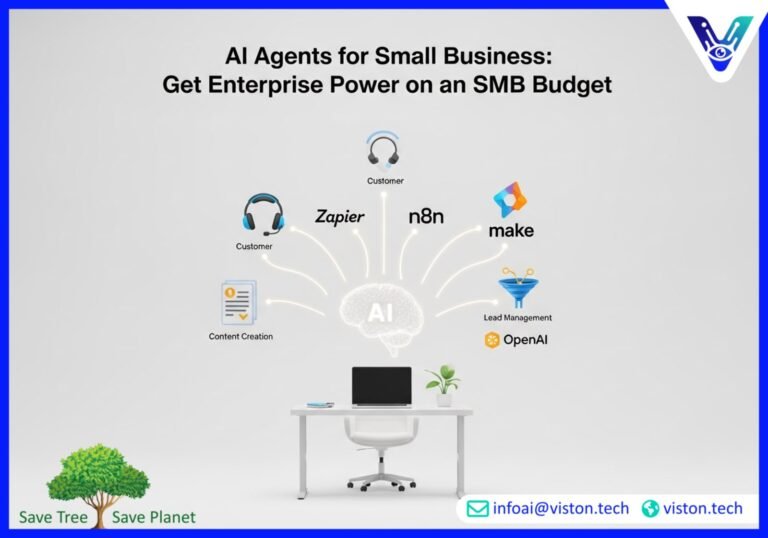
- Zapier: A household name in automation, Zapier allows you to connect thousands of different apps and services. With the integration of AI tools like OpenAI’s GPT models, you can create “Zaps” that automate complex tasks, from summarizing emails to drafting social media posts.
- n8n: An open-source, self-hostable workflow automation tool, n8n offers a more customizable and cost-effective alternative to Zapier for those with some technical comfort. Its visual workflow editor makes it easy to design sophisticated AI-powered automations.
- Make (formerly Integromat): Known for its powerful and flexible workflow automation capabilities, Make allows for intricate scenarios and data manipulation, making it a strong contender for building more complex AI agents.
The Power of LLMs
Large Language Models like those from OpenAI (GPT-4, GPT-4o), Anthropic (Claude 3), and Google (Gemini) are the “brains” behind these AI agents. When you connect an LLM to an LCNC platform, you unlock the ability to:
- Understand and process natural language: Your agents can read emails, understand customer queries, and interpret unstructured data.
- Generate human-like text: They can write emails, create marketing copy, generate reports, and much more.
- Reason and make decisions: Based on the data they receive, they can make informed decisions, such as routing a customer query to the right department or prioritizing leads.
This combination of user-friendly LCNC platforms and powerful LLMs is the key to building affordable agents that can have a significant impact on your SMB’s productivity and efficiency.
SMB AI in Action: 3 Case Studies
Theory is great, but what does this look like in practice? Here are three real-world examples of how SMBs are using AI agents to drive growth and streamline operations.
Case Study 1: The E-commerce Retailer Automating Customer Support
The Challenge: A small online clothing boutique was overwhelmed with customer inquiries about order status, returns, and product availability. Their two-person customer service team couldn’t keep up, leading to slow response times and frustrated customers.
The Solution: Using a platform like Make, they built an AI agent that integrated with their Shopify store and email system. The agent was powered by an LLM trained on their store’s policies and product information.
The Results:
- The AI agent now handles over 60% of incoming customer queries automatically.
- It can instantly provide order tracking information, explain the return policy, and check stock levels.
- For more complex issues, the agent gathers all the necessary information and creates a detailed ticket for the human team, allowing them to resolve issues much faster.
- Customer satisfaction has increased, and the team is now free to focus on more complex, high-value customer interactions.
Case Study 2: The Marketing Agency Supercharging Content Creation
The Challenge: A boutique marketing agency struggled to produce high-quality content at scale for its diverse client base. The team spent hours each week on research, drafting blog posts, and creating social media calendars.
The Solution: They leveraged Zapier to create a series of AI-powered workflows. One workflow uses an LLM to generate blog post ideas and outlines based on a client’s industry and target audience. Another agent drafts social media posts in various tones and formats for different platforms.
The Results:
- The agency has reduced the time it takes to create a first draft of a blog post by 75%.
- Their social media output has doubled without increasing headcount.
- The AI agents handle the heavy lifting of initial content creation, allowing the human team to focus on strategy, editing, and adding their unique creative touch.
- To learn more about AI’s role in content creation, this guide to AI content creation tools is a great resource.
Case Study 3: The Local Service Business Optimizing Lead Management
The Challenge: A local HVAC company was losing potential customers because they couldn’t respond to online inquiries fast enough. Leads from their website contact form often went cold before a salesperson could follow up.
The Solution: Using n8n, they built an AI agent to manage their lead flow. When a new inquiry comes in, the agent instantly analyzes the message to determine the service needed and the urgency.
The Results:
- The agent immediately sends a personalized acknowledgment email to the potential customer.
- It then categorizes the lead and assigns it to the appropriate salesperson in their CRM.
- For urgent requests, the agent sends a text message alert to the on-call technician.
- Lead response time has dropped from hours to seconds, resulting in a significant increase in their conversion rate.
Pricing and ROI: Making the Numbers Work for Your SMB
The beauty of this new era of AI is that it’s surprisingly affordable. Let’s break down the typical costs and how to think about the return on your investment.
Typical Costs:
- LCNC Platform Subscription: Platforms like Zapier and Make offer free tiers with limited functionality. Paid plans typically range from $20 to $100 per month, depending on the number of tasks and features you need. Self-hosted options like n8n can be even more cost-effective if you have the technical resources to manage them.
- LLM API Usage: You pay for LLM access based on how much you use it (the number of “tokens” processed). For many SMB use cases, this can be as low as $10 to $50 per month.
Total Estimated Monthly Cost: For many powerful AI agent solutions, you could be looking at a total monthly cost of under $100.
Calculating Your ROI:
To understand the true value of your AI agent, consider the following:
- Time Saved: How many hours per week will your team save by automating tasks? Multiply those hours by their hourly rate to get a dollar value.
- Increased Revenue: How many more leads will you convert with faster response times? How much additional business will you generate with increased marketing output?
- Reduced Errors: How much money will you save by reducing human error in tasks like data entry or order processing?
- Improved Customer Satisfaction: While harder to quantify, happy customers are more likely to become repeat customers and recommend your business.
When you weigh the modest monthly investment against the significant potential gains in efficiency, revenue, and customer satisfaction, the ROI of implementing AI agents becomes incredibly compelling for most SMBs.
A Phased Roadmap for AI Adoption
Jumping into AI doesn’t have to be an all-or-nothing proposition. A phased approach allows you to learn, iterate, and build momentum without overwhelming your team or your budget.
Phase 1: Identify and Automate (Months 1-3)
- Goal: Achieve quick wins and build confidence in AI.
- Actions:
- Identify the most repetitive, time-consuming tasks in your business.
- Start with a simple, low-risk automation using a tool like Zapier. For example, automatically saving email attachments to a specific Google Drive folder.
- Introduce your team to the basic concepts of AI and automation.
Phase 2: Enhance and Augment (Months 4-9)
- Goal: Use AI to enhance existing processes and augment your team’s capabilities.
- Actions:
- Build a simple AI agent, like the lead management example above.
- Integrate an LLM to handle tasks like drafting email responses or summarizing meeting notes.
- Gather feedback from your team and refine your AI agents.
Phase 3: Transform and Innovate (Months 10+)
- Goal: Use AI to create new opportunities and transform core business functions.
- Actions:
- Develop more sophisticated AI agents that can handle multi-step, complex workflows.
- Explore using AI for data analysis and business intelligence to gain deeper insights into your operations and customers.
- Foster a culture of continuous improvement, where employees are empowered to identify new opportunities for AI-powered innovation.
The Future is Agentic. Is Your SMB Ready?
The rise of affordable, user-friendly AI agents is leveling the playing field, allowing SMBs to compete with larger enterprises on a scale never before possible. By embracing low-code platforms and the power of LLMs, you can automate mundane tasks, unlock new levels of efficiency, and empower your team to focus on what they do best: delivering value to your customers. The question is no longer if SMBs should adopt AI, but how quickly they can start.
Frequently Asked Questions (FAQs)
1. What is an AI agent in the context of an SMB?
For an SMB, an AI agent is a software program designed to perform specific tasks automatically. It uses artificial intelligence, often powered by a Large Language Model, to understand requests, process information, and take action. Examples include automatically responding to customer emails, scheduling appointments, or managing social media posts.
2. Do I need to be a programmer to build an AI agent for my business?
No, you don’t. The rise of low-code/no-code (LCNC) platforms like Zapier, Make, and n8n allows you to build powerful AI agents using visual, drag-and-drop interfaces. This empowers non-technical employees to create automations without writing a single line of code.
3. How much does it cost to implement AI agents in an SMB?
The cost is surprisingly affordable and can be scaled to your budget. It typically involves a monthly subscription to an LCNC platform (ranging from free tiers to around $100/month) and usage-based fees for the AI model (LLM), which can be as low as $10-$50 per month for many common use cases.
4. What are some of the best initial use cases for AI agents in a small business?
Great starting points are tasks that are repetitive and rule-based. Excellent examples include automating customer service responses for common questions, managing and qualifying new leads from your website, automating social media posting, and summarizing long documents or email chains to save reading time.
5. How can I ensure the AI agent understands my specific business needs?
You can “train” or provide context to your AI agent by giving it specific information. This can include your company’s FAQs, product details, brand voice guidelines, and internal policies. By providing this tailored information, the agent’s responses and actions will be much more accurate and aligned with your business.
6. What is the return on investment (ROI) for using AI agents?
The ROI comes from several areas: significant time savings by automating manual tasks, increased revenue through faster lead follow-up and improved customer service, reduced operational costs by minimizing errors, and empowering your employees to focus on higher-value, strategic work.
7. Are AI agents secure for handling sensitive business data?
Security is a valid concern. It’s crucial to choose reputable LCNC platforms and LLM providers that prioritize data security and offer features like data encryption and clear privacy policies. Always be mindful of the data you are allowing your agents to access and process.
8. How do I get started with building an AI agent for my SMB?
A great first step is to identify a simple, high-impact task you want to automate. Then, explore the free tiers of LCNC platforms like Zapier or Make to build a basic workflow. This hands-on experience will help you understand the possibilities and build momentum for more advanced AI implementations.
Ready to unlock the power of AI for your business? The journey starts with a single step. Don’t let your size hold you back from thinking big. Start exploring the world of SMB AI today and discover how affordable agents can redefine what’s possible for your team.
Contact Viston AI today to learn how our AI-powered solutions can be tailored to meet the unique needs and budget of your SMB. Let’s build your more efficient and intelligent future, together.
