
Agentic Coding Pipelines: The Future of Software Development is Here
Imagine a development environment that doesn’t just assist you; it anticipates your needs. It takes a high-level software specification and autonomously writes the code, creates the tests, identifies vulnerabilities, and even reviews its own work. This isn’t science fiction. This is the reality of agentic coding pipelines, a revolutionary approach poised to redefine the software development lifecycle (SDLC) in 2025 and beyond. For enterprise leaders and tech innovators, understanding this shift is no longer optional—it’s a strategic imperative.
In a landscape where speed, quality, and security are paramount, traditional development methods are showing their age. The pressure to innovate faster while managing technical debt and cybersecurity threats is immense. This is where agentic AI, a more advanced form of artificial intelligence that can act autonomously to achieve goals, enters the picture. These AI agents are transforming the developer experience (DevEx) from a series of manual, often tedious tasks into a streamlined, intelligent, and highly automated workflow. Organizations are no longer just experimenting with AI; they are embedding it into the very core of their development processes, creating AI dev environments that plan, code, test, and review with minimal human intervention.
What is an ‘Agentic IDE’? The New Hub of Innovation
For decades, the Integrated Development Environment (IDE) has been the digital workshop for developers. It’s where code is written, debugged, and compiled. Now, picture that workshop staffed by a team of tireless, expert AI assistants. This is the concept of the “agentic IDE.” It’s an evolution from simple AI-powered code completion tools to a sophisticated ecosystem of autonomous agents working in concert.
These are not just passive tools that respond to commands. They are proactive collaborators. An agentic IDE can:
- Understand Intent: A developer can provide a product specification in natural language, and the AI agents will interpret the requirements, ask clarifying questions, and formulate a development plan.
- Orchestrate Complex Tasks: Multiple AI agents can work in parallel. One agent might be responsible for generating the front-end code, another for the back-end logic, and a third for database schema creation.
- Learn and Adapt: The agentic IDE learns from your organization’s existing codebase, adhering to specific coding standards, architectural patterns, and security practices. It gets smarter and more efficient with every project.
This shift fundamentally enhances the Developer Experience (DevEx). By automating repetitive and time-consuming tasks, developers are freed to focus on what they do best: solving complex business problems and driving innovation. The cognitive load is reduced, bottlenecks are minimized, and the entire development process becomes more efficient and enjoyable.
From Spec to Deployment: The Automated Pipeline in Action
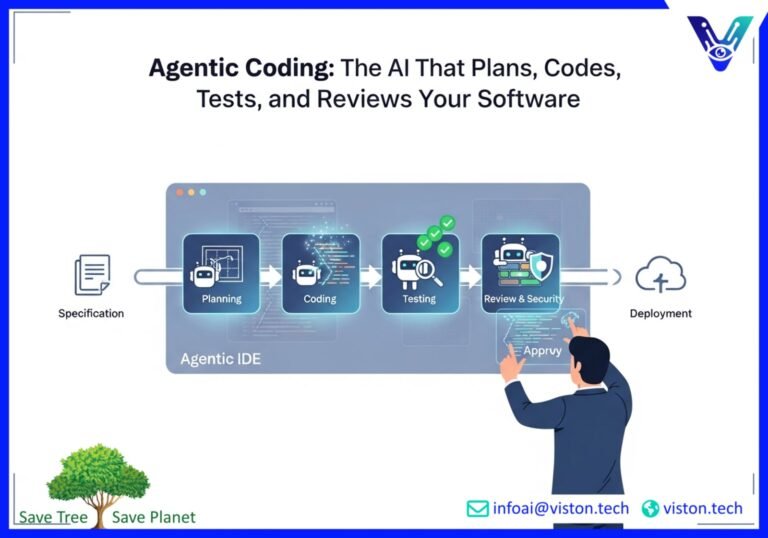
The true power of agentic coding is realized in the end-to-end automation of the software development lifecycle. Let’s walk through what this new, supercharged pipeline looks like, a process that represents the pinnacle of SDLC automation.
Step 1: The AI Planning Agent – From Specification to Blueprint
The journey begins with a product manager or developer inputting a high-level specification. This could be a detailed document or even a series of user stories. An AI Planning Agent takes over, parsing the information and breaking down the project into smaller, manageable tasks. It defines the required features, suggests a technical architecture, and creates a project roadmap. This initial step ensures that the project is well-defined and aligned with business goals from the very beginning.
Step 2: The AI Coding Agent – Autonomous Code Generation
Once the plan is approved, one or more AI Coding Agents begin the work of writing the code. Trained on vast datasets of open-source and proprietary code, these agents can generate high-quality, efficient code in multiple programming languages. They follow the architectural blueprint laid out by the Planning Agent, ensuring consistency and adherence to best practices. This phase dramatically accelerates the development process, turning what used to take weeks or months into a matter of days or even hours.
Step 3: The AI Testing Agent – Building Quality in from the Start
As the code is being generated, an AI Testing Agent works in parallel to create a comprehensive suite of tests. This isn’t limited to simple unit tests. These advanced agents can generate integration tests, end-to-end tests, and even performance tests. They are adept at identifying edge cases and potential failure points that a human tester might overlook. By integrating testing so early and thoroughly in the process, organizations can significantly improve software quality and reduce the number of bugs that make it to production.
Step 4: The AI Review and Security Agent – Your 24/7 Guardian
This is where the agentic pipeline truly shines, particularly from a security and governance perspective. An AI Review Agent, acting as an automated peer reviewer, meticulously scans every line of AI-generated code. Its capabilities are extensive:
- Security Vulnerability Detection: The agent is trained to identify common security flaws, such as SQL injection, cross-site scripting (XSS), and insecure authentication, before they become a threat.
- Quality Assurance: It checks for adherence to coding standards, looks for logic errors, and suggests performance optimizations.
- Continuous Monitoring: This process is not a one-off check. The AI Review Agent continuously monitors the codebase, ensuring that security and quality are maintained throughout the development lifecycle.
This automated, continuous review process provides a critical layer of defense, ensuring that the speed gained from AI-generated code doesn’t come at the cost of security or quality.
Seamless Integration with CI/CD: The Final Mile of Automation
An agentic coding pipeline doesn’t exist in a vacuum. Its output must seamlessly integrate into an organization’s existing Continuous Integration and Continuous Deployment (CI/CD) practices. The AI-generated code, along with its corresponding tests, is automatically committed to a version control system like Git. This commit triggers the CI/CD pipeline, which then builds, tests, and deploys the application.
The integration of agentic coding with CI/CD creates a fully automated “spec-to-deployment” workflow. This level of SDLC automation offers unprecedented benefits:
- Accelerated Time-to-Market: Features and updates can be delivered to customers at a velocity that was previously unimaginable.
- Enhanced Reliability: The extensive automated testing and review processes lead to more robust and reliable software.
- Improved Developer Productivity: Developers can oversee this automated process, intervening when necessary, but are largely freed from manual coding and testing tasks. For more information on how AI is transforming developer workflows, explore this insightful article on supercharging the developer experience.
The Critical Role of Governance and Human-in-the-Loop Approval
In a world of autonomous AI agents, the importance of governance cannot be overstated. While these systems are incredibly powerful, human oversight remains essential. A robust governance framework is necessary to manage the risks and ensure that AI-generated code aligns with enterprise standards.
Effective governance in an agentic coding environment includes:
- Clear Approval Workflows: Before any AI-generated code is merged into the main branch or deployed to production, it must pass through a human approval gate. This “human-in-the-loop” approach ensures that a qualified developer or security expert provides the final sign-off.
- Auditable Logs: The agentic system must maintain detailed logs of all actions taken by the AI agents. This provides a transparent and auditable trail, which is crucial for compliance and security purposes.
- Customizable Rules and Policies: Organizations must be able to configure the AI agents to enforce their specific security policies, coding standards, and regulatory requirements.
The goal is not to replace human developers but to augment their capabilities. By pairing the speed and power of AI with the critical thinking and domain expertise of humans, organizations can achieve a level of performance and security that neither could accomplish alone. A deeper dive into AI’s impact on software development can be found in this analysis by McKinsey, which highlights the strategic advantage of agentic AI.
The Future is Agentic: Are You Ready?
The transition to agentic coding pipelines is more than just a technological upgrade; it’s a fundamental shift in how we build software. By 2025, organizations that embrace this new paradigm will gain a significant competitive advantage. They will be able to innovate faster, deliver higher-quality products, and maintain a more secure and resilient technology stack.
The reports are clear: enterprises are increasingly relying on AI agents to continuously check AI-generated code for security and quality. This isn’t a trend on the horizon; it’s happening now. The question for every C-Suite executive, IT leader, and product manager is no longer if they should adopt this technology, but how quickly they can integrate it to start reaping the benefits. As you plan your organization’s future, consider the immense potential of creating a development environment that plans, codes, tests, and reviews for you. For those interested in the broader impact of AI, the World Economic Forum provides insights on how generative AI is transforming software development.
The journey to full SDLC automation is underway. The tools are here, the methodologies are proven, and the benefits are undeniable. Welcome to the future of software development.
#AgenticCoding #DevEx #SDLCAutomation #AIinDev #FutureOfCode #CodeGeneration #AITesting #SecureCoding #CI/CD
Frequently Asked Questions (FAQs)
1. What is agentic coding?
Agentic coding refers to the use of autonomous AI agents to perform various tasks within the software development lifecycle. These agents can understand high-level goals, plan a course of action, write code, create tests, review for errors and security vulnerabilities, and adapt their approach—all with minimal human intervention. It represents a shift from AI as a passive assistant to AI as a proactive collaborator.
2. How does an “agentic IDE” differ from current AI coding assistants?
Current AI coding assistants, like GitHub Copilot, primarily function as powerful autocompletion tools. They suggest code snippets and functions based on the immediate context. An agentic IDE is a much more comprehensive environment where multiple specialized AI agents work together to manage the entire workflow from specification to deployment. It’s the difference between an assistant that helps you lay bricks and an automated system that builds the entire house based on a blueprint.
3. Will agentic coding replace human developers?
No, the consensus is that agentic coding will augment, not replace, human developers. It automates the more repetitive and time-consuming aspects of coding, testing, and reviewing. This frees up developers to focus on higher-value activities like system architecture, complex problem-solving, product strategy, and innovation. The role of the developer will evolve to become more of an “AI orchestrator” or “AI architect,” guiding and overseeing the work of the AI agents.
4. What are the biggest security risks associated with AI-generated code?
The primary risks include the potential for AI models to introduce security vulnerabilities they may have learned from insecure code in their training data. AI might also generate code with subtle logic flaws or fail to account for the specific security context of an application. This is why having dedicated AI agents for security scanning and code review, along with mandatory human oversight and approval, is a critical component of any agentic coding pipeline.
5. How does SDLC automation through agentic AI improve the Developer Experience (DevEx)?
It significantly improves DevEx by reducing friction and cognitive load. Developers spend less time on tedious tasks like writing boilerplate code, creating routine tests, or performing manual code reviews. This automation allows them to focus on more creative and engaging challenges. Faster feedback loops from automated testing and review agents also lead to a more efficient and satisfying workflow, ultimately reducing burnout and increasing job satisfaction.
6. What is the role of governance in an agentic coding pipeline?
Governance is crucial for ensuring that the speed and automation of agentic coding do not compromise quality, security, or compliance. It involves establishing clear human-in-the-loop approval processes, maintaining detailed audit trails of all AI actions, and configuring the AI agents to adhere to the organization’s specific coding standards and security policies. Strong governance ensures that the autonomous system operates safely and accountably.
7. How can my organization start implementing agentic coding?
Implementation can be a phased approach. Start by introducing advanced AI-powered tools for specific parts of the SDLC, such as automated code review or AI-driven test generation. As the team becomes comfortable, you can begin to connect these tools into a more cohesive pipeline. The key is to start small, measure the impact on productivity and quality, and gradually build towards a fully integrated agentic development environment.
8. What kind of ROI can be expected from adopting agentic coding pipelines?
The Return on Investment (ROI) can be substantial and multifaceted. Key benefits include dramatically accelerated development timelines, leading to faster time-to-market for new products and features. It also leads to higher-quality and more secure code, reducing the long-term costs associated with bug fixes and security incidents. Furthermore, improved developer productivity and retention contribute to significant operational savings and a more innovative engineering culture.
Ready to Revolutionize Your Development Lifecycle?
The future of software development is intelligent, automated, and secure. If your organization is ready to harness the power of agentic coding pipelines to accelerate innovation and enhance your developer experience, Viston AI is here to help. Our team of experts specializes in creating tailored, enterprise-grade AI-powered solutions that drive real business results.
Contact Viston AI today to learn how we can help you build your own agentic dev environment and stay ahead of the competition.
