
Agentic AI ROI in 2026: Real Numbers Behind the Hype
The buzz around Artificial Intelligence is impossible to ignore. But for enterprise leaders, the conversation always comes back to one critical question: “Where’s the ROI?” In 2026, the answer is becoming crystal clear. We’re moving beyond hypothetical benefits and into an era of measurable, substantial returns. Agentic AI, the next evolution of artificial intelligence, is no longer a futuristic concept. It’s a strategic imperative delivering tangible business impact.
Forget abstract promises. We’re talking about real numbers. Projections show an incredible 171% average ROI for businesses leveraging autonomous decision-making technologies. For U.S. enterprises, that forecast is even more staggering, with some anticipating returns as high as 192%. These figures aren’t just hype; they are the result of AI’s power to fundamentally reshape how businesses operate, innovate, and compete.
Agentic AI refers to systems that can act autonomously to achieve goals with minimal human oversight. Think of them not as tools, but as digital employees who can plan, reason, and execute complex tasks. This capability is the driving force behind the massive cost reduction and revenue growth that early adopters are experiencing. From automating entire workflows to personalizing customer experiences at scale, Agentic AI is proving its value on the bottom line.
This post will cut through the noise. We will provide a clear framework for understanding and measuring AI ROI. We will explore real-world case studies with hard metrics. And we will offer actionable insights to help you build a compelling business case for Agentic AI in your organization. The future isn’t just coming; it’s generating returns.
Deconstructing the Hype: A 4-Part Model for AI ROI Measurement
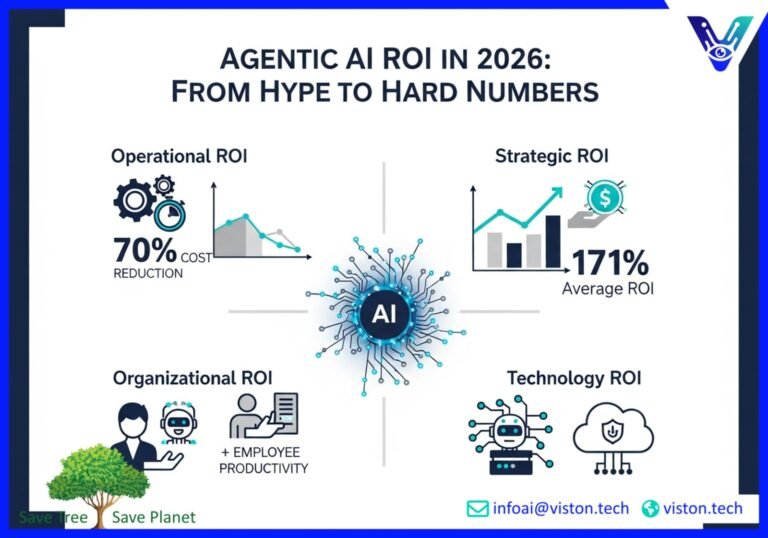
To truly grasp the financial impact of Agentic AI, we need to move beyond simple cost-versus-savings calculations. A holistic approach to AI ROI measurement reveals value across the entire enterprise. This four-part model breaks down how autonomous technology creates tangible returns.
1. Operational ROI: Efficiency and Cost Reduction
This is the most direct and easily quantifiable area of AI’s impact. Agentic AI excels at automating complex, repetitive tasks that consume significant human resources. This leads to dramatic improvements in operational efficiency and significant cost reduction. In fact, some studies show that AI automation can lead to a stunning 70% reduction in costs for suitable processes.
Key metrics to track:
- Reduced Labor Costs: Calculate the hours saved by automating tasks and multiply by the average employee cost.
- Increased Throughput: Measure the volume of tasks or processes completed by AI agents compared to manual efforts in the same timeframe.
- Error Rate Reduction: Track the decrease in errors in processes handled by AI, which reduces rework and associated costs.
- Faster Cycle Times: Monitor the time it takes to complete a process from start to finish. BCG research shows AI can accelerate business processes by 30% to 50%.
2. Strategic ROI: Revenue Growth and Competitive Advantage
Agentic AI is a powerful engine for revenue growth. By analyzing vast amounts of data, AI agents can uncover new market opportunities, optimize pricing strategies, and personalize customer interactions to a degree that was previously impossible. This creates a significant competitive advantage and directly impacts the top line.
Key metrics to track:
- Increased Sales Conversion Rates: AI-powered sales assistants can identify high-value leads and tailor outreach, boosting conversions.
- Customer Lifetime Value (CLV): Personalized experiences foster loyalty and increase the total revenue a customer generates over time.
- New Revenue Streams: AI can identify untapped market needs, leading to the development of new products and services.
- Market Share Growth: By optimizing marketing campaigns and sales strategies, businesses can capture a larger share of the market.
3. Organizational ROI: Empowering Your Workforce
A frequently overlooked benefit of Agentic AI is its positive impact on your human workforce. By offloading tedious, administrative tasks, AI frees up employees to focus on strategic, creative, and high-value work. This boosts morale, engagement, and innovation across the organization.
Key metrics to track:
- Employee Productivity: Measure the output of employees who are supported by AI agents.
- Employee Satisfaction and Retention: Happier, more engaged employees are less likely to leave, reducing recruitment and training costs.
- Innovation Rate: Track the number of new ideas, projects, or process improvements generated by employees with more time for strategic thinking.
4. Technology ROI: Future-Proofing Your Enterprise
Investing in Agentic AI is an investment in the future of your business. It enhances your existing technology stack and creates a more agile, scalable, and resilient infrastructure. This contributes directly to long-term enterprise value.
Key metrics to track:
- Scalability: AI agents can handle thousands of processes simultaneously without a proportional increase in costs.
- Data Quality Improvement: AI can cleanse and structure data, making all of your analytics and business intelligence tools more effective.
- Reduced IT Support Costs: AI can automate IT service tickets and resolve issues without human intervention. To explore more about the transformative potential of AI, read this insightful article from Boston Consulting Group.
Agentic AI in Action: 5 Case Studies with Real-World Metrics
Theory is one thing; results are another. Let’s look at how companies across various sectors are achieving remarkable ROI by deploying Agentic AI solutions.
Case Study 1: The Global Financial Institution
Challenge: A major bank was struggling with high costs and slow processing times in its mortgage application department. Manual data entry and verification were prone to errors, leading to compliance risks.
Solution: They implemented an Agentic AI platform to automate the entire document verification and data extraction process. The AI agent could read and understand various document formats, cross-reference information with internal systems, and flag inconsistencies for human review.
The ROI:
- 60% Reduction in Manual Workload: Freed up loan officers to focus on customer relationships and complex cases.
- 40% Faster Processing Time: Reduced the average mortgage approval time from weeks to days.
- 99% Accuracy Rate: Dramatically lowered the risk of costly errors and compliance breaches.
Case Study 2: The E-commerce Retail Giant
Challenge: A large online retailer wanted to increase customer loyalty and revenue by delivering truly personalized shopping experiences to millions of users.
Solution: They deployed AI agents to analyze real-time customer behavior, purchase history, and even sentiment from product reviews. The agents then autonomously updated product recommendations, personalized marketing emails, and optimized promotional offers for each individual user.
The ROI:
- 25% Increase in Sales: Attributed directly to personalized recommendations and targeted promotions.
- 30% Higher Customer Engagement: Measured by click-through rates and time spent on the site.
- 15-Point Increase in Net Promoter Score (NPS): Demonstrating a significant improvement in customer satisfaction.
Case Study 3: The Manufacturing Conglomerate
Challenge: A heavy manufacturing company faced significant inefficiencies in its supply chain, leading to inventory overstock and costly production delays.
Solution: An Agentic AI system was integrated with their ERP to create an autonomous supply chain. The AI agent could predict demand fluctuations, optimize inventory levels across different warehouses, and even negotiate with suppliers for better terms in real-time.
The ROI:
- 20% Reduction in Inventory Carrying Costs: By preventing overstock and optimizing stock allocation.
- 35% Decrease in Production Downtime: Ensured that necessary parts and materials were always available.
- Improved Supplier Relationships: Through automated and efficient communication and negotiation.
Case Study 4: The Healthcare Provider Network
Challenge: A network of hospitals was burdened by the administrative overhead of managing patient appointments, insurance claims, and medical records, taking valuable time away from patient care.
Solution: They implemented AI agents to handle routine administrative tasks. These agents could schedule appointments, process insurance claims from end-to-end, and automatically update patient records, all while ensuring HIPAA compliance.
The ROI:
- 50% Reduction in Administrative Costs: Allowed for the reallocation of resources to clinical staff and patient services.
- 40% Reduction in Claim Handling Time: Accelerated revenue cycles and improved cash flow.
- 25% Increase in Staff Productivity: Enabled healthcare professionals to focus on their primary mission: patient care.
Case Study 5: The Software-as-a-Service (SaaS) Innovator
Challenge: A rapidly growing SaaS company needed to provide 24/7, high-quality customer support without exponentially increasing its support team headcount.
Solution: They launched an Agentic AI-powered support platform. The AI agent could understand and resolve a wide range of technical issues, guide users through complex features, and escalate only the most challenging problems to human experts.
The ROI:
- 70% of Support Tickets Resolved Autonomously: Drastically reducing the need for human intervention.
- 90% Customer Satisfaction Score (CSAT) for AI-led interactions.
- Scaled Support for a 100% User Growth with only a 15% increase in human support staff.
Your Roadmap to Agentic AI Success
The numbers and case studies speak for themselves. The question is no longer if you should invest in Agentic AI, but how. Here are actionable steps to begin your journey:
- Start with a Clear Business Problem: Don’t adopt AI for the sake of technology. Identify a specific, high-impact business challenge that Agentic AI can solve.
- Build a Cross-Functional Team: Involve leaders from IT, finance, operations, and the relevant business units. A successful AI implementation requires diverse expertise and buy-in.
- Define Your Metrics for Success: Before you begin, establish the key performance indicators (KPIs) you will use to measure the project’s success and calculate its ROI.
- Choose the Right Partner: You don’t have to build everything from scratch. Partner with a company that has a proven track record of delivering enterprise-grade AI solutions. For deeper insights into AI adoption trends, check out this comprehensive report by McKinsey.
- Think Big, Start Small, Scale Fast: Begin with a pilot project to demonstrate value and build momentum. Once you’ve proven the ROI, you can scale the solution across the enterprise.
The era of autonomous enterprise is here. The companies that embrace Agentic AI will not just survive; they will lead their industries. They will operate more efficiently, grow faster, and deliver more value to their customers and shareholders. The real numbers behind the hype show that the ROI is not just positive—it’s transformative.
Are you ready to unlock the true potential of your enterprise? The journey to remarkable ROI starts now.
Take the Next Step with Viston AI
Ready to move from theory to tangible results? At Viston AI, we specialize in developing bespoke Agentic AI solutions that drive real business impact. Our team of experts can help you identify the right opportunities, build a powerful business case, and implement an AI strategy that delivers measurable ROI.
Contact us today to schedule a consultation and discover how Viston AI can help you harness the power of autonomous technology.
Frequently Asked Questions (FAQs)
1. What is Agentic AI and how is it different from traditional AI?
Agentic AI refers to artificial intelligence systems designed with agency, meaning they can act autonomously to achieve specific goals. Unlike traditional AI that simply responds to prompts or executes predefined commands, Agentic AI can plan, reason, and execute multi-step tasks with minimal human supervision. It’s the difference between a calculator that answers a question and a digital financial analyst that manages a portfolio.
2. How do you accurately calculate the ROI of an Agentic AI implementation?
A comprehensive AI ROI measurement involves more than just direct cost savings. You should use a blended model that includes: Operational ROI (cost reduction, efficiency gains), Strategic ROI (revenue growth, market share), Organizational ROI (employee productivity, retention), and Technology ROI (scalability, data infrastructure improvements). The formula is (Net Profit / Cost of Investment) * 100, but “Net Profit” must encompass all these areas of value creation.
3. What are the biggest challenges to adopting Agentic AI in an enterprise?
The primary challenges include integration with legacy systems, ensuring high-quality and accessible data, addressing security and privacy concerns, and managing organizational change. Overcoming these hurdles requires a strategic, phased approach, strong governance, and a focus on building a culture that embraces human-AI collaboration.
4. Can small and medium-sized businesses (SMBs) also benefit from Agentic AI?
Absolutely. While large enterprises are often early adopters, the rise of low-code and no-code AI platforms is making Agentic AI more accessible to SMBs. They can leverage these technologies to automate core business processes, enhance customer service, and compete more effectively with larger players, often seeing a faster time-to-value due to their agility.
5. What industries are seeing the highest ROI from Agentic AI?
Industries with complex processes and large datasets are seeing the most significant impact. This includes financial services (fraud detection, automated underwriting), healthcare (administrative automation, diagnostics), manufacturing (supply chain optimization), and retail (personalization, inventory management). However, the applications are expanding rapidly across all sectors.
6. How does Agentic AI impact jobs and the workforce?
Agentic AI is not about replacing humans but augmenting them. It automates repetitive and mundane tasks, allowing employees to focus on more strategic, creative, and problem-solving activities. This shift requires a focus on reskilling and upskilling the workforce to collaborate effectively with their new “digital colleagues,” ultimately leading to higher-value roles and increased job satisfaction.
7. What is the first step my company should take to explore Agentic AI?
The best first step is to identify a clear, high-impact business problem that is currently creating a bottleneck or significant cost. Start by asking, “What critical process, if automated and optimized, would deliver the most value to our business?” This focuses the initiative on solving a real-world problem and makes building a business case and measuring ROI much more straightforward.
8. How do we ensure the ethical and responsible use of autonomous AI agents?
Establishing a robust AI governance framework from day one is crucial. This involves setting clear ethical guidelines, ensuring transparency in how AI agents make decisions (explainability), maintaining human oversight for critical processes, and regularly auditing the systems for bias and fairness. Responsible AI is not just a compliance issue; it’s fundamental to building trust with customers and stakeholders.
