
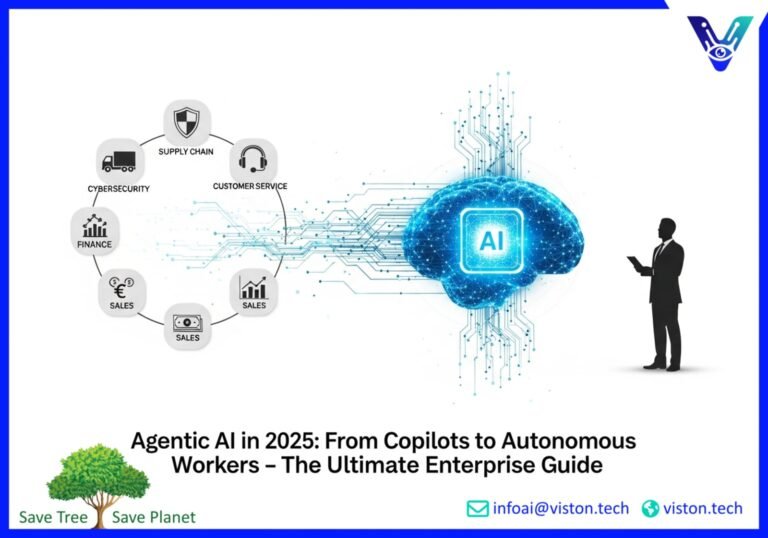
Agentic AI in 2025: From Chatbots to Autonomous Workers – A Complete Guide
The year is 2025, and the conversation around artificial intelligence has fundamentally shifted. We’ve moved beyond the era of reactive chatbots and intelligent assistants. The new frontier is agentic AI, a transformative technology where AI graduates from being a tool to becoming a teammate. This isn’t just another buzzword; it’s a strategic imperative for businesses aiming to maintain a competitive edge. This year, we are witnessing the transition from reactive copilots to proactive, autonomous AI systems that orchestrate complex tasks directly within your enterprise workflows. Forget simply answering questions; think of AI that anticipates needs, executes multi-step processes, and drives business outcomes with minimal human intervention.
For enterprise leaders, from the C-Suite to product managers and IT specialists, understanding this evolution is critical. This guide will demystify agentic AI, explore its architecture in simple terms, and provide a clear framework for navigating the crucial “build vs. buy” decision. More importantly, it will showcase real-world enterprise use cases that are already defining the next wave of business automation and efficiency.
The Great Leap: From Copilots to Autonomous AI Agents
To grasp the significance of AI agents in 2025, we must first distinguish them from the copilots and chatbots that have become commonplace. While both are powered by generative AI, their capabilities and roles within an organization are worlds apart.
Copilots: The Intelligent Assistants
Think of an AI copilot as a highly skilled assistant sitting next to you. It’s designed to augment human capabilities, not replace them. Copilots excel at specific tasks within a defined workflow, operating under direct human supervision. They are reactive, responding to your prompts and providing support.
- Role: Assistive and supportive.
- Autonomy: Low; requires human instruction for each step.
- Function: Enhances productivity by handling specific, isolated tasks like drafting emails, summarizing documents, or generating code snippets.
- Decision-making: Facilitates human decision-making by providing data and suggestions, but the final call rests with the user.
Examples like Microsoft Copilot or Salesforce Einstein are powerful tools that make employees more efficient. However, they remain passengers in the operational vehicle, not the drivers.
Agentic AI: The Autonomous Workers
Agentic AI, on the other hand, represents a paradigm shift toward proactive, goal-oriented autonomy. An AI agent is an autonomous system that can perceive its environment, make decisions, and take actions to achieve specific, often complex, goals. These are your new digital coworkers, capable of managing entire workflows from start to finish.
- Role: Proactive and goal-driven.
- Autonomy: High; operates independently with minimal human intervention.
- Function: Orchestrates and executes complex, multi-step tasks across various systems and applications.
- Decision-making: Possesses the ability to reason, plan, and make independent decisions to achieve its objectives.
Instead of just reminding you about a meeting, an autonomous AI system could schedule the meeting, invite attendees, prepare a briefing document by pulling data from multiple sources, and even send out a summary with action items afterward. This is the core difference: copilots assist with tasks, while agents take ownership of outcomes.
Under the Hood: A Simple Look at Agentic AI Architecture
You don’t need to be an AI engineer to understand the fundamental building blocks of an agentic AI system. At its core, the architecture is designed to enable autonomy and goal-oriented action. It typically consists of three main layers that work in a continuous loop: Perception, Reasoning, and Action.
- Perception Layer: This is how the AI agent “sees” and understands its environment. It ingests data from various sources—emails, databases, APIs, documents, and user inputs—to gather context.
- Reasoning and Planning Layer: This is the “brain” of the operation. Powered by advanced Large Language Models (LLMs), this layer processes the gathered information, breaks down a high-level goal into smaller, manageable steps, and formulates a plan of action.
- Action Layer: This is where the agent interacts with the world. It executes the plan by interacting with other software, calling APIs, sending emails, or updating records in a CRM. The agent learns from the outcomes of its actions, refining its approach for future tasks.
This architecture allows AI agents in 2025 to be dynamic and adaptive, continuously learning and improving their performance over time.
The Strategic Crossroads: To Build or to Buy Your Autonomous AI Systems?
As enterprises look to harness the power of agentic AI, a critical strategic question arises: should you build a custom solution from the ground up or buy a pre-built platform? The answer isn’t one-size-fits-all and depends on your organization’s specific needs, resources, and strategic goals. The debate has shifted from a simple procurement question to a core strategic decision influencing your speed, control, and long-term competitive advantage.
The Case for Buying: Speed and Simplicity
Opting for an off-the-shelf agentic AI platform can significantly accelerate your time-to-value. These solutions offer pre-built infrastructure, proven technology, and ongoing support from the vendor.
- Faster Deployment: Deploying a vendor solution can take weeks, compared to the months or even years required for custom development.
- Lower Upfront Investment: Buying reduces the need for extensive in-house R&D, specialized talent, and infrastructure costs.
- Access to Expertise: Vendors continuously refine their products based on learnings from a wide range of use cases, giving you access to best-in-class technology.
The Case for Building: Control and Customization
Building a proprietary agentic system offers unparalleled control and the ability to tailor the solution to your unique workflows and data. This path is often chosen when the AI’s function is core to the company’s intellectual property or competitive differentiation.
- Deep Customization: Build for highly specific or proprietary workflows that off-the-shelf solutions can’t accommodate.
- Greater Control: Maintain full control over data security, compliance, and the agent’s behavior and decision-making logic.
- Potential for Long-Term Cost Savings: At a large scale, a custom-built system may have a lower total cost of ownership compared to ongoing licensing fees.
The Hybrid Approach: The Best of Both Worlds
Increasingly, enterprises are adopting a hybrid strategy. This involves building custom agents for core, high-impact functions while leveraging vendor solutions for non-core or standardized tasks. For instance, a financial services firm might build a bespoke agent for algorithmic trading but buy a solution for automating its internal IT helpdesk. This approach balances the need for differentiation with the desire for speed and efficiency.
Agentic AI in Action: 5 Transformative Enterprise Use Cases for 2025
The true value of autonomous AI systems is realized when they are applied to solve real-world business challenges. Here are five high-impact use cases that are already reshaping industries in 2025.
1. Intelligent Customer Service Orchestration
AI agents are revolutionizing customer support by moving beyond simple chatbots to manage the entire service lifecycle. An agent can autonomously triage incoming support tickets, access customer history from a CRM, diagnose technical issues by querying knowledge bases, and even initiate a return process in an e-commerce system—all without human intervention. This leads to faster resolution times, 24/7 availability, and frees up human agents to handle the most complex and sensitive customer issues.
2. Dynamic Supply Chain Optimization
In the volatile world of supply chain management, agentic AI can act as a vigilant, autonomous operator. These systems can monitor global weather patterns, shipping delays, and inventory levels in real-time. If a potential disruption is detected, the AI agent can proactively reroute shipments, find alternative suppliers by interacting with procurement systems, and update delivery timelines for customers, ensuring resilience and efficiency.
3. Autonomous Financial Operations and Compliance
The finance sector is leveraging agentic AI to automate complex processes like invoice processing, expense report auditing, and regulatory compliance monitoring. An AI agent can ingest invoices, cross-reference them with purchase orders, check for discrepancies, and schedule payments. In compliance, an agent can continuously monitor transactions for fraudulent activity, flagging suspicious patterns and even generating reports for regulatory bodies, ensuring accuracy and reducing risk.
4. Proactive IT and Cybersecurity Management
AI agents are becoming essential for maintaining the health and security of enterprise IT infrastructure. An autonomous agent can monitor network performance, detect anomalies that might indicate a cyberattack, and take immediate action, such as isolating an affected device from the network. They can also manage routine tasks like software patching and user onboarding, ensuring systems are secure and up-to-date.
5. Automated Marketing and Sales Outreach
In marketing and sales, AI agents can automate and personalize outreach at a massive scale. An agent can research potential leads by scraping public data sources, enrich lead profiles in the CRM, and then craft and send personalized email sequences. It can even schedule meetings with interested prospects by interacting with calendar APIs, effectively managing the top of the sales funnel and allowing sales teams to focus on closing deals.
The Future is Autonomous: Are You Ready?
The rise of agentic AI marks a pivotal moment in the evolution of artificial intelligence. The transition from reactive assistants to autonomous workers is not a distant future; it is happening now. Enterprises that embrace this shift will unlock unprecedented levels of efficiency, innovation, and competitive advantage. By understanding the core concepts of agentic AI, strategically approaching the build vs. buy decision, and identifying the most impactful use cases for your business, you can position your organization to lead in this new era of automation.
To learn more about how to integrate these powerful autonomous AI systems into your operations, explore insightful resources like McKinsey’s analysis on the agentic AI advantage or IBM’s overview of agentic architecture.
Ready to unlock the power of agentic AI?
The journey to autonomous enterprise starts with the right partner. At Viston AI, we specialize in developing and deploying cutting-edge, custom AI-powered solutions that drive real business outcomes. Whether you’re looking to build a bespoke AI agent or integrate a powerful platform, our team of experts can help you navigate the complexities of agentic AI and craft a strategy that’s right for you.
Contact Viston AI today to schedule a consultation and discover how our AI-powered solutions can transform your business.
—
Frequently Asked Questions (FAQs)
1. What is the main difference between agentic AI and generative AI?
Generative AI is a broad category of AI that can create new content, like text, images, or code. Agentic AI is a type of system that uses generative AI (specifically, LLMs) as its reasoning engine to autonomously perform tasks and achieve goals. The key difference is action: generative AI creates, while agentic AI acts.
2. Are autonomous AI systems going to replace jobs?
While autonomous AI systems will automate many tasks currently performed by humans, the focus is on augmenting human capabilities, not outright replacement. By handling repetitive and complex workflows, AI agents free up employees to focus on more strategic, creative, and high-value work that requires human judgment and empathy.
3. What are the biggest challenges in implementing agentic AI in 2025?
The primary challenges include ensuring data security and privacy, integrating AI agents with existing legacy systems, managing the complexity of multi-agent orchestration, and establishing strong governance and ethical frameworks to ensure the agents act in alignment with business policies and values.
4. How do I measure the ROI of implementing agentic AI?
The ROI of agentic AI can be measured through various metrics, including reduced operational costs, increased employee productivity, faster task completion times, improved accuracy and reduced error rates, and enhanced customer satisfaction scores. It’s important to establish clear KPIs before deployment to track the impact effectively.
5. What is a “multi-agent system”?
A multi-agent system is an advanced implementation of agentic AI where multiple specialized AI agents collaborate to achieve a complex goal that would be difficult for a single agent to accomplish. For example, a “marketing agent” might collaborate with a “sales agent” and a “data analyst agent” to launch and manage a new product campaign.
6. How can a non-technical leader get started with agentic AI?
Start by identifying a specific, high-impact business problem that could be solved with automation. Focus on a well-defined use case with clear success metrics. Partner with technology leaders or external experts like Viston AI to evaluate the build vs. buy options and develop a phased implementation plan, starting with a small-scale pilot project.
7. What security considerations are important for autonomous AI systems?
Security is paramount. Key considerations include robust access controls to limit what systems and data an agent can interact with, continuous monitoring and anomaly detection to identify unexpected behavior, and implementing a “human-in-the-loop” for critical decisions to ensure oversight and prevent unintended consequences.
8. How do AI agents learn and improve over time?
AI agents learn through a continuous feedback loop. They execute tasks, observe the outcomes, and adjust their future actions based on what was successful and what was not. This is often achieved through techniques like reinforcement learning and by analyzing vast amounts of interaction data to refine their decision-making models.
#AgenticAI #AIAgents2025 #AutonomousAISystems #ArtificialIntelligence #EnterpriseAI #DigitalTransformation #BusinessAutomation #FutureOfWork #TechTrends2025
