
AI Agents vs Copilots: A 2025 Guide for Enterprise Leaders
The year is 2025, and the conversation around Artificial Intelligence in the enterprise has fundamentally shifted. We’ve moved beyond asking if we should use AI to asking how. As leaders, you face a critical decision in your AI strategy: should you deploy AI Agents or AI Copilots? The answer isn’t a simple choice between two competing technologies. It’s about understanding a powerful new synergy.
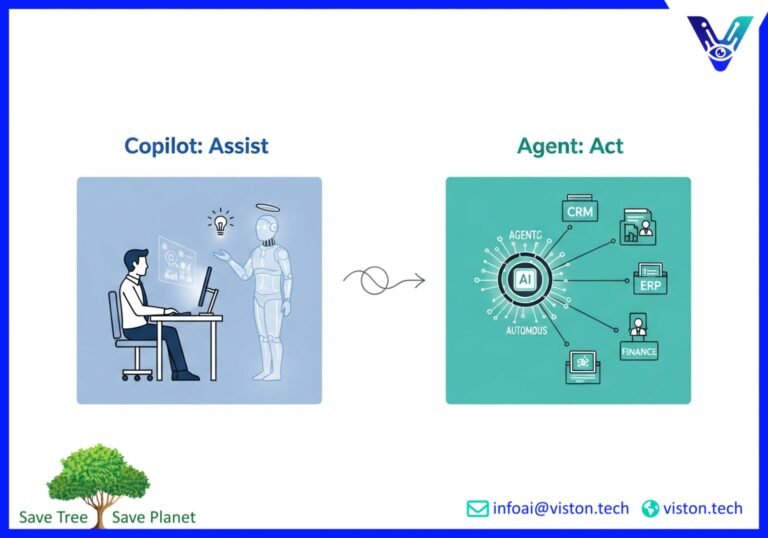
The core distinction is simple yet profound: Copilots assist; agents act. Copilots are your brilliant co-workers, enhancing your team’s capabilities with data-driven suggestions and creative insights. Agents are your autonomous employees, executing complex, multi-step tasks across your enterprise systems. For savvy organizations, the future isn’t about choosing one over the other. It’s about leveraging both in complementary roles to unlock unprecedented efficiency and innovation. This guide will explore when and how to deploy each, ensuring your enterprise is not just participating in the AI revolution, but leading it.
Decision Support vs. Execution: The Core Difference
Understanding the fundamental difference between AI Copilots and AI Agents is the first step in building a robust AI strategy. One serves as an advisor, the other as a doer. This distinction between decision support vs. execution is crucial for assigning the right AI to the right task.
What is an AI Copilot? The Ultimate Assistant
Think of an AI Copilot as a power-up for your human talent. It works alongside your employees, integrating into their existing workflows to provide real-time guidance, generate content, and analyze data. It enhances human judgment but never fully replaces it. The human is always in the loop, making the final call.
- Role: Decision Support
- Interaction: Reactive, responding to user prompts and requests.
- Autonomy: Low. It suggests, drafts, and analyzes, but requires human approval to act.
- Use Case Example: A marketing manager uses a Copilot to brainstorm campaign ideas, draft email copy, and analyze market sentiment from recent reports. The manager reviews the suggestions, refines the copy, and ultimately launches the campaign.
What is an AI Agent? The Autonomous Executor
An AI Agent, on the other hand, is designed for action. It’s a digital worker with a goal and the autonomy to achieve it. An agent can understand an objective, break it down into steps, interact with multiple applications, and execute a workflow from start to finish with minimal human intervention. It’s about delegating a task, not just getting help with it.
- Role: Execution
- Interaction: Proactive, initiating actions to achieve a predefined goal.
- Autonomy: High. It can plan, execute, and adapt across different systems.
- Use Case Example: A finance department deploys an AI Agent to handle invoice processing. The agent independently monitors an inbox for new invoices, extracts relevant data, cross-references it with the purchase order system, approves payment for matching invoices, and flags discrepancies for human review.
Capability Matrix: AI Agents vs Copilots at a Glance
To make the distinction clearer, let’s break down their capabilities side-by-side. This matrix will help you quickly identify which tool is right for a specific business need.
| Capability | AI Copilot | AI Agent |
|---|---|---|
| Primary Function | Augment human tasks; provide suggestions and insights. | Automate end-to-end workflows and processes. |
| Level of Autonomy | Low (Human-in-the-loop is essential). | High (Operates independently within defined guardrails). |
| Task Complexity | Handles single-step, focused tasks (e.g., drafting an email, summarizing a document). | Manages multi-step, complex processes (e.g., onboarding a new employee, managing inventory). |
| System Interaction | Typically operates within a single application or a limited set of connected tools. | Integrates and acts across multiple, disparate systems (CRM, ERP, external APIs). |
| Decision-Making | Supports human decision-making by providing data and options. | Makes operational decisions based on its programming and goals. |
| Best For | Creativity, coding, writing, complex analysis, and strategic planning. | Repetitive tasks, data entry, process automation, and system monitoring. |
Risk and Governance: Managing Your AI Workforce
As you integrate these powerful tools, establishing a robust risk and governance framework is not just a best practice—it’s a necessity. The autonomy of AI Agents introduces different challenges compared to the assistive nature of Copilots.
Governing AI Copilots
With Copilots, the primary risks revolve around data privacy, intellectual property, and the quality of suggestions. Since a human is always the final arbiter, governance should focus on enabling responsible use.
- Data Security: Ensure Copilots are deployed in a secure environment where sensitive enterprise data is protected. On-premise or private cloud deployments can provide greater control.
- Accuracy and Bias: Train employees to critically evaluate AI-generated content. Copilots can sometimes produce inaccurate or biased information. Fostering a culture of verification is key.
- Usage Policies: Establish clear guidelines on what Copilots should and should not be used for. Define rules around handling confidential information and client data.
Governing AI Agents
AI Agents operate with a higher degree of independence, which elevates the need for stringent oversight. The risks shift from suggestion to execution, where an error could trigger a problematic chain of events.
- Access Control: Limit the systems and data an AI Agent can access. An agent designed for HR should not have access to financial records. Implement the principle of least privilege.
- Audit Trails: Maintain detailed logs of every action an agent takes. This transparency is crucial for troubleshooting, ensuring compliance, and understanding agent behavior.
- Performance Monitoring: Continuously monitor agents for performance, accuracy, and adherence to their programmed goals. Implement “circuit breakers” that allow humans to intervene and halt an agent’s operation if it behaves unexpectedly. Explore frameworks like the NIST AI Risk Management Framework for comprehensive guidance.
Team Design: Structuring for Success with AI
Integrating AI requires more than just technology; it demands a thoughtful approach to team design. The ideal structure supports both the exploratory, human-centric nature of Copilots and the process-driven, autonomous world of Agents.
Fostering a Copilot-Ready Culture
Adopting Copilots is primarily a change management challenge. The goal is to empower your existing teams, not replace them. Success hinges on a culture of learning and experimentation.
- Cross-Functional Champions: Identify power users within each department (marketing, sales, engineering) to champion Copilot adoption, share best practices, and provide feedback.
- Continuous Training: Provide ongoing training to help employees master prompt engineering and learn how to get the most out of their AI assistants.
- Focus on Augmentation: Frame Copilots as tools that free employees from mundane tasks to focus on higher-value strategic work.
Building a Team to Manage AI Agents
Managing a workforce of AI Agents requires a more specialized team structure, often following a “Hub and Spoke” model.
- Central AI Center of Excellence (CoE): This “hub” is a central team of AI specialists, ML engineers, and data scientists. They are responsible for building, maintaining, and governing the AI infrastructure and the agents themselves.
- Embedded Business Liaisons: These “spokes” are individuals within business units who understand departmental processes. They work with the CoE to identify automation opportunities and define the goals and rules for AI Agents.
- Key Roles to Hire:
- AI Product Manager: Bridges the gap between business needs and technical development.
- ML Operations (MLOps) Engineer: Manages the deployment, monitoring, and maintenance of AI agents in production.
- AI Ethicist/Governance Specialist: Ensures agents operate ethically and within regulatory compliance.
For more insights on structuring your technical teams, this article from McKinsey & Company provides valuable perspectives on organizing for agentic AI.
Migration Paths and Coexistence: Your Enterprise AI Roadmap
The journey into AI is an evolution, not an overnight transformation. Most organizations will benefit from a phased approach, starting with Copilots and gradually introducing Agents as their capabilities and confidence grow. This allows for a natural migration path where both technologies can coexist and complement each other.
Phase 1: Empowerment with Copilots
The first phase focuses on familiarizing your workforce with AI. Deploying Copilots is a lower-risk way to introduce AI’s benefits and build AI literacy across the organization.
- Start with Specific Use Cases: Roll out Copilots to teams that can see immediate benefits, such as software development (code generation), marketing (content creation), or sales (email drafting).
- Measure Productivity Gains: Track metrics like time saved, content output, or code quality to demonstrate ROI and build momentum for wider adoption.
- Gather Insights: Use this phase to understand where your processes have the most friction. The tasks your employees constantly use Copilots for are prime candidates for future automation by Agents.
Phase 2: Targeted Automation with AI Agents
Once your organization is comfortable with AI assistants, you can begin identifying high-value, repetitive workflows to automate with AI Agents.
- Pick the Low-Hanging Fruit: Start with simple, rule-based processes like data entry, report generation, or IT ticket routing. Success in these initial projects builds trust in autonomous systems.
- Human-in-the-Loop as a Bridge: Design your first agents to require human approval at critical steps. This builds a bridge of trust and allows your team to verify the agent’s actions before granting it more autonomy.
- Scale Deliberately: As the agents prove their reliability, you can gradually expand their scope and autonomy, moving on to more complex processes like supply chain optimization or customer support resolution.
Phase 3: A Hybrid, AI-Powered Ecosystem
The ultimate goal is a seamless ecosystem where humans, Copilots, and Agents work in concert. In this mature stage of your AI strategy, workflows are fluid and intelligent.
Imagine a customer support scenario in this hybrid world:
- An AI Agent first receives a customer ticket. It categorizes the issue, retrieves the customer’s history from the CRM, and attempts to resolve it by, for example, processing a refund.
- If the issue is too complex, the Agent escalates it to a human support specialist. It packages all the relevant information and a summary of the steps already taken.
- The human specialist then uses an AI Copilot to analyze the complex case history, draft a personalized and empathetic response, and identify the root cause of the problem.
In this model, the Agent handles the high-volume, repetitive work, while the human, augmented by a Copilot, focuses on the high-touch, complex problem-solving where their judgment is most valuable.
Conclusion: The Future is a Collaborative Workforce
The agents vs copilots debate is not about choosing a winner. It’s about recognizing that you are building a new kind of workforce—one composed of human talent and two distinct types of AI. Copilots are the mentors and assistants that make your people better, faster, and more creative. Agents are the tireless executors that run your operations with speed and precision, 24/7.
By understanding their unique strengths and designing a strategy that allows them to coexist, you can create a truly intelligent enterprise. Start by empowering your teams with Copilots to foster an AI-ready culture. Then, strategically deploy Agents to automate processes and unlock new levels of efficiency. The future of your business depends on this powerful, collaborative partnership.
Ready to build your AI-powered future? Contact the experts at Viston AI to design and implement an AI strategy that leverages the best of both Agents and Copilots for your enterprise needs.
Frequently Asked Questions (FAQs)
1. What is the single biggest difference between an AI Agent and an AI Copilot?
The biggest difference is autonomy. An AI Copilot assists a human by providing suggestions and completing small tasks under their direct supervision. An AI Agent acts autonomously to complete an entire multi-step process on its own to achieve a goal.
2. Can a business use both Agents and Copilots?
Absolutely. In fact, the most effective AI strategy involves using both. Copilots enhance the productivity of knowledge workers in creative and complex tasks, while Agents automate repetitive, high-volume operational processes. They serve different, complementary purposes.
3. Which one should my business adopt first, an Agent or a Copilot?
For most businesses, starting with AI Copilots is the recommended approach. It’s a lower-risk way to introduce AI, build AI literacy across your workforce, and identify the most impactful opportunities for automation before deploying fully autonomous AI Agents.
4. What are the biggest risks associated with AI Agents?
The primary risks for AI Agents stem from their autonomy. These include making errors in execution that could impact business operations, security risks if their access isn’t properly controlled, and compliance issues if their actions aren’t auditable. Strong governance and monitoring are essential.
5. How will AI Agents and Copilots impact jobs?
AI Copilots are expected to augment jobs by taking over mundane parts of a role, allowing humans to focus on strategy and creativity. AI Agents will automate tasks, which may change certain job roles, but they will also create new jobs focused on managing, governing, and directing these AI systems.
6. What kind of team do I need to manage AI Agents?
You need a specialized team that often includes an AI Product Manager, MLOps Engineers to handle deployment and maintenance, and Data Scientists. It’s also critical to have business stakeholders who can define the goals and rules for the agents, and a governance team to oversee risk and ethics.
7. Are AI Agents more expensive to implement than Copilots?
Generally, yes. Implementing AI Copilots often involves subscribing to an existing service (like Microsoft 365 Copilot or GitHub Copilot). Building and integrating a custom AI Agent to automate a specific business process requires more specialized development, integration work, and ongoing maintenance, making it a larger initial investment.
8. What is “human-in-the-loop” and does it apply to both?
Human-in-the-loop is a process where a human provides approval or verification at a key decision point. It is fundamental to how Copilots operate; they always require a human to approve their output. It can also be a feature of AI Agents, especially in the early stages of deployment, where an agent might execute several steps and then pause for human approval before proceeding with a critical action, like making a payment.
