
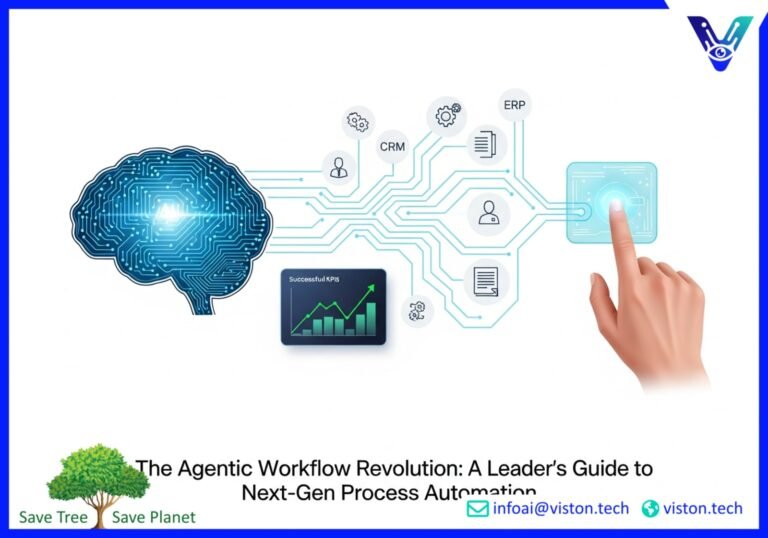
Agentic Workflows: Automating Complex Business Processes for 2025 and Beyond
In today’s fast-paced digital landscape, businesses are constantly seeking innovative ways to enhance efficiency, reduce costs, and gain a competitive edge. While traditional automation has made significant strides, a new paradigm is emerging that promises to revolutionize how we approach complex business processes: agentic workflows. As we look towards 2025, it’s clear that these AI-powered systems are not just a fleeting trend but a fundamental shift in enterprise operations. This blog post will demystify agentic workflows, exploring how they blend autonomy with governed human intervention to deliver unprecedented value. We’ll delve into the core components that make these workflows successful and provide actionable insights for leaders ready to embrace the future of process automation.
What Are Agentic Workflows? A Simple Explanation
Imagine a highly skilled, digital team member capable of understanding complex goals, planning multi-step actions, and executing them with precision. That, in essence, is what an AI agent in an agentic workflow does. Unlike traditional automation that follows rigid, pre-programmed rules, agentic workflows are dynamic and adaptive. They leverage artificial intelligence, particularly large language models (LLMs), to reason, make decisions, and interact with various systems to achieve a desired outcome. Think of it as the difference between a simple calculator and a seasoned financial analyst. Both can perform calculations, but only the analyst can understand the broader context, adapt to new information, and provide strategic recommendations.
At its core, an agentic workflow is a series of tasks carried out by one or more AI agents that can operate autonomously to achieve a specific goal. This means they don’t require every single step to be meticulously mapped out. Instead, you provide the destination, and the agent navigates the best path to get there, even if it encounters unexpected roadblocks along the way. This adaptability is what sets agentic workflows apart and makes them incredibly powerful for tackling the complex, real-world challenges that businesses face every day.
The Core Components of a Successful Agentic Workflow
To truly harness the power of agentic workflows, it’s essential to understand the key components that drive their success. These elements work in concert to create a robust, reliable, and intelligent automation ecosystem that can transform your business operations.
Mapping Decision Trees: The Blueprint for Autonomy
Before an AI agent can act autonomously, it needs a clear understanding of the goals, constraints, and potential pathways of a business process. This is where mapping decision trees comes in. A decision tree serves as the foundational blueprint, outlining the various choices an agent can make based on different inputs and conditions. It’s a structured way of representing the logic and flow of a complex process, ensuring that the agent’s actions are aligned with your business objectives.
Creating these decision trees is not just a technical exercise; it’s a strategic one that requires deep collaboration between business stakeholders and AI/ML engineers. By mapping out your processes in this way, you’re not just preparing for automation; you’re also gaining a deeper understanding of your own operations, often revealing opportunities for improvement even before an AI agent is deployed. This initial step is crucial for setting the stage for successful and predictable automation.
Tool Use and Retries: Equipping Agents for Success
For an AI agent to be effective, it needs the ability to interact with the real world, or in this case, your business’s digital ecosystem. This is achieved through “tool use,” where agents are given access to a variety of digital tools, primarily in the form of enterprise APIs. These APIs act as the bridges that connect the agent to your core business systems, such as your CRM, ERP, and marketing automation platforms. Through these connections, an agent can perform a wide range of actions, including:
- Retrieving customer data from Salesforce
- Sending an invoice through Stripe
- Updating inventory levels in your ERP system
- Sending a notification to a Slack channel
However, in the real world, things don’t always go as planned. APIs can fail, systems can be temporarily unavailable, and unexpected errors can occur. This is why the concept of “retries” is so important. A well-designed agentic workflow includes robust error-handling and retry mechanisms, allowing the agent to attempt a failed action again after a short delay. This built-in resilience ensures that your automated processes can handle transient issues without requiring manual intervention, making them more reliable and robust.
Human-in-the-Loop: Blending Autonomy with Governance
One of the biggest concerns for leaders considering advanced automation is the fear of losing control. Agentic workflows address this concern through a powerful pattern known as “human-in-the-loop.” This approach combines the speed and efficiency of AI with the critical thinking and oversight of human experts. It allows you to design workflows where the AI agent handles the majority of the tasks autonomously but pauses at critical junctures to seek human approval or input. For more information on this topic, you can read an insightful article from Forbes on the importance of human-in-the-loop design.
This “governed autonomy” is essential for high-stakes processes where the cost of an error is significant. For example, an agentic workflow for procurement might automate the entire process of identifying suppliers, negotiating prices, and generating purchase orders, but it would require a final sign-off from a procurement manager before a large payment is sent. This collaborative model ensures that you can leverage the full power of AI without sacrificing control or accountability. To delve deeper into how human expertise strengthens AI, explore this article on the key to value creation in AI.
KPIs and Alerts: Measuring Success and Staying Informed
To ensure that your agentic workflows are delivering the desired results, it’s crucial to establish a clear set of Key Performance Indicators (KPIs) to measure their effectiveness. These KPIs should be directly tied to your business objectives and provide tangible evidence of the value that automation is creating. Some common KPIs for measuring the success of process automation include:
- Process Cycle Time Reduction: The amount of time saved from the start to the end of a process.
- Error Rate Reduction: The decrease in errors or defects after implementing automation.
- Cost Savings: The reduction in operational costs, including labor and resource expenses.
- Employee Productivity: The increase in output and efficiency of employees who are now free from repetitive tasks.
In addition to tracking KPIs, it’s also important to implement a system of alerts that can notify stakeholders of important events, successes, or failures. These alerts can be configured to trigger based on specific conditions, such as the successful completion of a major workflow or an error that requires human attention. This proactive monitoring ensures that you always have visibility into the performance of your automated processes and can take action when needed.
Agentic API Patterns: The Engine of End-to-End Automation
The true power of agentic workflows is unlocked through a well-defined strategy for your enterprise APIs. These APIs are the connective tissue that enables seamless communication and interaction between your AI agents and your various business systems. Without a robust and accessible API layer, your agents would be operating in a vacuum, unable to perform the actions needed to complete complex, end-to-end workflows.
As we move into 2025, we’re seeing the emergence of “agentic API patterns,” which are new ways of designing and managing APIs specifically for AI consumption. These patterns prioritize things like natural language interfaces, self-documentation, and enhanced security, making it easier for AI agents to discover, understand, and use the tools at their disposal. By investing in a modern, API-first architecture, you’re not just enabling agentic workflows; you’re future-proofing your business and creating a more agile and interconnected enterprise. For a detailed overview of the latest trends in AI, TechCrunch offers a wealth of information and analysis.
The Viston AI Advantage: Building Your Agentic Future
Implementing agentic workflows can seem like a daunting task, but with the right partner, it can be a smooth and transformative journey. At Viston AI, we specialize in helping enterprises design, build, and deploy sophisticated AI-powered solutions that drive real business value. Our team of experts understands the nuances of process automation and can help you develop a tailored strategy that aligns with your unique goals and challenges.
We believe in a collaborative approach, working closely with your team to map your decision trees, integrate your enterprise APIs, and implement a human-in-the-loop model that provides the perfect balance of autonomy and governance. With our deep expertise and cutting-edge technology, we can help you unlock the full potential of agentic workflows and build a more efficient, agile, and intelligent enterprise.
Frequently Asked Questions (FAQs)
1. What is the main difference between traditional automation and agentic workflows?
Traditional automation, like Robotic Process Automation (RPA), is rule-based and follows a pre-defined script. It excels at simple, repetitive tasks. Agentic workflows, on the other hand, are goal-oriented and use AI to reason, plan, and adapt. They can handle complex, multi-step processes with variability and unexpected events.
2. Are agentic workflows secure for enterprise use?
Yes, security is a paramount concern. Agentic workflows are built on secure enterprise APIs with robust authentication and authorization protocols. The human-in-the-loop model also adds a layer of security by requiring human oversight for critical actions, ensuring that all automated processes operate within your company’s governance and compliance frameworks.
3. What types of business processes are best suited for agentic workflows?
Agentic workflows are ideal for complex processes that require decision-making, involve multiple systems, and have a degree of variability. Examples include lead qualification and routing in sales, claims processing in insurance, supply chain optimization, and personalized customer support.
4. How do I get started with implementing agentic workflows?
The best way to start is with a pilot project. Identify a high-impact, well-understood business process that could benefit from automation. Work with a team of business and technical experts to map the decision tree, identify the necessary tools (APIs), and define the points for human intervention. This allows you to learn and demonstrate value before scaling to more complex workflows.
5. What is the role of large language models (LLMs) in agentic workflows?
LLMs are the “brains” of the AI agents. They provide the reasoning, language understanding, and planning capabilities that allow the agent to interpret goals, break them down into steps, and interact with tools and humans in a natural way.
6. Can agentic workflows integrate with our existing legacy systems?
Yes, in many cases. Integration with legacy systems is often possible by creating custom API wrappers that expose the necessary functionality to the AI agents. This allows you to leverage the power of agentic workflows without having to completely overhaul your existing IT infrastructure.
7. How do you measure the ROI of an agentic workflow?
The ROI is measured by tracking the KPIs you’ve established. This includes quantifiable metrics such as cost savings from reduced manual labor, productivity gains from faster process completion, revenue increases from improved sales or customer retention, and cost avoidance from reduced errors and compliance risks.
8. Do we need to have a large team of AI experts to manage agentic workflows?
While you will need some technical expertise to set up and maintain the workflows, modern platforms are making it easier for business users to manage and configure them. The human-in-the-loop design also means that your existing subject matter experts play a crucial role in the day-to-day operation of the system.
Take the Next Step Towards Intelligent Automation
The era of agentic workflows is here, and the businesses that embrace this technology will be the leaders of tomorrow. By blending the autonomous power of AI with the strategic oversight of human experts, you can create a more efficient, resilient, and innovative organization. If you’re ready to explore how agentic workflows can transform your business, we’re here to help.
Contact Viston AI today to schedule a consultation and discover how our AI-powered solutions can help you automate your most complex business processes and achieve your strategic goals.
#AgenticWorkflows #ProcessAutomation #EnterpriseAPIs #AIinBusiness #DigitalTransformation #FutureOfWork #IntelligentAutomation #VistonAI
