
Multi-Agent Systems: The Next Automation Frontier
Imagine trying to build a modern skyscraper with a single worker. No matter how skilled, one person cannot manage the complexity of design, engineering, logistics, and construction simultaneously. This is the bottleneck many businesses face with their AI today. They rely on single-agent systems—powerful, yet solitary AI—to tackle increasingly complex workflows. But as we push the boundaries of automation in 2025, it’s clear that the future isn’t about a single, all-powerful AI. It’s about creating a team of them.
This is the world of multi-agent systems (MAS), the true next frontier in automation. By deploying teams of specialized AI agents that collaborate, co-plan, and co-execute tasks, organizations can solve problems far beyond the reach of any single AI. This shift from a solo performer to a coordinated symphony is unlocking unprecedented levels of efficiency, resilience, and innovation.
From Solo Acts to a Symphony: Single-Agent vs. Multi-Agent Systems
For years, single-agent AI has been the star of the show. Think of a chatbot answering customer questions or an algorithm analyzing a dataset. These systems are designed to follow a specific loop: plan, execute, and complete a task. They are effective for linear, well-defined problems. But what happens when the workflow becomes dynamic and multifaceted?
The Limits of the Lone Wolf: Why Single-Agent AI Falls Short
A single AI agent, much like a single worker, eventually hits a ceiling. As you add more tools and responsibilities, its efficiency drops. The agent gets confused about which tool to use or becomes overwhelmed by too much context. This leads to errors and suboptimal outcomes. It’s like asking one musician to play every instrument in an orchestra—the result is chaotic, not harmonious. In complex business environments, this translates to failed workflows, stalled projects, and missed opportunities.
The Power of the Pack: Introducing Multi-Agent Systems (MAS)
Now, envision an entire orchestra. Each musician is an expert on their instrument, but they all follow the same sheet music and conductor. This is the essence of a multi-agent system. Instead of one AI trying to do everything, a MAS uses multiple specialized agents that work together. Each agent has a specific role, a focused set of tools, and a clear purpose. This collaborative approach, known as agent cooperation, delivers significant advantages:
- Increased Capability: By dividing a complex problem into smaller, manageable sub-tasks, a multi-agent system can solve challenges that would be impossible for a single agent.
- Enhanced Specialization: Agents can be fine-tuned for specific functions, such as data analysis, customer communication, or code generation, leading to higher-quality results.
- Greater Scalability: Need to add a new capability? Simply add a new agent to the team. This modularity allows the system to grow and adapt without overloading any single component.
- Improved Resilience: In a single-agent system, one failure can bring the entire process to a halt. In a multi-agent system, if one agent fails, others can often adapt and continue the work, making the entire system more robust.
The Art of Teamwork: How Agent Cooperation Unlocks Complexity
The true power of multi-agent systems lies in their ability to do more than just divide labor. They engage in sophisticated co-planning and co-execution. This means agents don’t just work in parallel; they communicate, negotiate, and adapt their plans in real-time based on the actions of their teammates. This dynamic collaboration is what allows them to navigate the unpredictable nature of real-world business challenges.
Beyond Simple Commands: Co-Planning and Co-Execution
Imagine a team of autonomous drones tasked with a search and rescue mission in a disaster zone. A single drone would cover ground slowly and sequentially. A multi-agent system of drones, however, can co-plan the search area, with each drone taking a specific sector. They co-execute by sharing real-time data about what they find, allowing the team to dynamically adjust its search pattern. If one drone’s view is obstructed, another can be redirected to cover that area. This level of intelligent teamwork is made possible by sophisticated orchestration frameworks.
Orchestration Frameworks: The Conductor of the AI Symphony
If the AI agents are the musicians, then orchestration frameworks are the conductors. These frameworks provide the structure and rules that govern how agents interact. They manage communication, delegate tasks, and ensure that all agents are working towards a common goal. Leading frameworks in 2025, such as LangChain, CrewAI, and Microsoft’s Agent Framework, are making it easier than ever to build and manage these sophisticated AI teams. They provide the tools to define agent roles, establish communication protocols, and design complex, collaborative workflows.
Coordinator-Worker Patterns in Action
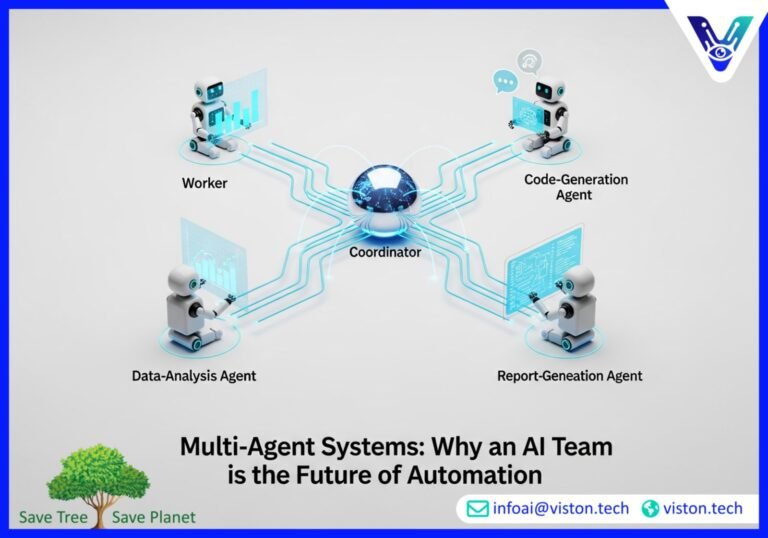
A popular and effective model for agent cooperation is the coordinator-worker pattern. In this setup, a “coordinator” agent acts as the project manager. It receives a high-level goal, breaks it down into smaller tasks, and assigns those tasks to specialized “worker” agents. For example, to generate a quarterly business report:
- A Coordinator Agent receives the request: “Create the Q4 2024 sales report.”
- It tasks a Data-Mining Agent with pulling sales figures from the company database.
- Simultaneously, it tasks a Market-Analysis Agent with gathering competitor data and market trends.
- Once the data is collected, a Visualization Agent is tasked with creating charts and graphs.
- Finally, a Report-Generation Agent synthesizes all the information into a polished, human-readable document.
This parallel processing and specialization dramatically reduce the time and effort required while producing a more comprehensive and accurate result.
Measuring Success: How Do We Evaluate an AI Team?
Evaluating a single agent is relatively straightforward—did it complete the task successfully? But evaluating a multi-agent system is more complex. Success is not just about individual performance; it’s about the collective outcome. The key is to shift from measuring individual outputs to assessing the team’s overall effectiveness and efficiency.
Beyond Individual Performance: Metrics for Collective Success
When evaluating a multi-agent system, you need to look at metrics that reflect the quality of the agent cooperation. These can include:
- Task Completion Rate: How successfully did the team achieve the final goal?
- Resource Efficiency: How effectively did the team use time, computing power, and other resources?
- Robustness and Fault Tolerance: How well did the system handle unexpected errors or the failure of an individual agent?
- Adaptability: How quickly and effectively did the team adjust its plan in response to new information or changing conditions?
Traditional accuracy scores are no longer sufficient. We need a holistic view that captures the nuances of collaborative problem-solving.
The Challenges of Evaluating Emergent Behavior
One of the most powerful and challenging aspects of multi-agent systems is the potential for emergent behavior—unplanned but often innovative solutions that arise from the interaction of multiple agents. While this can lead to incredible breakthroughs, it also makes the system’s behavior harder to predict and evaluate. Continuous monitoring and sophisticated simulation environments are becoming essential tools for understanding and harnessing these complex dynamics.
The Ops Playbook: Ensuring Your Multi-Agent System is Reliable and Robust
Deploying a multi-agent system is not a one-time setup. It requires a new operational playbook focused on ensuring long-term reliability and performance. Unlike traditional software, where you can test for a finite set of outcomes, the dynamic nature of multi-agent systems demands a continuous approach to validation and monitoring.
From Development to Deployment: A New Paradigm
The lifecycle of a multi-agent system is continuous. It involves ongoing learning and adaptation. An effective operations playbook must move beyond pre-deployment unit tests and embrace a culture of continuous evaluation. This means testing the system under a wide variety of simulated real-world conditions, including injecting failures to see how the system responds.
Key Strategies for Dependable AI Teams
To build a reliable multi-agent system, organizations should focus on several key strategies:
- Implement Adaptive Architectures: Design your system with modular components that can be updated or reconfigured without disrupting the entire workflow. Standardize communication protocols to ensure seamless interaction.
- Establish Continuous Evaluation Frameworks: Don’t just test before deployment. Implement ongoing monitoring to track both individual agent performance and the effectiveness of their collaboration. Real-time anomaly detection can help identify issues before they escalate. For more on this, see how industry leaders approach evaluating AI systems.
- Conduct Adversarial Testing: Go beyond testing for expected behavior. Deliberately introduce challenges like network latency, corrupted data, or conflicting information to test the system’s resilience and identify potential breaking points.
- Prioritize Observability: Ensure that every agent’s decisions and actions are traceable. This visibility is crucial for debugging issues, understanding emergent behaviors, and building trust in the system.
The Viston AI Advantage: Pioneering the Future of Automation
The transition to multi-agent systems represents a fundamental shift in how we approach AI and automation. It’s a move from simple task execution to complex, collaborative problem-solving. This is not just a technological upgrade; it is a strategic evolution that allows businesses to tackle challenges with greater speed, intelligence, and resilience.
At Viston AI, we are at the forefront of this revolution. We build sophisticated AI-powered solutions that leverage the power of multi-agent systems to transform business operations. Our expertise in designing robust orchestration frameworks and fostering seamless agent cooperation enables our clients to automate complex workflows and unlock new levels of productivity and innovation.
Are you ready to move beyond the limitations of single-agent AI? Let us help you build your AI team.
Contact Viston AI today to discover how our multi-agent solutions can help you conquer the next frontier of automation.
#MultiAgentSystems #AIAutomation #AgentCooperation #OrchestrationFrameworks #FutureOfWork #DigitalTransformation #ArtificialIntelligence #VistonAI
Frequently Asked Questions (FAQs)
1. What is the main difference between a single-agent and a multi-agent system?
A single-agent system relies on one AI entity to perform all aspects of a task. A multi-agent system distributes tasks among multiple specialized AI agents that collaborate to achieve a common goal, making it more scalable, resilient, and capable of handling complex problems.
2. What is an orchestration framework and why is it important?
An orchestration framework is a platform that manages the interactions between multiple AI agents. It’s crucial because it sets the rules for communication, delegates tasks, and ensures all agents are working together efficiently, much like a conductor leading an orchestra.
3. How does “agent cooperation” lead to better results?
Agent cooperation allows for co-planning and co-execution of tasks. Agents can share information in real-time, adapt their strategies based on new data from other agents, and work in parallel. This collaborative approach leads to faster problem-solving, more innovative solutions, and greater resilience to errors.
4. What are some real-world examples of multi-agent systems?
Multi-agent systems are used in various industries. Examples include teams of robots in automated warehouses (like those at Amazon), networks of smart sensors optimizing traffic flow in a city, autonomous drones conducting coordinated search and rescue missions, and sophisticated financial trading systems.
5. Is it difficult to implement a multi-agent system?
While multi-agent systems are more complex than single-agent systems, modern orchestration frameworks have made them much more accessible. These tools provide the necessary infrastructure to build, manage, and scale AI teams, allowing developers to focus on defining agent roles and goals.
6. How do you ensure a multi-agent system is reliable?
Reliability is ensured through a combination of adaptive architectural design, continuous evaluation and monitoring, and rigorous testing. This includes adversarial testing, where potential failure scenarios are simulated to ensure the system remains robust and fault-tolerant in a live production environment.
7. Can multi-agent systems be used for creative or strategic tasks?
Yes. By combining agents with different specializations—such as a data analyst agent, a creative brainstorming agent, and a strategic planning agent—a multi-agent system can tackle complex challenges that require both analytical rigor and creative thinking, like developing a new marketing strategy or business plan.
8. How will multi-agent systems evolve in the near future?
We can expect multi-agent systems to become even more sophisticated, with agents capable of more autonomous learning and adaptation. The integration with technologies like Large Language Models (LLMs) will enhance their communication and reasoning abilities, leading to more powerful and versatile AI teams. For an in-depth look at this evolution, check out this overview from TechTarget on multi-agent systems.
