
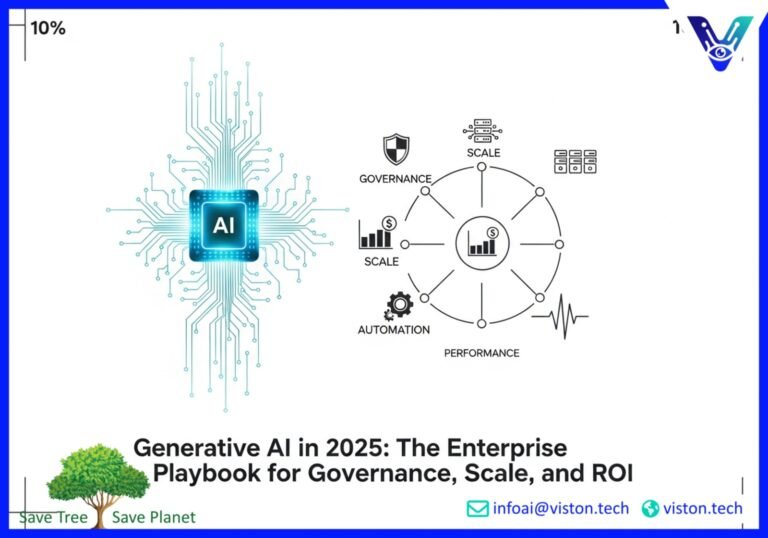
The New Enterprise Standard: Generative AI in Production for 2025
For the past few years, generative AI has been the star of the experimental stage. We saw fascinating demos and clever chatbots. But 2025 marks a critical turning point. The curtain is falling on isolated experiments and rising on enterprise-wide, production-grade generative AI. This is the year we move beyond the hype and focus on two first-class goals: rigorous governance and measurable business value. For leaders, the question is no longer “What can this technology do?” but rather, “How do we deploy it securely, affordably, and at a scale that transforms our business?”
The shift is profound. We are moving from simple text generation to deeply integrated AI systems that power core business processes. These are not just add-ons; they are becoming part of the critical infrastructure. This leap requires a new way of thinking. It demands robust architectures, ironclad safety protocols, disciplined cost control, and a clear-eyed focus on performance. This guide provides a blueprint for C-suite executives, IT leaders, and AI engineers to navigate this new era of enterprise generative AI.
Beyond the Bot: Unlocking Real Value with Enterprise Generative AI
The initial wave of generative AI was defined by standalone chat interfaces. While useful, their true power is unleashed when they are woven into the fabric of the enterprise. In 2025, leading organizations are deploying AI solutions that go far beyond answering simple queries. They are building intelligent systems that drive efficiency, create new revenue streams, and deliver unprecedented levels of personalization.
Think bigger than a summary tool. Imagine AI that doesn’t just write code, but also tests and secures it. Imagine a system that doesn’t just draft marketing copy, but dynamically personalizes a customer’s entire digital journey in real-time. This is the promise of AI in production.
Key use cases emerging as mainstream in 2025 include:
- Hyper-Personalized Customer Experiences: AI agents that understand a customer’s entire history to provide proactive support and tailored recommendations across all touchpoints.
- Intelligent Process Automation: Automating complex workflows like claims processing, supply chain logistics, and contract analysis with a high degree of accuracy and nuance.
- Accelerated Research & Development: In fields like pharmaceuticals and materials science, generative AI can simulate and predict outcomes, drastically cutting down discovery timelines.
- Advanced Predictive Maintenance: AI systems that analyze sensor data to predict equipment failures with greater accuracy than ever before, minimizing downtime and saving millions.
- Sophisticated Code Generation and Quality Assurance: AI assistants that help developers write, document, and test code more efficiently, improving both productivity and software quality.
Building for Scale: Reference Architectures for AI in Production
Moving from a successful pilot to a full-scale production deployment is one of the biggest challenges enterprises face. Ad-hoc solutions built for a small user group will crumble under the weight of enterprise demand. A solid blueprint—a reference architecture—is not just recommended; it’s essential for success. It ensures your AI solution is scalable, secure, and maintainable.
The Core Components of a Modern AI Stack
A production-ready AI architecture is composed of several interconnected layers, each with a critical role.
- The Data Foundation: High-quality AI starts with high-quality data. This layer includes your data lakes, warehouses, and increasingly, vector databases designed to handle the complex data that generative models use. Your architecture must ensure this data is clean, secure, and accessible in real-time.
- The Model Layer: This is the engine of your AI solution. Here, you face the “build vs. buy” decision. You can leverage powerful foundation models from providers like Google, OpenAI, and Anthropic, or you can fine-tune smaller, open-source models on your proprietary data for specific tasks. The right choice depends on your use case, budget, and privacy requirements.
- The Integration and Orchestration Layer: An AI model is useless in a silo. This layer connects your AI to your existing enterprise systems, such as your CRM, ERP, and internal databases. It uses APIs and orchestration tools to create seamless workflows, ensuring the AI’s intelligence is delivered where it’s needed most.
- The Application Layer: This is the final, user-facing part of the solution. It could be an internal tool for your employees, a new feature in your customer-facing app, or a fully automated backend process. This layer is where the business value is ultimately realized.
Governance First: Mastering AI Safety and Compliance in 2025
In the enterprise, trust is not optional. As AI becomes more powerful and autonomous, a strong AI governance framework is the only way to ensure it is used safely, ethically, and in compliance with evolving regulations. Smart leaders see governance not as a barrier to innovation, but as a critical enabler. It builds the trust with customers, employees, and regulators that is necessary for long-term success.
A robust governance strategy is proactive, not reactive. For a deeper dive into establishing a formal framework, the NIST AI Risk Management Framework provides a comprehensive and widely adopted starting point for organizations of all sizes.
Key Pillars of Robust AI Governance
- Data Privacy and Security: Generative AI models must be trained and operated with strict data controls. This means ensuring sensitive customer and corporate data (PII, intellectual property) is not exposed, and complying with regulations like GDPR and CCPA.
- Model Transparency and Explainability: For many enterprise use cases, especially in regulated industries like finance and healthcare, you must be able to understand and explain why an AI model made a particular decision. Black box models are no longer acceptable.
- Bias and Fairness Audits: AI models trained on biased data will produce biased results. A rigorous governance program includes proactive scanning of data and model outputs to identify and mitigate harmful biases related to race, gender, age, and other factors.
- Access Control and Audit Trails: You need clear rules about who can access and use your AI models. Detailed logging and audit trails are essential to track usage, troubleshoot issues, and ensure accountability.
The Bottom Line: Implementing Strict Cost Control for Generative AI
Let’s be clear: training and running large-scale generative AI models can be incredibly expensive. The cost of compute power, API calls, and specialized talent can quickly spiral out of control without a disciplined approach to financial management. In 2025, cost optimization is a core competency for any team putting AI in production.
Strategies for Financial Sanity
Fortunately, there are several effective strategies for managing your AI budget without sacrificing performance.
- Right-Sized Model Selection: One of the most common mistakes is using a massive, state-of-the-art model for a simple task. Use the most powerful models for complex reasoning, but opt for smaller, faster, and cheaper models for tasks like classification or simple summarization.
- Fine-Tuning vs. RAG: For tasks requiring domain-specific knowledge, Retrieval-Augmented Generation (RAG) is often far more cost-effective than fine-tuning a large model. RAG allows a model to pull in information from your private knowledge base in real-time, reducing the need for costly retraining.
- Infrastructure Optimization: Smartly managing your cloud infrastructure is key. This includes using cost-effective GPU instances, leveraging spot pricing for non-critical workloads, and implementing caching strategies to reduce redundant API calls. For more insights, exploring resources on managing GenAI costs from cloud providers can offer practical tips.
- Robust Monitoring and Budgeting: You cannot control what you cannot measure. Implement real-time dashboards to monitor key cost drivers like API usage and token consumption. Set up automated alerts and hard budget caps to prevent unexpected overruns.
Performance is Non-Negotiable: Defining Production SLOs and SLAs
When an AI system is part of a critical business process, “best effort” is not good enough. You need formal guarantees about its performance. This is where Service Level Objectives (SLOs) and Service Level Agreements (SLAs) come in. These are not just technical metrics; they are promises to your users and customers about the reliability and quality of your AI service.
What to Measure for Enterprise Generative AI
Defining and tracking the right metrics is crucial for ensuring your AI solution delivers consistent value.
- Latency: How fast does the model provide a response? For real-time, user-facing applications, a delay of even a few seconds can be unacceptable.
- Accuracy and Relevance: Is the model’s output correct, helpful, and relevant to the user’s query? This often requires a combination of automated testing and human-in-the-loop review.
- Uptime and Availability: Is the AI service consistently available when your business needs it? An SLA should define a clear uptime guarantee, such as 99.9%.
- Model Drift Monitoring: The world is constantly changing, and an AI model’s performance can degrade over time as the data it was trained on becomes outdated. You must continuously monitor for this “drift” and have a plan to retrain or update the model as needed.
The Viston AI Advantage: Your Partner for Production-Ready AI
Navigating the transition to production-grade enterprise generative AI is complex. It requires deep expertise in architecture, security, cost management, and operations. At Viston AI, we specialize in helping businesses move beyond the experimental phase to build and deploy scalable, secure, and value-driven AI solutions.
We partner with you to design the right architecture, implement a robust governance framework, optimize for cost-efficiency, and guarantee performance with clear SLAs. We handle the complexity so you can focus on the business transformation.
Frequently Asked Questions (FAQs)
1. What is the difference between a pilot AI project and AI in production?
A pilot project is a small-scale experiment designed to test feasibility and potential value, often with a limited user group and relaxed performance requirements. AI in production is a fully integrated, scalable, and reliable system that is part of a critical business workflow, with formal guarantees for performance (SLAs), security, and support.
2. How can we ensure our proprietary data is safe when using large language models?
This is a critical aspect of AI governance. Solutions include using models hosted in a private cloud environment, leveraging services from major cloud providers that guarantee data privacy, and implementing data anonymization techniques before sending any information to a model API.
3. What is “model drift” and why should we monitor it?
Model drift occurs when a model’s predictive accuracy deteriorates over time because the real-world data it encounters in production differs from the data it was trained on. Monitoring for drift is essential to ensure the AI continues to make reliable and accurate decisions.
4. Is it better to use a large commercial model or a smaller, fine-tuned one?
It depends on the task. For general-purpose, complex reasoning, a large commercial model is often best. For specialized tasks that require deep domain knowledge but a narrow set of capabilities, a smaller, fine-tuned model can be more accurate, faster, and significantly more cost-effective.
5. How do we start building an AI governance framework?
Start by assembling a cross-functional team including legal, compliance, IT, and business leaders. Begin by identifying the highest-risk use cases and defining clear principles for AI usage, data handling, and model transparency. Use established guides like the NIST AI Risk Management Framework as a foundation.
6. What is the first step to controlling generative AI costs?
The first step is visibility. Implement a monitoring and logging system that tracks every API call and its associated cost. This allows you to understand your key cost drivers and identify opportunities for optimization, such as switching to a less expensive model for high-volume, low-complexity tasks.
7. Can generative AI integrate with our existing CRM and ERP systems?
Absolutely. Modern enterprise generative AI platforms are designed for integration. Through APIs and orchestration tools, you can connect AI models to your existing systems to automate data entry, generate reports, analyze customer interactions, and much more.
8. What kind of ROI can we realistically expect from enterprise generative AI in 2025?
The ROI varies by use case but typically falls into two categories: cost savings through automation and efficiency gains, and revenue growth through improved customer experiences, faster product development, and new AI-powered services. With a well-defined strategy, many enterprises are seeing a significant and measurable return on investment.
Ready to move your generative AI from experiment to enterprise powerhouse?
Don’t navigate the complexities of production AI alone. Contact the experts at Viston AI today to build a scalable, secure, and valuable AI-powered solution that delivers measurable results.
#EnterpriseAI #GenerativeAI #AIGovernance #AIinProduction #DigitalTransformation #Innovation2025 #VistonAI #TechTrends
