
How AI Search Is Changing SEO (And What To Do About It)
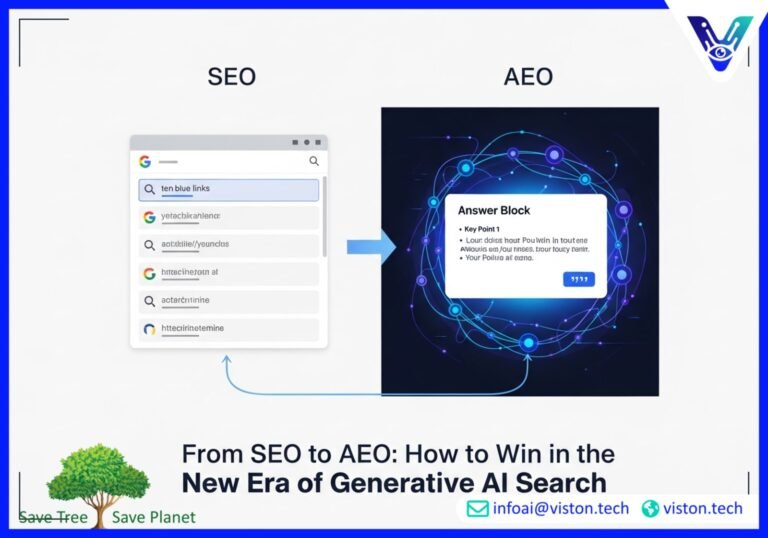
The familiar landscape of search is undergoing a seismic shift. For two decades, the “ten blue links” on a Google results page have been the primary target for SEO professionals. But the rise of powerful AI is redrawing the map. We’re moving from a world of search engines to a world of answer engines. This new era, driven by generative search, demands a fundamental rethink of how we approach online visibility. Welcome to the age of AI Search Optimization (AEO) and Generative Engine Optimization (GEO).
This isn’t a distant future; it’s happening now. AI-powered search experiences, like Google’s AI Overviews, are designed to provide direct, synthesized answers to user queries, often eliminating the need to click through to a website. For businesses, this presents both a significant challenge and a massive opportunity. The companies that adapt their strategies to this new reality will thrive, while those that cling to outdated SEO tactics risk becoming invisible. This post will break down exactly how AI search is changing the game and provide actionable steps you can take to stay ahead.
AI Answers vs. Blue Links: The New Search Paradigm
For years, the goal of SEO was straightforward: get your website to rank as high as possible in the search engine results pages (SERPs). This meant focusing on keywords, building backlinks, and optimizing on-page elements to signal relevance to search engine crawlers. The ultimate prize was a top spot among the coveted “blue links,” which would drive organic traffic to your site.
Enter generative search. Powered by large language models (LLMs), these new search experiences don’t just point users to a list of potential answers; they create a single, comprehensive answer synthesized from multiple sources across the web. This has led to a dramatic increase in “zero-click searches,” where the user gets their answer directly on the results page without ever visiting a third-party website.
This shift from a list of links to a direct answer is the core of the new search paradigm. It means that simply ranking for a keyword is no longer enough. Your new goal is to have your content be the trusted source that AI models cite in their generated responses. This is the essence of AEO (Answer Engine Optimization) and GEO (Generative Engine Optimization). It’s not about driving clicks in the traditional sense; it’s about influencing the AI’s answer to position your brand as an authority.
Content Patterns AI Cites: Becoming the Source of Truth
To succeed in this new AI-driven landscape, you need to understand what kind of content AI models prefer to cite. It’s no longer just about keyword density or the number of backlinks. AI models are looking for content that is clear, authoritative, and structured in a way that is easy for them to understand and synthesize. Here are some of the key content patterns that AI tends to cite:
- Direct and Concise Answers: AI models favor content that provides clear and direct answers to specific questions. Think in terms of “Question & Answer” formats. Structuring your content with headings that pose common questions and then providing succinct answers can make your content more attractive to AI.
- Structured Data and Schema Markup: Implementing structured data, such as schema markup, is more critical than ever. This metadata helps search engines and AI models understand the context of your content, making it easier for them to extract specific information. For a deeper dive into schema, Schema.org is the definitive resource.
- Expertise, Authoritativeness, and Trustworthiness (E-A-T): Google’s E-A-T guidelines are now even more crucial. AI models are designed to prioritize information from credible sources. Demonstrating your expertise through well-researched content, author bios, and citations from other authoritative sites will signal to AI that your content is trustworthy.
- Factual and Data-Driven Content: Including statistics, data points, and quotes from experts can significantly increase the chances of your content being cited. AI models often look for verifiable facts to include in their answers.
- Conversational Language: Users are increasingly interacting with search engines using natural, conversational language. Optimizing your content for these long-tail, conversational queries will align it with how people actually search in the age of AI. For more on this, check out this insightful article on conversational marketing.
On-Page Changes for the AI Era
Adapting your on-page SEO strategy for an AI-first world requires a shift in focus from pleasing algorithms to providing clear, structured information for both humans and machines. Here are some critical on-page changes to implement for effective AI search optimization:
Content Structure and Formatting
- Use Clear Hierarchies: Employ logical heading structures (H1, H2, H3, etc.) to break down your content into digestible sections. This makes it easier for AI to parse and understand the key topics covered on your page.
- Leverage Lists and Bullet Points: Break up dense paragraphs with bulleted and numbered lists. This not only improves readability for users but also provides scannable information that AI can easily extract.
- Emphasize Key Information: Use bold and italic text strategically to highlight important terms and concepts. This can help AI identify the most critical pieces of information within your content.
Semantic SEO and Topic Clusters
- Focus on Topics, Not Just Keywords: Move beyond targeting individual keywords and focus on creating comprehensive content around broader topics. This approach, known as topic clustering, signals to AI that you are an authority on a particular subject.
- Incorporate Semantic Keywords: Use synonyms and related terms throughout your content. This helps AI understand the context and nuances of your topic, leading to more relevant citations.
Technical SEO for AI Crawlers
- Ensure Crawlability: Make sure that AI crawlers can easily access and index your content. Check your robots.txt file to ensure you are not blocking important parts of your site.
- Optimize for Site Speed: A fast-loading website is crucial for both user experience and AI crawlers. A slow site can hinder the ability of AI to efficiently process your content.
Measurement KPIs: Redefining Success in a Zero-Click World
With the rise of zero-click searches, traditional SEO metrics like click-through rate (CTR) and organic traffic are becoming less indicative of success. In the era of AEO and GEO, we need to adopt a new set of Key Performance Indicators (KPIs) that reflect our visibility and influence within AI-generated answers. Here are the new metrics you should be tracking:
- Share of Voice in AI Responses: This is the new “rank tracking.” Instead of monitoring your position in the blue links, you should be measuring how often your brand or content is mentioned or cited in AI-generated results for your target queries.
- AI Citation Count: Track the number of times your website is referenced as a source by major AI platforms. An increase in citations is a strong indicator of your content’s authority and usefulness to AI models.
- Brand Sentiment in AI Answers: It’s not just about being mentioned; it’s about how you are mentioned. Monitor the sentiment of the language used when AI refers to your brand. Positive sentiment can significantly impact brand perception.
- Correctness and Accuracy of Brand Information: Ensure that when AI mentions your brand, the information it provides is accurate and up-to-date. Track and work to correct any inaccuracies in how AI represents your company, products, or services. An excellent resource for understanding these new metrics is this guide on new SEO KPIs for the age of AI.
The world of search is evolving at a breakneck pace. The transition to AI-powered search is not just a trend; it’s a fundamental transformation of how people access information. By embracing AI search optimization, focusing on creating high-quality, structured content, and adapting your measurement strategies, you can not only survive but thrive in this new landscape. The future of search is here, and it’s time to adapt or be left behind.
Ready to future-proof your SEO strategy?
The shift to AI search requires a new set of tools and expertise. At Viston AI, we specialize in helping businesses navigate the complexities of this new digital landscape. Our AI-powered solutions are designed to enhance your visibility in a world of generative search. Contact Viston AI today to learn how we can help you optimize for the future of search and turn this industry-wide disruption into your competitive advantage.
Frequently Asked Questions (FAQs)
1. What is the main difference between traditional SEO and AI Search Optimization (AEO)?
Traditional SEO focuses on ranking web pages in search engine results to drive traffic to a website. AEO, on the other hand, aims to have your content cited and accurately represented in the direct answers generated by AI search engines. The goal shifts from earning clicks to becoming a trusted source for the AI.
2. Is SEO dead because of AI search?
SEO is not dead, but it is evolving. The foundational principles of SEO, such as creating high-quality content and ensuring technical site health, are still crucial. However, the strategies and tactics must adapt to the new reality of generative search. Think of AEO and GEO as the next evolution of SEO.
3. How can I track my performance in AI search results?
You need to look beyond traditional metrics like keyword rankings and organic traffic. Start tracking new KPIs such as your share of voice in AI answers, the number of AI citations your content receives, and the sentiment of those mentions. New tools are emerging to help track these metrics.
4. What is Generative Engine Optimization (GEO)?
GEO is a subset of AI Search Optimization that focuses specifically on optimizing content to be found, understood, and used by generative AI models. This involves creating content that is easily digestible for these models, using structured data, and building brand authority to be seen as a credible source.
5. How does structured data help with AI search?
Structured data, like schema markup, provides context to your content in a way that is easily understood by machines. It helps AI models quickly identify key information on your page, such as product details, author information, or answers to frequently asked questions, increasing the likelihood of being featured in an AI-generated response.
6. What kind of content works best for AI search optimization?
Content that is clear, concise, well-structured, and factually accurate performs best. Think about creating content that directly answers common questions your audience has. Using formats like FAQs, how-to guides, and in-depth articles with clear headings and bullet points is highly effective.
7. Will AI search completely replace traditional search results?
While AI-generated answers are becoming more prevalent, it’s unlikely they will completely replace traditional search results in the near future. Many search queries, especially those with transactional intent, will still benefit from a list of links. However, for informational queries, AI answers will continue to grow in prominence.
8. How important is E-A-T (Expertise, Authoritativeness, Trustworthiness) for AI search?
E-A-T is more important than ever. AI models are being trained to prioritize information from sources that demonstrate strong expertise, authority, and trust. Building your brand’s credibility and showcasing your expertise will be a key factor in getting your content cited by AI.
