
AI Agents for Knowledge Management: Auto‑Curating, Tagging, and Summarizing Enterprise Content
The future of work is intelligent. As we move through 2026, enterprise AI business trend reports consistently highlight knowledge management and “end-to-end visibility” as pivotal use cases. For businesses aiming to stay competitive, leveraging artificial intelligence is no longer an option—it’s a necessity. The days of clunky, outdated intranets are numbered, replaced by dynamic, intelligent systems powered by AI agents.
Organizational knowledge is a priceless asset. Yet, many companies struggle to harness its full potential. Traditional knowledge management systems can’t keep up with the explosive growth of unstructured data. The result is buried insights, decreased productivity, and valuable time wasted on information hunting. AI-powered knowledge agents are changing this narrative, transforming how enterprises capture, organize, and utilize their collective intelligence.
The Problem with Outdated Intranets
For years, intranets have been the go-to solution for internal knowledge sharing. However, they often become digital dumping grounds. Content becomes stale, irrelevant, and difficult to find. This leads to employee frustration and a decline in usage. When your team can’t trust the information they find, they stop looking. This creates knowledge silos and hinders collaboration.
Common issues with legacy intranets include:
- Poor Search Functionality: Keyword-based searches often yield irrelevant results, forcing employees to sift through pages of outdated documents.
- Stale Content: Without a dedicated team to constantly update information, intranets quickly become filled with obsolete files and broken links.
- Lack of Integration: Older systems rarely connect with the modern applications your team uses daily, creating a disjointed user experience.
- Information Overload: A sea of unorganized content makes it nearly impossible to find specific, valuable information.
These challenges highlight the urgent need for a more intelligent approach to knowledge management. This is where AI agents come in, offering a solution that is both powerful and intuitive.
Learn more about the rise of generative AI in enterprise knowledge management.
The Rise of Intelligent Knowledge Agents
Imagine an assistant that never sleeps, understands context, and can instantly provide you with the exact information you need. That’s the power of AI knowledge agents. These are not just advanced chatbots. They are sophisticated systems that can reason, learn, and act on the vast sea of enterprise data.
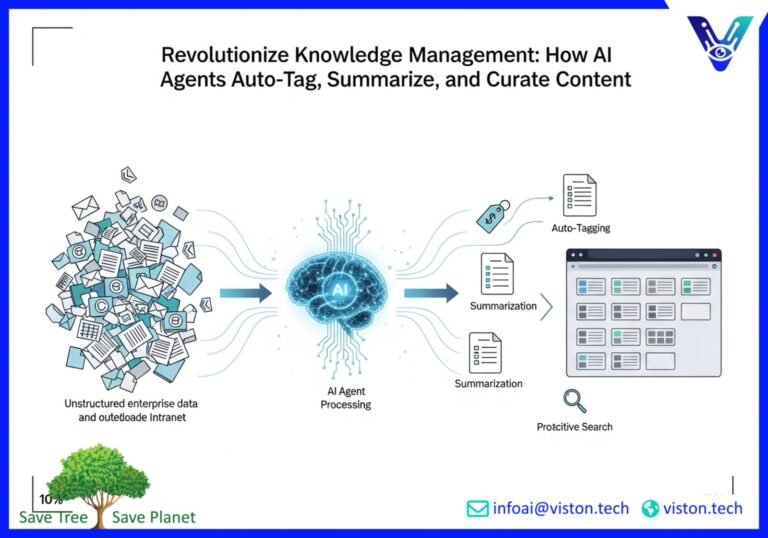
AI agents are designed to perform a variety of tasks that streamline knowledge management, including:
Automated Summarization of Meetings and Content
How much time is wasted in your organization on meetings? And how much of what is discussed is actually retained and actioned? AI agents can transcribe, summarize, and highlight key takeaways from meetings in real-time. This ensures that everyone is on the same page, even if they couldn’t attend. This technology extends beyond meetings to summarize long reports, articles, and other documents, delivering the essential information in a fraction of the time.
Intelligent Auto-Tagging of Documents
Properly tagging documents is crucial for effective enterprise search. However, manual tagging is time-consuming and often inconsistent. AI agents use natural language processing (NLP) to understand the content of a document and automatically apply relevant and accurate tags. This makes information easier to find and organize, breaking down data silos and improving accessibility.
Proactive Question Answering
Instead of just retrieving a list of documents, AI agents can provide direct answers to complex questions. By understanding the user’s intent, these agents can synthesize information from multiple sources to deliver a concise and accurate response. This transforms enterprise search from a reactive tool to a proactive knowledge discovery engine.
The Architecture of an AI Knowledge Management System
A successful AI-powered knowledge management system is built on a robust and scalable architecture. While the technical details can be complex, the core components are straightforward and designed to work together seamlessly.
The basic structure of these systems typically includes:
- Data Ingestion Layer: This is where the system connects to all of your enterprise data sources, including documents, emails, chat logs, and databases.
- Processing and Enrichment Layer: Here, AI models process the raw data. This includes transcription, translation, and the application of NLP for understanding context and sentiment. This is also where auto-tagging and summarization occur.
- Knowledge Base: This is the centralized repository where all the processed and enriched information is stored. It’s a living library of your organization’s collective knowledge.
- Inference and Reasoning Engine: This is the “brain” of the system. It uses the knowledge base to answer questions, make recommendations, and perform tasks.
- User Interface: This is how your team interacts with the system, whether through a search bar, a chatbot, or integration with their existing tools.
Discover more about the current state of AI and its impact on business.
Measuring Success: Key Performance Indicators (KPIs)
Implementing an AI knowledge management system is a significant investment. To ensure you’re getting the most out of it, it’s crucial to track the right key performance indicators (KPIs). These metrics will help you understand the impact of the system on your organization’s productivity and efficiency.
Consider tracking the following KPIs:
- Time to Information: How quickly can employees find the information they need? A significant reduction in search time is a key indicator of success.
- Employee Engagement and Adoption: Are people actually using the new system? High adoption rates suggest that the tool is valuable and easy to use.
- First Contact Resolution Rate (for customer support): If you’re using AI agents to support your customer service team, an increase in this metric indicates that agents are finding the right answers faster.
- Content Accuracy and Relevance: Monitor user feedback on the quality of the information provided by the AI agents.
- Reduction in Redundant Work: Are teams collaborating more effectively and spending less time recreating existing knowledge?
The Viston AI Advantage
At Viston AI, we understand the challenges of modern knowledge management. Our AI-powered solutions are designed to transform your enterprise content into a strategic asset. We specialize in creating custom AI agents that can auto-curate, tag, and summarize your information, providing your team with the insights they need, right when they need them.
Our solutions are built on a flexible and scalable architecture, allowing us to integrate seamlessly with your existing systems. We work closely with you to understand your unique needs and develop a solution that delivers measurable results.
Don’t let your organization’s knowledge go untapped. Contact Viston AI today to learn how our AI-powered solutions can revolutionize your knowledge management strategy.
Frequently Asked Questions (FAQs)
1. What are AI knowledge agents?
AI knowledge agents are intelligent systems that use artificial intelligence, particularly natural language processing and machine learning, to automate the management of enterprise content. They can understand, organize, and retrieve information, as well as perform tasks like summarizing documents, tagging content, and answering questions.
2. How does auto-tagging work?
Auto-tagging uses AI to analyze the content of a document and identify key concepts, topics, and entities. It then automatically assigns relevant keywords or “tags” to the document, making it easier to categorize and find through enterprise search.
3. What is the benefit of AI-powered summarization?
AI-powered summarization can quickly condense long documents, meeting transcripts, or reports into concise summaries. This saves employees significant time and allows them to quickly grasp the most important information without having to read through lengthy content.
4. Can AI agents integrate with our existing software?
Yes, modern AI knowledge management solutions are designed to integrate with a wide range of enterprise applications, such as CRMs, ERPs, and collaboration tools. This creates a unified experience and allows employees to access information from within the tools they already use.
5. How do we measure the ROI of an AI knowledge management system?
The return on investment (ROI) can be measured through various KPIs, including increased productivity, reduced time spent searching for information, improved employee satisfaction, and better decision-making. These factors contribute to both cost savings and revenue growth.
6. Is it difficult for non-technical employees to use AI agents?
Not at all. AI agents are designed with user-friendly interfaces, often resembling a simple search bar or a chatbot. The goal is to make accessing information as easy and intuitive as possible for all employees, regardless of their technical expertise.
7. How is data security handled with AI knowledge management systems?
Reputable providers of AI knowledge management solutions prioritize data security. They employ robust security measures, including encryption, access controls, and compliance with industry standards, to ensure that your enterprise data remains secure.
8. What makes AI-powered enterprise search different from traditional search?
Traditional enterprise search relies on keywords and often returns a long list of documents that may or may not be relevant. AI-powered search understands the context and intent behind a user’s query, allowing it to provide direct answers and more accurate, relevant results.
#KnowledgeManagement #AIAgents #EnterpriseAI #AutoTagging #Summarization #EnterpriseSearch #DigitalTransformation #FutureOfWork #VistonAI
