
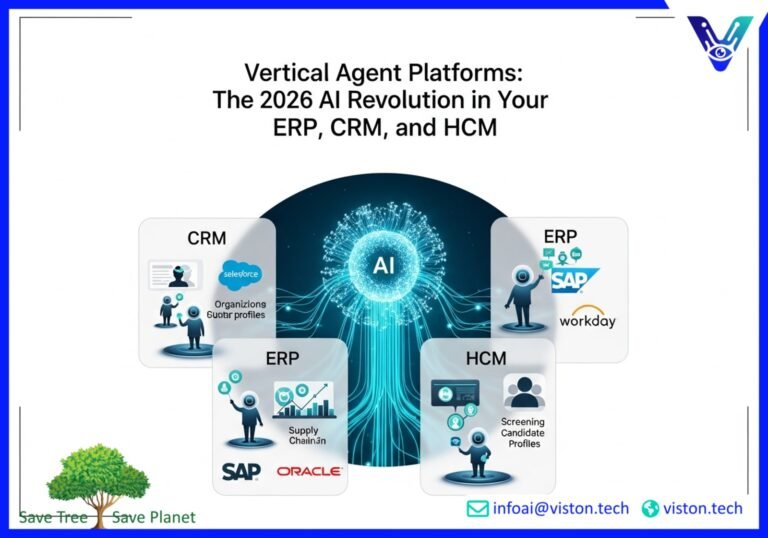
Vertical Agent Platforms: The 2026 AI Revolution in Your ERP, CRM, and HCM
The way we interact with core business software is about to fundamentally change. Forget endless clicking, complex dashboards, and siloed data. The next era of enterprise technology is here, and it’s powered by **Vertical Agent Platforms**. By 2026, the world’s leading Enterprise Resource Planning (ERP), Customer Relationship Management (CRM), and Human Capital Management (HCM) vendors are embedding intelligent, autonomous AI agents directly into the fabric of their software.
This isn’t just another feature update; it’s a seismic shift. We’re moving from software that simply stores information to platforms that actively *work for you*. These aren’t generic chatbots. They are specialized, pre-built **embedded agents** designed with deep industry knowledge—what we call **vertical AI**. They understand the unique workflows of your business, whether in sales, finance, or HR, and are poised to automate complex tasks, drive efficiency, and unlock unprecedented productivity.
For C-suite leaders, IT professionals, and product managers, understanding this transformation is critical. It’s the key to building a more intelligent, agile, and competitive enterprise.
The Great Shift: From Clunky Software to Intelligent SaaS Platforms
For decades, enterprise software has been powerful but passive. It required users to navigate complex menus, manually input data, and switch between different systems to complete a single workflow. This created friction, wasted time, and kept valuable insights locked away in disparate databases.
Agentic AI changes the equation. Instead of you working for the software, the software works for you. This is the core idea behind vertical agent platforms.
What are Vertical AI Agents?
Vertical AI agents are specialized AI systems designed for a specific industry or business function. Unlike horizontal AI (like general-purpose chatbots), vertical AI is trained on domain-specific data and understands the unique language, processes, and compliance needs of a particular sector. When embedded in **SaaS platforms**, they become powerful digital assistants that can execute tasks autonomously.
Think of it this way:
- A horizontal AI might be able to write a generic email.
- A vertical AI agent embedded in your CRM can analyze a customer’s entire purchase history, identify a churn risk, draft a personalized retention email with a specific offer, and schedule a follow-up task for the account manager—all without human intervention.
This is not a distant future. Leading vendors are already deploying these capabilities, reshaping user expectations and delivering significant ROI.
How Embedded Agents Work: A Look Inside Your Core Systems
The magic of embedded agents lies in their native integration. They live inside the applications your teams use every day, with full access to the data and workflows within that system. This deep connection allows them to perform tasks with a level of context and efficiency that external tools simply cannot match.
Let’s explore how this looks across different business functions:
In CRM: Supercharging Sales and Service
CRM platforms are the lifeblood of customer interactions. Embedded agents transform them from static databases into proactive, intelligent partners for your sales and service teams.
- Automated Lead Qualification: An AI agent can analyze incoming leads from various channels, score them based on firmographic data and engagement behavior, and assign the highest-priority leads directly to the right salesperson’s queue.
- Proactive Follow-ups: Agents can monitor deal stages and automatically draft and send follow-up emails. For example, if a proposal hasn’t been viewed in three days, the agent can send a polite nudge to the prospect.
- Instant Call Summaries: After a sales call, an agent can transcribe the conversation, identify key action items, and update the opportunity record in the CRM, saving reps hours of administrative work.
- Intelligent Customer Support: Service agents can instantly summarize long and complex support cases, suggest relevant knowledge base articles, and even resolve common issues autonomously, freeing up human agents to handle more complex problems.
In ERP: Driving Operational Excellence
ERP systems are the central nervous system of an organization, managing everything from finance to the supply chain. Embedded agents bring a new level of intelligence and automation to these critical back-office functions.
- Predictive Supply Chain Management: An ERP agent can monitor global shipping data, weather patterns, and supplier performance to predict potential disruptions. It can then automatically suggest alternative suppliers or adjust inventory levels to prevent stockouts.
- Automated Financial Reconciliation: Agents can automate the tedious process of matching invoices to purchase orders and receipts, flagging discrepancies for human review and speeding up the month-end close.
- Real-time Insights for Executives: A finance leader can simply ask the ERP, “What was our product margin in the EU last quarter?” and the agent will analyze the data and provide a concise, accurate answer in seconds.
In HCM & ATS: Revolutionizing Talent Management
In the war for talent, speed and intelligence are everything. Human Capital Management (HCM) and Applicant Tracking Systems (ATS) with embedded agents give HR teams a powerful competitive edge.
- Smarter Candidate Screening: An agent can screen thousands of resumes against a job description, identifying the top candidates based on skills, experience, and other predefined criteria.
- Automated Interview Scheduling: Once top candidates are identified, an agent can coordinate with both the candidate and the hiring manager to find a mutually available time and schedule the interview.
- Personalized Onboarding Workflows: For new hires, an agent can create a personalized onboarding plan, assign required training, and schedule introductory meetings with key team members.
- Employee Growth Plans: Agents can analyze an employee’s performance reviews, skills, and career goals to suggest personalized development plans and relevant internal job opportunities.
Survey of Major SaaS Vendors: Who is Leading the Charge?
The race to embed agentic AI is heating up among the titans of enterprise software. While their approaches differ, the goal is the same: to make their platforms smarter, more automated, and indispensable to their customers.
- Oracle: Oracle is aggressively embedding generative AI agents across its Fusion Cloud Applications (ERP, HCM, SCM) and NetSuite. Their strategy focuses on providing pre-built, task-specific agents that automate core processes like financial reconciliation and candidate sourcing. They are also offering an “AI Agent Studio” that allows customers to extend these embedded agents or build their own custom ones, providing a balance of out-of-the-box value and flexibility.
- Salesforce: With **Einstein Copilot**, Salesforce has created a conversational AI assistant that is deeply integrated into the CRM workflow. It can do everything from drafting sales emails and summarizing service cases to creating new records using natural language commands. A key part of their strategy is the Copilot Studio, which enables businesses to customize and build their own AI actions and prompts, tailoring the assistant to their specific business processes.
- SAP: SAP’s AI assistant, **Joule**, functions as a copilot across its cloud portfolio, including S/4HANA Cloud. Joule is designed to understand business context and provide proactive insights and automation. For example, it can help a supply chain manager identify and resolve a bottleneck or assist a finance professional in analyzing spending variances. SAP’s focus is on connecting data and processes across the entire enterprise to deliver intelligent, cross-functional workflows.
- Workday: Workday is leveraging AI and machine learning to enhance its HCM and finance platforms. Their focus is on delivering intelligent insights for managers, such as identifying retention risks or suggesting personalized learning paths for employees. Workday is also using generative AI to streamline tasks like writing job descriptions and generating performance review summaries, aiming to make HR and financial processes more efficient and data-driven.
Embedded Agents vs. Custom Solutions: What’s the Right Path?
The rise of powerful, pre-built embedded agents raises a critical question for business leaders: Should we use the AI that comes with our SaaS platforms, or should we build our own custom AI solutions?
The answer, as is often the case, is: it depends.
| Embedded Agents (The “Buy” Approach) | Custom AI Solutions (The “Build” Approach) | |
|---|---|---|
| Best For | Automating standard, well-defined business processes within a single platform (e.g., lead scoring in CRM, invoice processing in ERP). | Solving unique, highly specialized business problems or creating a proprietary competitive advantage that cannot be addressed by off-the-shelf tools. |
| Pros |
|
|
| Cons |
|
|
For most organizations, the future is a hybrid approach. Use the powerful **embedded agents** in your core **SaaS platforms** to handle the 80% of tasks that are common to your industry. This frees up your valuable in-house AI talent to focus on building custom solutions for the 20% of problems that truly differentiate your business.
Your Integration Strategy: Preparing for an Agentic Future
Adopting these new AI capabilities isn’t as simple as flipping a switch. To truly capitalize on the power of vertical agent platforms, you need a thoughtful integration strategy.
1. Start with Data Quality. AI agents are only as good as the data they are trained on. Before you deploy any AI, ensure your data in your CRM, ERP, and HCM systems is clean, accurate, and well-structured. A robust data governance framework is no longer a “nice-to-have”; it’s a prerequisite for success.
2. Identify High-Impact Use Cases. Don’t try to boil the ocean. Start by identifying a few specific, high-value business processes that are ripe for automation. Look for tasks that are repetitive, time-consuming, and have a clear ROI.
3. Rethink Your Workflows. Simply layering AI on top of inefficient processes will only get you so far. Take this opportunity to redesign your workflows to take full advantage of what these intelligent agents can do. Empower your teams to think like orchestrators of AI, not just users of software.
4. Prioritize Change Management. This is a significant shift in how people work. Communicate the vision clearly, provide comprehensive training, and celebrate early wins. Emphasize that the goal of AI is to augment human capabilities, not replace them, freeing up employees to focus on more strategic, creative, and customer-facing work. For more on this, check out this insightful article from IBM on modernizing business systems.
The Takeaway: Your Business Is Now an AI Business
The embedding of agentic AI into core business systems is the most significant evolution in enterprise software in a generation. Vertical agent platforms are turning passive systems of record into proactive systems of action. This shift is creating a new competitive landscape where the companies that successfully harness this power will pull ahead, and those that don’t will be left behind.
The future is not about simply buying software. It’s about building an intelligent, interconnected, and automated enterprise. The journey starts now, by understanding the capabilities of these new platforms and developing a clear strategy to integrate them into the heart of your business.
Frequently Asked Questions (FAQs)
1. What is the main difference between an AI agent and an AI copilot?
While often used interchangeably, a copilot typically assists a user with tasks by providing suggestions and automating steps (e.g., drafting an email for you to review). An AI agent can take this a step further, performing tasks autonomously from start to finish without direct human intervention (e.g., identifying a sales opportunity, contacting the client, and scheduling a meeting on its own).
2. Are these embedded agents secure with my company’s data?
Major SaaS vendors like Oracle, Salesforce, and SAP build their AI features on their trusted, enterprise-grade cloud infrastructure. The agents use your organization’s data within the secure confines of your platform instance and are subject to the same strict security and privacy protocols as the core application. They do not share your proprietary data with public models.
3. Will we need AI experts on our team to use these new features?
For the pre-built, embedded agents, the goal is “no-code” or “low-code” usability. Business users and administrators should be able to configure and deploy them without needing a data science background. However, for extending these agents or building custom solutions using vendor “studios,” having AI/ML expertise on your team will be a significant advantage.
4. How will vertical AI impact niche industries?
Vertical AI is particularly transformative for niche industries because it’s trained on the specific data, terminology, and regulatory requirements of that sector. This allows for highly accurate and relevant AI solutions that horizontal, general-purpose models can’t match. We will see the rise of specialized SaaS platforms with embedded agents for industries like construction, legal, and life sciences.
5. What is the pricing model for these embedded AI agents?
Pricing models are still evolving. Some vendors may include basic AI capabilities in their standard subscription tiers, while more advanced agentic features are often sold as premium add-ons, sometimes priced based on usage (e.g., per-conversation or per-transaction) or on a per-user, per-month basis.
6. How do I measure the ROI of implementing embedded AI agents?
Measure ROI by focusing on key performance indicators (KPIs) tied to the specific process you’re automating. This could include metrics like reduced time-to-close for sales deals, decreased customer service resolution times, improved supply chain forecast accuracy, or lower costs for financial reconciliation. Track these metrics before and after implementation to quantify the impact.
7. Can these agents work across different SaaS platforms?
While an agent embedded in one platform (like Salesforce) is most powerful within that ecosystem, vendors are increasingly building capabilities for agents to interact with external systems via APIs. For example, an agent in your ERP might be able to pull customer data from your CRM to inform a financial forecast. This cross-platform orchestration is a key area of development for the coming years.
8. What is the first step my company should take to prepare for this shift?
The best first step is to conduct an audit of your current business processes and data quality. Identify 2-3 key areas where automation and intelligence could have the biggest impact. At the same time, begin conversations with your primary ERP, CRM, and HCM vendors to understand their AI roadmaps and the specific agentic capabilities they plan to release.
Ready to Build Your AI-Powered Future?
The shift to vertical agent platforms is here. Whether you’re looking to leverage the power of embedded agents or build a custom AI solution that sets you apart from the competition, having the right partner is crucial. The experts at Viston AI specialize in developing and integrating intelligent automation solutions that drive real business results. We can help you navigate this new landscape and build a strategy that aligns with your unique goals.
Contact Viston AI today to schedule a consultation and discover how our AI-powered solutions can transform your enterprise. #VerticalAI #EmbeddedAgents #SaaS #AgenticAI #ERP #CRM #HCM #FutureOfWork
