
Agent-First IT Operations: AIOps Agents That Detect, Diagnose, and Fix Incidents
The world of IT operations is on the cusp of a revolution. For years, we’ve talked about AIOps and its promise to bring artificial intelligence to the rescue of overwhelmed IT teams. Yet, 2025 was a year of reckoning. Many reports noted that AIOps had an “identity crisis,” a vague marketing term slapped onto a wide array of tools that didn’t always deliver on the promise of true automation. The result was often more complexity, not less.
But as we move into 2026, a new, more powerful paradigm is emerging: the convergence of AIOps with agentic AI. This isn’t just another buzzword. It’s a fundamental shift from passive analytics to proactive, autonomous agents that can independently detect, diagnose, and even fix IT incidents. Welcome to the era of Agent-First IT Operations, where self-healing systems are no longer a distant dream but a rapidly approaching reality.
This post will explore this exciting transformation. We’ll break down how these AIOps agents work, their real-world applications, and what it means for the future of your business. We will delve into how these intelligent agents are reshaping incident response and creating truly resilient IT environments. For those looking to stay ahead of the curve, understanding this evolution is not just important; it’s essential.
The AIOps Identity Crisis of 2025: A Necessary Evolution
Before we dive into the future, let’s understand the recent past. The term “AIOps” became a catch-all for any tool that applied some form of machine learning to IT operations data. This broad definition led to confusion in the market. Was AIOps about smarter alerts? Was it about better dashboards? Or was it about true automation? The answer, frustratingly, was “all of the above,” which often meant it excelled at none.
The core issue was that most AIOps platforms were still fundamentally human-in-the-loop systems. They could surface anomalies and correlate alerts, but the final interpretation and action were left to the IT teams. This led to several challenges:
- Alert Fatigue: While AIOps helped in reducing the noise, the sheer volume of alerts from complex cloud-native environments was still overwhelming.
- Complex Tooling: Many AIOps solutions were difficult to implement and required specialized data science skills to configure and maintain, creating another layer of complexity.
- Reactive Stance: Despite the “proactive” marketing, most IT teams were still in a reactive mode, waiting for an AIOps tool to tell them something was wrong before they could act.
This identity crisis was a clear signal that a new approach was needed. The market was ready for a move from data-driven insights to action-driven automation. This is where agentic AI enters the picture, providing the “brains” and “hands” that AIOps was missing.
The Rise of the AIOps Agent: A New Breed of Incident Responders
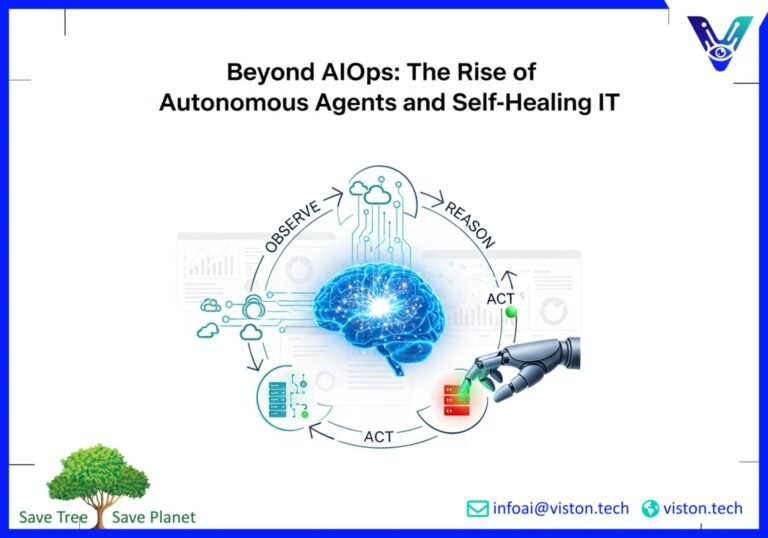
So, what exactly is an AIOps agent? Think of it as an autonomous entity within your IT environment that is designed to perform a specific set of tasks with minimal human intervention. These agents are more than just scripts or playbooks; they are intelligent, goal-driven systems that can perceive their environment, reason about the best course of action, and execute it. This is all made possible through a continuous cycle known as the observe-reason-act loop.
The Observe–Reason–Act Loop: The Engine of Autonomous Operations
The power of an AIOps agent lies in its ability to continuously learn and adapt through a simple yet powerful feedback loop. Let’s break down each stage:
- Observe: The agent constantly monitors the IT environment, ingesting vast streams of data from various sources. This is where robust observability is key. The agent pulls in metrics, logs, and traces from platforms like Datadog, giving it a real-time, holistic view of the system’s health. This is not just about collecting data; it’s about understanding the context and relationships between different components of the IT stack.
- Reason: Once the agent observes an anomaly or a deviation from the norm, it moves into the reasoning phase. Using advanced machine learning models and a deep understanding of the system’s topology, the agent analyzes the data to determine the root cause of the issue. It can correlate events across different systems, identify patterns that would be invisible to a human operator, and even predict the potential business impact of an incident.
- Act: Based on its reasoning, the agent takes decisive action to resolve the issue. This is where the true power of autonomous operations comes to life. The action could be as simple as restarting a service or as complex as re-provisioning infrastructure in a different cloud region. These actions are executed automatically, without the need for a human to approve or intervene, leading to a dramatic reduction in mean time to resolution (MTTR).
This continuous loop allows the AIOps agent to not only fix problems but also to learn from them. Each incident becomes a data point that refines its models and improves its future performance, creating a system that gets smarter and more resilient over time.
A Practical Scenario: Automated Ticket Triage and Resolution
To make this concept more concrete, let’s consider a common IT scenario: ticket triage. In a traditional IT environment, when an issue arises, a ticket is created in a system like ServiceNow. A human operator then has to read the ticket, understand its priority, and route it to the right team for resolution. This manual process is often slow and prone to errors.
Now, let’s see how an AIOps agent transforms this process:
- Automated Ticket Creation and Enrichment: An anomaly is detected in your application’s response time through your observability platform. The AIOps agent immediately and automatically creates a ticket. But it doesn’t stop there. It enriches the ticket with a wealth of contextual information, including relevant logs, traces, and metrics, and even identifies the specific microservice that is likely the cause of the problem.
- Intelligent Prioritization and Routing: The agent then uses natural language processing (NLP) to understand the ticket’s content and business context. It assesses the potential impact on end-users and revenue and assigns a priority level accordingly. Based on its understanding of team responsibilities and current on-call schedules, it routes the ticket to the appropriate team or, in many cases, decides to handle it autonomously.
- Autonomous Remediation: For a known issue with a pre-defined resolution, the agent immediately executes the necessary actions. This could involve rolling back a recent deployment, scaling up resources, or restarting a faulty pod in a Kubernetes cluster. The entire process, from detection to resolution, happens in a matter of seconds, often before a human is even aware of the problem.
- Continuous Learning: After resolving the issue, the agent documents the steps taken in the ticket and closes it. This information is then used to update its knowledge base, ensuring that it can resolve similar issues even faster in the future.
This is just one example of how AIOps agents can revolutionize IT operations. The same principles can be applied to a wide range of use cases, from proactive capacity planning to automated security incident response.
Integration with Your Existing Tools: The Power of Observability
A key to the success of Agent-First IT Operations is seamless integration with your existing observability and monitoring tools. Platforms like Datadog provide the rich, high-fidelity data that AIOps agents need to operate effectively. By unifying metrics, logs, and traces in one place, these platforms provide the “single pane of glass” that AIOps can then act upon.
The deep integration with these platforms allows the AIOps agent to:
- Gain Full-Stack Visibility: From the front-end user experience to the back-end infrastructure, the agent has a complete picture of your application’s performance.
- Correlate Data with Context: By linking logs, metrics, and traces, the agent can quickly move from “what” is happening to “why” it’s happening.
- Leverage AI-Powered Insights: Many modern observability platforms have their own built-in AI capabilities, such as anomaly detection and outlier analysis. The AIOps agent can leverage these insights to make more informed decisions.
The combination of a powerful observability platform and an intelligent AIOps agent creates a symbiotic relationship where each component makes the other more effective. To learn more about building resilient systems, you might find this article on building unbreakable IT systems insightful.
The AIOps Maturity Model: From Reactive to Self-Healing
The journey to fully autonomous IT operations is a gradual one. Organizations can assess their progress using an AIOps maturity model. This model helps you understand where you are today and provides a roadmap for the future.
- Level 1: Reactive Monitoring: At this stage, IT teams rely on basic monitoring tools and manual processes to detect and resolve incidents. There is little to no automation, and the focus is on firefighting.
- Level 2: Proactive Analytics: Here, organizations begin to adopt AIOps tools to correlate alerts and identify anomalies. The focus is on gaining better insights from the data, but the response is still largely manual.
- Level 3: Automated Remediation: This is where AIOps agents start to play a role. Organizations begin to automate the resolution of common and repetitive incidents. The focus shifts from mean time to detection (MTTD) to mean time to resolution (MTTR).
- Level 4: Predictive Operations: At this level, AIOps agents can predict potential issues before they occur. They can analyze trends and patterns in the data to identify potential bottlenecks or capacity constraints and take proactive steps to prevent them.
- Level 5: Self-Healing Systems: This is the ultimate goal of Agent-First IT Operations. The IT environment is largely autonomous, with AIOps agents continuously monitoring, analyzing, and optimizing the system for performance, reliability, and cost. Human operators focus on strategic initiatives and innovation, rather than day-to-day operations.
Understanding your position in this maturity model is the first step towards building a more resilient and efficient IT organization. For a deeper dive into the future of autonomous systems, this perspective on how AI is transforming industries offers valuable context.
The Future is Now: Embracing Agent-First IT Operations
The convergence of AIOps and agentic AI is not a distant future; it’s happening now. The “identity crisis” of 2025 was a necessary catalyst for the industry to move beyond hype and towards tangible outcomes. The rise of AIOps agents is ushering in an era of truly autonomous, self-healing systems that will redefine the role of IT operations.
For enterprise C-suite executives, AI/ML engineers, IT leaders, and product managers, the message is clear: the time to embrace this transformation is now. By adopting an Agent-First approach to IT operations, you can unlock unprecedented levels of efficiency, reliability, and innovation. You can free your teams from the drudgery of manual incident response and empower them to focus on what they do best: building great products and delivering exceptional customer experiences.
Frequently Asked Questions (FAQs)
1. What is the main difference between traditional AIOps and Agent-First IT Operations?
Traditional AIOps primarily focuses on analyzing IT operations data to provide insights and alerts to human operators. Agent-First IT Operations takes this a step further by using autonomous AI agents to not only detect and diagnose issues but also to independently act and resolve them without human intervention.
2. How does an AIOps agent work?
An AIOps agent operates on a continuous “observe-reason-act” loop. It observes the IT environment by collecting data from various sources, reasons about the state of the system to identify issues and their root causes, and then acts to remediate those issues automatically.
3. Is an AIOps agent the same as an automation script?
No. While an automation script follows a predefined set of instructions, an AIOps agent is an intelligent and adaptive system. It can make decisions based on real-time data and context, and it can learn from past incidents to improve its performance over time.
4. What are some key benefits of implementing AIOps agents?
The key benefits include a significant reduction in mean time to resolution (MTTR), improved system reliability and uptime, increased operational efficiency, and the ability for IT teams to focus on more strategic and innovative work.
5. How do AIOps agents integrate with tools like Datadog?
AIOps agents leverage the rich observability data from platforms like Datadog to get a comprehensive view of the IT environment. They ingest metrics, logs, and traces from these platforms to feed their “observe” and “reason” phases, enabling them to make informed decisions and take precise actions.
6. What is the AIOps maturity model?
The AIOps maturity model is a framework that helps organizations assess their progress in adopting AIOps and automation. It typically ranges from a reactive, manual approach to a fully autonomous, self-healing IT environment.
7. Will AIOps agents replace IT operations teams?
AIOps agents are not intended to replace IT operations teams but to augment them. By automating repetitive and manual tasks, these agents free up human experts to focus on more complex challenges, strategic planning, and innovation.
8. What are “self-healing systems”?
Self-healing systems are IT environments that can automatically detect, diagnose, and resolve issues without human intervention. They are the ultimate goal of Agent-First IT Operations, where the system itself maintains its health and performance autonomously.
Ready to embrace the future of IT operations?
At Viston AI, we are at the forefront of the Agent-First revolution. Our cutting-edge AI-powered solutions can help you transform your IT operations from a cost center to a strategic enabler of business innovation. Contact us today to learn how our AIOps agents can help you build a more resilient, efficient, and autonomous IT environment.
#AIOps #IncidentResponse #Observability #SelfHealingSystems #AgentFirstIT #ITOperations #ArtificialIntelligence #MachineLearning #Automation #FutureOfIT
