
Synthetic Knowledge Workers: How AI Agents Learn Your Company Playbooks Overnight
Every leader faces the same challenge: your company’s most valuable asset is the collective knowledge of your team. But this knowledge is often trapped—scattered across documents, buried in chat logs, and siloed within departments. Onboarding a new employee to this complex web of information can take months. What if you could create a team member who could read, understand, and apply your entire company playbook, instantly? Welcome to the era of the synthetic knowledge worker.
Recent breakthroughs in agentic AI are creating a new type of digital employee. These AI agents don’t just answer questions; they perform tasks, follow complex procedures, and act as trained staff from day one. They achieve this by developing “synthetic knowledge”—a deep, operational understanding synthesized directly from your organization’s internal data. This isn’t science fiction; it’s the next frontier in enterprise AI, and it’s transforming knowledge management as we know it.
What is Synthetic Knowledge? The New Frontier of AI
First, let’s clarify a common misconception. “Synthetic” doesn’t mean fake or artificial in the sense of being unreal. Think of synthetic diamonds—they are physically real diamonds, just created in a lab instead of mined. Similarly, synthetic knowledge is real, actionable intelligence that an AI agent synthesizes from your company-specific data. It’s the operational expertise your best employees have, but codified and scaled through AI.
Unlike general-purpose AI models like ChatGPT, which have broad world knowledge, synthetic knowledge workers possess deep, narrow expertise tailored to your business. They understand your unique acronyms, your specific customer support protocols, and your multi-step financial approval processes. This specialized intelligence allows them to move beyond simple Q&A and become active participants in your daily operations, capable of executing tasks with precision and consistency.
The most revolutionary aspect is the speed of acquisition. A human employee might take six months to internalize your processes. An AI agent can build this synthetic knowledge virtually overnight, creating an instantly productive digital team member.
The Learning Process: How Agents Ingest Your Internal Playbooks
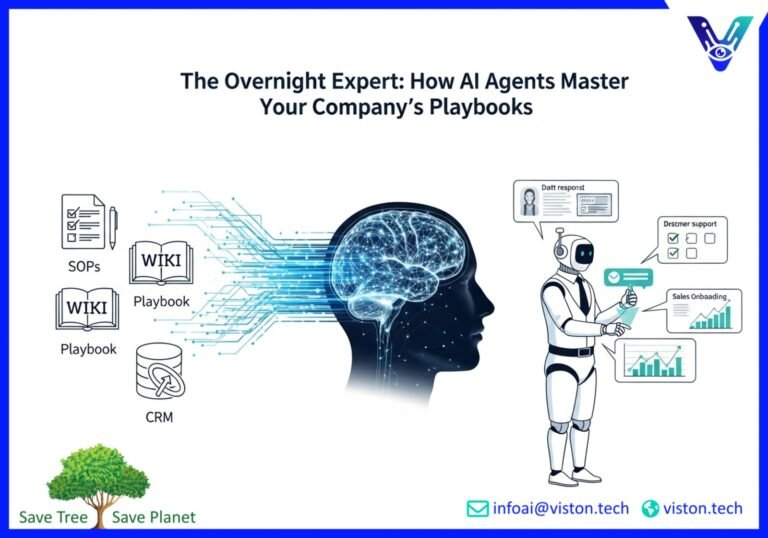
How does an AI agent go from a blank slate to a seasoned expert on your business? It learns by ingesting and processing the vast repository of documents and data you already own. This is where your existing knowledge management efforts pay off. The AI systematically consumes your internal playbooks, transforming them from static documents into a dynamic, queryable brain.
The raw materials for this learning process include a wide range of corporate data:
- Standard Operating Procedures (SOPs): Your detailed, step-by-step guides for routine tasks become the AI’s executable instructions. It doesn’t just know the policy; it knows how to apply it.
- Internal Wikis and Knowledge Bases: Your entire Confluence, SharePoint, or Notion database becomes the agent’s long-term memory, providing context and detailed information on products, projects, and policies.
- Past Support Tickets and CRM Data: By analyzing historical data from platforms like Zendesk, Jira, or Salesforce, the agent learns your specific problem-solving patterns, customer interaction styles, and sales cycles.
- Internal Communications: Channels in Slack and Microsoft Teams provide invaluable context on your company culture, project-specific jargon, and the informal logic behind decisions.
This ingestion process involves extracting, cleaning, and structuring this diverse information. The AI prepares the data to be understood not just by keywords, but by its underlying meaning and context.
Under the Hood: The Architecture Powering Synthetic Knowledge
Creating a synthetic knowledge worker may sound complex, but the core technology is surprisingly intuitive. Imagine you have a brilliant but amnesiac librarian. They can answer any question perfectly, but only if you hand them the exact right book and page. The technology behind synthetic knowledge acts as the system that finds that right book, every single time.
This is achieved through a powerful architecture centered around two key components: Retrieval-Augmented Generation (RAG) and vector databases.
Retrieval-Augmented Generation (RAG): Grounding AI in Your Reality
Retrieval-Augmented Generation (RAG) is a game-changing AI framework that ensures your agents are both smart and accurate. Instead of relying solely on its pre-existing knowledge, a RAG-powered agent first retrieves relevant, up-to-date information from your internal documents before generating a response or taking an action. This simple but powerful process is the single most effective way to prevent AI “hallucinations” and ensure every output is grounded in your company’s truth. For more on how RAG is reshaping enterprise AI, explore this insightful article on the latest AI trends from McKinsey.
Vector Databases: Your Company’s Super-Index
How does the agent find the right information so quickly? Through a vector database. Think of it as a hyper-intelligent index for your company’s brain. Traditional databases search for keywords. Vector databases search for meaning. They convert your documents into numerical representations (vectors) that capture semantic context. When an agent receives a query, it looks for the documents with the closest contextual meaning, not just matching words. This allows it to understand nuanced requests and retrieve the most relevant information, even if the user’s terminology doesn’t exactly match the source document.
Synthetic Knowledge Workers in Action: Real-World Examples
The true impact of synthetic knowledge is best understood through practical applications. These AI agents are already streamlining workflows across entire organizations, acting as tireless, expert assistants.
For Customer Support Teams
An AI support agent is integrated with your helpdesk. When a customer ticket arrives, the agent instantly analyzes it, retrieves the solution from your knowledge base, and drafts a precise, context-aware response. For complex issues, it can escalate the ticket to a human agent, providing a full summary and links to the relevant internal playbooks. This dramatically reduces resolution times and frees up your human experts to handle the most challenging cases.
For HR and Onboarding
A new hire joins your company. Instead of bombarding the HR team with questions, they interact with an HR AI agent. They can ask, “What is our policy on remote work equipment?” and receive an immediate, accurate answer pulled directly from the latest employee handbook. The agent can even provide links to the correct request forms and walk the employee through the submission process, ensuring a smooth and efficient onboarding experience.
For Sales and Marketing Teams
A sales executive is preparing for a client call. They ask their AI assistant, “What were the key pain points mentioned in our last three calls with this client, and what messaging from our new product brief addresses them?” The agent synthesizes information from call transcripts in the CRM and recent marketing documents to provide a concise, actionable briefing. This level of preparation, once requiring hours of manual work, is now available on demand.
Governance and Trust: Putting Guardrails on Your AI Workforce
The idea of an autonomous AI with access to sensitive company data naturally raises questions for the C-suite about security, accuracy, and control. A robust governance framework is not an afterthought; it is a prerequisite for deploying synthetic knowledge workers responsibly. Fortunately, the architecture is designed with these concerns in mind.
Data Security and Access Control
Security is paramount. Synthetic knowledge workers operate on a “zero-trust” principle. The AI agent’s access rights mirror those of the human user interacting with it. If an employee doesn’t have permission to view a confidential financial document, neither will the AI agent they are using. This ensures your existing data governance and permission structures are automatically enforced.
Maintaining Accuracy and Freshness
A synthetic knowledge worker is only as good as the information it learns from. The system’s accuracy depends on maintaining a clean, up-to-date knowledge base. This creates a positive feedback loop: as organizations deploy these agents, they become more disciplined about their knowledge management practices. The AI can even assist in this process by flagging outdated or conflicting information it encounters in your internal playbooks.
The “Human in the Loop”
The goal of this technology is to augment human intelligence, not replace it without oversight. Implementing a “human-in-the-loop” system is crucial. This means that for critical or sensitive tasks, an AI agent’s proposed action can be routed to a human for approval before execution. This collaborative approach ensures that you retain full control while benefiting from the speed and efficiency of AI. For a deeper dive into AI governance, check out the NVIDIA AI Enterprise platform, which emphasizes secure and explainable AI.
The Future is Now: Key Takeaways for Your Business
The rise of synthetic knowledge workers marks a pivotal shift from AI as a passive tool to AI as an active, integrated teammate. By harnessing the power of your own internal data, you can build a digital workforce that is perfectly aligned with your business processes from day one.
Here are the key takeaways for your organization:
- Unlock Hidden Value: Your internal documents, wikis, and support tickets are a goldmine of operational knowledge. AI agents can finally unlock this value.
- Amplify Productivity: Free your human experts from the repetitive work of finding and sharing information. Let them focus on high-value strategic tasks that require human creativity and critical thinking.
- Drive Unprecedented Consistency: Ensure every employee, from a new hire to a seasoned veteran, receives the same accurate, up-to-date information every single time.
- Start Small, Scale Fast: You don’t need to boil the ocean. Begin with a single, high-impact use case, like an internal IT helpdesk or an HR policy assistant. Prove the value and then scale across the enterprise.
Ready to Build Your Synthetic Knowledge Workforce?
The journey to harnessing your organization’s collective intelligence has begun. Agentic AI is no longer a future trend; it is a present reality delivering tangible business results. By creating synthetic knowledge workers, you can build a more efficient, consistent, and intelligent organization.
Contact Viston AI today to learn how our AI-powered solutions can help you build and deploy synthetic knowledge workers, transforming your knowledge management and operational efficiency.
Frequently Asked Questions (FAQs)
1. What is the main difference between a standard chatbot and a synthetic knowledge worker?
A standard chatbot typically relies on a pre-programmed script or general knowledge to answer simple questions. A synthetic knowledge worker is a more advanced AI agent that ingests your specific internal playbooks to gain a deep, operational understanding of your business. It can perform multi-step tasks, execute complex procedures, and is grounded in your company’s data using technologies like RAG.
2. How long does it take to “train” an AI agent on our internal documents?
The initial ingestion and indexing process is remarkably fast and can often be completed in a matter of hours or days, not months. The speed depends on the volume and complexity of your data. The result is an agent that can act like a knowledgeable employee almost overnight.
3. Is our proprietary data secure when using this technology?
Yes. Enterprise-grade platforms are built with security as a core principle. The AI agents adhere to your existing user permissions and access controls. Your data is used to provide answers for your users and is not used to train external, general-purpose models.
4. What is Retrieval-Augmented Generation (RAG) in simple terms?
RAG is a technique that makes AI more reliable. Instead of just answering from memory, the AI first searches your trusted internal documents for the most relevant information and then uses that information to generate its answer. It’s like an open-book exam for the AI, ensuring its responses are accurate and based on your facts.
5. Can these agents handle complex, multi-step business processes?
Absolutely. That is their key advantage. By understanding your SOPs and internal playbooks, they can be designed to execute complex workflows, such as processing an insurance claim, onboarding a new vendor, or managing a multi-stage marketing campaign, often with built-in checkpoints for human approval.
6. How do we ensure the AI’s answers remain up-to-date?
The AI’s knowledge is dynamic. The system is designed to connect directly to your live knowledge sources (like SharePoint, Confluence, etc.). When you update a document in your knowledge base, the AI’s understanding is updated in near real-time, ensuring it always provides the most current information.
7. Do we need a team of AI experts to implement this?
Not necessarily. Leading AI solution providers, like Viston AI, offer platforms and services that handle much of the underlying complexity. The focus for your team will be on identifying the right use cases and ensuring your source documentation is well-maintained.
8. What kind of ROI can we expect from implementing synthetic knowledge workers?
The ROI is typically seen in significant productivity gains, reduced operational costs, and improved employee and customer satisfaction. Key metrics include faster ticket resolution times, shorter employee onboarding periods, reduced time spent searching for information, and increased consistency in process execution.
#SyntheticKnowledge #AIAgents #KnowledgeManagement #RAG #EnterpriseAI #DigitalTransformation #FutureOfWork #VistonAI
