
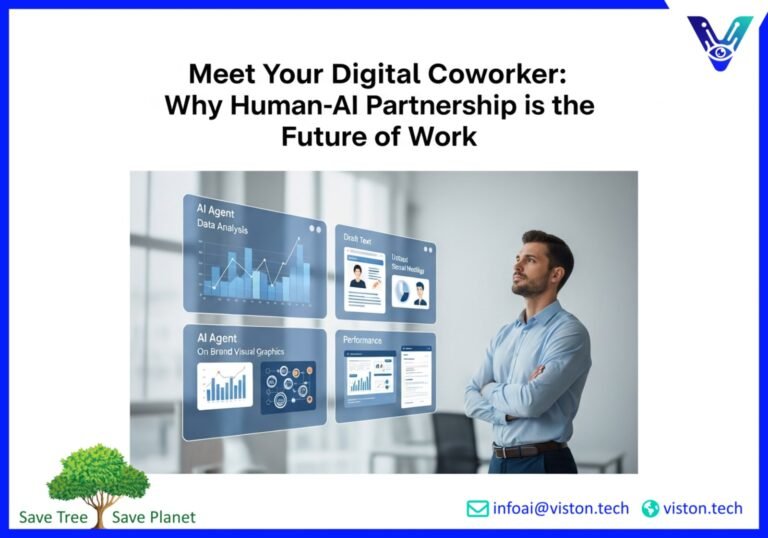
The Future of Work in 2026: AI Agents as Digital Coworkers, Not Replacements
The conversation about the future of work is evolving. For years, the narrative has been dominated by a fear of replacement. Headlines warned of robots taking jobs, leaving humans redundant. But as we stand on the cusp of 2026, a more nuanced and exciting reality is taking shape. The focus is shifting from automation anxiety to a powerful new paradigm: the human-AI partnership. This isn’t about humans versus machines; it’s about humans with machines, working together to achieve unprecedented levels of productivity and innovation.
Recent research from McKinsey paints a striking picture: while today’s technologies could theoretically automate a staggering 57% of current work hours in the United States, this doesn’t signal the end of human employment. Instead, it heralds a massive evolution. Jobs won’t vanish; they will transform. The future of work isn’t about replacement, it’s about collaboration. It’s time to meet your new digital coworker: the AI agent.
The Great Shift: From Automation Anxiety to AI Alliance
The initial wave of AI in the workplace was met with a mix of excitement and trepidation. The fear of being made obsolete was palpable. However, the data and real-world applications are telling a different story. The most effective workflows are not fully automated; they are the ones with a human in the loop. Think of AI not as a replacement, but as an exoskeleton for the mind—a tool that amplifies our own capabilities.
This shift in perspective is crucial for leaders navigating the complexities of workforce transformation. The message to teams must be clear and empowering: AI won’t replace you, but a person adept at using AI will likely replace a person who is not. This framing moves the conversation from fear to opportunity, encouraging employees to embrace new skills and new ways of working. The dialogue is no longer about preserving old tasks but about reimagining entire workflows to unlock new value.
Meet Your New Digital Coworker: The Rise of AI Agents
So, what exactly is an AI agent? Forget the clunky robots of science fiction. Think of an AI agent as a sophisticated software program designed to perform complex, multi-step tasks autonomously. They are more than just tools that execute a single command; they are digital coworkers that can reason, plan, and act to achieve a specific goal. They are designed to operate alongside human employees, creating a seamless and intelligent workflow.
In 2026, it’s becoming common for every employee, from a junior analyst to a senior vice president, to act as a “human supervisor” to a team of specialized AI agents. These agents are grounded in your company’s unique data, customer history, and knowledge bases, allowing them to perform their duties with a high degree of context and accuracy.
What Can Your Digital Coworker Do?
AI agents are not a one-size-fits-all solution. They are specialized professionals, each excelling in their designated area. Imagine a marketing manager’s digital team:
- The Data Analyst Agent: Works 24/7 to monitor market trends, track competitor movements, and analyze campaign performance, delivering a concise insights report to the manager’s inbox every morning.
- The Content Agent: Drafts social media posts, blog articles, and email newsletters in the company’s specific brand voice, based on strategic themes provided by the manager.
- The Creative Agent: Generates on-brand images, video clips, and ad creatives to accompany the written content, iterating based on feedback.
- The Reporting Agent: Automatically pulls data from various platforms (Google Analytics, CRM, social media) to create comprehensive weekly performance summaries, highlighting key metrics and trends.
This “digital assembly line” allows the human manager to offload time-consuming tasks and focus on higher-value work like strategy, creative direction, and team leadership. This is the essence of the emerging human-AI partnership.
The Partnership Paradigm: Why Human-AI Collaboration is the Future
The most successful organizations of 2026 are those that have stopped trying to simply automate old processes and have started to fundamentally redesign how work gets done. This is the core of the partnership model. It’s about leveraging the unique strengths of both humans and AI to create a synergistic effect where the whole is far greater than the sum of its parts.
- AI Strengths: Speed, pattern recognition, data processing, and performing repetitive tasks with flawless accuracy.
- Human Strengths: Creativity, emotional intelligence, critical thinking, ethical judgment, and complex problem-solving.
When you combine these strengths, you unlock incredible potential. For more on this collaborative future, explore insights from leading publications like Harvard Business Review, which delves into the leadership required for this new era. A study from Harvard Business School found that consultants using AI didn’t just work faster; they produced work that was 40% higher in quality compared to their non-AI-assisted peers.
Building Effective Human-AI Teams
Creating a thriving human-AI ecosystem requires intentionality. It’s not as simple as deploying new software. Leaders must focus on:
- Clear Role Definition: Clearly delineate which tasks are best suited for AI agents and which require human oversight and intervention.
- Establishing Trust: Implement processes to validate AI outputs and create transparent feedback loops for continuous improvement. Humans need to trust their digital coworkers.
- Fostering a Learning Culture: Encourage experimentation and provide ongoing training to ensure everyone feels confident and capable of working with AI tools.
The New Skill Economy: Thriving in the Age of AI
The rise of AI agents is fundamentally reshaping the skills landscape. The “half-life” of a technical skill is shrinking, making continuous learning a necessity. This workforce transformation is creating a new hierarchy of skills, and with it, a new economic reality. Those who possess the skills to effectively manage, prompt, and collaborate with AI are already seeing significant financial rewards.
Data from PwC’s 2025 Global AI Jobs Barometer shows that workers with AI skills can command an average wage premium of 56% compared to their peers in similar roles. This isn’t a temporary trend; it’s a clear market signal that AI fluency is becoming a highly compensated and critical competency across all industries.
In-Demand Skills for 2026 and Beyond:
- AI Fluency: This is the foundational skill. It’s not about being able to code an AI model, but about understanding how to use AI tools effectively, interpret their outputs, and integrate them into your daily workflow.
- Prompt Engineering: The ability to communicate effectively with AI is a skill in itself. Crafting clear, concise, and context-rich prompts is essential to getting the high-quality output you need.
- Data Analysis and Interpretation: AI can surface incredible insights from vast datasets, but it still requires a human to interpret those insights, ask the right questions, and make strategic decisions based on the findings.
- Critical Thinking and Strategic Oversight: As AI handles more of the “doing,” humans will be called upon to do more of the “thinking.” This means focusing on strategic planning, ethical considerations, and complex problem-solving that goes beyond the capabilities of current AI.
- Emotional Intelligence and Collaboration: Skills like empathy, communication, and leadership become even more valuable. AI can optimize a process, but a human leader is needed to motivate a team, navigate complex interpersonal dynamics, and build a strong company culture.
Redesigning the Organization for an AI-Powered Future
Simply plugging AI agents into an existing, outdated organizational structure will not work. To truly capture the value of this technological shift, leaders must be willing to undertake a comprehensive organizational redesign. The future of work demands a future-ready organization. This means moving away from rigid, hierarchical structures toward more agile, data-driven, and collaborative models.
As detailed in reports from firms like Forbes, this redesign is about more than just changing an org chart; it’s about changing the corporate mindset. Companies that succeed will rebuild their operations so that AI handles everything it can, while humans focus on oversight, creativity, and complex judgment.
Key Pillars of an AI-Ready Organization:
- Agile and Fluid Workflows: Break down silos and create cross-functional teams that can quickly adapt to changing priorities. AI agents can act as the connective tissue, sharing information and coordinating tasks seamlessly between teams.
- A Data-Driven Culture: Empower every employee with access to relevant data and the AI tools to analyze it. Decisions should be based on insights, not just intuition.
- Continuous Learning and Development: Invest heavily in upskilling and reskilling programs. Make AI literacy a core competency for everyone, from the front line to the C-suite.
- Ethical AI Governance: Establish a clear framework for the responsible and ethical use of AI. This includes ensuring data privacy, mitigating bias, and maintaining transparency in how AI-driven decisions are made.
Conclusion: Your Future of Work Starts Now
The year 2026 is not a distant future; it’s the reality we are building today. The narrative of AI as a job destroyer is being replaced by the much more accurate and promising story of AI as a collaborator. The rise of AI agents as digital coworkers represents a profound opportunity for businesses to enhance productivity, foster innovation, and empower their employees to focus on the uniquely human work that drives real value.
This transformation requires more than just technology investment. It demands a new vision for leadership, a commitment to workforce upskilling, and a willingness to fundamentally redesign the organization. The future of work is a partnership. The companies that embrace this new reality will not only survive, they will lead the way.
Frequently Asked Questions (FAQs)
1. Will AI agents completely replace human jobs by 2026?
No. While AI will automate many tasks, it is not expected to eliminate jobs wholesale. The dominant trend is job evolution, where roles are redesigned to focus on human strengths like strategy, creativity, and emotional intelligence, while AI agents handle repetitive and data-intensive tasks.
2. What is the difference between an AI tool and an AI agent?
An AI tool typically performs a specific, single task when prompted (e.g., generating text, translating a sentence). An AI agent is more advanced; it can perform multi-step, complex workflows autonomously to achieve a broader goal, often interacting with multiple systems and data sources along the way.
3. Do I need to be a programmer to work with AI agents?
Absolutely not. The most important skill is AI fluency—understanding how to use these agents effectively. This involves skills like prompt engineering and interpreting AI outputs, not coding. User-friendly interfaces are making it possible for non-technical professionals to manage and collaborate with AI agents.
4. What is the most critical step for a company to prepare for this future?
Organizational redesign is the most critical step. Technology alone is not enough. Leaders must rethink workflows, invest in continuous employee training, and foster a culture that embraces human-AI collaboration to truly unlock the benefits.
5. What are “wage premiums” for AI skills?
A wage premium is the additional compensation that employees with in-demand skills, such as AI fluency, can earn compared to their peers in similar roles without those skills. Current data shows this premium can be over 50%, highlighting the high market value of human-AI partnership skills.
6. How can small businesses and startups leverage AI agents?
AI agents can be a great equalizer for smaller businesses. They provide access to powerful capabilities—like 24/7 customer service, advanced market analysis, and content creation—that were once only affordable for large enterprises, allowing startups to compete more effectively.
7. What are the ethical considerations of using AI agents in the workplace?
Key ethical considerations include ensuring data privacy and security, mitigating algorithmic bias to ensure fairness in decision-making (like hiring), and maintaining transparency with employees and customers about how AI is being used.
8. How will human-AI collaboration impact company culture?
It will shift the culture towards continuous learning, agility, and data-driven decision-making. It will also place a higher value on uniquely human skills like communication, empathy, and creative problem-solving, as these are the areas where humans will complement their AI coworkers.
Ready to Build Your AI-Powered Workforce?
Don’t just prepare for the future of work—build it. The team at Viston AI specializes in developing bespoke AI-powered solutions that integrate seamlessly into your existing workflows, empowering your teams and driving unprecedented growth. Our custom AI agents are designed to become your organization’s most valuable digital coworkers, freeing up your human talent to focus on what they do best: innovate, lead, and create.
Contact us today to learn how Viston AI can help you navigate your workforce transformation and build a true human-AI partnership for the future. #FutureOfWork #AI #HumanAIpartnership #WorkforceTransformation #OrganizationalRedesign #DigitalCoworker #Innovation #Leadership
