
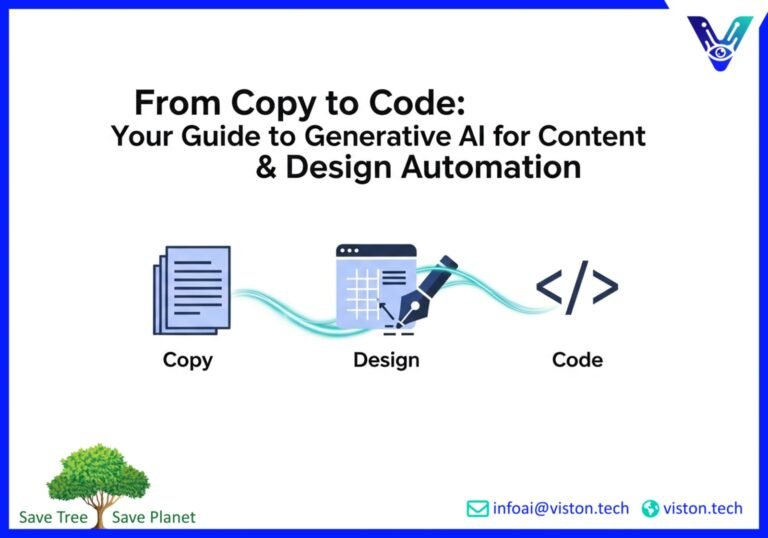
Generative AI for Content & Design Automation: From Copy to Code
In the heart of digital transformation, a powerful force is reshaping how businesses create, design, and innovate. This force is Generative AI, a groundbreaking technology that’s no longer the stuff of science fiction but a tangible, strategic asset for enterprises worldwide. From accelerating creative cycles to automating complex design and coding tasks, Generative AI is the catalyst for unprecedented efficiency and innovation. For C-suite executives, AI/ML engineers, and marketing teams alike, understanding its potential is not just an option—it’s essential for competitive advantage in 2025 and beyond.
This blog post delves into the world of Generative AI for content and design automation. We’ll explore its transformative use cases, the tools driving this revolution, and the critical importance of quality control. Most importantly, we’ll provide actionable insights on how to harness this technology to streamline workflows, from initial copy to final code.
The Dawn of a New Creative Era: AI-Powered Content and Design
Traditionally, content and design processes have been labor-intensive, requiring significant time and human resources. Brainstorming marketing campaigns, writing compelling product descriptions, creating design mockups, and drafting technical documentation are all critical but time-consuming tasks. Generative AI is rewriting this narrative by automating and augmenting these creative and technical workflows.
Accelerating Creative Cycles with AI Content Tools
Imagine generating a dozen variations of ad copy in the time it takes to write one. Picture crafting personalized email campaigns for different customer segments with a few clicks. This is the reality of AI-powered content generation. AI tools are becoming indispensable for marketing teams, enabling them to:
- Produce High-Volume, High-Quality Content: AI can rapidly generate blog posts, social media updates, and website copy, freeing up human writers to focus on strategy and more complex creative endeavors.
- Enhance Personalization at Scale: By analyzing vast datasets, AI can create highly personalized marketing messages that resonate with individual customers, boosting engagement and conversion rates.
- Optimize for SEO: Many AI writing assistants are designed with SEO in mind, helping to create content that ranks higher in search engine results by naturally incorporating relevant keywords.
Cutting Mockup Time with Design Automation
The design process, particularly the creation of mockups and prototypes, can be a significant bottleneck in product development. Design automation, powered by generative AI, is dramatically reducing this timeframe. Instead of spending days or weeks manually creating mockups, designers can now:
- Generate Multiple Design Concepts Instantly: By inputting specific parameters and style guides, AI can produce a wide array of design mockups in minutes, allowing for rapid iteration and exploration of creative possibilities.
- Create Realistic Product Visualizations: AI tools can generate photorealistic images and 3D models of products, providing a clear and accurate representation for stakeholders before a single physical prototype is created.
- Automate Repetitive Design Tasks: From resizing images to creating consistent branding elements across different platforms, AI can handle the tedious aspects of design, allowing designers to focus on the creative vision.
Use Cases: Where Generative AI is Making a Tangible Impact
The applications of generative AI are vast and continually expanding. Here are some of the most impactful use cases across various business functions:
Marketing Copy and Product Descriptions
For e-commerce businesses and marketing departments, compelling copy is the lifeblood of sales. Generative AI tools excel at creating persuasive and informative marketing copy and product descriptions. They can analyze top-performing listings and ad campaigns to understand what resonates with customers, and then generate new copy that is both engaging and optimized for conversions. This not to say that human oversight is not needed, but the efficiency gains are undeniable.
Design Mockups and Creative Automation
In the realm of design, creative automation is a game-changer. AI-powered tools can generate a multitude of design options for websites, mobile apps, and marketing materials. This allows design teams to quickly visualize different layouts, color schemes, and user interfaces, significantly speeding up the ideation and approval process. The ability to create and test numerous design variations rapidly leads to more innovative and user-centric final products. For further reading on this evolving landscape, Adobe’s insights on generative AI offer a deep dive into its creative potential.
Technical Documentation
Creating comprehensive and accurate technical documentation is a critical but often overlooked aspect of software development. Generative AI can assist in automating this process by analyzing code and generating clear, concise, and consistent documentation. This not only saves developers valuable time but also ensures that the documentation is always up-to-date with the latest code changes. Tools are emerging that can interpret complex codebases and produce human-readable guides, tutorials, and API documentation.
Integration into CI/CD Pipelines
For development and operations teams, the integration of generative AI into Continuous Integration/Continuous Deployment (CI/CD) pipelines represents a major leap forward. AI can be used to:
- Automate Code Generation: AI can write boilerplate code, complete code snippets, and even suggest entire functions, accelerating the development process.
- Enhance Code Review: AI tools can analyze code for potential bugs, security vulnerabilities, and adherence to coding standards, providing instant feedback to developers.
- Optimize Testing: AI can generate test cases, identify redundant tests, and even predict which parts of the code are most likely to have defects, leading to more efficient and effective testing.
This integration of AI into the software development lifecycle is not about replacing developers but empowering them to build better software faster.
Tools and Prompting: The Keys to Unlocking AI’s Potential
The market for generative AI tools is exploding with options, each with its own strengths. For content creation, platforms like Jasper, Copy.ai, and Writesonic have become popular for their ability to generate a wide range of marketing copy. In the design space, tools like Midjourney and DALL-E 2 are revolutionizing image generation, while platforms like Uizard are automating the creation of user interface mockups.
However, the power of these tools lies not just in their algorithms but in the art of “prompting.” A prompt is the instruction given to the AI to generate a specific output. Effective prompting is a skill that requires clarity, context, and a deep understanding of the desired outcome. For example, instead of a vague prompt like “write a product description,” a more effective prompt would be: “Write a 200-word product description for a new line of sustainable, all-natural skincare products targeting environmentally conscious millennials. Highlight the key ingredients (tea tree oil, shea butter, and lavender) and the product’s eco-friendly packaging. The tone should be informative, trustworthy, and inspiring.”
Mastering prompt engineering is crucial for getting the best results from any generative AI tool. For those looking to deepen their understanding, DeepLearning.AI offers valuable courses on prompt engineering.
The Human in the Loop: The Importance of Quality Control
While generative AI is incredibly powerful, it is not infallible. The output of AI models can sometimes be inaccurate, biased, or inconsistent with a brand’s voice. This is where human oversight and quality control become paramount. A “human-in-the-loop” approach ensures that AI-generated content and designs meet the required standards of quality, accuracy, and brand alignment.
A robust quality control framework for AI-generated assets should include:
- Fact-Checking and Accuracy Verification: All factual claims and data points generated by AI should be verified by a human expert.
- Brand Voice and Tone Alignment: A human editor should review the content to ensure it aligns with the company’s brand guidelines and maintains a consistent tone of voice.
- Plagiarism and Originality Checks: While AI models are designed to generate original content, it’s always a good practice to run outputs through plagiarism checkers to avoid any potential issues.
- Ethical Considerations: AI-generated content and designs should be reviewed for any potential biases or insensitive material.
By implementing a rigorous quality control process, businesses can leverage the speed and scale of generative AI without sacrificing the quality and integrity of their brand.
The Future is Now: Embracing Generative AI for a Competitive Edge
The rise of generative AI is not a fleeting trend; it’s a fundamental shift in how we approach creativity, design, and development. By embracing AI-powered solutions for content generation and design automation, businesses can unlock new levels of efficiency, innovation, and personalization. The ability to accelerate creative cycles, cut mockup time, and seamlessly integrate AI into workflow integration processes like CI/CD pipelines will be a key differentiator for industry leaders in 2025 and beyond.
The journey into generative AI can seem daunting, but the potential rewards are immense. By starting with specific use cases, choosing the right tools, mastering the art of prompting, and maintaining a strong focus on quality control, organizations can successfully navigate this new landscape and emerge stronger, more agile, and more innovative.
Frequently Asked Questions (FAQs)
1. What is Generative AI?
Generative AI is a type of artificial intelligence that can create new and original content, such as text, images, music, and code. Unlike other forms of AI that are designed to recognize patterns and make predictions, generative AI can produce entirely new outputs based on the data it has been trained on.
2. How is Generative AI different from other forms of AI?
The key difference lies in its creative capabilities. While traditional AI, often referred to as discriminative AI, is used for tasks like classification and prediction (e.g., identifying spam emails), generative AI is focused on creation. It can generate novel content that is similar in style and structure to its training data but is not a direct copy.
3. What are the benefits of using Generative AI for content creation?
The primary benefits include increased efficiency, scalability, and personalization. Generative AI can produce large volumes of content much faster than humans, enabling businesses to scale their content marketing efforts. It can also create highly personalized content for different audience segments, leading to higher engagement and conversion rates.
4. Is AI-generated content detectable by search engines?
Search engines like Google are becoming increasingly sophisticated in identifying AI-generated content. However, their primary focus is on the quality and helpfulness of the content, regardless of how it was created. High-quality, informative, and original AI-generated content that has been reviewed and edited by a human can still rank well.
5. What are the ethical considerations of using Generative AI?
Ethical considerations include the potential for bias in AI-generated content, the spread of misinformation, and copyright and intellectual property issues. It is crucial for businesses to have strong governance and quality control measures in place to mitigate these risks and ensure the responsible use of generative AI.
6. Will Generative AI replace human writers and designers?
While generative AI can automate many tasks currently performed by writers and designers, it is more likely to augment their roles rather than replace them entirely. The future will likely involve a collaboration between humans and AI, with AI handling the more repetitive and data-driven aspects of creation, while humans provide the strategic thinking, creativity, and emotional intelligence that AI currently lacks.
7. How can I get started with Generative AI in my business?
A good starting point is to identify a specific, high-impact use case within your organization, such as automating the creation of product descriptions or generating initial design mockups. Start with a pilot project, experiment with different tools, and focus on developing a strong prompting and quality control process. As you gain experience and see positive results, you can then scale your use of generative AI to other areas of the business.
8. What is the role of prompting in Generative AI?
Prompting is the process of giving instructions to a generative AI model to guide its output. The quality of the prompt directly impacts the quality of the generated content. Effective prompting requires being clear, specific, and providing sufficient context to the AI. Mastering prompt engineering is a key skill for leveraging the full potential of generative AI tools.
9. Ready to transform your content and design workflows with the power of Generative AI?
Contact Viston AI today to explore our cutting-edge AI-powered solutions and discover how we can help you accelerate innovation and drive growth for your enterprise.
