
The AI Skills Gap in 2026: Building Teams That Can Actually Deploy Agents
The year is 2026, and Artificial Intelligence is no longer a futuristic concept; it’s a core business function. AI-powered agents are streamlining workflows, personalizing customer experiences, and unlocking unprecedented levels of productivity. There’s just one problem: most organizations are struggling to keep up. A massive AI skills gap has emerged, leaving businesses with powerful tools but a workforce unprepared to use them effectively. This disconnect isn’t just an inconvenience; it’s a significant threat to growth and competitiveness.
The statistics are staggering. Despite a sevenfold increase in job postings requiring “AI fluency,” a recent World Economic Forum report reveals a concerning reality: a very small percentage of the workforce has received any formal AI training. This talent shortage is creating a fierce competition for skilled professionals, with wage premiums for AI-related roles skyrocketing. To navigate this challenging landscape, organizations must shift their focus from simply acquiring AI technology to strategically developing the in-house talent needed to deploy and manage it successfully.
This blog post will guide you through the essential steps to bridge the AI skills gap within your organization. We’ll explore a practical skill map, effective training models, a blueprint for building an internal AI academy, and how to measure the return on your investment in learning. By the end, you’ll have a clear, actionable plan to build a team that can truly harness the power of AI agents.
The 2026 AI Skill Map: More Than Just Coding
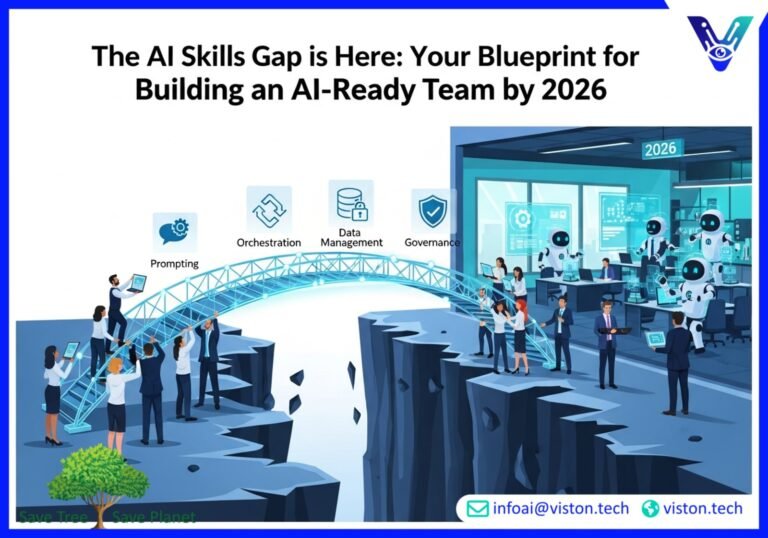
Successfully deploying AI agents requires a broader range of skills than just machine learning and data science. To build a well-rounded and effective AI team, you need to cultivate expertise across four key domains. Think of this as your organizational AI skill map, guiding your talent development and recruitment efforts.
1. Prompting and AI Interaction
This is the art and science of communicating effectively with AI models. It’s about more than just asking questions; it’s about structuring queries to get the most accurate, relevant, and creative responses. Strong prompting skills are essential for everyone in your organization, from marketing teams crafting ad copy to analysts extracting insights from data.
- Key Competencies: Understanding AI model capabilities and limitations, crafting clear and concise prompts, iterative prompt refinement, and ethical considerations in AI communication.
2. Orchestration and Workflow Automation
AI agents rarely work in isolation. Orchestration is the skill of integrating multiple AI models and software tools into a seamless, automated workflow. This is where you move from simple task automation to creating complex, intelligent systems that can handle multi-step processes. For a deeper dive into how AI is reshaping industries, read this insightful piece from Forbes on the future of work.
- Key Competencies: Process mapping and optimization, API integration, low-code/no-code platform proficiency, and systems thinking.
3. Data Management and Strategy
Data is the lifeblood of AI. Without high-quality, relevant data, even the most advanced AI models will fail. Your team needs to be proficient in sourcing, cleaning, and managing the data that fuels your AI initiatives. This includes understanding data privacy and security best practices to ensure responsible AI deployment.
- Key Competencies: Data sourcing and acquisition, data cleaning and preparation, database management, and an understanding of data privacy regulations.
4. Governance and Responsible AI
As AI becomes more integrated into business operations, governance becomes critical. This involves establishing clear policies and procedures for the ethical and responsible use of AI. Your team needs to be able to identify and mitigate potential biases in AI models, ensure transparency in decision-making, and comply with evolving regulations.
- Key Competencies: Ethical AI frameworks, bias detection and mitigation, AI model transparency and explainability, and regulatory compliance.
Choosing Your AI Training Model: Upskilling from Within
With a clear understanding of the skills you need, the next step is to determine the best way to develop them. While hiring external talent will likely be part of your strategy, a focus on upskilling your existing workforce offers significant advantages. Internal candidates already understand your company culture, processes, and business goals, which can accelerate their ramp-up time and improve the relevance of their AI applications.
Blended Learning: The Best of Both Worlds
A blended learning approach, combining online courses with hands-on, project-based work, is often the most effective way to build practical AI skills. This allows employees to learn foundational concepts at their own pace and then immediately apply them to real-world business challenges. This approach fosters a deeper understanding and ensures that the training is directly relevant to their roles.
Peer-to-Peer Learning and Mentorship
Encourage a culture of knowledge sharing by creating opportunities for peer-to-peer learning and mentorship. This can be as simple as establishing a dedicated Slack channel for AI-related questions or as structured as a formal mentorship program that pairs experienced employees with those who are just beginning their AI journey.
Blueprint for an Internal AI Academy
For organizations committed to building a sustainable AI talent pipeline, establishing an internal AI academy is a powerful long-term solution. This centralized hub for AI training and development can be tailored to your specific business needs and can serve as a powerful engine for organizational change.
Step 1: Define Your Curriculum
Start by mapping your AI skill map to the different roles within your organization. A marketing specialist will need a different set of AI skills than a data analyst. Develop a tiered curriculum that offers foundational AI literacy for all employees, as well as specialized tracks for those in more technical roles.
Step 2: Curate and Create Content
You don’t have to create everything from scratch. Leverage high-quality online courses from platforms like Coursera and edX for foundational knowledge. Then, supplement this with custom content that is specific to your industry, your data, and your business challenges. This might include case studies, hands-on tutorials using your company’s data, and guest lectures from your internal AI experts.
Step 3: Foster a Community of Practice
An AI academy should be more than just a collection of courses. Foster a vibrant community of practice where employees can connect, collaborate, and learn from each other. Host regular workshops, hackathons, and guest speaker events to keep the learning engaging and to celebrate successes.
Step 4: Provide Access to Tools and Resources
To truly learn AI, employees need hands-on experience. Provide them with access to the necessary tools and resources, such as sandboxed environments where they can experiment with different AI models and datasets without impacting production systems. This hands-on practice is essential for building confidence and practical skills.
Measuring the ROI of Your AI Training Initiatives
Investing in AI training is a significant commitment, and it’s essential to be able to measure its impact. While it can be challenging to quantify the exact financial return of learning, there are several key metrics you can track to demonstrate the value of your upskilling programs.
Productivity Gains
Track the impact of AI training on key productivity metrics. For example, are your marketing teams able to generate campaigns more quickly? Are your customer service agents able to resolve issues faster? By measuring these improvements, you can build a strong business case for continued investment in AI training.
Employee Engagement and Retention
Investing in your employees’ development is a powerful way to boost engagement and retention. Track metrics such as employee satisfaction, promotion rates, and turnover rates for employees who have participated in your AI training programs. A more skilled and engaged workforce is a significant competitive advantage.
Innovation and New Business Opportunities
As your employees become more proficient in AI, they will begin to identify new opportunities for innovation. Encourage them to experiment and to propose new AI-powered solutions to existing business challenges. Track the number of new ideas generated and the impact of those that are implemented. To explore how AI is driving innovation across various sectors, check out this comprehensive report from McKinsey on the state of AI.
Your Partner in Building an AI-Ready Workforce
The AI skills gap is a significant challenge, but it’s also a tremendous opportunity. By taking a strategic approach to talent development, you can build a workforce that is not only prepared for the future of work but is actively shaping it. By investing in AI training and fostering a culture of continuous learning, you can unlock the full potential of your team and position your organization for long-term success in the age of AI.
Ready to bridge the AI skills gap in your organization? The journey to AI fluency begins with a single step. Contact Viston AI today to learn how our AI-powered solutions and expert guidance can help you build a team that is ready to deploy and manage the next generation of AI agents.
Frequently Asked Questions (FAQs)
1. What is the AI skills gap?
The AI skills gap refers to the significant and growing disparity between the demand for workers with artificial intelligence skills and the available supply of qualified professionals. This gap exists across various roles, from data scientists and machine learning engineers to business leaders and frontline workers who need to understand and use AI tools effectively in their jobs.
2. Why is there a shortage of AI talent?
The shortage of AI talent is driven by several factors. The rapid advancement and adoption of AI technologies across industries have created a sudden and massive demand for these skills. Educational institutions are still catching up in developing comprehensive AI curricula, and the interdisciplinary nature of AI, which combines computer science, mathematics, and domain-specific knowledge, makes it challenging to produce well-rounded experts quickly.
3. What are the most in-demand AI skills in 2026?
In 2026, the most in-demand AI skills go beyond just technical expertise. While proficiency in machine learning, deep learning, natural language processing, and data science remains crucial, there is a growing demand for skills in AI ethics and governance, prompt engineering, AI system orchestration, and the ability to translate business problems into AI-driven solutions. Soft skills such as critical thinking, problem-solving, and collaboration are also highly valued.
4. How can companies address the AI skills gap?
Companies can address the AI skills gap through a multi-pronged approach. This includes investing in robust upskilling and reskilling programs for their existing workforce, creating internal AI academies, fostering a culture of continuous learning, and forming strategic partnerships with universities and online learning platforms. Additionally, companies can focus on hiring for foundational skills and a willingness to learn, rather than solely seeking candidates with extensive AI experience.
5. What is the role of organizational change in closing the AI skills gap?
Organizational change is fundamental to closing the AI skills gap. It involves more than just implementing new training programs. It requires a cultural shift where data-driven decision-making is encouraged, experimentation and learning from failure are accepted, and cross-functional collaboration between technical and non-technical teams is the norm. Leadership must champion this change and communicate a clear vision for how AI will be integrated into the organization’s future.
6. How do I measure the return on investment (ROI) of AI training?
Measuring the ROI of AI training involves tracking both quantitative and qualitative metrics. Quantitative measures can include improvements in productivity, reductions in operational costs, increased revenue from AI-driven initiatives, and higher employee retention rates. Qualitative measures might include improved employee morale and engagement, increased innovation, and a stronger competitive position in the market. It’s important to establish baseline metrics before implementing training to accurately assess the impact.
7. What are AI-powered solutions for corporate training?
AI-powered solutions for corporate training leverage artificial intelligence to create more personalized, engaging, and effective learning experiences. These can include adaptive learning platforms that tailor content to individual learning styles and paces, intelligent tutoring systems that provide real-time feedback and support, and AI-driven simulations for hands-on practice in a safe environment. AI can also be used to analyze learning data to identify knowledge gaps and recommend relevant training modules.
8. How can a non-technical employee benefit from AI training?
Non-technical employees can benefit immensely from AI training. Understanding the fundamentals of AI can help them identify opportunities to use AI tools to automate repetitive tasks, gain deeper insights from data to make better decisions, and collaborate more effectively with technical teams. AI literacy empowers all employees to contribute to the organization’s AI strategy and to be more innovative and efficient in their roles.
#AISkillsGap #AITraining #TalentDevelopment #Upskilling #OrganizationalChange #FutureOfWork #AIStrategy #VistonAI
