
Model Observability for AI Agents: Detecting Drift Before Customers Notice
Your AI agent is your newest employee. It works 24/7, handles thousands of customer queries, and never asks for a coffee break. But what happens when it starts making silent, costly mistakes? What if your chatbot starts giving bizarre answers, or your recommendation engine pushes irrelevant products? Without the right visibility, these AI agents can fail quietly, damaging customer trust and your bottom line long before you notice something is wrong. This is not a distant future problem; it’s happening now. Recent industry reports highlight a shocking reality: as many as 75-85% of AI projects fail to deliver their expected outcomes, often due to a lack of visibility and control once they are deployed.
This is where model observability transforms from a technical nice-to-have into an essential business strategy for 2025 and beyond. It’s the difference between flying blind and having a full cockpit of instruments to navigate the complexities of production AI. By embracing modern observability, you can detect and fix issues like model drift before they ever impact a single customer.

Beyond the Dashboard: Observability vs. Traditional Monitoring
For decades, IT leaders have relied on monitoring. Think of it as the check-engine light in your car. It tells you when a known problem occurs—CPU is high, or an application is down. It’s reactive and built for systems that are predictable. Monitoring answers questions you already know to ask.
AI agents, however, are not predictable. They are probabilistic systems that learn and evolve. They don’t just “work” or “break”; they can degrade in subtle ways. This is where observability comes in. If monitoring is a check-engine light, observability is the car’s entire onboard diagnostic system, giving you deep insights into why that light came on. It’s about asking questions you didn’t know you needed to ask and understanding the “unknown unknowns.”
Traditional monitoring tracks technical metrics like latency and error rates. AI observability goes deeper, evaluating the quality and meaning of the model’s outputs. It helps you understand your AI’s behavior, not just its operational status. This proactive approach is vital for maintaining trust and reliability in production AI systems.
The Four Pillars of AI Agent Observability: Key Metrics to Track
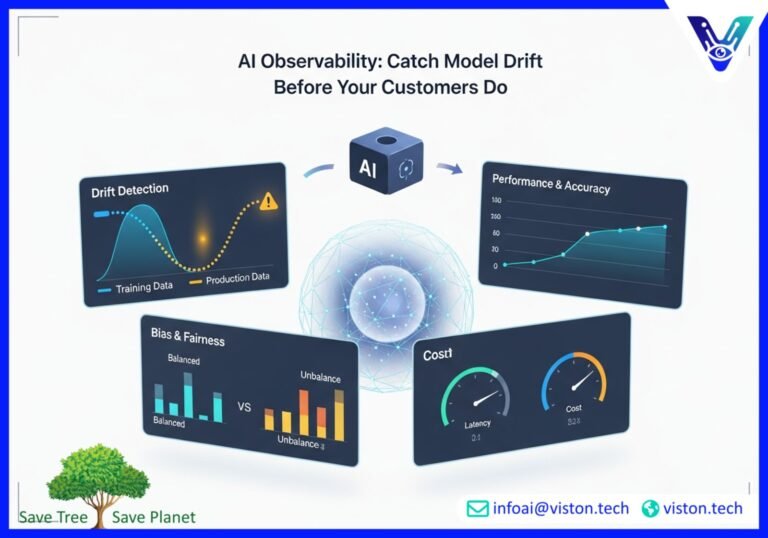
To achieve true model governance, you need to track more than just uptime. Effective AI observability rests on four critical pillars. These metrics provide a holistic view of your AI agent’s health and impact, ensuring it aligns with your business goals.
1. Performance and Accuracy Drift
This is the most fundamental question: Is your AI agent still doing its job correctly? Performance drift occurs when the model’s predictions become less accurate over time. For an AI agent, this could manifest in several ways:
- A customer service chatbot sees its successful resolution rate decline.
- A fraud detection model starts flagging more legitimate transactions as fraudulent (false positives).
- A content summarization tool begins producing incoherent or irrelevant summaries.
Observability tools continuously evaluate the agent’s outputs against a “golden dataset” or use human feedback to catch this degradation early.
2. Bias and Fairness
AI models are trained on data, and if that data reflects historical biases, the model will learn and amplify them. This is not just an ethical concern; it’s a major business and compliance risk. An AI agent must perform equitably across all user segments. Key questions to ask include:
- Is your hiring AI favoring candidates from a specific demographic?
- Is a loan-approval agent showing bias based on gender or ethnicity?
- Does your marketing personalization agent offer better deals to one group of customers over another?
Modern observability platforms can segment performance by user attributes, helping you detect and mitigate bias before it causes reputational or legal damage.
3. Latency and Speed
In the digital world, speed matters. A slow AI agent can be just as frustrating as an inaccurate one. Monitoring latency is crucial for user experience. For instance, a customer waiting more than a few seconds for a chatbot response is likely to abandon the conversation. Observability goes beyond average response times. It helps you understand latency at a granular level, such as the time to first token, which is critical for streaming applications. This allows you to identify bottlenecks in complex agent workflows that might involve multiple tool calls and LLM queries.
4. Cost and Efficiency
AI agents, especially those using powerful large language models (LLMs), can be expensive to operate. Every API call to a model like GPT-4 costs money. Without proper oversight, these costs can spiral out of control. Observability platforms provide detailed cost attribution, allowing you to track expenses per user, per task, or even per individual agent interaction. This financial visibility is essential for managing the ROI of your AI initiatives and optimizing for efficiency.
Taming the Unknown: How Modern Observability Prevents AI Failures
The core promise of observability is to turn the “black box” of AI into a transparent system. It achieves this through a combination of powerful techniques that provide unprecedented visibility into how your AI agents think and operate.
Traces: The GPS for Your AI’s Decisions
Imagine trying to debug a complex process without knowing the steps it took. That’s what it’s like managing an AI agent without tracing. A trace is a complete, end-to-end record of an agent’s workflow for a single request. It captures every LLM call, every tool used, and every piece of data retrieved. This detailed “GPS” for your agent’s journey allows you to replay its exact decision-making process, making it dramatically easier to pinpoint the root cause of any failure.
Evals: Your AI’s Continuous Report Card
How do you know if your AI’s output is good? You evaluate it. Evals, or evaluations, are automated tests that continuously score the quality of your agent’s responses. These can range from simple checks (like ensuring a response is in valid JSON format) to sophisticated assessments using another AI as a judge to score for things like helpfulness, coherence, or lack of toxicity. Evals act as a continuous report card, providing real-time feedback on performance and flagging quality regressions instantly.
Drift Detection: The Early Warning System
The world is constantly changing, and so is the data your AI agent sees. Drift happens when the live, production data starts to differ from the data the model was trained on. There are two main types:
- Data Drift: The statistical properties of the input data change. For example, a retail AI trained on summer clothing trends may perform poorly when winter arrives.
- Concept Drift: The relationship between inputs and outputs changes. For instance, a model predicting customer churn might become less accurate if a competitor launches a new, disruptive pricing plan.
Advanced drift detection techniques, which use statistical tests to compare data distributions, act as an early warning system. They alert you to drift long before it impacts your model’s accuracy, giving you time to retrain or adapt your agent proactively.
The Modern AI Toolkit: A Look at Top Observability Platforms
Building a robust observability solution from scratch is a massive undertaking. Fortunately, a new generation of specialized tools has emerged to meet this challenge. Platforms like LangSmith, Arize AI, and WhyLabs provide the infrastructure needed to implement comprehensive model governance.
- LangSmith: Tightly integrated with the popular LangChain framework, LangSmith excels at debugging and tracing complex LLM-based applications and agents. It is particularly strong for developers who want deep visibility into their agent’s chains and workflows.
- Arize AI: Arize offers a more holistic ML observability platform that caters to both traditional machine learning models and LLMs. It provides powerful tools for performance monitoring, drift detection, and explainability, making it a strong choice for enterprises with diverse AI portfolios.
- WhyLabs: With a primary focus on data health, WhyLabs helps teams prevent data quality issues from ever impacting their models. It provides a lightweight and scalable way to monitor data pipelines and model inputs, ensuring the foundation of your AI is solid.
These tools are essential for moving from a reactive to a proactive stance on AI management, enabling you to build more reliable and trustworthy systems.
Your Action Plan for Production AI Success
Implementing AI without observability is a gamble you can’t afford to take. The path to reliable, production-grade AI is paved with proactive insights and robust governance. Here are your key takeaways:
- Embrace a New Mindset: Shift from traditional, reactive monitoring to proactive, deep-dive observability. Understand the “why” behind your AI’s behavior, not just the “what.”
- Track What Matters: Go beyond simple uptime metrics. Focus on the four pillars: performance, bias, latency, and cost, to get a complete picture of your AI’s health.
- Leverage Modern Techniques: Use traces, evals, and drift detection as your core toolkit to diagnose issues, ensure quality, and stay ahead of changes in the real world.
- Adopt the Right Tools: Don’t reinvent the wheel. Leverage specialized observability platforms to accelerate your journey toward mature model governance.
Your AI agents are powerful tools, but they are not infallible. By giving them the oversight and visibility they require, you can unlock their full potential while protecting your business and your customers. Don’t wait for a silent failure to force your hand. The future of successful AI deployment is observable.
Ready to bring clarity and control to your AI initiatives? Contact Viston AI today to learn how our AI-powered solutions can help you build, deploy, and manage trustworthy AI agents at scale.
Frequently Asked Questions (FAQs)
1. What is model observability?
Model observability is the practice of gaining deep, real-time insights into the behavior and performance of AI models in production. It goes beyond traditional monitoring by not only flagging when something is wrong but also providing the detailed data (like traces, logs, and metrics) needed to understand why it’s wrong. This helps teams proactively detect issues like performance degradation, bias, and data drift.
2. How is observability different from traditional monitoring?
Traditional monitoring is about watching for known failure modes, like server downtime or high error rates. It’s reactive. Observability is about exploring the unknown. It’s designed for complex, non-deterministic systems like AI agents, where failures can be subtle and unpredictable. Observability allows you to ask new questions about your system’s behavior and diagnose problems you didn’t anticipate.
3. What is model drift and why is it important?
Model drift is the degradation of a model’s predictive power due to changes in the environment after it has been deployed. There are two main types: data drift (input data changes) and concept drift (the relationship between input and output changes). Detecting drift is crucial because it is a leading indicator of future performance issues. Catching it early allows you to retrain or update your model before its accuracy and business value decline.
4. What are the most important metrics to track for an AI agent?
The four key pillars of metrics are:
- Performance: How accurate and effective is the agent? (e.g., resolution rate, accuracy).
- Bias and Fairness: Is the agent treating all user segments equitably?
- Latency: How fast is the agent responding to users?
- Cost: How much does it cost to operate the agent? (e.g., token usage, API calls).
5. Can’t I just build my own observability tools?
While possible, building a comprehensive AI observability platform from scratch is a significant engineering challenge. It requires expertise in data pipelines, statistical analysis, and large-scale system monitoring. Specialized platforms like LangSmith, Arize, and WhyLabs offer ready-made, enterprise-grade solutions that accelerate time-to-market and allow your team to focus on building your core AI products rather than infrastructure.
6. How does observability help with AI governance and compliance?
AI governance involves creating policies and ensuring that AI is used responsibly and ethically. Observability provides the technical foundation for governance. By tracking metrics related to bias, fairness, and data lineage, and by providing transparent records of model decisions through traces, observability platforms create an audit trail. This helps businesses demonstrate compliance with regulations like the EU AI Act and build trust with stakeholders.
7. At what stage should I implement model observability?
You should implement observability from day one. Treating it as an afterthought is a common reason why AI projects fail when they move from development to production. By integrating observability practices and tools early in the development lifecycle, you can catch issues sooner, iterate faster, and ensure your AI agent is ready for the complexities of the real world.
8. What is the business impact of poor AI observability?
Poor observability leads to silent failures. This can result in a poor customer experience, eroded brand trust, biased or unfair outcomes leading to legal risk, and spiraling operational costs. Ultimately, it can cause the entire AI initiative to fail to deliver its promised ROI, wasting significant time and investment.
#AIObservability #ModelDrift #ProductionAI #ModelGovernance #LLMs #AIagents #MachineLearning #MLOps #TechLeadership #VistonAI
