
Custom AI Solutions for Unique Workflows: When Off-the-Shelf Tools Fall Short
In the race to innovate, businesses are turning to Artificial Intelligence. Many start with off-the-shelf AI tools, expecting a quick win. Yet, a staggering reality is emerging: the DIY AI failure rate is remarkably high. Recent studies in 2025 show that a vast majority of these self-led AI initiatives fail to deliver any measurable business value. The core issues often trace back to a fundamental mismatch between generic tools and unique business needs.
Off-the-shelf solutions promise simplicity but often deliver rigidity. They force your unique workflows into a pre-defined box. This one-size-fits-all approach can stifle the very innovation you seek. For businesses with specialized processes, the path to significant returns lies in a different direction: custom AI development.
Vertical and bespoke AI solutions are not just about building something from scratch. They are about crafting a competitive edge. These tailored systems are designed to understand your specific data, processes, and goals. The result is a significantly higher return on investment (ROI) and a much faster path to production. In a landscape where generic AI often leads to generic results, a custom approach can be your key differentiator.
This post explores why a tailored strategy to AI is crucial. We will delve into a framework for making the right choice for your business. We’ll also provide actionable insights for leaders ready to move beyond the limitations of off-the-shelf AI.
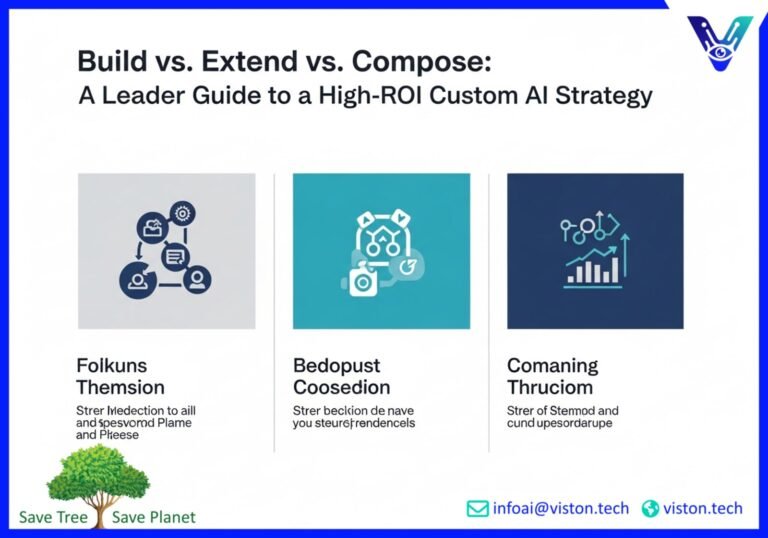
Build vs. Extend vs. Compose: Choosing Your Custom AI Strategy
When off-the-shelf AI doesn’t fit, you have three main paths forward: build, extend, or compose. Each strategy offers a different level of control, investment, and time to value. In the age of generative AI, understanding these options is more critical than ever.
Build: The Path of Maximum Control and Differentiation
Building a custom AI solution from the ground up is the most intensive approach. It involves creating proprietary algorithms and models tailored precisely to your business. This path offers the highest potential for a unique competitive advantage. Think of it as designing a custom engine for your specific race car.
When to Build:
- Your workflow is entirely unique and core to your business value.
- You have access to large, proprietary datasets that can fuel a powerful AI model.
- Existing solutions do not address your specific security and compliance needs.
- You have the in-house technical expertise or a dedicated partner for custom AI development.
Extend: Enhancing Existing AI with Your Unique Expertise
The extend strategy involves taking a powerful pre-existing AI model and fine-tuning it with your own data. This approach is becoming increasingly popular with the rise of powerful foundation models. It’s like taking a high-performance engine and modifying it to excel on your specific track.
When to Extend:
- You need a solution that understands your industry’s specific jargon and nuances.
- You want to leverage the power of a state-of-the-art model without the cost of building one from scratch.
- Your goal is to get a customized solution to market relatively quickly.
- Integration services are a key requirement to connect the AI with your existing systems.
Compose: Assembling Best-in-Class AI Components
The compose strategy is about creating a solution by integrating various pre-built AI services and bespoke agents. This is akin to building a high-performance car from the best available parts. You select the best engine, transmission, and chassis from different manufacturers and integrate them into a cohesive whole.
When to Compose:
- Your workflow can be broken down into a series of tasks that can be handled by different specialized AI tools.
- Speed to market is a top priority.
- You want to create a flexible and scalable system that can be easily updated with new AI capabilities as they emerge.
- You need a solution that can be seamlessly integrated into your existing technology stack.
Making the right choice between build, extend, and compose is the first step toward a successful custom AI initiative. It requires a clear understanding of your business needs, resources, and strategic goals. To learn more about how to navigate these choices, consider exploring resources like MIT Sloan’s take on AI acquisition strategies.
Your Blueprint for Success: A Discovery and Assessment Framework
Embarking on a custom AI journey without a clear plan is a recipe for failure. A structured discovery and assessment process is essential to ensure your AI initiative is aligned with your business goals and technically feasible. This framework will guide you from a promising idea to a robust, value-driven AI solution.
Start with Why: Defining the Business Problem
Before any code is written, you must clearly define the problem you are trying to solve. What specific pain point will this AI solution address? How will it create value for your business? A well-defined problem statement is the foundation of a successful AI project.
Key Questions to Answer:
- What is the precise business challenge we are facing?
- How are we currently handling this process, and what are its limitations?
- What are the key performance indicators (KPIs) we want to improve?
- How will this AI solution contribute to our overall business strategy?
Assess Your Readiness: People, Processes, and Data
A brilliant AI model is useless if your organization isn’t ready for it. This phase involves a candid look at your internal capabilities and resources.
- People: Do you have the right skills in-house, or will you need to partner with an AI consulting firm? Equally important is ensuring you have buy-in from the teams who will use the new system.
- Processes: How will the AI solution fit into your existing workflows? A successful implementation often requires redesigning processes to take full advantage of the new technology.
- Data: Data is the lifeblood of AI. Do you have enough of the right kind of data? Is it clean, accessible, and relevant to the problem you are trying to solve?
Feasibility and ROI: Building the Business Case
Once you have a clear problem and an understanding of your readiness, it’s time to build a solid business case. This involves a technical feasibility study and a detailed ROI analysis.
Technical Feasibility:
- Can we technically build a solution to this problem with current AI technology?
- What are the potential technical hurdles and how can we overcome them?
- A proof of concept (PoC) can be invaluable at this stage to test the core idea on a small scale.
Return on Investment (ROI):
- What are the expected costs of development, implementation, and ongoing maintenance?
- What are the anticipated financial benefits, such as cost savings, revenue growth, or productivity gains?
- A clear ROI projection is crucial for securing stakeholder buy-in and funding.
A thorough discovery and assessment phase de-risks your AI investment. It ensures you are solving the right problem with the right approach, setting the stage for a solution that delivers real, measurable results.
From Vision to Reality: Architecture Blueprints for Custom AI
Once you have a validated business case, the next step is to design the architecture of your custom AI solution. A well-designed architecture is scalable, reliable, and adaptable to future needs. For a non-technical audience, think of this as the blueprint for your new, intelligent business process. It shows how all the different parts will work together to create a seamless and effective system.
The Core Components of a Modern AI Architecture
A modern AI architecture typically consists of several key layers, each with a specific function. Understanding these layers will help you appreciate how a custom AI solution is constructed.
- Data Layer: This is the foundation of your AI system. It includes all your data sources, from customer databases to real-time sensor feeds. A robust data layer ensures your AI has access to high-quality, up-to-date information.
- Intelligence Layer: This is where the magic happens. It contains the AI models and algorithms that analyze your data and generate insights. This could be a custom-built model, a fine-tuned foundation model, or a combination of specialized AI agents.
- Integration Layer: This layer connects your AI solution to your existing business systems, such as your CRM, ERP, or marketing automation platforms. Seamless integration services are crucial for ensuring a smooth workflow.
- Presentation Layer: This is the user interface of your AI solution. It could be a dashboard, a chatbot, or a set of automated alerts. The goal is to present the AI’s insights in a way that is easy for your team to understand and act upon.
Designing for Scale and Adaptability
The world of AI is constantly evolving. Your architecture needs to be flexible enough to incorporate new technologies and adapt to changing business needs. This is where concepts like a “composable enterprise” and “agentic AI mesh” come into play.
- Composable Enterprise: This approach involves building your AI solution from a set of modular, interchangeable components. This makes it easy to add new features or swap out existing components as better technology becomes available.
- Agentic AI Mesh: This is a more advanced architectural concept where multiple specialized AI agents work together to solve complex problems. Each agent has a specific skill, and they collaborate to achieve a common goal. This is a powerful way to automate complex, multi-step workflows. For those interested in the technical underpinnings, Google Cloud offers a look at various real-world generative AI use cases with technical blueprints.
The Importance of a Human-in-the-Loop
Even the most advanced AI systems are not infallible. A well-designed architecture includes a “human-in-the-loop” component. This means that there are specific points in the workflow where a human can review and approve the AI’s decisions. This is crucial for building trust in the system and ensuring that the final output is accurate and reliable.
A solid architectural blueprint is your roadmap to a successful AI implementation. It ensures that your solution is not only powerful but also practical, scalable, and aligned with the long-term vision of your business.
Planning for Success: Timeline and Investment Model
A common question from business leaders is, “How long will this take, and what will it cost?” While every custom AI project is unique, understanding the typical timeline and investment model can help you plan effectively and set realistic expectations. The journey from an initial idea to a fully deployed AI solution is a phased process, with costs and timelines varying based on complexity.
A Phased Approach to Custom AI Development
Custom AI projects are not a single, monolithic task. They are broken down into distinct phases, each with its own timeline and deliverables.
- Phase 1: Discovery and Planning (1-2 months): This initial phase focuses on defining the business problem, assessing readiness, and building the business case. It’s a critical investment in planning that saves time and money down the road.
- Phase 2: Data Preparation and Infrastructure Setup (1-3 months): This is where the foundational work happens. Your data is cleaned, organized, and prepared for the AI models. The necessary cloud infrastructure is also put in place.
- Phase 3: Model Development and Training (2-6 months): This is the core development phase where the AI models are built or extended. The length of this phase depends heavily on the complexity of the AI and the amount of data involved.
- Phase 4: Integration and Testing (1-4 months): The AI solution is integrated with your existing systems and rigorously tested to ensure it performs as expected.
- Phase 5: Deployment and Optimization (Ongoing): The solution is rolled out to your team. This phase also includes ongoing monitoring and optimization to ensure the AI continues to deliver value over time.
Understanding the Investment
The cost of a custom AI solution can range significantly, from tens of thousands of dollars for a simple proof of concept to millions for a complex, enterprise-wide system. The investment can be broken down into several key areas:
- Talent: This is often the largest component of the cost, whether you are hiring an in-house team or partnering with a custom AI development firm.
- Infrastructure: This includes the cost of cloud computing resources for training and running your AI models.
- Data: There can be costs associated with acquiring, cleaning, and labeling data.
- Software and Tools: This includes licensing fees for any pre-built AI components or development tools you use.
- Maintenance and Support: Like any software, AI solutions require ongoing maintenance and support to keep them running smoothly.
The ROI of Custom AI: A Long-Term Perspective
While the upfront investment in custom AI can be significant, the long-term ROI is often substantial. Vertical and bespoke solutions are designed to address your most critical business challenges, leading to significant cost savings, revenue growth, and productivity gains. The key is to view your AI investment not as a one-time cost, but as a long-term strategic asset that will continue to deliver value for years to come.
By understanding the phased approach to development and the key components of the investment, you can plan your custom AI initiative with confidence, ensuring that it is delivered on time, on budget, and in a way that maximizes its long-term value to your business.
The Viston AI Advantage: Your Partner in Custom AI Solutions
Navigating the complexities of custom AI development requires more than just technical expertise. It requires a strategic partner who understands your business and can guide you through every stage of the journey. At Viston AI, we are that partner. We specialize in creating bespoke agents and custom AI solutions that are tailored to the unique workflows of our clients.
Our team of experienced AI consultants and engineers works closely with you to understand your specific challenges and opportunities. We don’t just build technology; we build solutions that solve real-world business problems and deliver measurable ROI. From initial discovery and assessment to architecture design, development, and ongoing support, we provide the end-to-end integration services you need to succeed with AI.
Don’t let your business be constrained by the limitations of off-the-shelf AI. Embrace the power of a custom solution and unlock your full potential. Contact Viston AI today to learn how our custom AI development services can help you transform your unique workflows into a powerful competitive advantage.
For more insights into the world of AI, you can explore authoritative sources such as McKinsey’s State of AI reports, which provide a broad overview of the latest trends and developments in the field.
Frequently Asked Questions (FAQs)
1. What is the biggest reason DIY AI projects fail?
The most common reason for failure is a lack of a clear business case. Many companies start with the technology, not the problem. Without a well-defined problem and measurable success metrics, AI projects often drift and fail to deliver any real value.
2. How is the ROI of custom AI different from off-the-shelf solutions?
Custom AI solutions are designed to address your specific business needs and leverage your unique data. This tailored approach leads to a much deeper integration into your workflows and a significantly higher impact on your key business metrics, resulting in a much stronger and more sustainable ROI.
3. What is the difference between extending and composing an AI solution?
Extending involves taking a pre-existing AI model and fine-tuning it with your own data to specialize its capabilities. Composing involves integrating multiple, pre-built AI services and agents to create a new workflow. Extending is about specialization, while composing is about integration.
4. What is an ‘agentic AI mesh’?
An agentic AI mesh is a modern architectural concept where multiple, specialized AI agents collaborate to perform complex tasks. Each agent has a unique skill, and they work together as a team, passing information and tasks between them to automate an entire workflow.
5. How long does it really take to see value from a custom AI project?
While the full development and deployment can take several months, you can often see initial value much sooner. A well-planned project will include a proof-of-concept (PoC) phase, which can demonstrate the potential of the solution within a few weeks and help to build momentum and buy-in.
6. Do I need a team of data scientists to have a custom AI solution?
Not necessarily. Many businesses choose to partner with a specialized custom AI development firm like Viston AI. This gives you access to a team of experts without the cost and complexity of building an in-house AI team from scratch.
7. How do I know if I have enough data for a custom AI solution?
The amount of data you need depends on the complexity of the problem you are trying to solve. A key part of the initial discovery and assessment phase is a thorough data audit. An experienced AI partner can help you determine if your existing data is sufficient and, if not, develop a strategy for acquiring the data you need.
8. What are the ongoing costs of a custom AI solution?
Ongoing costs typically include cloud infrastructure for hosting the AI model, as well as maintenance and support to ensure the system continues to run smoothly and accurately. A good AI partner will provide a clear and transparent breakdown of all ongoing costs.
