
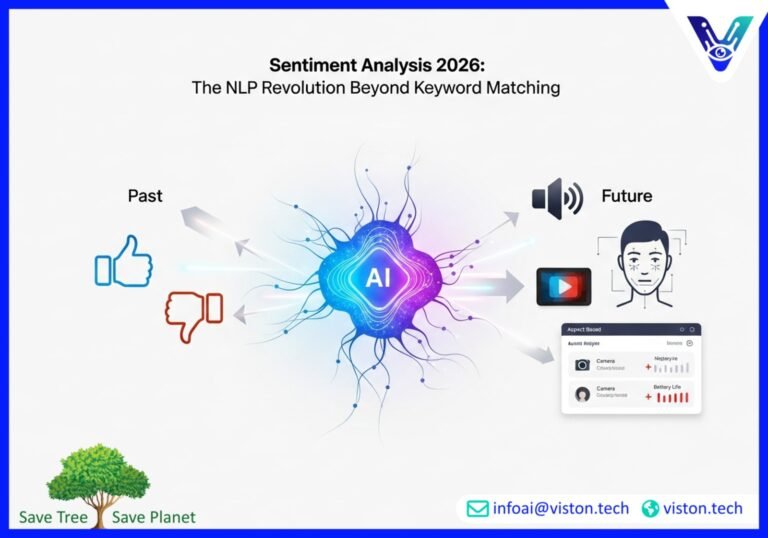
Sentiment Analysis That Actually Works: NLP in 2026 Beyond Keyword Matching
In today’s hyper-competitive market, understanding your customers is no longer a strategic advantage—it’s a necessity. For years, businesses have relied on sentiment analysis to gauge customer emotion. However, traditional methods, often based on simple keyword matching, are becoming obsolete. The nuances of human language, laden with sarcasm, context, and cultural subtleties, demand a more sophisticated approach.
Welcome to the future of sentiment analysis. By 2026, Natural Language Processing (NLP) will have moved far beyond basic positive, negative, or neutral classifications. We are entering an era of emotionally intelligent systems that can understand the intricate web of human emotion, providing businesses with unprecedented customer insights. This evolution is powered by advanced AI, machine learning, and a shift towards more holistic data analysis.
For enterprise leaders, AI and ML engineers, and product managers, this transformation presents a wealth of opportunities. It’s about turning unstructured feedback into actionable intelligence that can drive everything from product development to marketing strategies and customer service.
The Evolution of Sentiment Analysis: From Keywords to Context
The journey of sentiment analysis is a story of increasing sophistication. Let’s explore how we’ve moved from rigid, rule-based systems to the dynamic models of tomorrow.
The Limitations of Lexicon-Based Approaches
In the early days, sentiment analysis was primarily lexicon-based. This method relies on a predefined dictionary of words, with each word assigned a sentiment score. For example, “happy” might be +1, and “sad” might be -1. While straightforward, this approach has significant limitations:
- Lack of Context: A word’s meaning can change dramatically depending on the context. “Sick” can mean ill or, in modern slang, excellent. Lexicon-based systems struggle to differentiate.
- Inability to Understand Nuance: Sarcasm, irony, and idioms are pillars of human communication. A sentence like, “Great, another meeting,” is likely negative, but a keyword-based system would probably miss the sarcastic tone.
- Static Nature: Language is constantly evolving. New slang, phrases, and cultural references emerge daily. Manually updating a lexicon to keep pace is an impossible task.
These limitations mean that businesses relying on older sentiment analysis tools are likely getting an incomplete, and often inaccurate, picture of customer sentiment.
The Rise of Machine Learning and Deep Learning
The advent of machine learning (ML) and deep learning has revolutionized NLP and sentiment analysis. Instead of relying on predefined rules, ML models learn from vast amounts of data. This allows them to understand the context, nuance, and subtleties of human language.
Transformer-based models, such as BERT and GPT, have been particularly groundbreaking. They can process entire sentences and paragraphs, understanding the relationships between words and the overall context. This leads to far more accurate and reliable sentiment analysis. In 2025, these advanced models are becoming the standard, enabling businesses to unlock a more human-like understanding of conversations.
The Next Frontier: What Sentiment Analysis Looks Like in 2026
As we look ahead to 2026, several key trends are shaping the future of sentiment analysis. These advancements promise to deliver even deeper, more actionable customer insights.
Multimodal Emotion Detection: A Holistic View of the Customer
Human emotion is expressed through more than just text. Tone of voice, facial expressions, and even behavior all provide crucial emotional cues. Multimodal sentiment analysis integrates and analyzes data from these various sources—text, audio, and video—to create a comprehensive understanding of a person’s emotional state.
Imagine a customer service call. A multimodal system could analyze the customer’s words, the frustration in their voice, and their agitated speech patterns. This provides a much richer and more accurate picture of their sentiment than text analysis alone. As this technology matures, it will enable businesses to respond to customer emotions with greater empathy and effectiveness. For more on how AI is becoming more emotionally aware, see this insightful article from Gartner.
Edge-First Inference: Real-Time Insights, Enhanced Privacy
Traditionally, sentiment analysis has been a cloud-based process. Data is sent to a central server for analysis, which can introduce latency and raise privacy concerns. The shift to edge-first inference is changing this paradigm.
Edge AI involves running AI algorithms directly on local devices, such as smartphones or IoT sensors. This offers several key advantages:
- Real-Time Processing: By eliminating the need to send data to the cloud, edge AI provides instant sentiment analysis. This is crucial for applications that require immediate feedback, such as monitoring social media for a PR crisis.
- Enhanced Privacy and Security: Keeping data on the device significantly improves privacy and security, a growing concern for consumers and regulators alike.
- Offline Functionality: Edge devices can perform sentiment analysis even without an internet connection, making it ideal for a variety of environments.
This move to the edge will make sentiment analysis more responsive, secure, and versatile than ever before.
Aspect-Based Sentiment Analysis (ABSA): Granular Insights for Targeted Action
Overall sentiment is useful, but often businesses need to know *why* customers feel a certain way. Aspect-Based Sentiment Analysis (ABSA) provides this granular level of detail. Instead of assigning a single sentiment to a piece of text, ABSA identifies specific aspects or features and the sentiment associated with each.
Consider a product review: “The camera on this phone is amazing, but the battery life is terrible.”
- Document-level sentiment: Mixed/Neutral
- Aspect-based sentiment:
- Camera: Positive
- Battery life: Negative
This level of detail is incredibly valuable for product managers, who can use it to pinpoint specific strengths and weaknesses. Marketing teams can tailor their messaging to highlight popular features, while customer support can better understand common pain points. ABSA transforms vague feedback into a prioritized roadmap for improvement.
Putting Advanced Sentiment Analysis to Work: Powerful Use Cases
The theoretical advancements in sentiment analysis are impressive, but their real value lies in their practical applications. Here’s how businesses are leveraging next-generation NLP to gain a competitive edge.
Proactive Churn Prediction and Prevention
Customer churn is a major challenge for any business. By analyzing customer communications—from support tickets to social media posts—advanced sentiment analysis can identify customers at risk of leaving before they make the decision.
By detecting subtle cues of dissatisfaction or frustration, businesses can proactively reach out with targeted solutions or offers, turning a potentially negative experience into a positive one. This not only reduces churn but also builds stronger customer loyalty.
Real-Time Brand Monitoring and Crisis Management
In the age of social media, brand reputation can be made or broken in an instant. Real-time sentiment analysis allows businesses to monitor online conversations as they happen, providing an early warning system for potential PR crises.
If negative sentiment starts to spike, the system can alert the communications team, allowing them to respond quickly and effectively. Conversely, it can also identify positive trends and opportunities for engagement, helping to amplify positive brand messaging.
Actionable Customer Feedback and Product Development
Customer feedback is a goldmine of information for product development. However, manually sorting through thousands of reviews, surveys, and support tickets is a monumental task. Advanced text mining and sentiment analysis automate this process, extracting valuable insights from unstructured data.
By using Aspect-Based Sentiment Analysis, product teams can quickly identify which features customers love and which ones are causing frustration. This data-driven approach ensures that development efforts are focused on what matters most to customers, leading to better products and higher satisfaction. To learn more about how businesses are using customer insights to drive decisions, check out this comprehensive guide from SurveySensum.
The Future is Here: Are You Ready?
The evolution of sentiment analysis from simple keyword matching to sophisticated, multimodal emotion detection represents a fundamental shift in how businesses can understand and interact with their customers. The technologies that will define 2026 are already emerging, offering unprecedented opportunities for those ready to embrace them.
By leveraging the power of advanced NLP, businesses can move beyond simply listening to their customers to truly understanding them. This deeper connection is the key to building lasting relationships, driving innovation, and thriving in the competitive landscape of tomorrow.
Take the Next Step with Viston AI
Is your organization ready to unlock the full potential of your customer data? At Viston AI, we specialize in developing cutting-edge, AI-powered solutions that deliver actionable customer insights. Our expertise in NLP, sentiment analysis, and machine learning can help you transform your customer feedback into a strategic asset.
Contact Viston AI today to learn how our tailored solutions can help you understand your customers on a deeper level and drive meaningful business growth.
Frequently Asked Questions (FAQs)
1. What is the main difference between traditional sentiment analysis and the advanced methods of 2026?
Traditional sentiment analysis primarily relies on lexicon-based methods, matching keywords to a predefined list of positive and negative words. The advanced methods of 2026, on the other hand, use sophisticated NLP and machine learning models to understand context, nuance, and sarcasm. They also incorporate multimodal data (text, audio, video) and provide more granular insights through Aspect-Based Sentiment Analysis.
2. How does Aspect-Based Sentiment Analysis (ABSA) work?
ABSA breaks down text into specific topics or features (aspects) and then determines the sentiment for each one. For example, in a hotel review, it can separately analyze the sentiment towards the “room,” “service,” and “location.” This provides much more detailed and actionable feedback than a single overall sentiment score.
3. What is multimodal sentiment analysis?
Multimodal sentiment analysis is an advanced technique that analyzes multiple types of data simultaneously to understand emotion. This can include text, audio (tone of voice), and video (facial expressions). By combining these different “modes,” it can achieve a more accurate and holistic understanding of a person’s feelings.
4. What are the benefits of edge-first inference for sentiment analysis?
Edge-first inference means that the sentiment analysis is performed directly on the user’s device rather than in the cloud. This results in faster, real-time analysis, improved data privacy and security (as sensitive data doesn’t need to be transmitted), and the ability to function offline.
5. How can sentiment analysis help with churn prediction?
By analyzing customer communications like emails, support chats, and social media comments, sentiment analysis can detect early signs of dissatisfaction or frustration. These subtle emotional cues can be strong predictors of churn, allowing businesses to intervene proactively and retain the customer.
6. Is advanced sentiment analysis difficult for a non-technical audience to understand and use?
While the underlying technology is complex, modern sentiment analysis tools are designed to be user-friendly. They often present insights through intuitive dashboards and visualizations, making it easy for marketing teams, product managers, and other non-technical users to understand the data and make informed decisions.
7. How does sentiment analysis handle different languages and cultural nuances?
Advanced NLP models are often trained on vast, multilingual datasets, allowing them to perform sentiment analysis in many different languages. They are also getting better at understanding cultural nuances, slang, and idioms, although this remains a challenging area of development.
8. What are some of the key industries that can benefit from advanced sentiment analysis?
Virtually any industry that deals with customers can benefit. This includes retail and e-commerce (analyzing product reviews), hospitality (understanding guest feedback), finance (gauging market sentiment), healthcare (analyzing patient feedback), and technology (improving user experience).
#NLPSentimentAnalysis #EmotionDetection #TextMining #CustomerInsights #AIin2026 #NaturalLanguageProcessing #VistonAI #FutureOfAI #MachineLearning #DataAnalytics
